
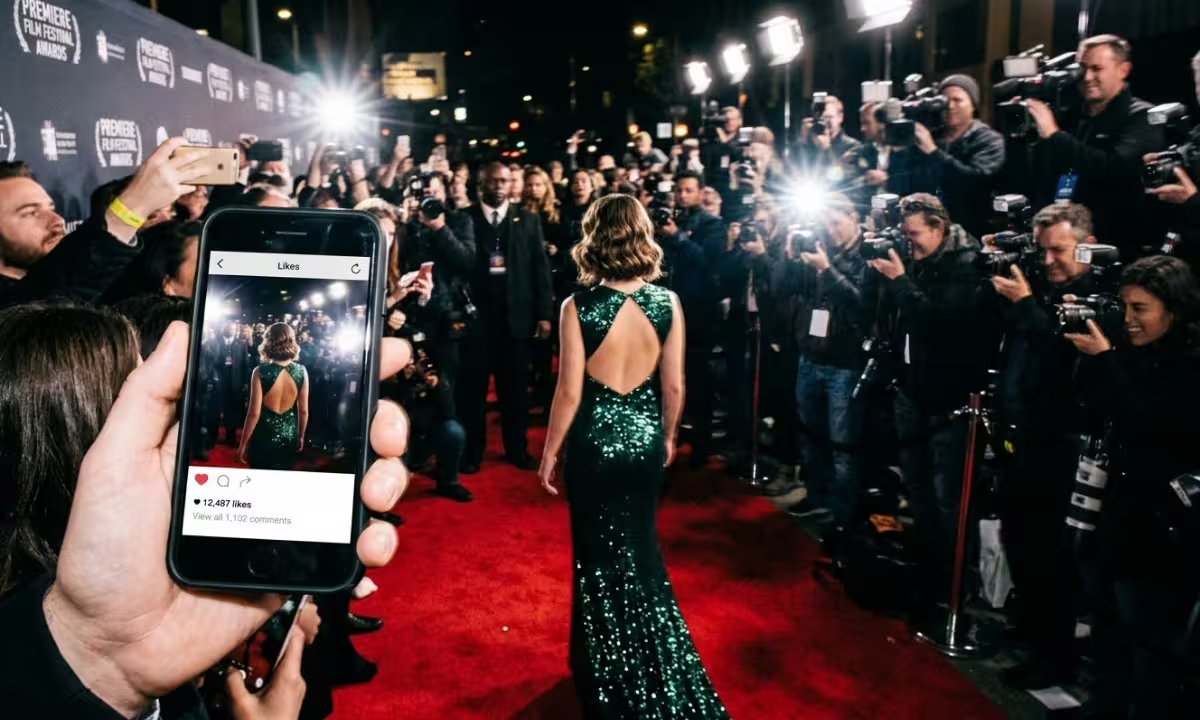

What happens when the most private thing that ever happened to you becomes the best marketing a movie studio has ever had?
That is the question at the center of Hollywood, Ending, John Green’s first novel in nine years and his first written for adults. Dutton published it on September 22, 2026. On the surface it is a love story between two young actors on a press tour. Underneath, it is a novel about a trade most of us now make every day without thinking: we give up a little privacy, and we get a little attention back.
Here is the twist the marketing won’t tell you. This is not a dystopia, and it does not predict the future. It is set in 2019, the last year before the pandemic. Green’s argument is quieter and more unsettling than a prophecy. He suggests the future already arrived, and Hollywood was just the first place it showed up.
Snapshot
Hollywood, Ending follows Juniper Castillo, a former child star, and Kai Laramie, a near-unknown from Indianapolis, as they film and then promote an indie biopic called Andy Warhol Never Gets Old.
When Kai’s childhood trauma leaks to a gossip site in the middle of the press tour, the people around him treat it less as a wound and more as a sales opportunity.
Green uses Andy Warhol, the artist most linked to celebrity culture, as a mirror: Warhol was world famous but kept his love life hidden. Kai and Juniper can’t.
The book’s sharpest point is that the difference between a movie star and the rest of us is now one of scale, not kind.
The Studio Wants Your Password
Early in the novel, a studio publicist named Ellen sits on Kai’s hotel bed and asks for his Instagram password. And his Facebook login. For the next twenty-three days, she tells him, she is him.
It is a funny scene, and Green plays it lightly. But it sets up everything that follows. Kai’s feelings for Juniper are real. The studio wants those feelings posted on a schedule. A will-they-or-won’t-they romance sells tickets to an art film nobody has heard of, so the romance becomes a campaign.
Juniper understands this better than Kai does. She grew up on children’s television and has close to four million Instagram followers. In one passage she refreshes her phone after a single post from the makeup chair and watches the likes and new followers climb with every pull of the screen. Later she reflects that Instagram is a bargain: you make yourself available to strangers, and in exchange they give you their attention. The truly enormous stars, she notes, are the ones who don’t need to make that deal at all.
That observation is the hinge of the whole book. If you have ever posted something personal and then checked how it was doing, you have made the same bargain Juniper describes. You just made it for a smaller crowd.
Andy Warhol Saw This Coming
Green did not pick Warhol by accident. His wife, Sarah Urist Green, is a Warhol scholar; in the book’s acknowledgments Green says she co-edited Andy Warhol Enterprises and that he could shout Warhol questions down the hall to her.
In an interview with The Boston Globe published September 29, 2026, Green said Warhol saw celebrity culture coming long before most people did, and understood that the attention economy would become a huge force in American life.
But Green also drew a distinction. Warhol, he said, was world famous, yet the public knew almost nothing about his partners while he was alive.
The novel turns that distinction into one of its best scenes. Late in the press tour, a sharp Dutch journalist asks Kai why he has laid his love life and his abuse out for the public when Warhol, the ultimate public figure, guarded his private life so closely. Kai’s answer is that maybe he is just worse at protecting it, or maybe he lives in a different era with different expectations.
That second answer is the one that lingers. Warhol could control what the public saw because he controlled the camera. In Kai’s world, everyone holds one.
A quick note on the famous Warhol line about everyone being world famous for fifteen minutes. It appeared in print in the late 1960s, including in the catalogue for a 1968 Warhol exhibition in Stockholm, but who actually coined it has been disputed for decades. Green’s novel never leans on the quote. It doesn’t need to. Its point is not that everyone gets fifteen minutes of fame. It is that everyone now carries a small, permanent audience in their pocket.
When Trauma Becomes Marketing
Light spoiler warning for the middle of the book.
As a teenager, Kai testified in the trial of a teacher who abused him and other students. He has never wanted to talk about it publicly. Ellen, the publicist, even gets a teacher she spoke with to sign a nondisclosure agreement.
Then, partway through the junket, Kai’s story appears on a gossip site under a headline that casts him as the hero who put his abuser in jail. The headline isn’t even accurate. Another student first reported the teacher; Kai was chosen to testify. The article hands him a heroism he never claimed, and almost immediately a former classmate posts on Twitter that Kai is taking credit for something he didn’t do.
What Green captures so precisely is the reaction of the business around Kai. His agent’s first response is that the story helps. Juniper’s own publicist later says, in effect, that she would have leaked it too, because a story like that is worth a fortune in press. The novel eventually traces the leak to someone inside the production, and that reveal is one of the book’s most painful moments.
Green contrasts Kai with Juniper. Before the story begins, Juniper published a viral essay about growing up with a mother who drank and left her children alone for days. Her pain also went public. The difference is that she chose it. Kai did not.
Juniper puts the gap between actors and everyone else into a single line: “if you’re an actor, everyone gets a ticket to the show.” Just before it, she makes the larger point that you don’t need to be an actor for the world to flatten you into a hero or a villain. Fame doesn’t create that pressure. It sells tickets to it.
Why This Hits Harder in 2026
Green has been open about his discomfort with the attention economy. In the same Globe interview, he said personalized algorithms give everyone their own internet, one built to grab and hold attention rather than to be accurate. He also described the period when The Fault in Our Stars was becoming a movie, when strangers came to his house and knocked on the door.
Asked about sharing so much of his life online through the YouTube channel he runs with his brother Hank, he said: “I worry sometimes that when you share something, it’s not yours anymore.”
That sentence could serve as the novel’s epigraph. And the audience for it is huge.
According to the Pew Research Center’s 2025 survey of U.S. adults, half of Americans use Instagram, and about eight in ten adults under 30 do. Most of those people are not famous. But many of them know the small jolt of checking a post, the urge to share something painful because it might help someone, and the strange feeling when a private moment starts to belong to strangers.
Hollywood, Ending does not lecture anyone about this. It simply shows two people living at the extreme end of a scale the rest of us are already on.
The Ending Is a Choice to Go Quiet
Green’s answer to all of this isn’t to log off forever or to burn Hollywood down. His characters keep acting. They still love the work. What changes is what they are willing to sell.
Kai and Juniper turn down an awards campaign that would have required them to keep smiling beside the person who hurt Kai. When they move on to their next film, they keep separate apartments so the public won’t know they are together. They want, as Juniper puts it, a secret that belongs only to them. On their next press tour, Kai answers every question about his abuse with two words: “Next question.”
It is a small ending, and that is the point. In a world that rewards disclosure, choosing not to share becomes its own kind of freedom.
What Critics Are Saying
Reviewing the book for Slate on September 20, 2026, Laura Miller wrote that the novel is about “the near impossibility of being genuine in an environment founded on artifice.” She singled out Green’s portrait of the press junket, where young actors are coached to say nothing of importance and to manicure a social media feed.
That matches the experience of reading it. The junket chapters, set in hotel suites and conference rooms from Los Angeles to New York to Paris, are the best writing in the book. The romance is tender, sometimes almost too tender, and readers who want a fast plot may find the middle slow. But as a portrait of how attention gets bought and sold, it is sharp.
Best For / Not For
Best for: Longtime John Green readers who grew up with The Fault in Our Stars, anyone curious about how celebrity publicity works, and readers interested in social media, privacy, and the ethics of sharing personal pain.
Not for: Readers looking for a light Hollywood romance, or anyone who wants to avoid a storyline involving childhood sexual abuse. The abuse is discussed directly in places, though it is not the focus of every chapter.
Frequently Asked Questions
Is Hollywood, Ending a young adult novel?
No. It is John Green’s first novel written for adults, published by Dutton on September 22, 2026. His previous novel was Turtles All the Way Down (2017).
When is Hollywood, Ending set?
In 2019, with the epilogue reaching into the March 2020 pandemic shutdown.
Does the book predict a future without privacy?
Not exactly. It is set in the recent past. Its argument is that the loss of privacy already happened, and that Hollywood simply shows it in its most extreme form.
Why is Andy Warhol in the novel?
The two leads star in a Warhol biopic, and Green uses Warhol as a contrast: a world-famous artist who still kept his private life hidden, something Green’s characters find almost impossible.
Is the book based on John Green’s life?
It is fiction. In interviews Green has described his own uneasy experience with fame, and in the acknowledgments he writes that he wanted to depict the machine that turns private experience into public expression and then sells it.
The Bottom Line
Hollywood, Ending is marketed as a Hollywood love story, and it is one. But the reason it will stay with you is the question it leaves behind. Every time you post something true about your life, who does it belong to afterward?
Green’s characters find their answer by keeping one thing for themselves. That may be the most radical move left, for movie stars and for everyone else.
More from Sopranu on John Green:
- Why The Anthropocene Reviewed Will Break Your Heart
- Everything Is Tuberculosis Book Review
- 9 Painful Realities and Beautiful Moments in The Fault in Our Stars
- Related reading on attention: Deep Work Book Review





