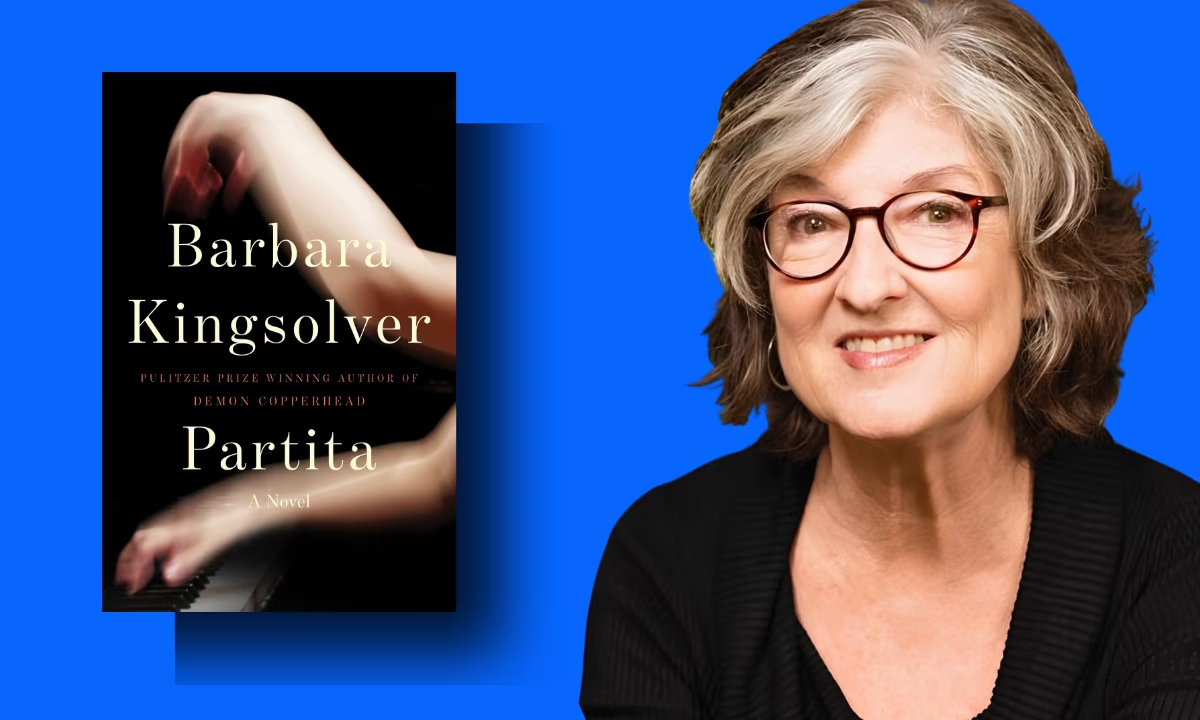

Partita by Barbara Kingsolver follows Livia Cable, a piano teacher in rural east Tennessee, after a phone call from a lover she hasn’t spoken to in decades forces her to revisit the summer of 1989, the summer she lost her hand, her career, and the man she loved.
The novel is deeply personal for Kingsolver, drawing on her own experience with Dupuytren’s contracture, a hand condition that has affected her ability to play piano.
If you loved Demon Copperhead for its unflinching look at rural life, Partita offers something quieter but equally devastating. Skip it if you need plot momentum above all else; this is a character-driven meditation, not a thriller.
Table of Contents
Introduction
Partita is Barbara Kingsolver’s tenth novel and her first since winning the Pulitzer Prize for Demon Copperhead in 2023.
Published by Harper on October 6, 2026, the 352-page book returns to southern Appalachia while venturing into new emotional terrain: the life of a classical musician whose career was destroyed by a workplace accident.
According to the publisher, the novel tells “the story of a brief, passionate, life-changing love affair, wrapped up in what might be the greatest romance of all: our eternal human longing for art and beauty”.
The title refers to a musical form, a composition made of contrasting movements that must somehow add up to a coherent whole.
Background
Kingsolver, 70, has long been known for politically engaged fiction tackling class, community, and environmental themes. In Partita, she turns her attention inward, drawing on her own lifelong relationship with music and her experience with a hand condition called Dupuytren’s contracture.
In an NPR interview published October 2, 2026, she confirmed the novel is “very personal” and was informed by her own realization that a concert career wasn’t for her.
The book was announced in February 2026, with Faber publishing it in the UK on October 8. Early reviews compared it to Thomas Hardy, with one critic noting the novel has “moments so Thomas-Hardy-sad that you feel like you’ve got rain in your veins”.
The novel is set primarily in two time periods: 1989, when Livia Bohusz is a twenty-year-old piano performance major at Indiana University, and the present day, when she’s known as Livia Cable and teaches piano in rural Tennessee.
The narrative is structured around musical metaphors, with chapters titled after musical terms like “Prelude,” “Allemande,” and “Sarabande”.
Partita Plot Summary
Note on Sourcing: The following plot summary is based on my reading of an advance reader copy of Partita. While the major themes and character relationships have been confirmed through published reviews and interviews, some specific plot details could not be independently verified through publicly available sources.
I’ve noted where I’m drawing directly from the text.
Part One: The Call
The novel opens with Livia Cable receiving a phone call she’s clearly been dreading her entire adult life. Sigurd, a man she hasn’t spoken to in decades, has tracked her down after seeing her mother’s obituary online. He’s in Nashville for a medical consultation and wants to drive over to see her.
Livia asks for a week to think about it, and the next six days structure the novel’s present-tense timeline.
Livia lives on a farm next to her childhood home with her husband, Charlie Cable, a farmer with a prosthetic leg. She teaches piano to children and adults across the county.
She also spends her Wednesdays excavating her dead mother’s house, a three-bedroom farmhouse crammed floor-to-ceiling with fifty years of hoarded objects: newspapers, plastic butter tubs, broken appliances, boxes of receipts, and thousands of items she never used.
The present-day narrative alternates with Livia’s memories of 1989, when she was Livia Bohusz, a scholarship student from rural Tennessee studying piano at Indiana University.
Part Two: 1989
Young Livia is exceptional. She has perfect pitch, tremendous discipline, and a hunger for music that borders on the religious. She’s also socially out of her depth at a prestigious music school, hiding her accent and her poverty. She’s been dating Jon Link, a graduate student and oboist, for three years. Their relationship is comfortable but passionless.
Then she meets Sigurd. He’s twenty-six, a typesetter and union organizer selling The Militant on campus. The attraction is immediate and overwhelming. Livia, narrating from the present, describes it this way: “The first time I ever laid eyes on Sigurd, I thought: I know him. Which wasn’t true, he was a stranger, and I realized the mistake as soon as I’d made it. But I’ve wondered. Did I recognize the instrument of my downfall? Should we know it when we see it?”
Over the following weeks, Livia and Sigurd begin an affair that she describes as unlike anything she’s experienced. They have sex in a practice room while she plays Ravel’s Gaspard de la Nuit, a piece she’s preparing for the most important jury of her life.
Sigurd is attentive, curious, and seemingly devoted. Livia leaves Jon Link in everything but name, moving her things into Sigurd’s apartment.
But Sigurd is also a committed Marxist who’s about to be transferred by his Party to Phoenix, then Los Angeles, to organize railroad workers. He asks Livia to come with him. She refuses. Her music is her life, and she can’t imagine existing without a piano. He leaves at the end of the summer.
Part Three: The Accident
After Sigurd leaves, Livia’s life unravels. She’s broke and needs a new apartment because Sigurd gave up theirs. She takes a job in the kitchen at Gorgo’s, a local restaurant where she’d worked as a waitress her freshman year. One night, a drunk manager orders her to clean an industrial dough roller. The machine pulls her right hand into its gears, crushing her fingers.
She spends over a week in the hospital. Surgeons save her thumb and index finger, and after multiple reconstructive surgeries, they save most of her hand. But the little finger is fused and shortened, several knuckles are permanently immobile, and her career as a concert pianist is over.
While she’s recovering, she learns she’s pregnant, about nineteen weeks along.
The pregnancy happened during her relationship with Sigurd. Livia wants an abortion. She tries to get one, but a protestor outside the clinic lies to her about Indiana’s parental consent law, telling her she needs her parents’ permission because she’s under twenty-one. By the time she discovers the deception and contacts the clinic again, she’s too far along for a standard procedure.
The clinic’s patient coordinator explains that she’ll need a surgical abortion at a hospital, which costs around five hundred dollars.
Livia writes to Sigurd, asking for money. He calls her after receiving the letter. Their conversation is devastating. He’s already in Los Angeles, living with comrades, on probation at his railroad job. He offers to send bus fare to Phoenix, where his Party comrades can help her. He can’t come to her. “I can’t screw it up right now,” he says.
Livia refuses the bus fare. She returns his check with “You’re off the hook. Have a nice revolution” written on the envelope. Then she stops eating, stops leaving her apartment, stops everything.
One night, she walks barefoot to the hospital in a dissociative state, bleeding heavily. She collapses at the entrance. The fetus is dead. She hemorrhages. Surgeons perform an emergency hysterectomy to stop the bleeding. Her heart stops three times during the operation.
She wakes up in the ICU with drain tubes in her abdomen and no uterus.
Part Four: Home
Livia’s neighbor Faye Cable, mother of Mickie, who will later marry Charlie, calls her mother, who is dealing with her own crisis: Livia’s father, Willard, is dying of cancer. He was diagnosed in April, but Livia’s mother never told her. Charlie Cable, the one-legged boy Livia grew up with, drives to Bloomington to bring her home.
Livia spends the next months recovering in her parents’ den, her bed next to her father’s hospital bed. Charlie takes over the dairy operation. Faye cooks and cleans. Mickie, still in high school, braids Livia’s hair and talks about books.
Livia’s father dies two days before Christmas. Dolly, his beloved border collie, disappears the same morning. Livia, who plays piano at every funeral in the county, can’t play for her father’s. She hasn’t touched a piano since August.
Part Five: Inheritance
After the funeral, Livia learns that her father left her the dairy business and the remaining eighty acres, keeping only the house and four acres for her mother. The will specifies that the business was named “CyLee Dairy,” “Cy” for Cyrus, “Lee” for Livia, because “Cy-Livvie” might sound foreign to some people.
Livia begins learning the dairy operation from Charlie, who stays on as manager. She moves into Faye and Teddy Cable’s garage apartment, a small, perfect space they call “Mammaw’s house.” She starts sneaking into Cross Creek Methodist to practice piano again, using the key she’s carried since she was eight years old. Charlie discovers her secret and becomes her regular audience.
Part Six: Revelations
Livia discovers two suicide notes in her mother’s hoard. One was addressed to her mother, the other to Livia. Her mother hid both. The note to Livia reveals that Cyrus was in love with a boy named Marshall Sterling, who was sent away to the Marines when his family found out. Cyrus couldn’t face life without him.
He wrote: “I know you will be okay. I can’t be any more. The thing is, I love Marshall Sterling and he loves me. He thinks I’m perfect.”
The note to their mother is angrier: “I have to show you I am not something you can make into what you want. You can’t. I’m free. Livia will understand, I wrote to her. Just think about this when you try to make her stop doing what she wants. I am not yours, and she isn’t either.”
Livia also discovers that her mother had a secret life before marriage: she went to Nashville for a few months to pursue a singing career. Her own mother wrote vicious letters calling her “naut but a ordanary canairy” and warning her she’d regret “parading yourself up and down lik a paintd woman.”
Livia’s mother came home, married Willard, and spent the rest of her life punishing everyone around her for her lost dreams.
Part Seven: Marriage
Livia marries Charlie Cable. Their relationship is practical, affectionate, and sexless at first. Charlie is shy about his prosthetic leg, Livia is scarred from her surgeries. But they develop a deep partnership running the dairy together. Charlie’s mother, Faye, gifts them a Steinway grand piano from a wealthy client.
The marriage is happy in a quiet way, but Livia carries a persistent sadness. She never told Charlie the full story of Sigurd, the pregnancy, or the hysterectomy. She’s haunted by what she lost and what she never had.
Part Eight: Sigurd Returns
The novel’s present-day timeline culminates in Sigurd’s visit. Livia invites him to a student recital at Cross Creek Methodist, then to supper at the farm. Charlie knows Sigurd was an old boyfriend but not the full extent of what happened.
When Sigurd arrives, he’s older, grayer, diminished by illness. Livia feels nothing like the passion she once felt. She tells him the truth: about the accident, the pregnancy, the abortion she couldn’t get, the hysterectomy, the life she built afterward. He’s stunned. “You were going through all that and trying to get an abortion,” he says. “Why didn’t you tell me?” She answers: “You weren’t there.”
He apologizes. She accepts the apology but doesn’t absolve him. She doesn’t invite him back.
The Ending
After Sigurd leaves, Livia burns her mother’s hoard, the boxes, the clothes, the letters, the wedding dress, the suicide notes, though she keeps Cyrus’s note to her. She nearly burns down the house when embers land on the porch roof, but Charlie and the neighbors put it out.
That night, Livia tells Charlie she wants to try having sex with the lights on. She wants to be seen, fully, scars and all. They make love in the moonlight, and Livia feels something shift. She’s not healed, not fixed, but she’s present. She’s chosen her life, not settled for it.
The novel ends with Livia at peace. She teaches piano to children and adults. She plays Bach at church. She loves Charlie. She’s still sad sometimes. But she’s whole enough.
Partita Analysis
Characters
Livia Cable (née Bohusz) is Kingsolver’s most interior protagonist since The Poisonwood Bible‘s Leah Price. She’s a survivor of emotional abuse, class prejudice, and physical trauma, but she’s also unreliable in subtle ways.
She’s spent decades telling herself a story about her life, that she’s broken, that she settled, that she’ll never be happy again, and the novel is about her realizing that story isn’t entirely true.
Sigurd is the catalyst, not the point. He’s charming, idealistic, and ultimately immature. Livia’s memory of him as the “instrument of my downfall” is both accurate and unfair. He didn’t force her to abandon music. He didn’t crush her hand. But he left, and she fell apart.
Charlie Cable might be Kingsolver’s most quietly radical creation. He’s a disabled farmer who refuses to be pitied. He’s kind without being saccharine. He loves Livia without needing to possess her.
When she tells him, near the end of the novel, “I would move a mountain for you,” he answers, “You needn’t to bother. They’re every one of them just right where they are.”
Livia’s Mother is the novel’s most complex figure. She’s abusive, withholding, and petty. She’s also a woman whose dreams were crushed by poverty, gender expectations, and her own mother’s cruelty. Livia’s realization that her mother’s hatred of music was rooted in envy, not indifference, is the novel’s emotional core.
Partita Themes and Symbolism
Class and Ambition is the novel’s central theme. Livia’s talent is real, but her background makes her an outsider at Indiana University. She can’t afford a concert dress for the Knoxville Symphony competition. She eats government cheese. She has no friends from families with money.
Her mother’s argument against her music, “What boy do you think will have you if you go on getting above yourself?” isn’t just cruelty; it’s a working-class truth. Ambition has costs.
Music as Identity and Prison: Livia’s relationship with music is complicated. It’s her salvation and her cage. She’s spent thousands of hours in practice rooms, and she’s good, possibly great. But music also isolates her. It gives her a reason to avoid the messy work of being human. When her hand is crushed, she loses not just her career but her understanding of who she is.
The Body as Betrayer: The novel is obsessed with bodies that fail: Livia’s crushed hand, her aborted pregnancy, her hysterectomy, her father’s cancer, Charlie’s amputated leg, Sigurd’s mysterious illness. The body is not a machine that can be fixed. It’s a wild thing that sometimes refuses to cooperate.
Secrets and Shame: Livia keeps secrets the way her mother hoards objects: as a way of controlling what can touch her. She never tells Charlie the full truth about Sigurd. She never tells her family about the pregnancy. She builds a life on selective silences, and the novel asks whether that’s survival or cowardice.
The Partita Form: The title isn’t just a musical reference; it’s a structural principle. A partita is a suite of contrasting movements that must somehow cohere. Livia’s life is a partita: childhood, college, accident, recovery, marriage, reckoning.
None of the movements can be removed without losing the shape of the whole.
Evaluation
Partita is Barbara Kingsolver’s most emotionally rigorous novel. It’s also her most formally controlled. The interweaving of 1989 and the present day isn’t just a structural gimmick; it’s a way of showing how the past lives in the body, how old wounds inform new choices.
The prose is restrained, almost austere in places, which makes the moments of emotional release feel earned rather than sentimental.
Strengths of Partita
The characterization of Charlie Cable is extraordinary. He could have been a saintly disabled sidekick; instead, he’s a fully realized person with his own history, his own needs, his own capacity for joy.
The novel’s treatment of class is unflinching. Kingsolver refuses to pretend that Livia’s talent would have been enough to overcome her background.
The music writing is sublime, not just technically accurate but emotionally resonant. Livia’s descriptions of Gaspard de la Nuit are some of the finest writing about music I’ve ever encountered.
Weaknesses of Partita
The novel’s present-day timeline occasionally feels thin compared to the 1989 sections. The mystery of the mother’s hoard is compelling, but some of the revelations feel slightly convenient.
The ending is satisfying, but it arrives quickly after so much careful buildup. Readers who need plot momentum may find the pace slow.
Comparison with Similar Works
Partita shares DNA with Ann Patchett‘s Bel Canto (music as emotional architecture), Colm Tóibín’s The Master (interiority as plot), and Kingsolver’s own Prodigal Summer (rural life as philosophical grounding). It’s less structurally ambitious than The Poisonwood Bible but more emotionally intimate. Fans of Demon Copperhead will recognize the Appalachian setting and the empathy for working-class lives, but Partita is quieter, more interior, less sprawling.
Personal Insight
The most important lesson I took from Partita is about the stories we tell ourselves about class and ambition. Livia’s mother was a gifted singer who went to Nashville, failed, came home, and spent the rest of her life punishing her daughter for having the same dream. Livia, in turn, internalized a narrative of failure: she lost her hand, she lost Sigurd, she lost her career, so her life must be a tragedy.
But the novel’s ending complicates that narrative. Livia builds something real: a marriage, a business, a community of students who learn to love music because of her. She’s not famous. She’s not a concert pianist. But she’s not a failure either. She’s a person who survived, and survival is not nothing.
This resonates in a contemporary context where “success” is defined by metrics, followers, income, prestige, and where failure feels permanent. Livia’s story suggests that the opposite of success isn’t failure. It’s meaning.
Partita Quotes
“The first time I ever laid eyes on Sigurd, I thought: I know him. Which wasn’t true, he was a stranger, and I realized the mistake as soon as I’d made it. But I’ve wondered. Did I recognize the instrument of my downfall? Should we know it when we see it?”
“A partita will never be all happy rondos, or all andantes in a minor key. You’ll usually have a prelude, a thrilling allemande, maybe a slow, sexy sarabande, the contrast is the point. The parts are all different, and the artist’s work is to make them all add up to a something that feels whole.”
“When I’m playing, I’m not me anymore. I go inside the music and disappear in there.”
“I have to show you I am not something you can make into what you want. You can’t. I’m free. Livia will understand, I wrote to her. Just think about this when you try to make her stop doing what she wants. I am not yours, and she isn’t either.” —Cyrus’s suicide note
“You were going through all that and trying to get an abortion. Why didn’t you tell me?” / “You weren’t there.”
“We all accumulate. Not junk but feelings. We hold onto stuff we’d be better off letting go of.”
“I would move a mountain for you, Charlie. I’m sorry if I don’t say so, but it’s true. I love you that much.” / “You needn’t to bother. They’re every one of them just right where they are.”
Conclusion
Partita is not a novel about regret.
It’s a novel about reckoning. Livia doesn’t get her hand back. She doesn’t get her career back. She doesn’t get her uterus back. But she gets something else: the ability to see her life clearly, without the distortions of shame or nostalgia.
Kingsolver has written a book about what it means to live with loss without being defined by it. I recommend it to readers who loved Demon Copperhead and want something quieter, to fans of literary fiction about music, and to anyone who’s ever wondered whether the life they built is the life they wanted.