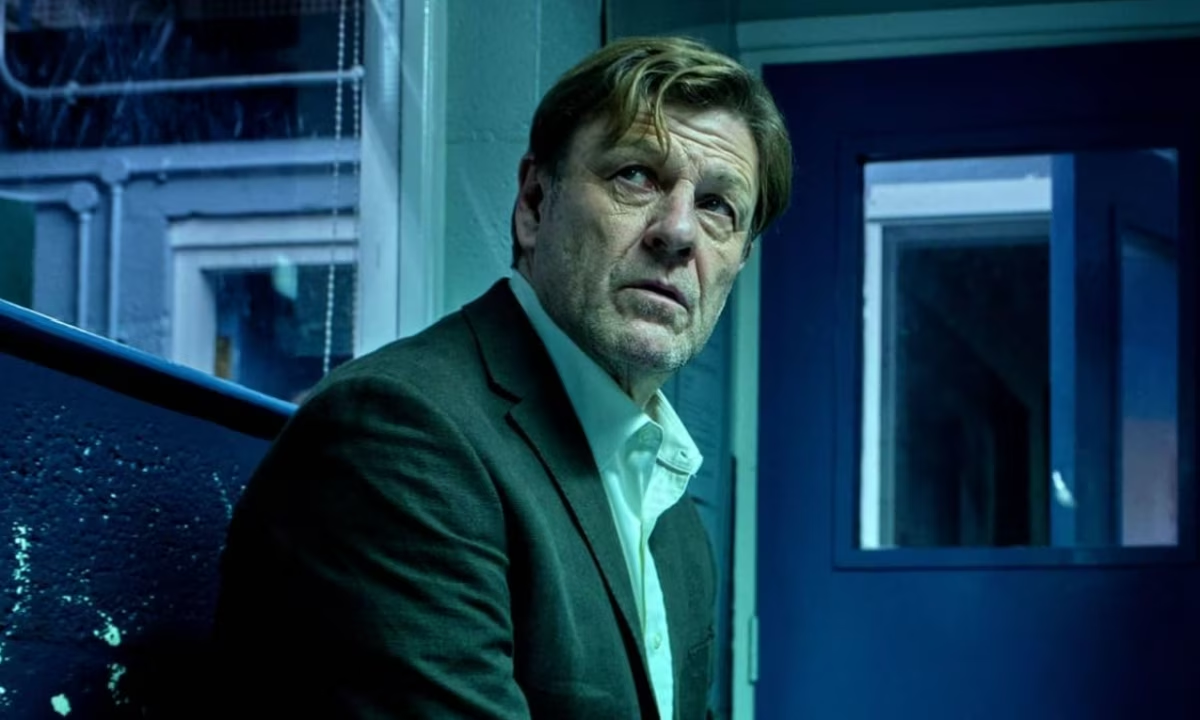

Is Time (2021 TV series) worth watching? Yes, and it may be the most honest prison drama British television has made. Time is a three-part BBC One anthology drama written by Jimmy McGovern, and its first series premiered on 6 June 2021 with Sean Bean as a teacher jailed for killing a man while drunk and Stephen Graham as the prison officer whose love for his own son drags him into crime.
It won the BAFTA for Best Mini-Series, earned Bean the BAFTA for Leading Actor, and scored 100% on Rotten Tomatoes. It is also hard to sit through.
I want to tell you why the pain is worth it, what happens in every episode of both series, and why the real numbers coming out of British prisons in 2025 and 2026 suggest McGovern was not exaggerating at all.
The timing matters too. A third series, starring David Tennant and set inside a young offender institution, starts on BBC One on Sunday 11 October 2026, according to Northern Ireland Screen and Geektown. If you want to catch up before then, or you simply want to know what you are getting into, this Time BBC series review covers everything.
Table of Contents
What Is Time (2021 TV series) About, in 60 Seconds?
Time (2021 TV series) is a British anthology prison drama in which each series follows new inmates and staff over three hour-long episodes. Here is the short version.
Created and written by: Jimmy McGovern (series 1), with Helen Black co-writing series 2.
Directed by: Lewis Arnold (series 1) and Andrea Harkin (series 2).
Network: BBC One and BBC iPlayer, made by BBC Studios Drama Productions with BritBox.
Series 1 (June 2021): Sean Bean plays Mark Cobden, a remorseful teacher serving four years. Stephen Graham plays Eric McNally, an officer blackmailed into smuggling drugs to protect his son.
Series 2 (October to November 2023): Jodie Whittaker, Tamara Lawrance and Bella Ramsey play three women in Carlingford, a women’s prison.
Series 3 (from 11 October 2026): David Tennant leads a story set in a young offender institution.
Ratings: Series 1 averaged 6.09 million viewers, and the opening episode drew 8.04 million, according to the viewing figures compiled on Wikipedia.
Awards: BAFTA TV Awards 2022 for Mini-Series and Leading Actor (Bean). Royal Television Society awards in 2024 for Lawrance and Ramsey.
Verdict: Bleak, angry and beautifully acted. A must-watch for anyone who cares about justice, though the violence, self-harm and suicide scenes will be too much for some viewers.
Quick Facts About the Time BBC Series
| Detail | Information |
|---|---|
| Title | Time |
| Genre | Prison drama, crime drama, anthology |
| Creator | Jimmy McGovern |
| Writers | Jimmy McGovern, Helen Black (series 2), Samuel Bailey (series 3) |
| Directors | Lewis Arnold (S1), Andrea Harkin (S2), Paul Whittington (S3) |
| Original network | BBC One |
| Series 1 dates | 6 June to 20 June 2021 |
| Series 2 dates | 29 October to 12 November 2023 |
| Series 3 premiere | 11 October 2026 |
| Episodes per series | 3 (about 56 to 67 minutes each) |
| Main filming location (S1) | Former HM Prison Shrewsbury, plus the Liverpool City Region |
| Rotten Tomatoes | 100% (S1, 23 reviews), 93% (S2, 15 reviews) |
| Metacritic | 82 (S1), 80 (S2) |
Who Should Watch Time (2021 TV series)?
Time is for viewers who want television to say something true about how a country treats the people it locks up. It is not a thriller in the usual sense, and it never pretends prison is a place where clever men plan clever escapes.
Best for:
- Fans of serious British drama such as Broken, Adolescence or Line of Duty without the twists.
- Students of criminology, social work, law, psychology and criminal justice.
- Anyone working with prisoners, ex-offenders, addicts or their families.
- Viewers who admire Sean Bean, Stephen Graham, Jodie Whittaker or Bella Ramsey.
- People who like short, finished stories. Each series is only three hours.
Not for:
- Viewers looking for an escape-plan caper like Prison Break.
- Anyone who finds scenes of self-harm, overdose, suicide or child death distressing. The show depicts all of these.
- People who want a neat, happy ending. McGovern rarely gives one.
Background: How Did Jimmy McGovern Make Time?
Jimmy McGovern spent decades thinking about prison before he wrote Time. Speaking to The Yorkshire Post in 2021, he said he had been working on it “since the 80s,” and added that a British prison “is full of stories.”
This is the writer who made Cracker in the 1990s and Broken in 2017, the BBC drama for which Sean Bean won a BAFTA playing a troubled Catholic priest. He told the same paper he had the two actors “uppermost in my thoughts all the way through,” and praised their “faces you’d die for.”
The production filmed the cell blocks in the decommissioned HM Prison Shrewsbury, which closed in 2013. According to What to Watch, the set designers painted the place to look “miserable and oppressive.” Courtrooms, police stations and exteriors were shot in and around Liverpool, including the Silver Jubilee Bridge in Widnes and Southport Pier.
When the first episode aired on Sunday 6 June 2021, it became a hit. The BBC confirmed on 15 June 2021 that episode one had been viewed 8.4 million times, which made it the corporation’s biggest new drama of the year at that point, according to Yahoo News UK.
The viewing figures listed on Wikipedia put the episode at 8.04 million viewers. The two numbers measure slightly different things, so I treat 8 million as the safe round figure.
In the United States, the first series streamed on BritBox. In the UK, both series remain on BBC iPlayer.
Time Plot summary: What Happens in Time?
This is the complete story of both finished series. If you have not watched yet and want to go in fresh, skip to the analysis section.
Series 1, Episode 1: The First Night (6 June 2021)
Mark Cobden is a middle-aged schoolteacher. He drank four large vodkas, got behind the wheel and drove into a cyclist, killing him. The court gave him four years. In the prison van to Craigmore Prison he hears two inmates, Johno and Baz, screaming at each other, and the fear on Bean’s face in those first minutes tells you everything about the man. He does not know the rules, and nobody explains them.
He is strip-searched, gets one phone call to his family, and lands in a cell with Bernard (Aneurin Barnard), a seriously ill young man serving ten years for the manslaughter of his own father. Bernard is scarred from self-harm. He is also, oddly, the clearest thinker on the wing.
He tells Mark that people come in bad and go out worse, and that everyone keeps quiet because the system pays their wages.
On the other side of the bars is Eric McNally, a decent, steady prison officer who treats inmates as people. Eric has a secret pressure point. His own son David is serving time in Lowood Prison. A prisoner on the wing lets Eric know he has found this out, and the threat behind it is clear.
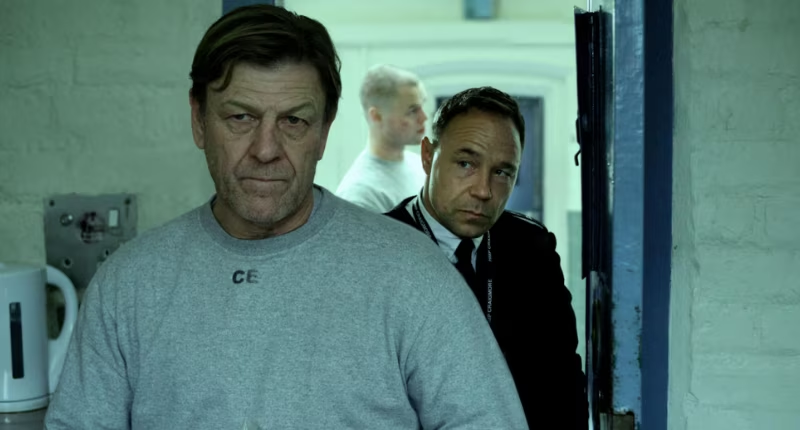
Johno, a wiry bully played by James Nelson-Joyce, quickly marks Mark as prey. In one of the most shocking moments of the series, Baz describes how he was attacked with a kettle of boiling water mixed with sugar, because the sugar makes it stick to the skin, and the sugar came from Mark’s own cell.
When another prisoner snatches the phone during Mark’s call home and Mark refuses to hit back, an inmate tells him his life won’t be worth living now.
Bernard’s mental health collapses. He is self-harming, Eric has to move him to segregation, and soon after Bernard takes his own life by saving up his medication and swallowing it all at once.
Eric, warned that the prisoner can reach David, arranges for his son to be moved to Chapel Grove, a prison he believes is safe. The episode ends with Eric losing his temper, grabbing the prisoner who threatened his son and screaming that he will kill him if he lays a finger on the lad.
Series 1, Episode 2: The Price of Protection (13 June 2021)
Mark gets a new cellmate, Daniel (Jack McMullen), a young man serving 21 years for stabbing Gerard Wilson to death. Daniel tells Mark that once he had pulled out the knife, the hardest thing was not to use it. Later, Daniel sits down with Gerard Wilson’s parents in a restorative justice session led by Marie-Louise, with Mark there as his cellmate, and the couple come with hard questions about how their son really died.
Mark also asks to write a letter of apology to the widow of the man he killed. Later in the episode Eric has to tell him the letter has been refused. Mark helps another prisoner, Kavanagh, put together an anniversary card. Then his wife Alicia visits and asks for a divorce. She has met someone else, and she says she does not want to stay married to him a second longer than she has to.
Eric’s world caves in. The move did not work: David is attacked in Chapel Grove and left in a critical condition. Eric visits Bernard’s mother, Mrs Hughes, to say sorry, and she tells him he put a seriously ill boy in segregation and that is when her son decided to kill himself. Eric gives in to the pressure.
His contact on the outside is Kenny Meadows (Michael Socha), a former prisoner from Eric’s wing whose own son has been beaten up inside. Kenny hands Eric a vest with pockets full of drugs to wear into Craigmore.
On the wing, Johno’s bullying gets worse, and he keeps taking Mark’s food. Jackson Jones, a hard man who runs things, coaches Mark to fight and tells him that hurting Johno once will be enough. Mark finally snaps and bites Johno’s ear in a fight.
He wins a kind of peace, and in doing so he becomes a little more like the place he is in. The episode closes with Eric pulled over by police for a smashed rear light while he has one of Kenny’s parcels in the car.
Series 1, Episode 3: Atonement (20 June 2021)
Eric gets through the traffic stop, but the noose tightens. In a prisoners’ group, Brendan (Jonathan Harden) admits that, at 13, he killed his best friend with a brick after the boy no longer wanted to be his friend. Elsewhere, a lifer at his sixth parole hearing points out that he was given life with a minimum of ten years and has served 25.
Daniel finds a mobile phone and Mark tells him to get rid of it, but Daniel lies and hides it behind their television. Then the worst news arrives.
Mark’s mother phones to say his father, John, has been taken into intensive care, and soon he is dead. Mark is searched and handcuffed to an officer for the trip to the funeral, but before they get there word comes that a phone has been found in his cell, and he is driven back. The chaplain, Marie-Louise O’Dell (Siobhan Finneran), gets the order of service so the two of them can follow the funeral in the prison chapel, while the eulogy Mark wrote is read out at the funeral without him. It is one of the saddest sequences in the whole show.
The governor invites Mark to speak, unescorted, at a crime and punishment conference in Crewe. Jackson Jones sees an opportunity and tells Mark to call at an address on the way back, where something will be sewn into the lining of his coat.
Mark refuses because he wants to finish his sentence clean. Jackson’s men beat him, and Kavanagh steps in to stop it. At the conference, Mark tells the audience the truth. He drank four large vodkas, and the moment he turned the ignition key he killed a man. He says you can never atone for taking a life, and all you can do is try.
Eric is searched on his way into work one morning and arrested. He phones his wife, Sonia (played by Hannah Walters, Graham’s real-life wife), from the police station. He pleads guilty, and a judge gives him four years. The two men have swapped places. Mark walks out after serving two years, while Eric is about to go in.
The final scene takes place about a year after Mark’s release, according to The Killing Times. He meets the widow of the man he killed. She tells him she wants to forgive him, that she has tried and cannot, but that she will keep trying. Maybe one day, she says.
There is no hug and no swelling music. Just two people sitting with something that cannot be undone.
Series 2, Episode 1: Three Women Arrive (29 October 2023)
Series 2 moves to Carlingford, a women’s prison, and to a new set of characters. Only the chaplain, Marie-Louise, carries over.
Orla O’Riordan (Jodie Whittaker) is a single mother of three, Kyle, Callum and Nancy. She gets six months for tampering with her electricity meter, which she calls “fiddling the leccy,” so that she could keep her kids warm. She had been told nobody goes to prison for that, so she did not even tell her family she was in court. Her mother, Elizabeth, drinks too much to be trusted with the children, and they are taken into care.
Kelsey Morgan (Bella Ramsey) is a young heroin addict transferred from another prison. A test on arrival shows she is pregnant. She quickly works out that the prison’s mother and baby unit lets a mother keep her baby up to 18 months old, and she starts planning around it. Her boyfriend, Adam, is a dealer.
Abi Cochrane (Tamara Lawrance) is a lifer who keeps her head down and tells people she killed her sister-in-law. A woman who knew her in another prison knows the truth and tries to use it against her. When it comes out, loudly, in the visits hall, that she killed her own baby, she becomes the most hated woman on the wing.
Series 2, Episode 2: Back Inside (5 November 2023)
Orla is released, but freedom does not bring her children back. She needs a home before social services will return them, so she takes a bar job and steals from it. Her boss catches her on camera, calls the police, and she is sent back to Carlingford for 12 months for theft.
Her mother is terminally ill. When Orla is allowed a hospital visit, she sees her children there. Kyle, the eldest, is cold and angry with her. When Kyle stops answering her calls, Orla breaks down so badly that, back inside, she seizes her cellmate and demands to speak to him. Her cellmate later says Orla meant her no harm, but the incident still goes to a disciplinary hearing.
Abi has had her face slashed by another prisoner, Mills, and has to decide whether to take revenge. On the chaplain’s advice she joins a support group and begins, slowly, to talk about her past with Marie-Louise. Kelsey, now heavily pregnant, wants a place in the prison’s mother and baby unit, which takes babies up to 18 months old.
Adam agrees to marry her, though, according to The Review Geek, Marie-Louise warns that marrying a drug dealer could ruin her chances. Kelsey’s labour comes on, and Abi, who used to be a nurse, helps her deliver her son.
Series 2, Episode 3: Grief (12 November 2023)
At her adjudication, the tariff starts at 35 days, but her cellmate asks for leniency, and Orla ends up with only 20 extra days. Her mother dies in a hospice, and Orla has to break the news to Kyle.
When she is finally released, the authorities have no hostel space and offer her a tent. She meets Kyle and promises to find work and a home so the family can live together again. She tells him she is not ashamed of anything she has done for him, Callum or Nancy.
Kelsey’s story turns. During a visit, Adam passes her drugs, and officers see it. Her baby, Daniel, is taken into care. Kelsey then does the bravest thing of her life and gives evidence against Adam. He gets ten years in total, for importing drugs, supplying class A drugs into prison and threatening to kill her.
Kelsey, who pleaded guilty and helped the prosecution, gets two and a half years, and with her nine months on remand she is soon released. In the final scene, a social worker brings her to see Daniel and tells her he will be hers again soon if she keeps going.
Abi finally speaks in the group. She and her husband, Rob, had tried for a baby for ages. After a two-day labour, her son kept losing weight and crying, Rob worked long hours, and she had moved to a new town for his job and knew nobody. She held the baby under the water because she wanted him to stop crying. She tells the group that what she was ashamed of was not coping, and that she had never told anyone that part.
The women on her unit tell her they do not forgive her, but nobody there will do her any harm. When Marie-Louise asks what she would wish for, Abi says she would like to be able to grieve for her son, Daniel. By the end, she finally breaks down and sobs.
What Do We Know About Time Series 3?
Time series 3 premieres at 9pm on Sunday 11 October 2026 on BBC One, with episode one on iPlayer from 6am that day, according to Northern Ireland Screen. It moves to a young offender institution and was filmed in Belfast.
David Tennant plays custodial manager Bobby Bailey, Daniel Ryan plays fellow custodial manager Freddie Jennings, Siobhan Finneran returns as a Marie-Louise who has lost her faith, and the young cast includes Louis McCartney, Ollie McNulty and Chukwubuikem Molokwu.
McGovern co-wrote it with Samuel Bailey, Paul Whittington directs, and Amanda Black produces. In an interview reported by Brit Brief, McGovern, now 77, called what is going on in young offender institutions today “an absolute disgrace.” I have not seen series 3 yet, so I will not guess at its story.
Critical Analysis: Why Does Time Hit So Hard?
Time (2021 TV series) works because it refuses to treat prison as a backdrop. In most crime dramas the jail is the place the story ends. In McGovern’s drama it is the whole story, and the institution is the real antagonist. Johno, Jackson and Mills are dangerous, yet the show keeps reminding you that they were made, at least in part, by the same buildings Mark and Orla are now trapped in.
The Guardian‘s review, by Lucy Mangan, summed the series up as a story about “the inhumanity of the penal system,” and that is fair. Still, what struck me most is how quiet the writing is. McGovern never stops the story for a lecture.
Bernard’s line about people coming in bad and going out worse is delivered by a frightened young man in a dirty cell, not by a politician. The argument lands harder because it comes from the least powerful person on screen.
The structure is also clever. Series 1 sets two “good men who did terrible things” side by side, as The Killing Times review put it. Mark is a prisoner moving toward redemption. Eric is an officer moving toward a cell. By the last episode they pass each other going in opposite directions. That mirror is what lifts the first series from a good prison drama to a great one.
Initially, it may seem that series 2 is weaker. In some ways it is. With three lead characters packed into three hours, each story gets about an hour of screen time, and a reviewer at Writers Room Reviews argued that Abi’s arc felt underdeveloped compared with the others.
I partly agree. Yet series 2 makes a sharper point about poverty. Orla first goes to jail for fiddling an electricity meter to heat her children’s home, and when she is finally released the only shelter on offer is a tent, because, as the probation officer tells her, all the hostels are full.
That single detail does more political work than a whole season of speeches could.
Lewis Arnold’s direction in series 1 is plain and close. The camera stays tight on faces, and, to my eye, the washed-out greens and greys make the building feel like a character of its own. Mark Wolf’s photography and Arnold’s direction were both nominated at the 2022 BAFTA TV Craft Awards.
The weaknesses are real. The pacing drags in the middle of episode 2 of both series. Some side characters, Kavanagh and Brendan especially, are sketched rather than drawn.
And the hopeful endings, Mark meeting the widow and Kelsey being promised her son back, feel a little too tidy against the darkness before them. Rotten Tomatoes’ consensus for series 2 calls it “grinding and grueling,” and that is not unfair.
Acting Performances: Who Gives the Best Performance in Time?
Sean Bean gives the best performance of his career in Time (2021 TV series). I do not say that lightly about an actor whose death scenes have their own fan videos. Here he plays the opposite of every hard man he has ever portrayed.
Mark is soft, frightened and ashamed, and Bean lets you see all three at once, often without a word. The sequence where he follows his father’s funeral from an almost empty prison chapel is acting stripped to the bone. The BAFTA jury agreed and gave him the Leading Actor award on 8 May 2022.
Stephen Graham matches him. Eric is a kind man who makes a terrible choice for a good reason, and Graham shows the way guilt eats him from the inside. His scenes with Hannah Walters, who plays his wife, Sonia, carry an ease that comes from a real marriage, and the phone call from the police station, when he tells her he has been arrested, is quietly devastating.
Graham was nominated for Best Supporting Actor at the 2022 BAFTAs. The Guardian’s Lucy Mangan called the pair’s work “astonishing.”
Among the supporting cast, Aneurin Barnard’s Bernard is unforgettable in less than one episode. James Nelson-Joyce makes Johno truly frightening without turning him into a cartoon. Siobhan Finneran’s chaplain is the moral spine of both series, and it makes sense that she is the one character the BBC kept for all three.
In series 2, Bella Ramsey steals the show as Kelsey. Camilla Long of The Times called the performance “transfixing,” and Ramsey won the Royal Television Society award for Supporting Actor (Female) in March 2024. Tamara Lawrance won the RTS award for Leading Actor (Female) for Abi, and her final confession scene is the hardest thing in the entire show to watch.
Jodie Whittaker, also RTS-nominated, gives Orla a raw, sweary energy that is a long way from Doctor Who.
Time Themes and Messages
At its heart, the Time BBC series is about whether punishment can ever become repair. Here are the main threads I noticed.
Guilt versus shame. Mark feels guilt, which pushes him to make amends. The system mostly offers shame, which just pushes people down. The show keeps asking which one actually changes a person.
The prison as a factory of harm. Bernard kills himself after being put in segregation. Baz is scalded. Mark has to commit violence to stop violence. The message is blunt: if you put frightened, ill and addicted people in a violent place, you get more violence back.
Poverty and punishment. Orla’s offence in series 2 is a cost-of-living crime. The punishment then takes away the exact things she needs to stop offending: her home, her job and her children.
Mental health and addiction. Bernard’s schizophrenia, Kelsey’s heroin use and Abi’s exhaustion after giving birth are all treated as health problems that the system handles as discipline problems.
Restorative justice. Daniel’s restorative justice meeting with Gerard Wilson’s parents and Mark’s final meeting with the widow show the slow, painful kind of justice that involves victims instead of ignoring them.
Families serve the sentence too. Eric’s son, Mark’s dying father, Orla’s three children and Kelsey’s baby are all punished without being convicted of anything.
These themes connect to big emotions: anger, pity, and a slightly uncomfortable recognition that most of us are one bad decision away from Mark’s position. McGovern said as much to The Yorkshire Post, using the old phrase “There but for the grace of God go I.”
Comparison: How Does Time Compare to Other Prison Dramas?
Time (2021 TV series) sits in a long British tradition of prison stories, but it does something its neighbours mostly do not.
Scum (1979). Alan Clarke’s borstal film, with Ray Winstone, began as a 1977 BBC Play for Today that was pulled from broadcast because of its violence. It is angrier and more violent than Time. Scum shows the brutality. Time shows the brutality and then asks what it costs the victims outside.
Starred Up (2013). David Mackenzie’s film, with Jack O’Connell and Ben Mendelsohn, shares Time‘s interest in violence that is learned. Its screenwriter, Jonathan Asser, drew on his work as a voluntary therapist at HM Prison Wandsworth. Starred Up is more of a father and son thriller. Time is broader and slower.
The Shawshank Redemption (1994). Frank Darabont’s film is about hope and escape. Time is about the absence of escape. If you read the Sopranu essay on The Shawshank Redemption and institutionalization, you will see that Brooks Hatlen, the old librarian who cannot cope with freedom, would fit right into McGovern’s world.
Orange Is the New Black (2013 to 2019). Netflix’s women’s prison show used comedy to carry its politics. Time series 2 covers similar ground, with motherhood, addiction and poverty, but with no jokes to soften it.
Adolescence (2025). Stephen Graham’s own Netflix drama, co-created with Jack Thorne and released on 13 March 2025, won the 2025 Emmy for Outstanding Limited or Anthology Series, and Graham and Owen Cooper both won acting Emmys. Adolescence asks how a 13-year-old boy becomes a killer. Time asks what we do with people after the crime. The two shows make a natural double bill.
Broken (2017). McGovern and Bean’s earlier BBC drama about a priest in a struggling northern parish has the same moral seriousness. Time is tighter, harder and, I think, better.
Where Time falls short is depth of character in its smaller roles. Long-form shows such as Oz or Orange Is the New Black had years to build their inmates. Time has three hours.
What sets it apart is restraint. It never glamorises violence, it never makes a villain of the officers as a class, and it cares as much about the victims outside the walls as the people inside them.
Audience Appeal, Reception and Awards
The Time BBC series found a mass audience, which is unusual for a show this dark. Series 1 averaged 6.09 million viewers over its three episodes (8.04 million, 5.18 million and 5.06 million). Series 2 averaged 3.89 million. Critics were almost unanimous. Series 1 holds 100% on Rotten Tomatoes from 23 reviews and 82 on Metacritic. Series 2 holds 93% from 15 reviews and 80 on Metacritic.
Target audience: adults who like serious drama, people interested in criminal justice, and fans of McGovern, Bean, Graham, Whittaker or Ramsey. Casual viewers will be gripped, though they should expect to feel worn out afterwards. Cinephiles will appreciate the direction and the acting. It is not family viewing.
Awards and nominations:
| Year | Award | Category | Result |
|---|---|---|---|
| 2022 | BAFTA TV Awards | Mini-Series | Won |
| 2022 | BAFTA TV Awards | Leading Actor (Sean Bean) | Won |
| 2022 | BAFTA TV Awards | Supporting Actor (Stephen Graham) | Nominated |
| 2022 | BAFTA TV Craft Awards | Director: Fiction (Lewis Arnold) | Nominated |
| 2022 | BAFTA TV Craft Awards | Photography and Lighting: Fiction (Mark Wolf) | Nominated |
| 2022 | BAFTA TV Craft Awards | Scripted Casting (Beverley Keogh, David Martin) | Nominated |
| 2024 | BAFTA TV Craft Awards | Editing: Fiction (Alex Mackie) | Nominated |
| 2024 | BAFTA TV Craft Awards | Scripted Casting (Amy Hubbard) | Nominated |
| 2024 | RTS Programme Awards | Leading Actor, Female (Tamara Lawrance) | Won |
| 2024 | RTS Programme Awards | Supporting Actor, Female (Bella Ramsey) | Won |
| 2024 | RTS Programme Awards | Leading Actor, Female (Jodie Whittaker) | Nominated |
Personal Take: What Does Time Teach Us About Prisons Today?
Time (2021 TV series) taught me that the scariest thing about prison is not the other prisoners. It is how ordinary the damage becomes. When I first watched Bernard tell Mark that people come in bad and go out worse, I took it as a dramatic line. Then I went looking at the official numbers, and the line stopped sounding like drama.
According to the Ministry of Justice, there were 85,858 people in prison in England and Wales on 30 June 2026, the latest figure in its quarterly statistics published on 30 July 2026. The Ministry’s Safety in Custody statistics, published on 30 April 2026, recorded 72,753 self-harm incidents in the 12 months to December 2025.
That works out to 837 incidents for every 1,000 prisoners. In the same period there were 31,345 assaults, and 10,142 of them were on staff. In the 12 months to March 2026, 67 people took their own lives in prison. Every one of those numbers has a Bernard, a Baz or an Eric behind it.
The figure that stopped me cold was the gap between men and women. In male prisons, the self-harm rate was 631 incidents per 1,000 prisoners. In female prisons it was 5,730 per 1,000. That is roughly nine times higher. Watching series 2 again with that number in my head, Abi’s despair and Orla’s breakdown no longer felt like plot devices. They felt like reporting.
Then there is the question of whether prison works. The Ministry of Justice’s proven reoffending statistics show that 66.0% of adults released from custodial sentences of less than 12 months in the January to March 2024 cohort went on to reoffend within a year. The figure was 67.1% for April to June 2024 and 68.2% for July to September 2024.
For adults who served 12 months or more, it was 22.9% in that last quarter. In plain terms, roughly two in every three people released from a short sentence are back in trouble within a year.
Orla, with her six months for an electricity meter, is exactly the kind of person those statistics describe.
What does this mean for you and me? I think Time asks three things of its audience.
First, it asks you to separate the act from the person. Mark killed a man. That is a fact, and the show never lets him or us forget it. Yet he is also a teacher who keeps teaching, even inside. Both things are true at once, and a justice system that can only see the first one will keep producing worse people.
Second, it asks you to count the families. Orla’s three children did nothing wrong. Neither did Mark’s father, who died while his son was inside. When we talk about being “tough on crime,” we rarely add up the children placed into care or the parents who die waiting.
Third, it asks you to listen to people who have been inside. John Crilly, who served 13 and a half years of a 20-year sentence for joint enterprise murder before his conviction was overturned on appeal, wrote for Sounddelivery Media in 2021 that Time was a “no holds barred” portrait of prison life.
He said he hoped it would wake the public up to what imprisonment is really like. I trust his judgment on this more than any critic’s, including mine.
There is a line often credited to Dostoevsky, that you can judge a society by entering its prisons. I could not verify that exact wording in his work, so I will not pin it on him.
What I can say is that Sopranu’s review of Notes from a Dead House, Dostoevsky’s semi-autobiographical account of his years in a Siberian prison camp, argues something close to it, and McGovern said almost the same thing in October 2026 while promoting series 3: “You judge a country on how it treats its prisoners.”
After watching Time, I find it hard to disagree.
The practical lesson, if there is one, is small.
The next time a politician promises more prison places as the answer to crime, ask what happens inside those places. Ask about the self-harm figures, the reoffending rates and the waiting lists for mental health care. Time does not give you the answers. It makes it very hard to stop asking the questions.
Time Quotations
“You come in here bad and you go out worse. It’s money down the drain.”
Bernard, Series 1, Episode 1
“I drank four large vodkas. And the second I turned the key in that ignition, I killed that man.”
Mark Cobden, Series 1, Episode 3
“You can never atone for the killing of another human being. All you can do is try.”
Mark Cobden, Series 1, Episode 3
“Once I’d pulled out the knife, the hardest thing to do was not use it.”
Daniel, Series 1, Episode 2
“All you need to do is hurt him once and he’ll stop.”
Jackson Jones, Series 1, Episode 2
“The judge sentenced me to life with a minimum of ten years. And I’ve done 25.”
A lifer at his parole hearing, Series 1, Episode 3
“I am not ashamed of anything I have done for you, Callum or Nancy.”
Orla O’Riordan, Series 2, Episode 3
“I’d like to be able to grieve.”
Abi Cochrane, Series 2, Episode 3
“I want to forgive you, you see. I need to forgive you.”
The widow, Series 1, Episode 3
“There but for the grace of God go I.”
Jimmy McGovern, speaking to The Yorkshire Post, 2021
“You judge a country on how it treats its prisoners.”
Jimmy McGovern, as reported by Brit Brief, 5 October 2026
Pros and Cons of Time (2021 TV series)
| Pros | Cons |
|---|---|
| Career-best performances from Sean Bean and Stephen Graham | Slow pacing in the middle episode of both series |
| Bella Ramsey and Tamara Lawrance are outstanding in series 2 | Very distressing scenes of self-harm, overdose and suicide |
| Realistic, research-led portrait of British prisons | Side characters such as Kavanagh and Brendan feel thin |
| Short, finished stories of three hours each | Series 2 splits its time between three leads, so Abi’s arc feels rushed |
| Gives real weight to victims and families, not just prisoners | Endings can feel slightly tidy after so much darkness |
| Plain, close direction with no glamorised violence | Washed-out visual style can feel monotonous |
| BAFTA and RTS winning, 100% on Rotten Tomatoes for series 1 | Not suitable for younger viewers or a light evening |
Conclusion: Is Time (2021 TV series) a Must-Watch?
Time (2021 TV series) is a must-watch for anyone who cares about justice, and one of the finest British dramas of the decade. It is brutal, it is slow in places and it will leave you drained. Yet it earns every bruise. Sean Bean and Stephen Graham give the performances of their careers in series 1, and Bella Ramsey and Tamara Lawrance carry series 2 to places most television avoids. Above all, the show’s central claim, that prison too often makes damaged people more damaged, is backed by the government’s own figures in 2026.
My recommendation is simple. Watch series 1 first, in one or two sittings. Watch series 2 if the first one moved you. Then, if you can, watch series 3 when it starts on BBC One on 11 October 2026, because McGovern clearly is not finished with this subject.
Rating: 9/10 for series 1, 8/10 for series 2.
FAQs About Time BBC Series
Is Time (2021) based on a true story?
No. Time is fiction, though McGovern drew on years of research into British prisons. The characters and events are invented.
Where was Time filmed?
Series 1 was filmed mainly at the former HM Prison Shrewsbury and around the Liverpool City Region. Series 3 was filmed in Belfast.
How many episodes does Time have?
Each series has three episodes of roughly an hour. Series 1 and series 2 together run to six episodes.
What did Mark Cobden do in Time?
He drank four large vodkas, drove, and killed a cyclist. He was sentenced to four years for causing death by dangerous driving and was released after serving about two.
What happens to Eric McNally at the end of Time?
Eric is searched on his way into work, arrested for smuggling drugs into the prison to protect his son, pleads guilty and is sentenced to four years.
What was Abi’s secret in Time series 2?
Abi told other prisoners she had killed her sister-in-law. In truth, she drowned her baby son while exhausted and unsupported. She is serving a life sentence.
Is Time series 2 connected to series 1?
Only through the chaplain, Marie-Louise O’Dell, played by Siobhan Finneran. Each series is a standalone story.
When does Time series 3 come out?
Series 3 starts at 9pm on Sunday 11 October 2026 on BBC One, with episode one on iPlayer from 6am that day. David Tennant leads the cast.
Where can I watch Time?
In the UK, both finished series are on BBC iPlayer. In the US, series 1 was released on BritBox in 2021, according to What to Watch. Availability in other countries varies, so check your local streaming services.
Related Reading on Sopranu
If Time stayed with you, these pieces on Sopranu cover similar ground:
- Notes from a Dead House: Dostoevsky’s Prison Memoir and Human Nature
- The Shawshank Redemption 1994: Examining the Psychological Toll of Institutionalization
- Hard Rain Falling (1966): From a Shocking Prison Ordeal to Hopeful Triumph
- On The Waterfront (1954) and the Sibling Relations of Prison Break (2006) and Conviction (2010)
- Ordinary People (1980) Review: A Painfully Honest Portrait of Family Dysfunction and Redemption
- The Gambler by Dostoevsky Review: Addiction, Obsession and Self-Destruction
Who Would Benefit Most From Reading This Review?
This review is written for general audiences who want to know whether Time is worth their evening, and for viewers who have already watched and want the full plot and ending explained.
It will also help students and professionals in criminology, social work, law and psychology, because it links the drama to current Ministry of Justice data. You do not need any specialist knowledge to follow it.
A note of care: Time depicts suicide, self-harm and the death of a child. If any of these subjects affect you personally, please consider watching with support, and reach out to someone you trust if you need to talk.