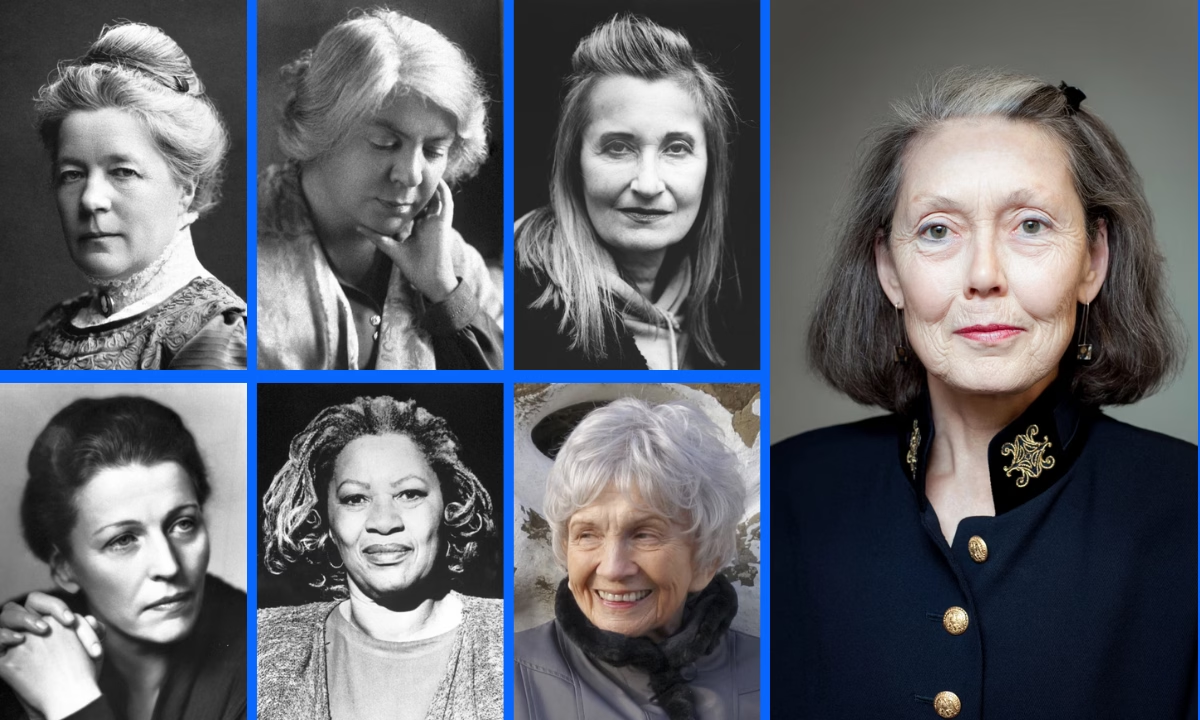

Women Nobel Prize winners in literature: only 19 women have won the Nobel Prize in Literature in 125 years, and the 19th arrived just days ago, when the Swedish Academy gave the 2026 prize to Canadian poet Anne Carson on 8 October.
That is the short version. The longer version, however, is stranger and, honestly, more interesting. Women Nobel Prize winners in literature were so rare for most of the 20th century that whole decades passed without a single one, yet since 2018 the prize has gone to a woman every other year.
Nevertheless, this guide gives you the complete list of female laureates from 1909 to 2026, the countries they came from, the books I think you should actually read, and a frank look at why the gap lasted so long.
Table of Contents
Women Nobel Prize Winners in Literature at a Glance
The winner count: 19 women have won the Nobel Prize in Literature as of October 2026. NobelPrize.org listed 18 women among 122 laureates through 2025, and Anne Carson’s 2026 win makes it 19 out of 123. That is roughly 15 percent.
First woman: Selma Lagerlöf of Sweden, 1909.
Latest woman: Anne Carson of Canada, 2026, for work that reworks the classical tradition into new literary forms.
The split that matters: 14 women in the prize’s first 117 years, then 5 of the 9 laureates from 2018 to 2026.
Top country: the United States, with 3 (Pearl Buck, Toni Morrison, Louise Glück).
Biggest drought: 25 years, from Nelly Sachs in 1966 to Nadine Gordimer in 1991.
Turning point: the 2018 Swedish Academy scandal, after which the prize’s own committee chair admitted it had been “much more male-oriented”.
How Many Women Have Won the Nobel Prize in Literature?
Nineteen women have won the Nobel Prize in Literature as of October 2026. Before this year’s announcement, the official tally stood at 18 women among 122 individual laureates for 1901 to 2025. Anne Carson’s win pushed the total to 19 women among 123 laureates by my count, a figure that matches Wikipedia‘s updated total of 123 laureates as of 2026.
As per AFP‘s report on Carson’s win described the tally as 19 women out of 122 laureates. Based on the Nobel Foundation’s own figures, though, 122 was the total through 2025, so the correct denominator after 2026 should be 123. Either way, the share lands at about 15 percent.
Here is the part that changed how I read the whole list. If you split the history at 2018, you get two completely different prizes:
| Period | Total laureates | Women | Share |
|---|---|---|---|
| 1901 to 2017 | 114 | 14 | about 12% |
| 2018 to 2026 | 9 | 5 | about 56% |
| All years | 123 | 19 | about 15% |
Calculated from the official laureate list on NobelPrize.org and the decade breakdown on Wikipedia.
In other words, the last nine years produced more than a quarter of all female literature laureates ever. Still, 19 is a small number, and even with the recent run, Literature remains the Nobel category with the second-most women, behind only the Peace Prize.
Complete List of Female Nobel Laureates in Literature (1909 to 2026)
This is the main reference table. Each year links to the official prize page. Country and language follow the Nobel Foundation’s listing as reproduced on Wikipedia, which notes that the country column may not match birthplace or citizenship.
| S.l | Year | Laureate | Country | Language | Main genre | A good first book |
|---|---|---|---|---|---|---|
| 1 | 1909 | Selma Lagerlöf (1858 to 1940) | Sweden | Swedish | Novels, stories | The Wonderful Adventures of Nils |
| 2 | 1926 | Grazia Deledda (1871 to 1936) | Italy | Italian | Novels | Reeds in the Wind |
| 3 | 1928 | Sigrid Undset (1882 to 1949) | Norway | Norwegian | Historical novels | Kristin Lavransdatter |
| 4 | 1938 | Pearl Buck (1892 to 1973) | United States | English | Novels, biography | The Good Earth |
| 5 | 1945 | Gabriela Mistral (1889 to 1957) | Chile | Spanish | Poetry | Desolación |
| 6 | 1966 | Nelly Sachs (1891 to 1970) | Germany / Sweden | German | Poetry, drama | O the Chimneys |
| 7 | 1991 | Nadine Gordimer (1923 to 2014) | South Africa | English | Novels, stories | Burger’s Daughter |
| 8 | 1993 | Toni Morrison (1931 to 2019) | United States | English | Novels | Beloved |
| 9 | 1996 | Wisława Szymborska (1923 to 2012) | Poland | Polish | Poetry | View with a Grain of Sand |
| 10 | 2004 | Elfriede Jelinek (born 1946) | Austria | German | Novels, plays | The Piano Teacher |
| 11 | 2007 | Doris Lessing (1919 to 2013) | United Kingdom (born in Iran) | English | Novels | The Golden Notebook |
| 12 | 2009 | Herta Müller (born 1953) | Germany (born in Romania) | German | Novels, poetry | The Hunger Angel |
| 13 | 2013 | Alice Munro (1931 to 2024) | Canada | English | Short stories | Runaway |
| 14 | 2015 | Svetlana Alexievich (born 1948) | Belarus (born in Soviet Ukraine) | Russian | Nonfiction, oral history | Voices from Chernobyl |
| 15 | 2018 | Olga Tokarczuk (born 1962) | Poland | Polish | Novels | Flights |
| 16 | 2020 | Louise Glück (1943 to 2023) | United States | English | Poetry | The Wild Iris |
| 17 | 2022 | Annie Ernaux (born 1940) | France | French | Autobiographical prose | The Years |
| 18 | 2024 | Han Kang (born 1970) | South Korea | Korean | Novels | The Vegetarian |
| 19 | 2026 | Anne Carson (born 1950) | Canada | English | Poetry, essays, translation | Autobiography of Red |
A quick skimming of the table tells us a lot. Five of the 19 are primarily poets. Only one, Svetlana Alexievich, won mainly for nonfiction. And only one woman has ever shared the prize: Nelly Sachs, who split the 1966 award with Shmuel Yosef Agnon. The Literature prize has been shared on just four occasions in total.
Who Was the First Woman to Win?
Selma Lagerlöf was the first woman to win the Nobel Prize in Literature, in 1909. Counting from the official list, she was also only the tenth literature laureate overall, after nine men between 1901 and 1908.
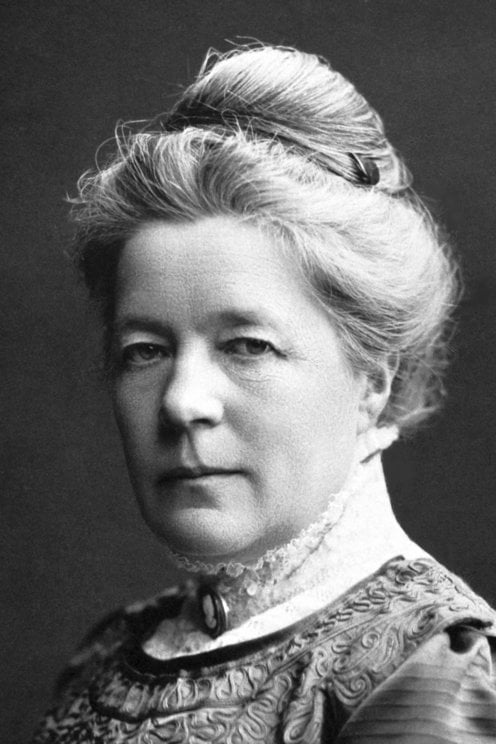
What I find most striking about Lagerlöf is that she won the prize before she was allowed into the room that awards it. The Swedish Academy elected her as its first female member in 1914, five years after her Nobel. NobelPrize.org itself flags that odd order of events in its fact sheet.
Her best-known book has an unusual origin, too. The Wonderful Adventures of Nils began as a commission from Sweden’s National Teachers’ Association for a school geography reader, published in two volumes in 1906 and 1907. A textbook about a boy riding a goose became a children’s classic. I like that a “useful” book turned out to be the one people kept.
There is one more detail that ties this whole list together. In 1940, Lagerlöf interceded with the Swedish royal family to help the poet Nelly Sachs escape Nazi Germany for Sweden.
Sachs went on to become the sixth woman to win the prize, in 1966. So the first female laureate helped save the life of a future one. Lagerlöf died in March 1940, the same spring Sachs reached Stockholm, and she never saw that Nobel.
Who Is the Latest Female Winner?
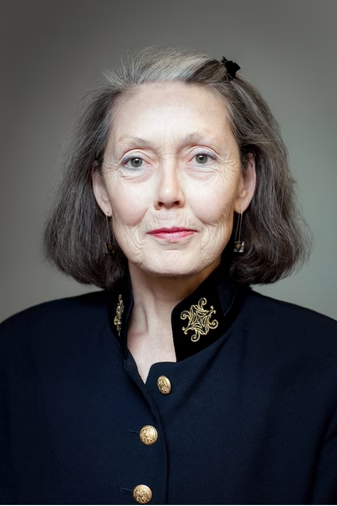
Anne Carson is the latest woman to win the Nobel Prize in Literature. The Swedish Academy announced her as the 2026 laureate on Thursday, 8 October 2026, praising her “bold and inventive oeuvre” for creating new literary forms in conversation with classical tradition.
A few facts worth knowing about her win:
- Carson was born in Toronto in 1950 and writes mainly in English.
- She is the second Canadian author ever to receive the literature prize, after Alice Munro in 2013.
- She was 76 at the time of the announcement, and bookmakers Ladbrokes had listed her among the favourites.
- The prize is worth 12 million Swedish crowns, about $1.2 million.
The story of how she found out is lovely. According to AFP, Carson ignored the Academy’s repeated calls at first, and her husband persuaded her to ring back. Permanent Secretary Ingrid Carlberg said Carson was in Iceland at the time, listening to the wind.
In fact, I can’t think of a more Carson-like answer.
Her work is famously hard to shelve. It mixes verse, prose, dialogue, and translation. Her best-known book, Autobiography of Red (1998), is a verse novel, and Norma Jeane Baker of Troy (2019) blends Euripides’ Helen with Marilyn Monroe. Nox is a more private work, written in memory of her brother Michael. Asked by NPR in 2016 why ancient Greek drew her in, she said it felt like being “in the morning of language”.
If you want a place to start, I’ve written about two of her books on this site: a full Autobiography of Red summary and review, and a review of Eros the Bittersweet, her essay on why desire needs distance.
Female Nobel Literature Winners by Country
The United States has produced the most female Nobel laureates in literature, with three. Poland and Canada follow with two each, and every other country on the list has one. Here is the full breakdown, using the countries listed by the Nobel Foundation:
| Country | Women laureates | Names |
|---|---|---|
| United States | 3 | Pearl Buck (1938), Toni Morrison (1993), Louise Glück (2020) |
| Poland | 2 | Wisława Szymborska (1996), Olga Tokarczuk (2018) |
| Canada | 2 | Alice Munro (2013), Anne Carson (2026) |
| Sweden | 1 | Selma Lagerlöf (1909) |
| Italy | 1 | Grazia Deledda (1926) |
| Norway | 1 | Sigrid Undset (1928) |
| Chile | 1 | Gabriela Mistral (1945) |
| Germany / Sweden | 1 | Nelly Sachs (1966) |
| South Africa | 1 | Nadine Gordimer (1991) |
| Austria | 1 | Elfriede Jelinek (2004) |
| United Kingdom | 1 | Doris Lessing (2007) |
| Germany | 1 | Herta Müller (2009) |
| Belarus | 1 | Svetlana Alexievich (2015) |
| France | 1 | Annie Ernaux (2022) |
| South Korea | 1 | Han Kang (2024) |
Grouped by continent, the imbalance is hard to miss. By my count, 11 of the 19 are European, 5 are North American, and there is exactly one each from South America, Africa, and Asia.
Each of those “one” entries carries its own milestone:
- Latin America: Gabriela Mistral was the first Latin American writer of any gender to win the literature prize, in 1945. She is still the only Latin American woman on the list.
- Africa: Nadine Gordimer remains the only woman from Africa to win the literature prize.
- Asia: Han Kang became the first Asian woman and the first South Korean to win, in 2024 (Asia News Network).
Language tells a similar story. Seven of the 19 wrote in English, three in German, and two in Polish, according to the language listings on Wikipedia. No woman writing in Arabic, Hindi, Bengali, Chinese, Japanese, Portuguese, or any African language has won the Nobel Prize in literature. As a reader from South Asia, I notice that absence every time I scroll this list.
France is a useful case study. It has the most literature laureates of any country overall, 16 through 2025, yet Annie Ernaux in 2022 was its first woman. Fifteen French men came first.
Most Influential Books by Female Nobel Laureates
Not every laureate’s work has aged the same way, and you don’t need to read all 19 to understand why they matter. Below is my reading guide, grouped by what you might be looking for. Every book listed has a verified connection to its author’s reputation.
If you want the novels everyone argues about
Beloved by Toni Morrison. Morrison won the 1988 Pulitzer Prize for this novel, and five years later became the first Black woman to receive the Nobel Prize in Literature. She was nearly 40 when her first novel, The Bluest Eye, came out. That detail matters to me. It’s a reminder that a late start didn’t stop her from writing one of the defining American novels.
The Golden Notebook by Doris Lessing. This 1962 novel is the book Lessing is best known for. She remains the oldest person ever to win the literature prize, at 87 years and 355 days on the day it was announced. Her reaction on her doorstep was famously unimpressed.
She joked to reporters that the Academy had to hurry, since “they can’t give the Nobel to someone who’s dead”.
The Good Earth by Pearl Buck. This was the best-selling novel in the United States in 1931 and 1932 and won the Pulitzer in 1932. In 1938, Buck became the first American woman to win the Nobel Prize in Literature.
The Vegetarian by Han Kang. The novel won the International Booker Prize in 2016, a first for a Korean writer. If you finish it and want more, the same source points to Human Acts and The White Book.
If you want history told from the inside
Kristin Lavransdatter by Sigrid Undset. NobelPrize.org calls this her best-known work, a story of honour, faith, and shared life between women and men in 15th-century Norway. Britannica dates the trilogy to 1920 to 1922. It’s long. It’s also worth it.
The Hunger Angel by Herta Müller. Her 2009 novel portrays the deportation of Romania’s German minority to Soviet labour camps. Müller wrote for years under the eye of Romania’s secret police. After her win, a former Securitate officer reportedly said she “should share her Nobel with the Securitate“.
I read that line as an accidental compliment.
Few novelists get under the skin of a surveillance state that deeply.
Voices from Chernobyl by Svetlana Alexievich. Built from interviews with hundreds of people touched by the 1986 disaster, this is the book that most English-language readers know her for. Her first book, The Unwomanly Face of War, collects the testimony of Soviet women who fought in the Second World War.
Burger’s Daughter by Nadine Gordimer. Written after the Soweto uprising, it was banned in apartheid South Africa. Nelson Mandela read it in prison on Robben Island. Gordimer had already been joint winner of the 1974 Booker Prize for The Conservationist.
If you want poetry
View with a Grain of Sand by Wisława Szymborska. When the Academy announced her prize in 1996, its own press release pointed readers to this 100-poem English selection by Stanisław Barańczak and Clare Cavanagh as the best overview. I’d start here before anything else on this list if you think you “don’t like poetry.”
The Wild Iris by Louise Glück. This collection won the Pulitzer in 1993, and Glück’s Nobel in 2020 made her the first American woman to win since Morrison.
O the Chimneys by Nelly Sachs. Her poetry is available in English through this selection, which includes the verse play Eli. On receiving her shared prize, she said Agnon represented Israel while “I represent the tragedy of the Jewish people”.
Desolación by Gabriela Mistral. Her first collection, from 1922. Her pen name combined two of her favourite poets, Gabriele D’Annunzio and Frédéric Mistral. Frédéric Mistral, interestingly, was himself a Nobel laureate in 1904.
If you want writing that breaks the rules
Flights by Olga Tokarczuk. It won the 2018 International Booker in Jennifer Croft’s translation. Here’s a fact I love: on that prize list, Flights beat books by Han Kang and László Krasznahorkai. All three would go on to win the Nobel, in 2018, 2024, and 2025.
The Years by Annie Ernaux. This is her best-known book internationally, notable for telling her life in the third person. The year after Tokarczuk’s Booker win, Ernaux and Tokarczuk appeared on the same International Booker shortlist Two future laureates, one shortlist.
The Piano Teacher by Elfriede Jelinek. Her 1983 novel was adapted into a 2001 film by Michael Haneke . Be warned, it is a hard read in the best sense.
Runaway by Alice Munro. This 2004 collection won the Giller Prize, and Dear Life (2012), her 14th collection, was her last.
I can’t recommend Munro without being honest about what came out after her death. In July 2024, her daughter Andrea Skinner wrote in the Toronto Star that Munro’s second husband, Gerald Fremlin, had sexually abused her as a child, and that Munro stayed with him.
Whether you separate the art from that history is your call. I think you should know it before you pick up the book.
Autobiography of Red by Anne Carson. The newest laureate’s most famous book, and the one I’d hand to a friend first. My full summary and review is here.
Why Have So Few Women Won the Literature Nobel?
So few women have won the Literature Nobel because, for most of its history, the prize reflected a narrow, European, male idea of what great literature looked like, and the people choosing were mostly European men. That’s not only my reading. In 2019,
Anders Olsson, the new chair of the Academy’s Nobel Committee, said the prize had taken a Eurocentric view and that “previously it was much more male-oriented”.
Let me break the causes into what the evidence actually supports.
1. Long droughts with no women at all
The decade-by-decade numbers are blunt. There were zero women laureates in the 1910s, 1950s, 1970s, and 1980s. After Nelly Sachs in 1966, no woman won again until Nadine Gordimer in 1991. That’s 25 years. A reader born in 1967 could have finished university without ever seeing a woman win this prize.
2. A narrow geographic lens
Gender bias didn’t operate alone. It overlapped with a heavy focus on Europe and North America. When Ernaux won in 2022, Smithsonian Magazine counted 96 of the then 119 laureates as European or North American. If the Academy mostly looked at Western writing, and Western literary culture mostly promoted men, the shortlists were going to skew male before any vote took place.
3. Critics who boxed women in
Pearl Buck said as much herself. In a 1969 interview she complained that American critics tended to dismiss her “as a woman writer”. Even in 2004, Elfriede Jelinek felt the need to tell reporters that the Academy had assured her she won for her work, not because she was a woman. That a laureate had to say this out loud tells you something about the climate.
If you want the philosophical background on how women’s work gets framed as “secondary,” I’d point you to Simone de Beauvoir. My review of The Second Sex covers her argument that women are defined in relation to men. Beauvoir never won a Nobel, but her ideas explain a lot of this list.
4. The 2018 scandal that forced a reset
The modern turn started with a crisis.
In November 2017, 18 women accused Jean-Claude Arnault, the husband of Academy member Katarina Frostenson, of sexual assault, and the fallout exposed conflicts of interest and a culture of silence inside the institution. Arnault was jailed for rape in 2018, seven members quit, and the Academy postponed the 2018 prize, the first delay in 70 years.
When the prize came back in 2019, it had a new selection body made up of four Academy members and five outside specialists. The delayed 2018 prize went to Olga Tokarczuk. Since then, the pattern has been a clean alternation: woman, man, woman, man, all the way to Carson in 2026.
5. Was the reform real, or just good PR?
This is where I’d ask you to stay a little skeptical. Critics weren’t satisfied in 2019. The same announcement that crowned Tokarczuk also gave the 2019 prize to Peter Handke, and Electric Literature argued the Academy had learned nothing from its own promises. PEN International called the Handke choice a failure to meet the assurances made only a week earlier.
Has the strict alternation since 2018 been a deliberate policy? I cannot confirm that with certainty. The Academy has not, in anything I found, said it follows a gender rotation, and nominations stay confidential for 50 years. So we can see the outcome, but we can’t yet see the deliberations behind it. Based on the available data, the honest conclusion is this: the results changed sharply after 2018, and the reasons are only partly visible.
What I can say without hedging is that the change is real in the numbers. Five women in nine years, compared with fourteen in the previous 117. That’s not a rounding error.
Frequently Asked Questions
How many women have won the Nobel Prize in Literature?
Nineteen, as of October 2026. The official count was 18 through 2025 (NobelPrize.org), and Anne Carson became the 19th in 2026.
Who was the first woman to win the Nobel Prize in Literature?
Selma Lagerlöf of Sweden, in 1909.
Who won the Nobel Prize in Literature in 2026?
Anne Carson, the Canadian poet, essayist, and classicist, announced on 8 October 2026.
Which country has the most female Nobel laureates in literature?
The United States, with three: Pearl Buck, Toni Morrison, and Louise Glück.
Who was the first Black woman to win the Nobel Prize in Literature?
Toni Morrison, in 199.
Who was the first Asian woman to win the Nobel Prize in Literature?
Han Kang of South Korea, in 202.
Who is the oldest woman to win the Nobel Prize in Literature?
Doris Lessing, who was 87 years and 355 days old when her 2007 win was announced. She is the oldest literature laureate of any gende.
Has any woman won the Nobel Prize in Literature twice?
No. In fact, no one of any gender has won the literature prize more than once.
Has a woman ever shared the Nobel Prize in Literature?
Only once. Nelly Sachs shared the 1966 prize with Shmuel Yosef Agnon.
Why was there no Nobel Prize in Literature in 2018?
The 2018 prize was postponed after a sexual assault and conflict-of-interest scandal shook the Swedish Academy. It was awarded a year late, in October 2019, to Olga Tokarczuk.
Which female Nobel literature laureates are still alive?
Based on Wikipedia‘s laureate list as I checked it in October 2026, seven are living: Elfriede Jelinek, Herta Müller, Svetlana Alexievich, Olga Tokarczuk, Annie Ernaux, Han Kang, and Anne Carson. Please double-check before citing this, since it can change.
Has Margaret Atwood won the Nobel Prize in Literature?
No. As of October 2026, she does not appear on the official list of literature laureates. The only Canadian winners are Alice Munro and Anne Carson.
How many women have won any Nobel Prize?
According to NobelPrize.org, 65 women had received Nobel Prizes (66 awards, since Marie Curie won twice) between 1901 and 202. I could not verify an updated all-category total that includes 2025 and 2026.
Final Thoughts
When I first lined these 19 names up in a single table, two feelings landed at once. One was frustration. A century of the world’s most famous literary prize, and some decades didn’t produce a single woman.
The other was something closer to excitement, because the recent winners are not token picks. Tokarczuk, Ernaux, Han Kang, and now Carson are writers who bend form, and they are being read widely because of it.
If you only take one thing from this list, make it a reading plan rather than a statistic. Pick one book from the guide above, maybe View with a Grain of Sand or Beloved or Autobiography of Red, and read it this month.
The numbers tell you the prize got it wrong for a long time. The books tell you what everyone was missing.
Related reading on Sopranu:
- Autobiography of Red summary, the book that explains Carson’s Nobel win
- Eros the Bittersweet review, Anne Carson on why desire needs distance
- The Second Sex (1949), Simone de Beauvoir review