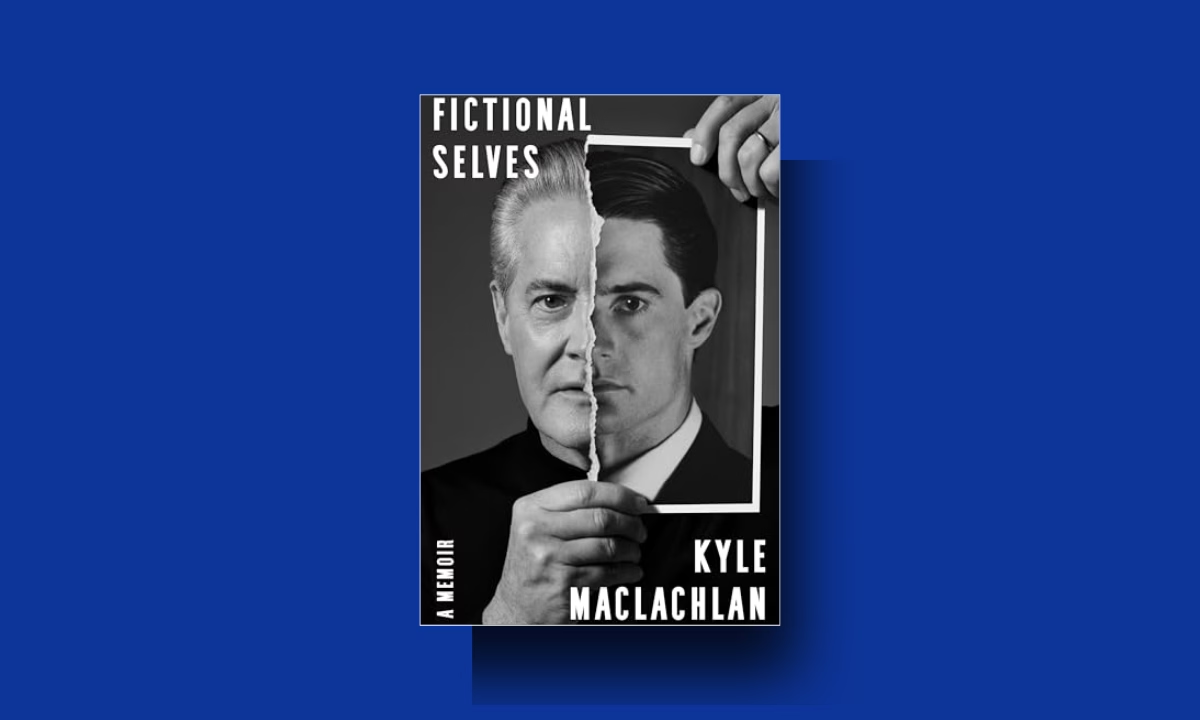

Fictional Selves is Kyle MacLachlan’s 2026 memoir about the strange double life of an actor whose characters outlive the moment he plays them, and it is the rare celebrity book that gets more honest the more it talks about failure.
The Fictional Selves review you are reading comes from a full read of all 24 chapters, so here is the short answer up front. The man who played Paul Atreides, Agent Dale Cooper and Trey MacDougal argues that his flops, from the 1984 Dune to Showgirls, did more to shape him than his hits ever did.
He tells it with a running gag, a doubting voice he calls “Other Kyle,” and with a portrait of David Lynch that I think Lynch fans will be quoting for years.
Table of Contents
Fictional Selves at a Glance
Fictional Selves is a warm, funny, sometimes painfully candid memoir in which Kyle MacLachlan treats every famous role as a separate self and asks which one is really him. Here is the book at a glance.
The core idea: Actors create “another person who then exists, outside of you, in perpetuity” (Introduction). MacLachlan spends 320 pages making peace with those doubles.
Failure is the engine. His own line sums it up: “Dune’s success would’ve changed my career, but Dune’s failure ends up changing my life” (Chapter 9).
David Lynch is the book’s second hero. Lynch cast him in Dune, Blue Velvet and Twin Peaks, gave him the direction “MORE WIND,” and died while the book was being written.
Fear of feeling is the real subject. MacLachlan admits he spent decades hiding emotion behind jokes and learned to cry on camera only on Blue Velvet.
The lost-roles list is gold. Platoon, Top Gun, Sex, Lies, and Videotape, A River Runs Through It, Bram Stoker’s Dracula, The Matrix and Grey’s Anatomy all slipped away, and he tells each story without bitterness.
He owns his worst moments. He calls himself “young and selfish” about cheating on Laura Dern, apologizes to her and to Lynch in 2019, and admits a conveniently timed cold kept him off the Showgirls press tour.
The ending is gentle. “You don’t find yourself. You build him” (Chapter 24).
Suggested Readers
You will love it if you are a Twin Peaks or Lynch fan, an acting student, a memoir reader who prefers self-doubt to bragging, or anyone over forty who has watched a younger version of themselves on a screen (or a phone) and wondered who that person was.
You will probably bounce if you want a tell-all. MacLachlan is kind to almost everyone. He names Oliver Stone’s temper and Paul Verhoeven’s bullying, but he never goes for the throat. If you came for Sex and the City gossip, that section is short, and the Desperate Housewives years get one chapter.
Best format: The audiobook, which MacLachlan narrates himself across 10 hours and 32 minutes. His Lynch impression alone is worth it.
What is Fictional Selves about?
Title, author and publication details
Fictional Selves: A Memoir by Kyle MacLachlan was published by Crown on September 29, 2026, at 320 pages and $34 in hardcover, with an ebook and an audiobook released the same day.
In the UK it comes from Century, a Penguin imprint. MacLachlan first announced the book on Twin Peaks Day, February 24, 2026, according to Welcome to Twin Peaks.
The acknowledgments credit writer Jon Sternfeld as his “partner on this journey,” and the editors were Matt Inman and Kevin Doughten.
Context: what kind of book is it, and who wrote it?
Fictional Selves is a Hollywood memoir, but it reads more like a book about identity than a career highlight reel.
MacLachlan was born in Yakima, Washington, in February 1959, trained in the University of Washington’s Professional Actor Training Program, and was performing for $185 a week at Seattle’s Empty Space theater when a casting agent called about Dune (Chapter 1). He went on to win the 1991 Golden Globe for Best Actor in a TV drama for Twin Peaks and earned two Emmy nominations for the same role.
He also runs the Washington wine label Pursued by Bear, which he co-founded in 2005.
Purpose
The thesis sits in the introduction, which is dated Los Angeles, July 2026. Every role he plays becomes a double who “doesn’t stay within the bounds of the screen,” and those doubles stack into a composite stranger the public thinks is him.
He asks it plainly: “Or am I just a character, too?” The answer, which arrives in the last chapter, is that the self is not discovered but assembled. The epigraph from Kurt Vonnegut’s Mother Night sets the tone: we must be “careful about what we pretend to be.”
Why does Kyle MacLachlan’s story matter now?
Two things make this book land in 2026. The first is grief. David Lynch’s family announced his death on January 16, 2025, days before his 79th birthday, and MacLachlan writes that “during the course of my writing this book, my dear friend David passed away” (Chapter 24). The second is reappraisal.
Lynch’s Dune was a box-office failure that earned about $30.9 million in the US on an estimated $40 to $42 million budget, and Showgirls won seven Razzies from a record 13 nominations.
Both films have since found cult audiences. MacLachlan was the face of both, and this memoir is his version of what it felt like to stand in the blast zone.
The early reception has been warm. Penguin Random House’s page quotes starred reviews from Library Journal and BookPage. Airmail’s Joanne Kaufman reviewed it warmly, and on NPR’s Fresh Air, MacLachlan told Terry Gross that he saw himself as Lynch’s guide into dark territory: “I’m sort of David’s submersible”, tethered to the mothership.
Fictional Selves debuted at number five on The New York Times Best Seller list.
Fictional Selves summary
I am going to walk through Fictional Selves in order, because the order is the argument. Each stage of his career gives him a new “self,” and each self teaches him something the previous one could not. If you only want the big picture, the TL;DR above covers it. If you want to know what is actually in these pages, read on.
How did a Seattle stage actor get cast in Dune? (Chapters 1 to 4)
He got the part almost by accident. In December 1982, MacLachlan was six months out of acting school, co-starring as Damis in Molière’s Tartuffe, and planning a move to New York, when casting agent Elisabeth Leustig left a message on his answering machine.
He thought it was a prank. After a hotel-room audition in Seattle, he flew to Los Angeles to meet David Lynch in a temporary office on the Universal back lot.
The meeting is one of the best scenes Fictional Selves Lynch barely talked about Dune. The two men swapped stories about growing up in the Northwest (Lynch was born in Missoula), about red wine and coffee, and MacLachlan slowly realized “this is the meeting.” Then came Dino De Laurentiis, who received him in Bungalow 9 of the Beverly Hills Hotel wearing an apron, with a piece of pasta stuck to his lip. Dino asked his age, asked if he would cut his hair, said “va bene,” and went back to lunch.
The screen test nearly sank him. Trained to act off another actor’s eyes, he froze in front of a lens that felt “like coming face-to-face with a shark.” Lynch walked over and said, in that flat Montana honk the book renders in capital letters, that he had total faith in him.
That night a bottle of Château Lynch-Bages was waiting in his hotel room. He signed a contract for five Dune films and three non-Dune films with De Laurentiis Entertainment Group and was paid $50,000, which he notes was “exponentially more” than his theater wage (Chapter 1).
Chapter 2 goes back to Yakima to explain why Paul Atreides mattered so much. MacLachlan read Herbert’s novel at about fourteen, wrote Dune quotes on his English teacher’s blackboard, and wore Paul “as a costume, a suit of armor over my frightened self.” He was bullied by a pair of twins, terrified of the junior-high locker room, and learned to “exit my body” as a survival trick. That skill, he admits later, became one of his main acting tools.
The shoot itself, in Chapters 3 and 4, is a comic disaster story told with affection. Crew members burned tires in the Samalayuca dunes to blot out a blue sky.
The production had about 1,700 cast and crew, four camera crews and some 80 sets, according to MacLachlan. He lost nearly fifteen pounds to stomach bugs over the seven-month shoot, while Lynch claimed he stayed healthy because “I SHOWER WITH VODKA IN MY MOUTH.” Patrick Stewart, a last-minute replacement, quietly asked him what they were supposed to be looking at in front of the blue screen.
Jürgen Prochnow was burned by a smoke tube. Sting was on the set the summer “Every Breath You Take” hit number one.
This is where the Lynch shorthand begins. Directing a father-and-son farewell, Lynch told him to speak “MORE LIKE A MYSTERY, LIKE A WIND.” From then on, the note was simply “more wind.” MacLachlan’s verdict on the production is generous and clear: “We aren’t making Frank Herbert’s Dune; we’re making David Lynch’s Dune” (Chapter 4).
What happened after Dune flopped? (Chapters 5 to 9)
Nothing, at first, and that was the problem. His contract barred him from any other film or TV work until Dune came out in December 1984, more than a year after he wrapped.
So he bought a secondhand Honda CX550 in London, stayed with Patrick Stewart and his wife Sheila in Chiswick, and rode across France and Italy to surprise Raffaella De Laurentiis’s niece Simona in Rome. She had gotten back together with her boyfriend. He could not even find his way out of Rome, circling Piazza Venezia until he rode the wrong way down a one-way street.
Chapter 5 also holds Fictional Selves‘s first real wound. His mother had been diagnosed with ovarian cancer around the time Dune started filming and chose not to tell him until he finished. Their visits became, in his words, an “unspoken arrangement”: she protected him from her fear, and he protected her from his doubts.
Chapter 6, “Theater, Kid,” rewinds to 1972, when his mother dragged him to Yakima’s Teen Theater with the promise that there would be girls there. He found a place where he could “fake a confidence I didn’t really have and, through that process, make it real.”
He played Henry Higgins in My Fair Lady, dropped out of the University of Washington after a miserable freshman year in his father’s fraternity, cut lumber on a swing shift, and was rescued by summer stock at North Carolina’s Flat Rock Playhouse. Chapter 7 covers the training program, where he could handle accents and stage combat but not tears.
The day he finally broke down in class, remembering his father on the front lawn after learning his wife wanted a divorce, he ran out of the room and felt he had failed.
Chapter 8 is the crash. Dune premiered at the Kennedy Center, Universal printed a glossary for confused audiences, and Roger Ebert named it the worst film of the year. MacLachlan quotes Janet Maslin’s New York Times line that the psychic characters were the only ones who could understand the movie, and admits, “I can’t disagree.” His manager called with the news that the sequels were dead.
His self-description is blunt: “I’m an unexploded shell. A dud.” In a footnote he adds a detail I had never seen before. Dino always called Dune a $40 million picture, but Raffaella told him it may have cost about half that.
Chapter 9, “La La Landing,” is the most entertaining stretch of Fictional Selves because it is a catalog of what he calls “a pretty good filmography of the movies I am rejected for.” He was fired from John Hughes’s Some Kind of Wonderful three days before shooting, along with director Martha Coolidge.
Tony Scott sized him up for Top Gun in about five minutes and they both knew he was no “Goose.” Oliver Stone told him he was the top choice for Platoon, but his agent wanted “the safer move,” his mother disliked the ending, and the project fell apart at De Laurentiis before Stone made it elsewhere.
A year later, handing Stone an Independent Spirit Award, MacLachlan heard him say, “And you turned it down.”
Why did MacLachlan almost refuse Blue Velvet? (Chapters 9 to 12)
He refused it once, for his mother. He sent her Lynch’s script about a college boy who finds a severed ear, and she was so upset that his stepfather called to tell him.
MacLachlan told Lynch he could not do it. Lynch replied, “NO WORRIES, BUDDY.” Months later, with no other work and the script still haunting him, he changed his mind, explaining to his mother that a film can suggest what a script spells out. Lynch’s answer: “I ALWAYS KNEW YOU’D COME BACK.”
The Blue Velvet chapters are the heart of Fictional Selves for me. MacLachlan describes stripping to his underwear while Isabella Rossellini held a knife to his chest and trying to think about “the ball game on that night.” He met Laura Dern at Bob’s Big Boy, where Lynch doodled in ketchup and cast her before the fries were gone.
He fell for Dern almost at once. Lynch asked him to add his “chicken walk” to a scene without telling her, and her surprised laugh is the one in the film.
He also argued for changes that matter. He convinced Lynch to cut a scripted detail that implied Jeffrey had been sexually assaulted by Frank Booth’s gang, because he felt it would “throw off the balance of the film.” And he describes, in real detail, how he worked up to the scene where Jeffrey breaks down crying on his bed: narrowing his focus “from the set to the room to the camera to the lens,” then drawing on his mother’s illness and his father’s grief. For the first time, the tears came and he felt like a surfer riding a wave instead of a swimmer drowning.
Dennis Hopper, newly sober, arrives in Chapter 11 as a polite man in a houndstooth jacket who becomes, on “ACTION,” someone MacLachlan “can’t find” behind the eyes. Hopper tells stories in MacLachlan’s trailer about three grams of cocaine a day in Taos, and at the end of the shoot personally flies Jack Nance to rehab.
The release, in Chapter 12, repeats the Dune pattern before reversing it. Test-audience cards were the worst Dino had ever seen; one viewer wrote that the best thing about the film was “the dog.”
Then Pauline Kael called Lynch’s film “the work of a genius naïf” in The New Yorker, the tide turned, and Lynch earned a Best Director Oscar nomination. MacLachlan’s mother did not live to see it. She died in a Seattle hospital at fifty-one, the winter after the shoot. “Loss isn’t poetic; it just is.”
The chapter ends with acting teacher Sandra Seacat, whom Dern introduced him to. In a ritual exercise set to Led Zeppelin’s “Kashmir,” carrying a raw steak down a path of symbols from his life, he sobbed and discovered that “emotion is not a weakness, not something to be ashamed of.”
I found that passage more useful than most self-help books I have reviewed.
Which famous roles did Kyle MacLachlan turn down or lose? (Chapters 13 and 17)
More than you would guess. He passed on Steven Soderbergh’s Sex, Lies, and Videotape because he did not want to be “the creepy pervert” after Blue Velvet; the film won the Palme d’Or.
He auditioned lamely for the Coen brothers’ Miller’s Crossing. Oliver Stone let him read for Jim Morrison and then offered him keyboardist Ray Manzarek in The Doors, a part he took and then felt like “a glorified extra” in. In Chapter 17 he reaches the finals for A River Runs Through It, paired with Cary Elwes, and loses to Craig Sheffer and a young actor who, after Thelma & Louise, “turns overnight into Brad Pitt.”
He screen-tests at Francis Ford Coppola’s Napa estate for Bram Stoker’s Dracula, eats dinner in Coppola’s kitchen, and loses to Keanu Reeves and Gary Oldman. He blows a chemistry read with Sandra Bullock for The Net because nobody told him it was one.
Two later misses are played for laughs. In Chapter 19 he fumbles an audition with “a pair of sibling directors” for a black-suited villain called Agent Smith, then writes that he is “not really sure what comes of the movie,” before adding, “Obviously, I’m kidding.” In Chapter 20 he admits he lacked “the requisite smolder appeal” for Dr. Derek Shepherd on Grey’s Anatomy, a part that went to Patrick Dempsey.
How did Twin Peaks happen, and why did it fall apart? (Chapters 14 to 16)
It happened because nobody expected it to. In February 1989, MacLachlan shot a pilot then called Northwest Passage in Snoqualmie and North Bend, Washington, sure it would end up as a TV movie. Co-creator Mark Frost worried he was too young at nearly thirty; a lunch about golf changed his mind.
MacLachlan built Agent Dale Cooper partly from Lynch himself: the thumbs-up, the rhythm of “clean place, reasonably priced,” and lines like “Who’s the glad-handing dandy?”
The little notepad Cooper checks in his first scene was MacLachlan’s idea, to break up a long monologue shot in one take on a short stretch of road.
The origin stories are irresistible. Set dresser Frank Silva became the demon Bob after a crew member joked about him getting locked in Laura Palmer’s bedroom and he was then caught by accident in a mirror shot.
The Red Room came to Lynch while leaning on a hot car. Michael J. Anderson, who had to speak his lines backward, told the cast he used to talk backward as a child. MacLachlan spent almost an hour throwing rocks at a bottle until he hit it for the camera.
The numbers explain the “rocket” in the chapter title. MacLachlan writes that 35 million people, a third of all viewers, watched the pilot on April 8, 1990. Wikipedia gives the pilot a 22 rating and a 33 percent share, which fits his “third.” The show earned 14 Emmy nominations, and he won the Golden Globe. He hosted Saturday Night Live, where a nervous first-week Chris Farley played Leo, and he was mobbed at Tokyo’s airport by fans in black suits.
Then ABC forced the reveal of Laura Palmer’s killer in the seventh episode of season two.
MacLachlan’s view is simple: “The murder is not the point.” With Lynch and Frost off making other projects, the writers’ room drifted, guest directors reached for kookiness, and Cooper’s black suit was written out at MacLachlan’s own request, a choice he now calls “a disaster.” He also vetoed a planned romance between Cooper and the high-school character Audrey Horne, because Cooper “should stay straight and true.”
In a lovely detail, the next time he put on the black suit after the sprinkler scene, it had shrunk. “Metaphors don’t get more direct than that.”
The personal story runs alongside. MacLachlan began an affair with co-star Lara Flynn Boyle while still living with Laura Dern, and Dern found out when she visited the set. He does not soften it: “that’s no excuse for my behavior.” Lynch’s finale, in which he tore up the script and ended on Bob grinning in Cooper’s mirror, is described as “both surprising and inevitable.”
The prequel film Fire Walk with Me then caused a rift: MacLachlan questioned the script, Lynch bristled, and Cooper’s role was cut back. MacLachlan notes, a little wounded, that Cooper’s hair in the film is as flat as Lynch had wanted it from the start.
What does Kyle MacLachlan say about Showgirls? (Chapters 17 and 18)
He says he could not find “a single good thing to say about this movie,” and so he got a convenient cold. The Showgirls chapter opens with Other Kyle interrogating him (“What were you even thinking?”) and then explains the context honestly.
After Twin Peaks, he was falling for supermodel Linda Evangelista, whom he met on a Barneys shoot where he balanced a lobster on his head to make her laugh, and he had mentally drifted from his career.
He took Paul Verhoeven’s film because Verhoeven’s Dutch films and RoboCop had thrilled him and he wanted to break out of the Cooper box.
On set, he tiptoed around Verhoeven “like you might do with an angry bull” and watched Gina Gershon stand up to him. He refused Verhoeven’s suggestion of a full-frontal walk to the pool, even after the director offered to matte in an erection “any size you vant,” and he insists the backside in the film is his. “Film is forever.” The private screening at Carolco was so painful that he and his manager shared an “uh-oh” within minutes. He skipped the press tour, was nominated for a Razzie, and lost Worst Actor to Pauly Shore, which earns the footnote “Thank you, Pauly Shore.”
What I appreciated is that he defends Elizabeth Berkley, who he says “does not deserve as much responsibility as she was given,” and that he recognizes the film’s second life.
Showgirls became a midnight-movie favorite, he writes, because “no one is winking at the camera,” a reading that matches its documented cult status and $100 million-plus home-video gross. If you want the wider story of what the NC-17 rating meant, our list of 30 legendary banned movies covers the censorship side.
How did Sex and the City and Desperate Housewives change his career? (Chapters 19 and 20)
They made him famous to a new crowd as a man with problems. Chapter 19 starts with a bad back and a chiropractor’s office, where he spotted publicist Desiree Gruber, and then met her again the next night at Tina Brown’s Oscar party.
He drank only water, kept misidentifying celebrities as a joke (“Ah, I see Sean Connery made it”), and promised her a burger at the Apple Pan. When HBO called about a part, he could not remember the show’s name. Desiree could, and told him, “You’re doing it.”
The pitch for Trey MacDougal, an impotent Upper East Side surgeon who bathes while his mother sits on the tub’s edge, sends Other Kyle into despair: “You’re the only actor who’d join a show about sex and not have any.” He took it, connected with Kristin Davis, adored Frances Sternhagen as Bunny, and pushed back only once, over the cardboard-baby storyline, saying he “can’t play someone who does something nobody would do.”
He married Desiree, according to Wikipedia, in April 2002.
Chapter 20 covers Orson Hodge on Desperate Housewives. MacLachlan asked showrunner Marc Cherry to keep him past his planned one-season arc, and Cherry invented a scheming mother to do it. The chapter’s emotional center is Marcia Cross telling him he has a habit to “run from your power.”
He agrees, and traces it to his father’s caution and an unspoken rule he absorbed as a boy: “Don’t try too hard because then you’ll fail.”
What does Fictional Selves reveal about fathers and sons? (Chapter 21)
It reveals a quiet, almost wordless love. MacLachlan started Pursued by Bear, named for Shakespeare’s most famous stage direction in The Winter’s Tale, partly to spend time with his stoic father on drives through the Yakima Valley in a 1967 Mustang.
His father, a lawyer turned stockbroker who once walked out on five girlfriends gathered at his dining table, rarely talked about the past. On one drive he told the story of meeting MacLachlan’s mother, who smiled at him every day on campus only because she was too vain to wear her glasses. His father died of cancer in 2011.
Callum was born when MacLachlan was nearly fifty, and Fictional Selves says fatherhood opened “a door in my heart that I never even knew was there.”
He shows how it changed his acting too: a grieving father on Law & Order: SVU in 2003 felt like guesswork, but the 2011 return to the show, after three years with his son, did not. He talks through Dr. Calvin Zabo on Agents of S.H.I.E.L.D. and his voice work as Riley’s father in Pixar’s Inside Out, where he and director Pete Docter worked out where the character was standing in each scene.
The chapter’s best line is about inheritance: “My parents diluted into me, as I hopefully will into my son.”
How does MacLachlan describe Twin Peaks: The Return? (Chapters 22 and 23)
He calls it “the most challenging and rewarding experience I’ve ever had as an actor.” In 2012, Lynch summoned him to a Midtown hotel room, swore him to secrecy, and asked how he would feel about going back. His answer: “David, you know I’ve never left Twin Peaks.”
In early 2015 he read a 500-page script in a windowless room, apparently the only cast member to see all of it, and learned he would barely play Cooper. Instead he would play Mr. C, a killer, and Dougie Jones, a childlike “tulpa.”
Then, in April 2015, Lynch walked away over Showtime’s budget, before the network gave him what he needed. The Return premiered on May 21, 2017, with 18 episodes.
The craft notes in Chapter 23 are excellent. For Mr. C he wore black contact lenses, rarely blinked, borrowed “pure will” from Javier Bardem in No Country for Old Men, and spoke from low in his chest with no music in the voice.
He believes Lynch trusted him with the role partly because Lynch had seen his worst sides: “the ungracious creative partner” on Fire Walk with Me and “the callous romantic partner” with Dern. For Dougie, he used an acting-school exercise called object discovery and learned “the amount of courage it takes to do nothing.”
Laura Dern, cast as Diane, asked not to see him in Mr. C’s makeup until the cameras rolled. And when Cooper finally returns in the third-to-last episode, he gets to say, “I am the FBI.”
His reading of the famous ending is personal rather than puzzle-solving: “You can’t return to the past because it’s not there anymore.” He admits he hoped the show would make him big again, and then lets that go: “The gift, the whole time, was the thing itself.”
How does Fictional Selves end? (Chapter 24 and Epilogue)
It ends with apologies, a funeral of sorts, and a wave. At the 2019 Governors Awards, MacLachlan, Laura Dern and Isabella Rossellini presented Lynch’s honorary Oscar. Afterward, behind the theater among the catering boxes, MacLachlan apologized to Lynch for his behavior around Fire Walk with Me and to Dern for the past. Lynch told him, “I KNOW YOU ARE, BUDDY.”
Then Lynch is gone, and MacLachlan describes grief in small, exact moments: seeing the empty rooms in the real-estate photos of Lynch’s house. He describes “Online Kyle,” his goofy social-media self, his podcast What Are We Even Doing?, his work on Amazon’s Fallout, and his son turning eighteen.
The final sentence of Chapter 24’s argument is the book’s thesis: you build yourself “out of the pieces you love.”
The epilogue is set on Twin Peaks Day in February 2024, the 35th anniversary of Cooper’s fictional arrival.
MacLachlan drives through the Douglas firs outside North Bend to the spot where the “Welcome to Twin Peaks” sign stood, finds fans lined up on both shoulders shouting “Cooper,” and does not know what Cooper would do. So he does what Kyle would do. “I open the window and wave.”
Is Fictional Selves worth reading? My critical analysis
Fictional Selves is the most emotionally honest actor’s memoir I have read in a while, and also one of the most gently funny. I finished it with the odd feeling of having met two people: the actor I thought I knew from Twin Peaks, and the anxious Yakima kid who has been operating him for forty years.
Does MacLachlan support his argument with evidence?
Mostly, yes. The argument is that his failures shaped him more than his successes, and he backs it with a career that fits the claim almost too neatly: Dune fails and leads straight to Blue Velvet; Twin Peaks curdles and pushes him to grow; Showgirls teaches caution; a bad back leads him to his wife.
Where he cites outside sources, he is careful. Fictional Selves‘s endnotes trace his epigraphs and press quotes to real sources, including Maslin’s 1984 Times review, Kael’s 1986 New Yorker piece and Lynch’s Room to Dream.
Where his memory might be self-serving, he often flags it, as with the Dune budget footnote.
Strengths: what did I love about Fictional Selves?
The portrait of David Lynch. Lynch teaching him to build a fire without newspaper, Lynch living in his house with the dead tree from Eraserhead, Lynch tearing pages out of the season-two finale script. It is the warmest Lynch writing I know outside Lynch’s own book.
Real acting craft. Sense memory, the “pot on the stove” method for emotional scenes, object discovery for Dougie, the decision to give Mr. C no music in his voice. Acting students will underline half of Chapters 12 and 23.
Self-mockery that never turns cruel. The Agent Smith joke, the “Thank you, Pauly Shore” footnote, and the lobster on his head made me laugh out loud.
Courage about emotion. A man admitting that tears frightened him more than nudity is rare in this genre.
Weaknesses: where does Fictional Selves fall short?
It is kind to a fault. Kirkus’s word “amiable” is fair. Verhoeven, Stone and an unnamed Hamlet bully get criticism, but there is little real reckoning with the industry beyond his own choices.
The women in his life often serve his growth. Laura Dern brings spirituality, Lara Flynn Boyle “dark energy,” Linda Evangelista fashion, Desiree direction. He apologizes to Dern, which matters, but the women can read as chapters in his education rather than people with their own stories. Boyle gets almost no voice at all.
The middle 2000s and 2010s feel rushed. Desperate Housewives gets one chapter for six seasons, and Fallout and Overcompensating are mentioned only in passing.
Other Kyle wears thin. By the time the doubting voice heckles him in the chiropractor’s office, the device has become predictable.
Small copy slips. Chapter 22 calls Dana Ashbrook “Dana Ashcroft,” and Fictional Selves counts the original Twin Peaks run as 29 episodes, while Wikipedia lists 30. These are minor, but a careful fan will notice.
My honest summary: Fictional Selves is a sincere, wise and very readable memoir that would have been great if MacLachlan had pushed half as hard on other people as he pushes on himself.
What books are like Fictional Selves?
If you finish Fictional Selves and want more, these five sit closest to it, and several are cited in its own endnotes.
Room to Dream by David Lynch and Kristine McKenna (2018). The essential companion. It mixes McKenna’s biography with Lynch’s own recollections, and NPR said it “charms but doesn’t demystify.” Read MacLachlan for the view from in front of Lynch’s camera, and Lynch for the view from behind it.
Making It So by Patrick Stewart (2023). Stewart is MacLachlan’s Dune co-star and host in Chiswick, and his memoir covers the same Mexico City shoot from the Royal Shakespeare Company veteran’s side.
I’m Your Huckleberry by Val Kilmer (2020). Kilmer was MacLachlan’s rival for Paul Atreides and, as he puts it, his “cosmic alternative self.” Kilmer’s Simon & Schuster memoir is stranger and more poetic, a good contrast.
Sonny Boy by Al Pacino (2024). MacLachlan quotes it as an epigraph. Pacino’s Penguin Press memoir is also about an actor holding “a lot of mes” inside one body.
Some of Me by Isabella Rossellini (1997). Cited in the Blue Velvet chapter, it gives Dorothy Vallens’s actress her own say about the same shoot.
For a wider list of films that this book will send you back to, our guide to 101 best films you need to see is a good next stop. And if Marcia Cross’s “run from your power” note hit home, our Mindset book review looks at the same fear of failure from the psychology side.
Conclusion: who should read Fictional Selves?
Fictional Selves is a poignant, often hilarious memoir about the gap between an actor and his characters, and I recommend it to most general readers, not just film specialists. You do not need to have seen Dune or Twin Peaks to follow it, since MacLachlan explains every production he touches, though fans will get more out of the Lynch chapters.
Read it if you love Lynch, if you are training as an actor, if you are a parent trying to break a family habit of silence, or if you have ever let fear make your decisions for you. Skip it if you want scandal; the most shocking confession here is a conveniently timed cold.
As for me, I came for Agent Cooper and stayed for a Yakima boy learning, very slowly, that feeling something is not the same as falling apart.
Fictional Selves
Fictional Selves is Kyle MacLachlan's 2026 memoir about the strange double life of an actor whose characters outlive the moment he plays them, and it is the rare celebrity book that gets more honest the more it talks about failure.
URL: https://www.sopranu.com/fictional-selves-summary-review/
Author: Kyle MacLachlan
4
Pros
- Array
- Array
- Array
- Array
- Array
- Array
- Array
Cons
- Array
- Array
- Array
- Array
- Array
- Array