

Last updated on October 13th, 2026 at 09:04 am
Banned movies are not always the filthiest or the most dangerous films ever made. More often, they are the ones that embarrassed somebody powerful. Britain kept Battleship Potemkin off its screens for 28 years because of a Soviet mutiny.
Lebanon pulled Wonder Woman roughly two hours before its premiere because of the lead actress’s passport.
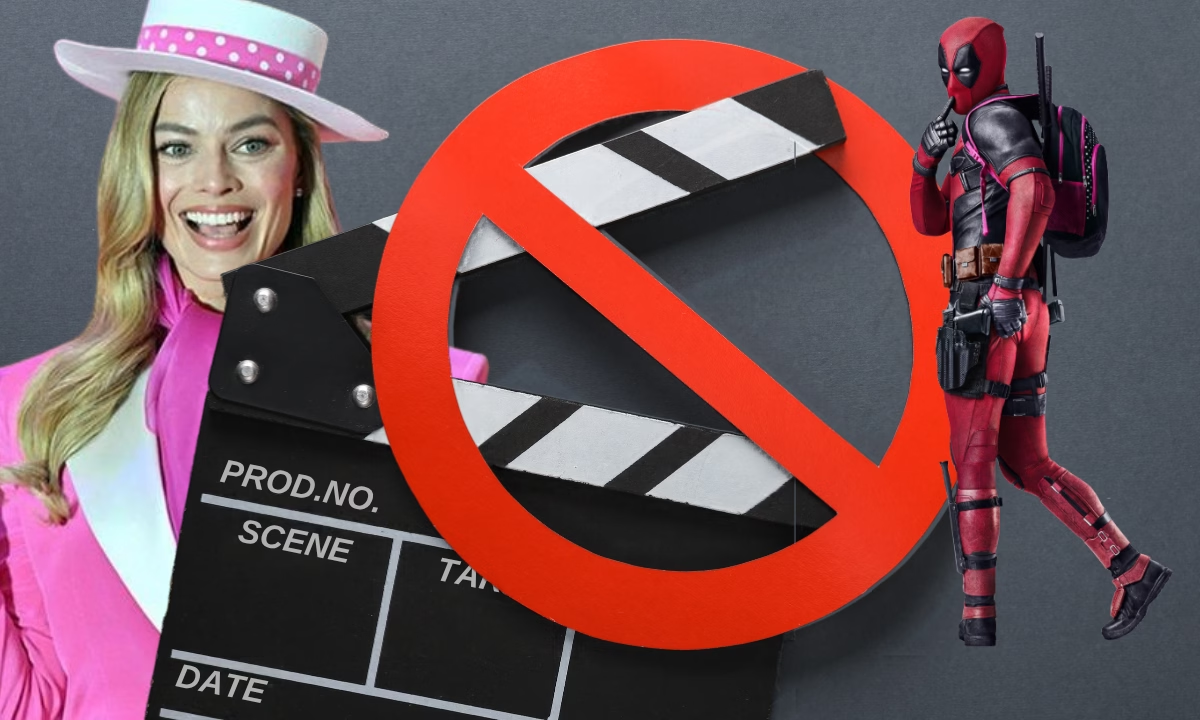
Vietnam blocked Barbie over a few seconds of a cartoon map. After going through censor records, court decisions and news archives for 30 legendary banned films, I found something the usual listicles skip: a handful of the most repeated “bans” are thin, exaggerated, or simply not on record.
Table of Contents
Which Legendary Movies Have Actually Been Banned?
At least 24 of the 30 films below were formally banned by a national government, a censorship board, or a city or state authority at some point. The rest were withdrawn, pulled from one cinema, never submitted, or ride on claims I could not trace to a reliable source. Each entry below carries a Ban check label so you can see which is which.
Banned movies at a Glance
The oldest ban here hit The Birth of a Nation (1915), stopped in cities such as Chicago, Denver and Pittsburgh and in the states of Ohio, Kansas and West Virginia.
The longest national ban I verified belongs to Battleship Potemkin: rejected by the British Board of Film Censors on 30 September 1926, passed on 11 January 1954.
The most common reasons censors gave: politics (13 films), religion (5), sex (2), and violence, horror or superstition (10), with oddities like ghosts and a map in the mix.
Ireland shows up in five entries, more than any other country. Malaysia and China appear in four each, China mostly through its rule against films that “promote cults or superstition.”
Myths to watch for: A Clockwork Orange was never banned in Britain (Kubrick withdrew it himself), The Exorcist was never formally banned on UK video, and the “banned in 50 countries” figure for Cannibal Holocaust is an unofficial estimate.
Bans rarely work. In Kuwait, Myanmar and Iran, banned films became bootleg best sellers.
Quick Reference Table of All 30 Banned Movies
| # | Film (Year) | Where it was banned | Main reason | Ban check |
|---|---|---|---|---|
| 1 | The Birth of a Nation (1915) | Several US cities and states | Racism, KKK glorification | Local bans, verified |
| 2 | Battleship Potemkin (1925) | UK, France, Pennsylvania | “Bolshevist propaganda” | National ban, verified |
| 3 | The Great Dictator (1940) | Nazi Germany and occupied Europe, Spain, Italy, Ireland | Mocking Hitler | National bans, verified |
| 4 | Oliver Twist (1948) | Israel, Egypt; US delayed to 1951 | Fagin portrayal | National bans, verified |
| 5 | Dirty Harry (1971) | Finland | Violence | National ban, verified |
| 6 | The Texas Chain Saw Massacre (1974) | UK (1975 to 1999), others | Violence and terror | National ban, verified |
| 7 | The Exorcist (1973) | Some UK councils; no UK video certificate until 1999 | Horror, child possession | Partial, often overstated |
| 8 | I Spit on Your Grave (1978) | UK video, Ireland, Norway, Iceland, West Germany | Sexual violence | National bans, verified |
| 9 | Life of Brian (1979) | Norway, Ireland, Italy, UK councils | Blasphemy | National bans, verified |
| 10 | Cannibal Holocaust (1980) | Italy, UK video, many others | Real animal killings, gore | Verified, numbers inflated |
| 11 | Rambo: First Blood Part II (1985) | Vietnam | Vietnam War politics | National ban, verified |
| 12 | The Last Temptation of Christ (1988) | Turkey, Mexico, Chile, Argentina, Philippines, Singapore | Blasphemy | National bans, verified |
| 13 | Schindler’s List (1993) | Malaysia (briefly), Indonesia, Jordan, Kuwait | Politics, nudity | National bans, verified |
| 14 | Natural Born Killers (1994) | Ireland | Incitement to crime | National ban, verified |
| 15 | South Park: Bigger, Longer & Uncut (1999) | No national ban found | Profanity | Unverified |
| 16 | Fahrenheit 9/11 (2004) | Kuwait | Insulting Saudi royals | National ban, verified |
| 17 | The Da Vinci Code (2006) | Samoa, Solomon Islands, Egypt, Jordan, Lebanon, others | Blasphemy | National bans, verified |
| 18 | Pirates of the Caribbean: Dead Man’s Chest (2006) | China | Ghosts, cannibalism | National ban, verified |
| 19 | 300 (2006) | Iran (never released) | Insulting Persians | De facto, no formal order found |
| 20 | Rambo (2008) | Myanmar | Depicting the junta | National ban, verified |
| 21 | 2012 (2009) | North Korea (claimed) | “Unlucky” year | Unverified |
| 22 | Argo (2012) | Iran (never released) | Anti-Iran portrayal | De facto |
| 23 | The Wolf of Wall Street (2013) | Malaysia, Nepal, Kenya | Sex, drugs, profanity | National bans, verified |
| 24 | Noah (2014) | Qatar, Bahrain, UAE, Indonesia, Malaysia, Egypt | Depicting a prophet | National bans, verified |
| 25 | American Sniper (2014) | Pulled from Baghdad’s only cinema | “Insults Iraqis” | Partial, often misreported |
| 26 | Fifty Shades of Grey (2015) | Malaysia, Indonesia, Kenya, India | Sexual content | National bans, verified |
| 27 | Deadpool (2016) | China | Violence, nudity, language | National ban, verified |
| 28 | Ghostbusters (2016) | China | Superstition or weak market (disputed) | Denied release, reason disputed |
| 29 | Wonder Woman (2017) | Lebanon | Israeli lead actress | National ban, verified |
| 30 | Barbie (2023) | Vietnam | Nine-dash line map | National ban, verified |
How I Checked These Bans
For every title, I looked for at least one of three things: a censor’s own record (the BBFC publishes case studies for its most famous decisions), a contemporary wire or newspaper report (AP, Reuters, AFP, UPI, The Hollywood Reporter), or a legal or academic source (the Council of Europe‘s IRIS legal bulletins, the National Coalition Against Censorship’s archive).
Where I found only blog posts or trivia sites, I say so. That is the whole point of this piece. A ban is a claim about history, and you deserve to know how solid each one is. And I personally watched may of the movies.
One quick definition before we start. In this article, a “ban” means a government body, censor board, court, or city authority refused to allow public screening or sale. A studio choosing not to release a film, or a director pulling his own work, does not count.
You will see why that distinction matters when we get to Stanley Kubrick.
Why Were Political Films Banned So Often?
Political films were banned most often because governments treat cinema as propaganda, and they assume everyone else’s films are propaganda too. Thirteen of the 30 films here were stopped mainly for political reasons, at least officially, and the pattern runs from 1915 to 2023 without much change.
1. The Birth of a Nation (1915)
D.W. Griffith’s Civil War epic was a technical leap and a moral disaster. It turned the Ku Klux Klan into heroes. According to the Wikipedia compilation of US film bans, which draws on the Roy Rosenzweig Center for History and New Media, it was banned in Chicago, Denver, Pittsburgh, St. Louis and other cities, plus the states of Ohio, Kansas and West Virginia.
The NAACP led the protests. Britannica notes that showings were stopped in only a few states and a handful of municipalities, and the film still became one of the biggest hits of the silent era.
What strikes me most is that the bans were driven by Black civic groups trying to protect their own communities, not by a state trying to silence its critics. That makes it the most morally complicated ban on this list. If you want the wider context of how Hollywood rewrote the Civil War, the Sopranu review of Gone With the Wind (1939) is a natural companion read.
Ban check: Local and state bans, verified.
2. Battleship Potemkin (1925)
Sergei Eisenstein’s silent film about the 1905 naval mutiny is now a fixture of greatest-films polls. Britain saw it as a threat. The BBFC‘s own case study says the film was rejected in September 1926 for “inflammatory subtitles and Bolshevist propaganda.” T
hat was only months after the nine-day General Strike of May 1926, and the timing was not a coincidence. The London and Middlesex county councils also refused it.
The ban held until 11 January 1954, less than a year after Stalin died, when the board decided a silent film would only reach a small, select audience anyway. That is 28 years. The National Coalition Against Censorship also records that French customs burned prints and that Pennsylvania censors objected to it.
Honestly, I find the British reasoning almost funny now: a film was too dangerous right up until it became too old to matter.
Ban check: National ban, verified by the BBFC itself.
3. The Great Dictator (1940)
Charlie Chaplin‘s satire of Hitler was his first true talking picture and, according to Roger Ebert, the highest-grossing film of his career. Hitler banned it in Germany and the territories it occupied.
Smithsonian magazine adds Japan, Spain, Peru and Argentina, and reports that Chicago also blocked it out of fear of upsetting its German-American population. Neutral Ireland banned it too.
The Spanish ban is the one I keep coming back to. According to Filmsite, the film was first shown in Spain in 1976, soon after General Franco died in 1975. Italy saw it in 1945, after fascism fell. In other words, the film was banned exactly as long as the type of man it mocked stayed in power.
The Cannes Film Festival’s write-up also notes that Britain had initially planned to ban it during its appeasement period, then embraced it once the war began.
Ban check: National bans in multiple countries, verified.
4. Oliver Twist (1948)
David Lean’s Dickens adaptation is gorgeous to look at, but Alec Guinness’s Fagin was made up with an exaggerated profile that many viewers read as an antisemitic caricature, three years after the Holocaust. Israel banned it for antisemitism. Egypt banned it for the opposite reason, saying it made Fagin too sympathetic. That contradiction tells you more about 1948 politics than about the film.
In the United States, the Rank Organisation postponed the release. The Jewish Chronicle reports that it finally opened in May 1951, after the Production Code Administration approved cuts meant to reduce shots of Fagin. Several sources put those cuts at about seven minutes.
Ban check: National bans (Israel, Egypt) and a three-year US delay, verified.
5. Rambo: First Blood Part II (1985)
Rambo goes back to Vietnam to rescue American prisoners of war and, in his own words, asks whether “we get to win this time.” It was a huge hit, earning about $150.4 million in the US according to Box Office Mojo. Vietnam was not amused. NPR reported in 2008 that the film had been banned in Vietnam on its release, along with the other films in the series.
Here is the twist I love: the 2008 Rambo, which made Myanmar’s military the villains, passed Vietnamese censors and played in multiplexes from Hanoi to Ho Chi Minh City. Same hero, different enemy, opposite verdict.
Ban check: National ban, verified.
6. Rambo (2008)
Sylvester Stallone set the fourth film in Myanmar (Burma), where the army was waging a brutal campaign against the Karen people. The junta did not ban a cinema release, because there was never going to be one. It went after the bootlegs.
Gulf News, citing a Yangon resident, reported that police ordered DVD sellers not to stock it. Burma News International later reported that military security and police searched computer shops in Mon State for copies, and that one person was arrested with a Rambo disc in Thaton Township.
It did not work.
The film’s tagline about living for nothing or dying for something became a slogan among opponents of the regime. If you are curious about the man behind the headband, the Sopranu summary of Stallone’s book The Steps gives a fair account of where his storytelling instincts come from.
Ban check: National ban on distribution, verified.
7. Fahrenheit 9/11 (2004)
Michael Moore’s documentary won the Palme d’Or and then got banned by one of America’s closest Gulf allies. Reporters Without Borders recorded that Kuwait’s Information Ministry banned it on 1 August 2004.
The ministry’s cinema supervisor told AP that Kuwait had a law against insulting friendly nations and that the film insulted the Saudi royal family. RSF pointed out that Kuwait was the only country in the region to take that step, since Qatar, Bahrain and Oman released it on 3 August.
The result? Gulf News reported that pirated copies became a best seller in Kuwait, sold on the street for about $3.40. One vendor said the ban only brought him more customers.
Ban check: National ban, verified.
8. 300 (2006)
Zack Snyder’s Spartans-versus-Persians action film enraged Iranians, who saw their ancestors turned into monsters. AP reported that the film angered Iranians in 2007, and that in 2009 Iranian officials demanded an apology from visiting Hollywood figures, including Annette Bening, over films like 300.
Was it “banned”? It was never released in Iran, and the government condemned it loudly. However, I could not find a reliable record of a specific formal ban order, as opposed to the film simply never being licensed. Many lists treat these two things as the same. They are close, but not identical.
Ban check: De facto ban; formal order not found.
9. Argo (2012)
Ben Affleck’s Best Picture winner about the CIA’s fake-movie rescue of six Americans in 1979 got a furious response in Tehran.
According to Al Jazeera, citing AP, the film never screened in Iranian theaters, and after a closed screening titled “The Hoax of Hollywood,” officials began exploring a lawsuit against Hollywood. A Middle East Forum piece claims bootleggers sold several hundred thousand copies, but I could not confirm that figure from an independent source, so treat it with caution.
Ban check: De facto ban, verified; bootleg sales figure unverified.
10. American Sniper (2014)
This is the first entry where the popular version of the story gets the details wrong. The Independent’s widely shared roundup says Iran banned Clint Eastwood’s film. TIME reported something more precise: Iran’s Supreme Leader criticized the film, admitted he had not seen it, and the film had not been released in Iran.
The documented action actually happened in Iraq. The Washington Post, as summarized by CBS News and The Hollywood Reporter in February 2015, reported that Baghdad’s only cinema pulled the film after a senior Culture Ministry official warned the manager about fines and possible closure. So “banned in Iran” is shaky, while “pulled in Baghdad under government pressure” is solid.
Ban check: Partial; often misreported.
11. Wonder Woman (2017)
Lebanon banned Patty Jenkins’s superhero film on 31 May 2017, only hours before its Beirut premiere, according to AP. The reason was its star, Gal Gadot, an Israeli citizen who served in the Israeli army. Lebanon is officially at war with Israel and has a long-standing boycott law. Morocco World News reported the film had been scheduled for 15 theaters.
Lebanon had not banned Batman v Superman, in which Gadot also played Wonder Woman. The distributor, Tony Chacra, told Reuters that “the movie has nothing to do with Israel.” I tend to agree with him. Banning a film because of an actor’s nationality punishes local cinemas and audiences far more than anyone it is aimed at.
Ban check: National ban, verified.
12. 2012 (2009)
You will see this one on many lists: North Korea supposedly banned Roland Emmerich’s disaster film because 2012 was the centenary of Kim Il-sung’s birth, a year meant to mark the country’s rise as a “strong and prosperous nation.” Owning a copy could reportedly bring up to five years in prison.
Due to insufficient evidence, I cannot confirm it. The only sources I found were secondary entertainment articles that do not name their original report. North Korea does punish people harshly for foreign media, and Radio Free Asia has documented prison camp sentences for students who watched a South Korean drama.
That makes the story plausible. Plausible is not the same as verified.
Ban check: Verified.
13. Barbie (2023)
The most recent ban on this list came from Vietnam. On 3 July 2023, Reuters reported that Vietnam’s Department of Cinema refused a license because a stylized map in the film showed China’s “nine-dash line,” the U-shaped claim over most of the South China Sea.
The department head was quoted as saying the film “contains the offending image of the nine-dash line.” It had been due to open on 21 July, the same day as in the US. Vietnam had done the same to DreamWorks’ Abominable in 2019 and Sony’s Uncharted in 2022.
Typically, people laugh at this ban. I do not. For Vietnam, the map is not a joke. It is a sovereignty dispute that a 2016 arbitration ruling in The Hague went against China on. A children’s toy movie simply walked into it.
Ban check: National ban, verified.
Why Do Religious Films Get Banned?
Religious films get banned when they show sacred figures in a way a powerful faith community rejects, whether that means portraying a prophet at all or giving Jesus human doubts. Five films here fall into this group, and notably, Christian and Muslim objections often lined up.
14. Monty Python’s Life of Brian (1979)
Brian is born next door to Jesus and spends the film being mistaken for the Messiah. Many religious groups called it blasphemous. According to the Cambrian News, the film was banned for a year in Norway, eight years in Ireland, and more than a decade in Italy. Marketing elsewhere turned the Norwegian ban into a joke, promoting it as so funny it was banned in Norway.
My favorite detail: the Welsh town of Aberystwyth kept a local ban for about three decades. It only lifted it in 2009, after Sue Jones-Davies, who played Judith Iscariot in the film, became the town’s mayor. Michael Palin and Terry Jones came to the celebratory screening. You could not script a better ending.
Ban check: National and local bans, verified.
15. The Last Temptation of Christ (1988)
Martin Scorsese’s adaptation of Nikos Kazantzakis’s novel shows Jesus, played by Willem Dafoe, tempted by a vision of an ordinary married life while on the cross.
According to the National Coalition Against Censorship, it was banned in Turkey, Chile, Argentina and Mexico, and remained banned in Singapore and the Philippines. Looper adds Greece and South Africa as countries that censored or banned it at some point.
The backlash was not just paperwork. On 22 October 1988, the Saint Michel cinema in Paris was attacked during a screening by a Catholic extremist group. Nobody died, but people were hurt. I think this is the clearest case on the list of a ban debate tipping into real violence.
(Editor’s note: your list said “The Temptation of Christ.” I have treated this as Scorsese’s The Last Temptation of Christ, the famous banned film with that title.)
Ban check: National bans, verified.
16. The Da Vinci Code (2006)
Ron Howard’s adaptation of Dan Brown’s thriller, built on the idea that Jesus married Mary Magdalene and had a child, ran into bans on several continents.
The Samoa Observer reported on 21 May 2006 that the Ministry of Justice censors banned it after church leaders watched it at a special screening. The Solomon Islands banned it as well. In Egypt, according to the Middle East Council of Churches, the ban followed a joint statement by Coptic, Catholic and Episcopal church leaders. Reset Dialogues reports bans in Lebanon and Jordan too.
Mental Floss reports that in China the film passed censors, opened, and was then abruptly pulled. Filmsite puts its budget at $125 million and its US gross at $217.5 million. The controversy did not hurt it at the box office one bit.
Ban check: National bans, verified.
17. Noah (2014)
Darren Aronofsky’s epic, with Russell Crowe as Noah, was banned in Qatar, Bahrain and the UAE in March 2014, then Indonesia (AFP, 25 March) and Malaysia (AP, April). Egypt’s Al-Azhar, a leading Sunni institution, argued it contradicted Islamic teaching, because Noah is a prophet in Islam and many scholars hold that prophets should not be depicted.
What most lists leave out is the counterpoint. Religion News Service noted at the time that most Muslim-majority countries did not ban the film. And according to AFP, China also declined to release it, without any religious argument at all.
Ban check: National bans, verified.
18. Schindler’s List (1993)
Steven Spielberg’s Holocaust drama won seven Oscars, including Best Picture. In Malaysia, the censorship board wrote to the distributor that the film was propaganda meant to win sympathy, according to AP via the Deseret News. The cabinet lifted the ban on 30 March 1994, but said the film would still face normal cuts.
Spielberg insisted it be shown complete, so it was withdrawn. Free Malaysia Today reports that a heavily censored DVD came out a decade later.
Indonesia banned it in June 1994, according to UPI, with the censor board citing violence and nudity. The Tampa Bay Times reported that Jordan and Kuwait banned it as well. In the Philippines, President Fidel Ramos overruled censors who wanted cuts. The US State Department publicly criticized governments trying to keep the film out.
Ban check: National bans, verified.
Why Were Some Movies Banned for Sex and Drugs?
These films were banned because conservative censor boards judged their sexual content or drug use incompatible with public morality, and cutting the offending scenes would have gutted them. Only two films on this list fall cleanly into this group, which surprised me.
19. The Wolf of Wall Street (2013)
Martin Scorsese’s three-hour portrait of stockbroker Jordan Belfort was banned outright in Malaysia and Nepal, according to The Hollywood Reporter via TIME, while India, the UAE and Lebanon cut scenes. Kenya’s Film Classification Board banned it in January 2014 with a Facebook post warning that there is “a LIMIT to everything.”
Index on Censorship later reported two arrests in Nakuru and 500 copies seized, with sellers facing up to five years in prison or a fine of 100,000 Kenyan shillings.
The irony is brutal. In 2016, the US Justice Department said money allegedly stolen from Malaysia’s 1MDB fund helped finance the film. As a US assistant attorney general put it, according to The Hollywood Reporter, Malaysians did not see a penny of profit from a film that was banned in their own country.
Ban check: National bans, verified.
20. Fifty Shades of Grey (2015)
Malaysia, Indonesia and Kenya banned the film, according to Reuters as published by The Peninsula. Malaysia’s censorship chief called it “more pornography than a movie.” India’s censor board later refused it as well, even after the studio removed all nudity. Universal did not pursue a release in China.
The film still opened in 57 international markets and grossed at least $400 million worldwide.
Here is what I found interesting: Business Insider, citing The Cut, said only about 20 minutes of the 100-minute film were sex scenes. That is not a small share, but it is far milder than the novel. The bans were about the reputation of the book as much as anything on screen.
Ban check: National bans, verified.
Why Were Horror and Violent Movies Banned?
Horror and violent films were banned because censors feared they would corrupt or traumatize viewers, especially once home video put them within reach of children. Ten films land here, including two China refused over ghosts, and Britain’s “video nasties” panic of the early 1980s explains a large share of them.
A little background helps. Before 1984, British home video had no age ratings at all. The Video Recordings Act 1984 changed that and gave the BBFC power over tapes. Films that had never been certified simply disappeared from the shelves.
21. The Texas Chain Saw Massacre (1974)
Tobe Hooper’s film is famous for showing very little blood. The BBFC’s problem was the tone, not the gore. Its case study explains that the board could find few explicit moments to cut, and cutting them would not change how disturbing the film felt. It was refused in 1975. Some local councils, including the Greater London Council, allowed it anyway.
After 1984 it vanished from video. It finally passed 18 uncut on 19 March 1999, after a successful run at a Camden cinema only five minutes’ walk from the BBFC’s office. According to Filmhounds, it also faced bans in France, Brazil and Ireland.
Ban check: National ban (UK, about 24 years), verified.
22. The Exorcist (1973)
This is the most misunderstood “ban” on the list. The BBFC passed The Exorcist uncut with an X certificate for cinemas. A few local councils banned it, but nationally it played. On video, Warner released it in 1981 before certification was required.
After the 1984 Act, it needed a certificate, and the BBFC under James Ferman would not give one. Den of Geek describes it as never formally banned, and the BBFC’s own account agrees it was not certified until the board reconsidered it at the end of 1998. It was released on video in 1999 with an 18 rating, uncut.
So, if you see “The Exorcist was banned in the UK for 25 years,” that is not accurate. It was available in cinemas, unavailable on legal UK video for more than a decade, and then cleared.
Ban check: Partial, often overstated.
23. I Spit on Your Grave (1978)
Meir Zarchi’s rape-revenge film was one of the titles that set off the video nasty panic. It was prosecuted in the UK and placed on the list of banned tapes.
When the BBFC finally passed it in 2001, it required about seven minutes of cuts, mostly to the long assault sequence. Several horror outlets report bans in Ireland, Norway, Iceland and West Germany. The Irish Film Classification Office also refused a later DVD re-release, citing acts of gross violence and cruelty.
I will be honest: of all 30 films here, this is the one where I understand the censors best, even if I still think adults should decide for themselves.
Ban check: National bans, verified.
24. Cannibal Holocaust (1980)
Ruggero Deodato’s found-footage horror film was so convincing that Italian authorities seized it within ten days of its premiere and charged him.
According to /Film and Filmsite, rumors claimed the actors had really been killed, and Deodato had to bring them before the court to prove they were alive. He was ultimately fined for animal cruelty; Cole Smithey counts seven animals killed on camera. The film was also a UK video nasty until a cut version was passed in 2001.
You will often read that it is “banned in 50 countries.” That number is an unofficial estimate, as one reviewer openly admits, and other sources say 40. I could not find any official count. The real story is dramatic enough without padding it.
Ban check: Verified bans; country count unverified.
25. Natural Born Killers (1994)
Oliver Stone’s satire of media-made murderers was banned by Ireland’s Film Censor. According to the Council of Europe‘s IRIS legal bulletin, the Films Appeal Board upheld the ban in January 1995, on the grounds of its violence and its tendency to incite crime.
Irish bans then lasted seven years before a film could be resubmitted. The Irish Film Institute was forced to drop a planned screening after the Department of Justice threatened legal action. The film was finally released on video and broadcast on TV3 on 25 August 2001.
Ban check: National ban, verified.
26. Dirty Harry (1971)
Clint Eastwood’s rule-bending cop drew accusations of glorifying police brutality, and Finland refused it. Empire magazine says it was banned there for over a year. Some websites add Norway, but I found that claim only on a low-quality trivia page, so I would not repeat it.
Ban check: National ban (Finland), verified.
27. Deadpool (2016)
China’s media regulator, SAPPRFT, refused Deadpool for its violence, nudity and language, according to The Hollywood Reporter as cited by Slashfilm and ComicBook.com. Studios often cut special versions for China, but sources said the offending material could not be removed without breaking the plot.
That is a backhanded compliment: the film was so committed to its tone that there was no clean version to make.
Ban check: National ban, verified.
28. Pirates of the Caribbean: Dead Man’s Chest (2006)
China’s censorship rules prohibit films that “promote cults or superstition,” a holdover from the Communist Party’s secular ideology. Dead Man’s Chest, with its ghostly crew and a cannibal island, was excluded from China’s foreign film slots in 2006 because of those ghosts and cannibalism scenes, according to Chinese authorities as reported at the time.
The next film, At World’s End, got in only after cuts, including a series of Chow Yun-fat’s scenes, according to Variety as reported by the BBC.
Ban check: National ban, verified.
29. Ghostbusters (2016)
Paul Feig’s reboot never reached Chinese cinemas, and many outlets reported it as “banned for ghosts.” The record is messier.
The Hollywood Reporter said Sony did not even submit it to the censors, and a Chinese executive told the paper the real issue was that most Chinese audiences never saw the first two films, so there was little market. Sony had already renamed it “Super Power Dare Die Team” in Chinese to avoid the word for ghost.
So was it banned? I would say it was denied a release slot, and the reason is disputed. Calling it a straightforward superstition ban goes beyond the evidence.
Ban check: Denied release, reason disputed.
30. South Park: Bigger, Longer & Uncut (1999)
The South Park movie is literally about censorship. Parents get a foul-mouthed Canadian film banned and end up starting a war with Canada. Guinness World Records lists it for the most swearing in an animated film, with 399 swear words. That number was not an accident. According to the Albany Herald in July 1999, one MPAA note warned that more than 400 swear words would mean an NC-17, so Parker and Stone stopped one short.
The real fight happened before release, at home. The New York Times reported on 29 June 1999 that the MPAA screened the film six times and gave it an NC-17 after the first five.
The last screening came only two weeks before opening. Paramount needed an R, producer Scott Rudin made an angry call, and the film was finally passed R with nothing cut, according to Stone’s own account to Playboy in June 2000. The board even made them drop the original title, South Park: All Hell Breaks Loose, over the word “hell.” Afterwards, USA Today reported that MPAA president Jack Valenti said he regretted not giving it an NC-17.
Outside the US, the record shows ratings, not bans. The BBFC passed it uncut at 15 for frequent coarse language and crude sexual references. Australia rated it MA15+. Most Canadian provinces gave it 18A or 14A, and Quebec rated it 13+. I also checked Wikipedia’s list of films banned in Singapore, a country that often turns up in these claims, and the film is not on it.
Even the Oscars only censored a performance: ABC asked for the “Blame Canada” lyrics to be changed, and composer Marc Shaiman joked, according to CNN, that it would be “ironic” to censor a song from a movie about censorship.
So where does the “banned” label come from? I think it bleeds over from the TV show, which really was erased in one country. After the episode “Band in China” aired on 2 October 2019, mocking Hollywood’s habit of bending to Chinese censors, Indiewire reported that clips and episodes vanished from Youku, Weibo searches returned nothing, and the show’s Baidu Tieba forum was suspended “according to the relevant law and regulation.”
By 7 October, Douban had wiped reviews of all 23 seasons. The creators answered the same day with a mock apology on Twitter, telling the Chinese censors that, like the NBA, “we too love money more than freedom and democracy,” as Global News reported.
You may see the fan-run South Park Archives page “Censorship in South Park” cited for a film ban. I tried to open that page while checking this entry and could not load it, so I could not confirm what it says about the movie.
What I can say with confidence is that it nearly lost its R rating in the US, and that the series was scrubbed from China’s internet in 2019. If you know of a documented national ban of the film, I would genuinely like to see the record.
Ban check: Film: no national ban found (US rating fight, verified). TV series: removed from Chinese platforms in 2019, verified.
Ban check: Verified.
Which Famous “Banned Movies” Were Never Actually Banned?
The most famous example is A Clockwork Orange. It was never banned in Britain. Den of Geek explains that Stanley Kubrick himself asked Warner Bros to withdraw it after its UK run ended in early 1973, amid claims it inspired copycat violence and threats to his family.
Warner honored his wishes until he died in 1999, and it returned to UK cinemas on 17 March 2000. According to the Anthony Burgess Foundation, a few local councils, including Hastings and Blackpool, did ban it before the withdrawal.
Ireland is a different story. The IRIS bulletin confirms the Irish censor banned it in 1973, and it was passed uncut with an 18s certificate only in 1999. So the correct sentence is: banned in Ireland, withdrawn by its own director in Britain.
Here is a quick list of the myths and half-truths I ran into while checking these 30 banned movies:
- “The Exorcist was banned in Britain.” It played in UK cinemas. It lacked a video certificate from the late 1980s until 1999.
- “Iran banned American Sniper.” It was never released there. The documented action was in Baghdad.
- “Ghostbusters was banned for ghosts.” The Hollywood Reporter’s source said it was mostly a market decision.
- “Cannibal Holocaust is banned in 50 countries.” That is an unofficial estimate, not a count.
- “North Korea jails people for owning 2012.” Plausible, but I could not trace it to a named original source.
- “South Park: Bigger, Longer & Uncut was banned.” No national ban found.
What Do These 30 Banned Movies Have in Common?
Looking at all 30 together, three patterns stand out to me.
First, bans usually protect power, not people. Kuwait protected a Saudi ally. Myanmar protected its generals. Franco’s Spain protected the idea of the strongman. Even Britain in 1926 was protecting a nervous establishment just after a General Strike. The cases where a ban arguably protected vulnerable people, like the NAACP’s fight against The Birth of a Nation, are the exception.
Second, bans almost never stop people from watching. Bootlegs of Fahrenheit 9/11 sold in Kuwait. Rambo discs circulated in Yangon. Kenyan police had to raid sellers of The Wolf of Wall Street within days. A ban is often the best marketing a film ever gets, and the Pythons knew it when they sold Life of Brian as too funny for Norway.
Third, the reasons change, but the reflex does not. In 1926 the fear was Bolshevism. In 1980 it was gore on videotape. In 2023 it was a cartoon map. The same instinct shows up every time: someone decides you cannot handle a film, and decides it on your behalf.
That said, I do not think every censorship decision is equal.
A film that depicts a real prophet in a country where that offends most citizens raises a different question from a film banned for mocking a dictator. You can believe adults should choose for themselves and still accept that culture shapes what a society tolerates. Where I draw the line is secrecy and permanence. The bans that aged worst were the ones that lasted decades without anyone being allowed to argue the case.
How Can You Watch These Banned Movies Today?
Most of the films on this list are legally available in many countries now, because the bans were lifted, expired, or only applied in one place. Here is the practical approach I use:
Check your own country’s classification. A film banned in Kenya or Malaysia may carry an ordinary 18 or R rating where you live. Your national film board’s website will tell you.
Use legal streaming search tools. Services such as JustWatch list which platforms carry a title in your region.
Look for restored or criterion-style editions of older films like Battleship Potemkin, The Great Dictator and Oliver Twist. They often include essays on the censorship history.
Respect local law. Where a film is still banned, importing or sharing it can carry real penalties, as the Kenyan arrests in 2014 showed. I am not a lawyer, so if you are unsure, check the rules where you live before buying an imported disc.
If you want to watch a few of these as great films rather than as curiosities, start with Battleship Potemkin, The Great Dictator, Life of Brian and Schindler’s List. For more classics worth your time, the Sopranu guide to 101 Best Films You Need to See is a good next step, and the 15 Best Denzel Washington Movies Ranked piece takes the same fact-checking approach to Hollywood’s “true stories.”
FAQs About Banned Movies
What is the most banned movie of all time?
No official global count exists. Cannibal Holocaust is often said to be banned in 40 to 50 countries, but those figures are unofficial estimates. Among films with well-documented bans, The Last Temptation of Christ, The Da Vinci Code and Noah were each banned by several national governments.
What was the longest film ban?
Among the 30 films here, Britain’s ban on Battleship Potemkin lasted 28 years (1926 to 1954). The local ban on Life of Brian in Aberystwyth lasted about 30 years, and Spain kept The Great Dictator off screens until after Franco died in 1975.
Is The Exorcist still banned?
No. The BBFC passed it 18 uncut for video in 1999, and it had already been shown uncut in UK cinemas since 1974.
Why does China ban so many Hollywood films?
China has no age-rating system, so its regulator approves or rejects every imported film for all ages. Its guidelines also bar content seen as promoting superstition, which is why ghost-heavy films like Pirates of the Caribbean: Dead Man’s Chest were refused.
Why was Barbie banned in Vietnam?
Vietnam’s Department of Cinema refused the film a license in July 2023 because a map in it showed China’s nine-dash line, which Vietnam rejects as a violation of its sovereignty.
Was A Clockwork Orange banned in the UK?
No. Stanley Kubrick withdrew it himself in 1973. It returned to UK cinemas in March 2000, after his death. It was, however, banned in Ireland from 1973 to 1999.
Why was Wonder Woman banned in Lebanon?
Because its star, Gal Gadot, is Israeli and served in the Israeli army. Lebanon is officially at war with Israel and boycotts Israeli products.
Conclusion
Banned movies tell you less about cinema than about the people holding the scissors. When I lined up these 30 legendary banned films, the truly shocking ones turned out to be the minority. Far more were stopped for mocking a dictator, upsetting an ally, depicting a prophet, or including the wrong map. And at least six of the “bans” that circulate online turned out to be withdrawals, non-releases, or claims nobody could trace.
So the next time you see a viral list of banned movies, ask two simple questions: who banned it, and where is the record? If a list cannot answer both, it is selling you a legend, not history.
