
Last updated on October 17th, 2026 at 10:50 pm
Rebel Without a Cause is Nicholas Ray’s 1955 Warner Bros. melodrama about three lonely, middle-class teenagers in Los Angeles who find each other in a police station and lose each other in a planetarium, all inside roughly one day. It is the film that turned James Dean into a permanent symbol of teenage hurt, and it reached cinemas on October 27, 1955, nearly a month after Dean died in a car crash on September 30.
In this Rebel Without a Cause review, I want to argue something slightly unfashionable: the film is clumsy, preachy and dated in places, and it is still one of the most honest pictures Hollywood ever made about what happens when parents stop showing up.
My overall impression is mixed in the best way. I love what it sees. I wince at some of what it blames.
Table of Contents
Rebel Without a Cause at a Glance
What it is: A 1955 American coming-of-age melodrama directed by Nicholas Ray, starring James Dean, Natalie Wood and Sal Mineo, shot in color CinemaScope, running 111 minutes on a budget of about $1.5 million.
The fresh angle: The title was borrowed from psychologist Robert Lindner’s 1944 study of a criminal psychopath, yet the film has nothing to do with that case history. Jim Stark is not a psychopath. He is a boy with a cause, and the cause is a father who will not stand up.
Best element: Dean’s raw, physical performance and Ray’s color-coded widescreen staging.
Weakest element: A 1950s habit of blaming domineering mothers for weak sons, which Roger Ebert traced to Philip Wylie’s idea of “Momism”.
Awards: Three Oscar nominations (Mineo, Wood, and Ray for story), no wins; Wood won the Golden Globe for Most Promising Newcomer.
Legacy: Added to the National Film Registry in 1990 and ranked #59 on AFI’s 1998 list of 100 movies.
Verdict: Watch it. Watch it with a critical eye, and watch it with your teenager if you have one.
Who Should Watch Rebel Without a Cause?
Rebel Without a Cause is best for viewers who care about why teenagers break down, not just how. That makes it a strong pick for a few groups.
Best for:
Parents of teenagers. The film is harder on adults than on kids. Watching Jim’s father dodge every hard question is an uncomfortable mirror.
Film students and cinephiles. Ray’s use of CinemaScope and color is still studied. American Cinematographer called it a leap forward for the widescreen format, according to Wikipedia’s summary of the magazine’s 2005 piece.
Readers of psychology and social history. The Lindner connection, the juvenile delinquency panic and the gender politics make this a useful primary source on 1950s America.
Anyone curious about James Dean. This was the only film in which Dean received top billing.
Not for:
Viewers who need tight realism. The adults are drawn with broad strokes, and some lines sound like a guidance counselor wrote them.
Anyone expecting an action film. The chickie run and the knife fight are short. Most of the movie is talk, glances and silence.
Background: Where Did Rebel Without a Cause Come From?
Rebel Without a Cause began as a book title Warner Bros. owned and did not know what to do with. Robert M. Lindner, a prison psychologist, published Rebel Without a Cause: The Hypnoanalysis of a Criminal Psychopath in 1944. It records 46 sessions of hypnosis and analysis with an inmate he called Harold. Lindner worked as chief of the psychiatric-psychological division at the federal penitentiary in Lewisburg, Pennsylvania.
Warner bought the rights in the 1940s, but those early attempts went nowhere. One of the strangest facts I found: the AFI Catalog lists a June 1946 first-draft script by Theodor Seuss Geisel, later famous as Dr. Seuss. None of that material survived into the finished film.
Nicholas Ray came to the project in the 1950s with a different idea. He wanted to make a film about middle-class kids like his own, not kids from the wrong side of the tracks. Ray and screenwriter Stewart Stern spent weeks traveling and interviewing hundreds of police officers, judges and youth workers. They even consulted Douglas Kelley, the psychiatrist who had examined Nazi prisoners before the Nuremberg trials. Irving Shulman adapted Ray’s story, and Stern wrote the final screenplay.
Casting fell into place partly by luck. Dean was due to start Giant, but that production was pushed back because of Elizabeth Taylor’s pregnancy, which freed him. To prepare, Dean spent time with Los Angeles gang members and befriended Frank Mazzola, a former gang member the studio hired as a consultant.
Filming ran from March 28 to May 26, 1955. Warner first treated it as a B-picture, and Ray shot in black and white. Once Jack Warner realized Dean was becoming a star, the studio switched to color and many scenes were reshot. That decision gave us the red jacket, and I would argue the red jacket gave us half the legend.
Rebel Without a Cause Plot Summary
What happens in Rebel Without a Cause? Over about a day and two nights, a new kid in town makes one friend, finds one girlfriend, loses one rival to a cliff and loses his friend to a police bullet. Here is the full story, act by act.
Act One: The Police Station
The film opens with 17-year-old Jim Stark (James Dean) lying drunk in the street, playing with a wind-up toy monkey. Police bring him to the juvenile division of a Los Angeles station for public intoxication. Two other teenagers are already there. John Crawford, whom everyone calls Plato (Sal Mineo), has been brought in for killing a litter of puppies. Judy (Natalie Wood) has been picked up for breaking curfew.
Each of them, separately, tells a juvenile officer what is wrong at home. Judy says her father treats her like a stranger now that she is no longer a little girl. When she dressed up and wore lipstick, he called her a “dirty tramp.” Plato’s father left when he was a toddler, and his mother is usually away, leaving him with the family housekeeper. It is his birthday, and nobody came.
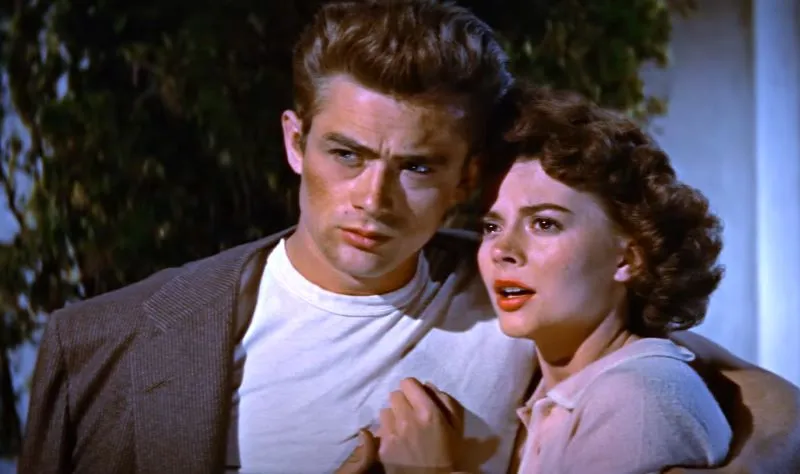
Jim’s parents, Frank (Jim Backus) and Carol (Ann Doran), arrive with his grandmother. They argue in front of everyone. Jim cannot stand his father’s timidity or the way his mother and grandmother run the house. The family has moved before because of Jim’s trouble, and it is about to happen again.
Jim explodes in front of the juvenile officer, Ray Fremick (Edward Platt), who treats him with a patience no one at home seems able to manage. That small kindness matters later.
Act Two: Dawson High and the Observatory
The next morning, on his way to his first day at Dawson High, Jim meets Judy again. She lives nearby. He offers her a ride, and she turns him down coolly. Her “friends” pick her up instead: a gang led by Buzz Gunderson (Corey Allen), who is also her boyfriend.
At school, Jim is ignored or mocked. Only Plato talks to him, and he quickly attaches himself to Jim with the intensity of someone who has never had a friend.
The class takes a field trip to Griffith Observatory. In the planetarium, a lecturer describes the end of the world, the sun swelling and the Earth vanishing without being missed. His closing line is that man alone seems an episode of little consequence. The gang laughs. Jim tries to join in and gets frozen out.
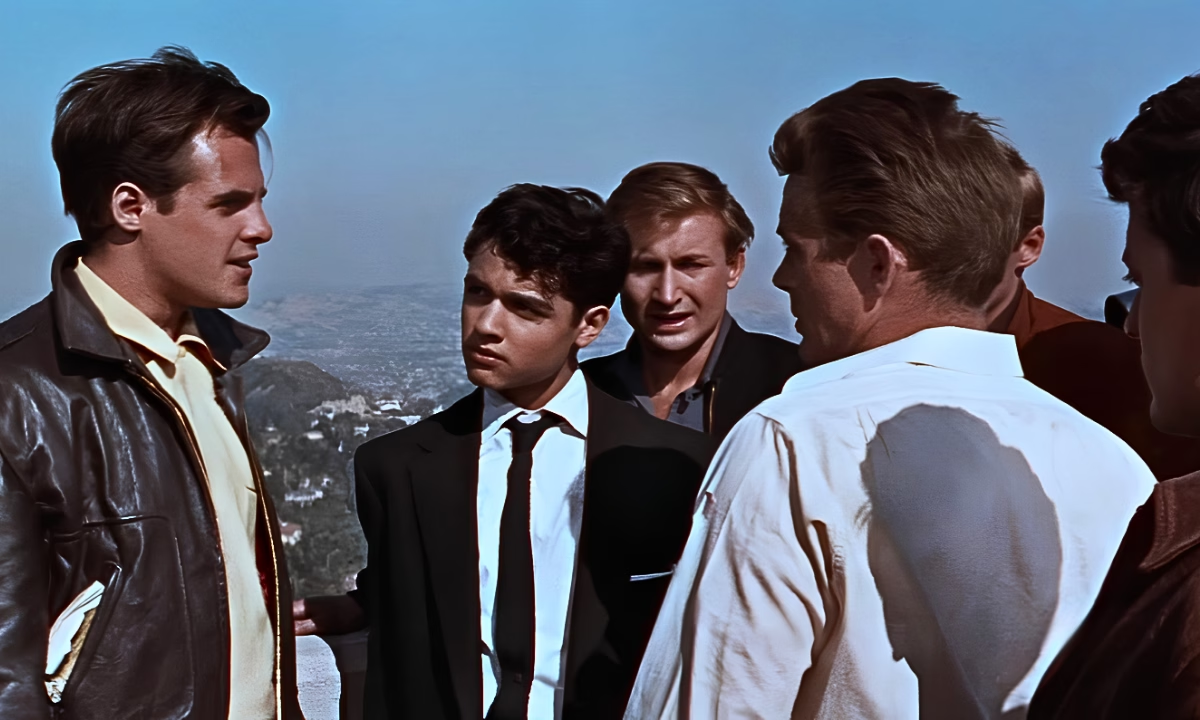
Outside, Buzz slashes Jim’s tire and challenges him with a switchblade. The gang calls Jim “chicken,” the one word he cannot bear. Jim fights, knocks Buzz’s knife away and throws his own blade aside. To save face as leader, Buzz proposes something worse: a “chickie run” that night. They will drive stolen cars toward a seaside cliff, and the first one to jump out is the chicken.
Act Three: The Chickie Run
Back home, Jim tries to ask his father a real question. What do you do when you have to defend your honor in a dangerous situation? Frank, wearing an apron, gives him nothing useful. He talks around the question and advises against confrontation of any kind.
At Judy’s house, a quieter cruelty plays out. At dinner she kisses her father on the cheek and he recoils, telling her she is too old for that kind of thing. She leaves.
At the cliff that night, Buzz and Jim talk privately before the race. Buzz admits he likes Jim. Jim asks why they are doing this at all. Buzz’s answer is the bleakest line in the film: you have to do something.
Judy signals the start. The cars race toward the edge. Jim rolls out. The strap on Buzz’s jacket sleeve catches on the door handle, and he goes over the cliff with the car. The gang scatters as police sirens approach, abandoning Judy. Jim persuades her to leave with him and Plato.
Act Four: The Night of No Help
Jim tells his parents what happened and says he wants to go to the police. This is the moral center of the film. The supposed delinquent wants to confess. His parents want him to keep quiet. Carol announces they will move again. Jim begs his father to stand up for him, just once. When Frank stays silent, Jim attacks him, then kicks through a portrait of his mother on the way out.
He goes to the police station hoping to find Officer Fremick and confess. The desk sergeant turns him away. The one adult who showed him patience is out of reach when it counts.
Three of Buzz’s gang see Jim leaving the station and assume he has betrayed them. They corner Plato, steal his address book to find Jim, and go hunting. Plato takes his mother’s gun and goes to warn Jim.
Jim drives home and finds Judy waiting. She apologizes for how she treated him in front of the gang. They talk openly for the first time and fall in love. Neither wants to go home. Jim remembers that Plato told him about an empty mansion near the observatory.
Act Five: The Mansion
Plato finds them there. For a short, lovely stretch, the three play house in the empty mansion. Plato acts like a real estate agent showing a young couple around. Jim does a voice like the cartoon character Mr. Magoo, which happens to be the character Jim Backus voiced in real life.
The three of them form what amounts to a family: Jim and Judy as parents, Plato as their child. Judy hums Brahms’ Lullaby while Plato falls asleep at their feet.
Jim and Judy wander off through the house on their own and share their first kiss. While they are gone, the gang arrives and wakes Plato. Terrified, he shoots and wounds one of them. When Jim comes back and tries to calm him, Plato feels abandoned by the one person he trusted. He accuses Jim of leaving him, like everyone else, and runs.
Act Six: The Planetarium Ending
Plato breaks into the observatory and barricades himself inside. Police surround the building. Jim’s parents and Officer Fremick arrive, having searched for Jim all night.
Jim and Judy go in after Plato. In the dark planetarium, Jim persuades him to trade the gun for Jim’s red jacket. Jim secretly removes the bullets and hands the gun back, then talks Plato into coming outside. When floodlights hit him, Plato panics and runs toward the police with the gun in his hand. An officer shoots him dead. Jim’s cry that he has the bullets comes too late.
Jim breaks down over Plato’s body. Frank comforts his grieving son and promises to be a better father. Jim, reconciled with his parents, introduces them to Judy, and the film ends.
Rebel Without a Cause Ending Explained
The ending gives Jim the thing he asked for all film: a father who stands up. The price is Plato. That trade is the point. Plato is the boy with no parent at all, and the system that might have saved him (police, school, home) only notices him when he holds a gun. Jim survives because two adults finally act. Plato dies because none did. I read the final reconciliation not as a happy ending but as a bill paid by the most vulnerable person in the story.
Critical Analysis: Does Rebel Without a Cause Still Hold Up?
Rebel Without a Cause holds up as an image and as a feeling, and it holds up less well as an argument. I think both halves of that sentence are true at once.
What still works. Ray was a director of space and color. He shot a film about kids who feel boxed in using the widest frame Hollywood had. Characters are often split by doorways, stairs and furniture inside that long rectangle. Jim’s red jacket stands out against grey police stations and beige living rooms like a flare. Even the observatory, a monument to science and order, becomes the place where order fails.
The Griffith Observatory itself notes that this was the first time a planetarium theater was used in a film.
The structure is also smarter than it looks. Squeezing everything into roughly a day gives the film a fever logic. Teenagers do not experience time in calm weekly installments. One terrible night can feel like a whole life, and the film moves that way.
What has dated. The adults are cartoons, and the cartoon has a political shape. Frank Stark is weak because he wears an apron, and the women in his house are the problem. Ebert pointed out that this fit a popular 1940s and 1950s argument, Philip Wylie’s attack on what he called “Momism.”
Watching now, I find the apron scene more revealing about 1955 anxieties than about Jim. The film blames a mother for a father’s failure, and it never asks Carol Stark what her life is like.
The script also announces its themes too often. Characters explain their feelings to police officers in complete paragraphs. When Rebel Without a Cause trusts images, it soars. When it trusts dialogue, it can sound like a public service film.
What critics said then, and now. Reviews in 1955 were genuinely split. William Zinsser of the New York Herald Tribune hated it, writing that the film runs two hours, “but it seems more like two days.” Bosley Crowther of The New York Times called it violent and disturbing, and he thought Dean was copying Brando. On the other side, Jack Moffitt of The Hollywood Reporter praised the acting and direction while objecting that the film trusted professionals more than families. Variety’s Robert J. Landry found Dean very effective and largely free of Brando mannerisms.
Modern opinion is warmer but not blind. Ebert placed it among his Great Movies in 2005 yet admitted it has not aged well, arguing that its confusion is exactly what makes it fascinating. Empire’s review calls it the best-directed film in the teen-movie genre. On aggregators, Wikipedia reports a 91% Rotten Tomatoes score from 85 reviews and a Metacritic score of 89; these numbers change over time, so check the live sites if you need the current figure.
My view sits between Zinsser and Empire. It is not turgid. It is overwrought, and the overwrought parts are where the truth leaks out.
Acting Performances: Who Gives the Best Performance in Rebel Without a Cause?
James Dean gives the defining performance, but Sal Mineo gives the most heartbreaking one.
James Dean as Jim Stark. Dean was 24 when he died, playing a 17-year-old.
He acts with his whole body: sprawled in the street with a toy monkey in the opening, coiled and twitching in the police station, slumped against doorframes at home. Ray reportedly gave him free rein to improvise, and it shows. Some gestures feel borrowed from acting class, and Ebert compared him unkindly to “marked-down Brando.”
I disagree. Brando’s rebels push outward. Dean’s Jim collapses inward. That difference is the reason teenagers saw themselves in him.
Natalie Wood as Judy. Wood had to make the jump from child actor to adult roles, and she does it with real nerve. Judy begins as a sneer and ends as the steadiest person in the film. The dinner-table scene with her father is quietly devastating. She earned an Oscar nomination and won the Golden Globe for Most Promising Newcomer.
Sal Mineo as Plato. Mineo was a 16-year-old newcomer, according to Filmsite, and he plays Plato with an openness that still stings. Every look at Jim is hungry. His Oscar nomination was deserved.
Jim Backus as Frank Stark. Backus has the hardest job: play a weak man without making him a joke. He does not always succeed, because the script keeps pushing him toward humiliation. Still, his face in the final scene, finally reaching for his son, lands.
Supporting players. Corey Allen makes Buzz more than a bully; his brief admission that he likes Jim is the most human moment of the cliff sequence. Edward Platt’s Fremick is the film’s model adult. A young Dennis Hopper appears in his film debut as one of the gang.
The chemistry among the three leads is the film’s engine. The mansion scene works because all three actors are playing children pretending to be adults, and you can see both layers at once.
Themes and Messages: What Is Rebel Without a Cause Really About?
Rebel Without a Cause is about absent and frightened parents far more than it is about rebellious kids. The teenagers are not rejecting the adult world. They are begging to be let into it.
The Title Is a Misdirection
Here is the angle I rarely see discussed. Lindner’s 1944 book described a psychopath as a person who rebels with no goal beyond his own impulses. The film uses Lindner’s title, then bears no relation to his case history. Jim Stark is the opposite of a psychopath. He feels too much guilt, not too little. He wants to confess. He wants rules. His “cause” is simple: a father who acts like one.
Even more interesting, Lindner himself had moved in a direction close to Ray’s by the 1950s. In Prescription for Rebellion (1952), he attacked psychotherapy for encouraging patients to adjust instead of rebel. His last book, Must You Conform?, included a chapter called “The mutiny of the young”.
Lindner died on February 27, 1956, at 41, only four months after the film opened. Sources disagree on whether Must You Conform? appeared just before or just after his death, so I cannot confirm the exact date.
Either way, the man whose title the film borrowed ended up arguing that rebellion against a conforming society can be healthy. The film and the author arrived at roughly the same place from opposite doors.
Masculinity as a Trap
“What can you do when you have to be a man?” Jim asks his father. The film offers two bad answers. Buzz’s answer is to risk death for status. Frank’s answer is to avoid conflict at any cost. Jim is stuck between a cliff and an apron. The film’s own answer, standing up for someone else, arrives only in the last scene.
The Chosen Family
The mansion sequence is the film’s real heart. Three kids rebuild the family they lack, with a gentleness none of their actual homes show. That is why Plato’s death hurts so much. He loses the only home that ever worked for him, and he loses it within hours.
Plato and the Unspoken
Sal Mineo later said Plato was meant to be gay. In a 1972 interview, he described Plato as, in a way, the first gay teenager in films, and suggested the character had to die partly because of it.
The Production Code would not allow this to be stated, so it lives in glances and, as Ebert noticed, a caressing hand on Jim’s shoulder in the planetarium. Watching today, the subtext is hard to miss, and it makes Plato’s isolation even more painful.
Cosmic Smallness
The planetarium lecture about the end of the world is not decoration. It tells the kids, in the coldest possible voice, that their lives do not matter. The rest of the film is their answer: they matter to each other. That is a surprisingly existential idea for a Warner Bros. teen picture.
Comparison: How Does Rebel Without a Cause Compare to Similar Films?
Rebel Without a Cause stands apart from other 1950s youth films because it moved delinquency out of the slums and into the suburbs.
The Wild One (1953). Marlon Brando’s biker film popularized juvenile delinquency on screen, but its rebel is a menace from outside. Jim Stark is the kid next door. Ebert grouped Brando, Dean and Elvis as the three figures who changed how young men could appear in popular culture.
Blackboard Jungle (1955). Released the same year, it tackled delinquency in an urban school and touched on race. The BFI notes that the two films together are among the earliest examples of the teen film. Blackboard Jungle is a teacher’s story. Rebel is the kids’ story.
East of Eden (1955). Dean’s other 1955 film, directed by Elia Kazan, also centers on a son desperate for a father’s approval. Eden is more literary. Rebel is more contemporary and more raw.
Nicholas Ray’s own work. They Live by Night (1948) and In a Lonely Place (1950) show Ray’s long interest in outsiders. His next film, Bigger Than Life (1956), turns the camera on a suburban father who breaks down, a portrait of the American dream gone wrong. Seen together, Rebel and Bigger Than Life read like two halves of one argument about the 1950s family.
Where Rebel falls short of its peers is subtlety. Kazan’s film gives its parents more inner life. Where it beats them is mood. No other 1950s youth picture looks or feels this lonely.
The influence ran long. The creators of The O.C. have said the film was a big reference for an early episode, and La La Land (2016) nods to its ending.
Audience Appeal, Reception and Awards
Rebel Without a Cause appealed instantly to teenagers and worked at the box office. It grossed $7,197,000 worldwide, Warner Bros.’ second-biggest hit of that year, against a budget of roughly $1.5 million.
Is it for casual viewers or cinephiles? Both, with a caveat. Casual viewers will connect with Dean and the emotional story, though the dated dialogue may make some scenes feel stiff. Cinephiles will get more from Ray’s framing, color and the film’s place in the history of the teen movie.
Censorship. The film’s violence frightened censors abroad. Britain released it with cuts and an X rating, and most of the knife fight stayed off British screens until 1967. New Zealand’s chief censor banned it in 1955, and Spain kept it out until 1964, according to Wikipedia’s censorship summary. If film bans interest you, Sopranu’s 30 Legendary Banned Movies, Real Bans vs Myths checks how often such stories hold up.
Awards and honors:
- Academy Award nominations: Best Supporting Actor (Sal Mineo), Best Supporting Actress (Natalie Wood), Best Motion Picture Story (Nicholas Ray). No wins.
- Golden Globe: Most Promising Newcomer, Female (Natalie Wood), won.
- BAFTA nominations: Best Film; Best Foreign Actor (James Dean).
- National Film Registry, Library of Congress, 1990.
- AFI’s 100 Years… 100 Movies (1998): #59. “You’re tearing me apart!” was nominated for AFI’s 100 Movie Quotes list.
All of the above are listed on the film’s Wikipedia awards table. Dean was nominated for an Oscar after his death, but for East of Eden, not for this film.
The legend grew from tragedy. Dean died at 24 before the release. Sal Mineo was stabbed to death at 37, and Natalie Wood drowned at 43, as Britannica notes. The Griffith Observatory now has a bust of Dean on its lawn. Sculptor Kenneth Kendall, whom Dean had asked for a portrait, began work on it the night Dean was killed.
One uncomfortable piece of production history deserves mention. A 2005 book by Lawrence Frascella and Al Weisel reports that 43-year-old Nicholas Ray had a relationship with the 16-year-old Natalie Wood during the production, as summarized by Filmsite. I cannot independently verify every detail of that account, but it is documented in a published history, and it changes how I watch a film that is so concerned with adults failing young people.
Personal Reflection: What Rebel Without a Cause Teaches Us Today
The lesson of Rebel Without a Cause in 2026 is not “teenagers are wild.” It is that teenagers in pain usually tell adults what is wrong, and adults often fail to hear it.
Watch the film again with that in mind. Every one of the three kids says exactly what hurts, out loud, to an adult, in the opening police-station scenes. Judy says her father hates her. Plato’s silence on his birthday says enough. Jim says his family is tearing him apart. The film is not about kids who hide their problems. It is about kids whose problems are in plain sight.
That feels current. The CDC’s 2023 Youth Risk Behavior Survey found that 39.7% of U.S. high school students reported persistent feelings of sadness or hopelessness. Among girls, the figure was 52.6%. These are not dramatic delinquents. They are ordinary students in ordinary schools, a lot like the kids Ray wanted to film.
The same CDC report contains the line I keep thinking about.
Students who reported high parental monitoring, meaning their parents usually knew where they were and who they were with, had lower prevalence of sadness and suicide risk indicators, with adjusted ratios between 0.51 and 0.74. So did students who felt connected to their school. The authors are careful to say the data are cross-sectional, so they cannot prove cause and effect. Still, the pattern lines up with the film.
Frank Stark does not know where his son goes at night. Neither do Judy’s parents. Plato’s mother is almost never home.
Now look at the adults’ side. In August 2024, the U.S. Surgeon General issued an advisory on parental stress, reporting that 48% of parents said most days their stress is completely overwhelming, compared with 26% of other adults. That number made me more sympathetic to Frank Stark than I was before. He is not evil. He is a frightened, overwhelmed man who has learned that avoiding conflict is the safest way through a day. The film’s mistake is blaming his wife. Its real point is that his avoidance has a cost, and his son pays it.
Officer Fremick offers a second lesson.
He is the only adult who listens without judging, and his single act of attention keeps Jim afloat. Then, at the exact moment Jim needs him, he is out of reach. Many teenagers today know that feeling: the school counselor with a waiting list, the helpline that rings out, the teacher who cared but moved on. One kind adult is not a system.
I also think the chickie run reads differently now. Buzz does not want to die. He tells Jim he likes him. He races because “you got to do something,” because status in his group demands it. Swap the cliff for a dangerous online challenge or a reckless stunt filmed for followers, and the logic is unchanged. The audience is bigger. The pressure is the same.
So what can you actually do with this film?
If you are a parent, here is one practical idea: watch it with your teenager and stop at the scene where Jim asks his father how to handle a dangerous situation. Ask what Frank should have said. You will learn more from that answer than from a dozen lectures.
If you are a teacher, pair the film with the CDC’s protective-factors findings and let students argue about whether the film is fair to the parents. If you are simply a viewer, notice how often the kids ask for help and how rarely anyone answers.
Lindner, in his last years, wrote about a coming “mutiny of the young.” He was right that young people would rebel. Rebel Without a Cause suggests a gentler reading. Most kids are not mutineers. They are passengers waiting for someone to take the wheel.
Memorable Quotes From Rebel Without a Cause
These are brief lines from the film, quoted for review and commentary. Since this is a film rather than a series, I note the scene instead of an episode number.
- “You’re tearing me apart!” Jim to his parents at the police station. It was nominated for AFI’s 100 Movie Quotes list.
- “What can you do when you have to be a man?” Jim to his father, the night of the chickie run.
- “Who lives?” Judy’s reply when Jim asks if she lives nearby, an early sign of her despair.
- “Since I got to be 16?” Judy to her father at dinner, after he rejects her kiss.
- “Why do we do this?” / “You got to do something.” Jim and Buzz at the cliff, minutes before the race.
- “I got the bullets!” Jim’s cry in the final scene, too late to save Plato.
Dialogue for these lines was checked against Roger Ebert’s Great Movies essay and the film’s Wikipedia entry. I have kept them short on purpose; the full scenes are worth hearing in context.
Pros and Cons of Rebel Without a Cause
| Pros | Cons |
|---|---|
| James Dean’s physical, vulnerable performance | Adults are drawn as broad caricatures |
| Sal Mineo’s heartbreaking Plato | Blames a domineering mother for a father’s weakness |
| Bold CinemaScope framing and striking color | Some dialogue explains feelings too directly |
| Tight one-day structure that feels feverish | Censorship era forced key themes into subtext |
| The mansion “chosen family” sequence | The ending’s family reunion feels too neat |
| Still useful for talking about teen mental health | Production history includes a troubling adult relationship with a minor |
Frequently Asked Questions
Is Rebel Without a Cause based on a true story?
No. The title comes from Robert Lindner’s 1944 case study of a real prison inmate, but the film’s story was written by Nicholas Ray and developed by Irving Shulman and Stewart Stern. It bears no relation to Lindner’s case history.
How old was James Dean in Rebel Without a Cause?
Dean was born on February 8, 1931, so he was 24 during filming in spring 1955. He died on September 30, 1955, at 24, before the film opened.
Did Rebel Without a Cause win any Oscars?
No. It received three nominations: Sal Mineo, Natalie Wood and Nicholas Ray’s original story. None won.
Why does Plato die at the end?
Police shoot Plato because they see him run toward them holding a gun. They do not know Jim has removed the bullets. Thematically, his death shows the cost of a boy having no adult at all.
Where was Rebel Without a Cause filmed?
Key scenes were shot at Griffith Observatory in Los Angeles. Dawson High was really Santa Monica High School, and the mansion exteriors used the William O. Jenkins House, which also appeared in Sunset Boulevard.
Was Plato gay?
The film could not say so under the Production Code, but Sal Mineo said in 1972 that Plato was meant to be gay, and many critics, including Ebert, read the character that way.
Conclusion: Is Rebel Without a Cause Worth Watching?
Yes, Rebel Without a Cause is worth watching, and it rewards a second look more than a first. It is a flawed classic. The parents are stereotypes, the gender politics belong to 1955, and the dialogue sometimes lectures. Yet the film’s core observation is sharper now than when it opened: kids in trouble usually say so, and the adults around them are too scared, tired or distracted to answer.
My recommendation is simple. Watch it for Dean and Mineo, for Ray’s color and framing, and for the mansion scene. Then watch it again as a parent, a teacher or a former teenager, and count how many times someone asks for help.
If you want to keep going, Sopranu has an earlier take on the film, Rebel Without a Cause 1955 and the Teenage Rebellion of Emerging American Society, and it sits at #27 in Sopranu’s 101 Best Films You Need to See.
For another 1955 classic about children failed by adults, read Sopranu on The Night of the Hunter (1955). If the psychology side of the story interests you, the 100 Best Psychology Books of All Time list is a good next step.
Recommendation for Potential Viewers
Parents of teenagers, teachers, film students and anyone interested in 1950s American culture will benefit most. It is suitable for general audiences aged roughly 13 and up; the violence is brief but includes a knife fight, a fatal car crash and a police shooting. Specialists will find extra depth in its widescreen technique, its censorship history and its Lindner backstory.
Rebel Without a Cause
Director: Nicholas Ray
Date Created: 1970-01-01 00:32
4







