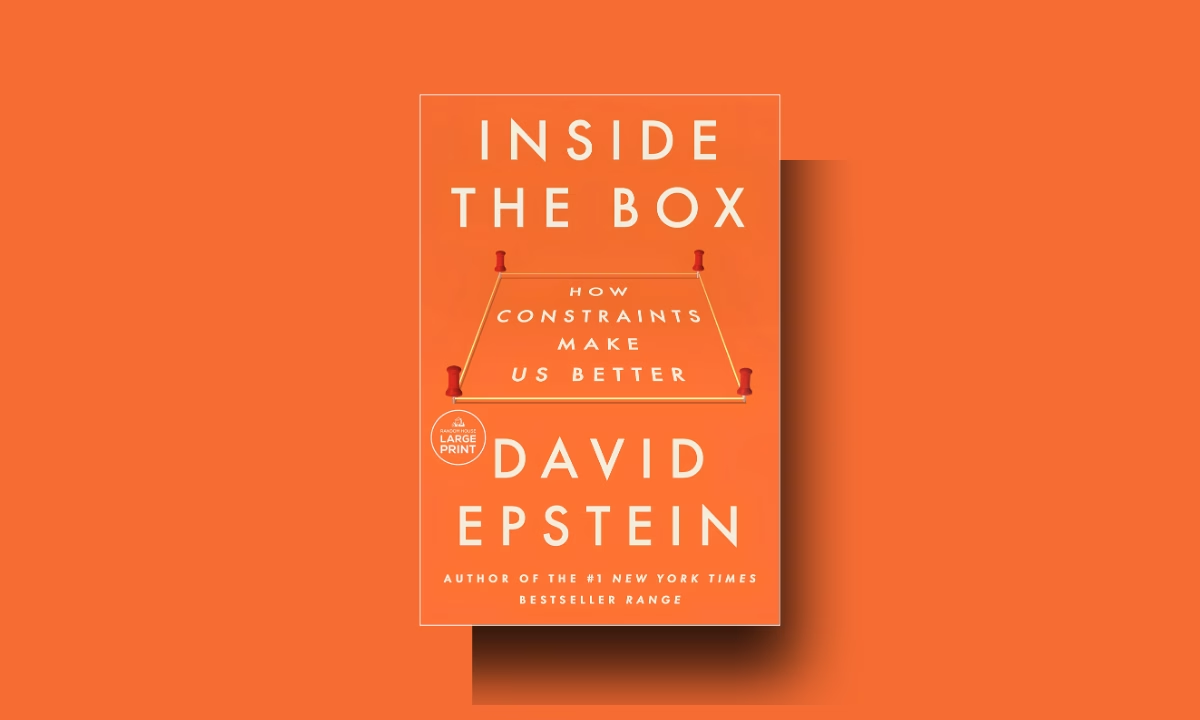

Does more freedom really make you more creative? Inside the Box, David Epstein’s 2026 follow-up to Range, says no, and this Inside the Box summary will show you exactly why he thinks so.
Epstein argues that limits (a tight deadline, a wrong piano, a fifty-word bet, a broken arm) push people off the easy, familiar path and into genuinely new work. I found the book smart, readable, and more useful than most productivity titles I have read in years.
I also found it guilty of the same habit it warns against: once Epstein falls in love with his idea, he hangs it on almost everything. Here is the complete summary, the practical rules you can take from it, and an honest account of where the argument is strong and where it bends.
Table of Contents
Brief summary of Inside the Box
The short summary of Inside the Box is that the right constraints improve creativity, learning, focus, teamwork, and happiness, while unlimited freedom tends to produce sprawl, conformity, false results, distraction, and dissatisfaction. If you only have two minutes, these are the rules I took from it:
Constrain the problem, not the solution. Pixar and This American Life told creators what was not working and let them figure out the fix.
Think slow, act fast. Test small and cheap before you scale, as Pixar did for twenty years before Toy Story.
Write down your hypotheses before you begin. It stops you from rewriting history after the fact.
Block the easy path. Freedom sends the brain toward what it already knows.
Preclude, then promote. Ban one familiar method and name a specific replacement.
Anchor the new in the familiar. Radical ideas travel on old, trusted forms.
Design for the most constrained user. What works for them usually works better for everyone.
Find your one bottleneck and widen it. Improving anything else is wasted effort.
Do one thing at a time. Attention is a hard limit, not a soft preference.
Make the rules clear and equal for everyone. Strangers cooperate when rules are predictable.
State problems sharply. Breakthroughs follow well-framed questions.
Satisfice. “Good enough” choosing leaves room for a happier life.
Who will actually love Inside the Box, and who should skip it?
You will love Inside the Box if you are the kind of reader who finished Range and wondered what to do with all that breadth, or if you run teams, teach, coach, write, design, or build products and keep watching good ideas drown in scope.
It is also a strong pick for anyone who feels paralyzed by options in work or life, because the closing chapter on satisficing reads like a permission slip. Readers who like Malcolm Gladwell’s storytelling but want more careful sourcing will feel at home.
You may bounce if you want a workbook with exercises, since the method lives inside the stories and you have to pull it out yourself (I did some of that work for you below). Specialists in creativity research or behavioral economics will recognize most of the science. And if you came for a hard-nosed debate with skeptics, you will find the skeptics mostly offstage.
What is Inside the Box by David Epstein, and who wrote it?
Inside the Box: How Constraints Make Us Better is a 2026 nonfiction book by David Epstein, published by Riverhead Books on May 5, 2026 in a 304-page hardcover (ISBN 9780593715710), with an ebook, audiobook, and large-print edition.
It is built in four parts (boundaries and breakthroughs, creative constraints, focus, and collaboration and contentment), each with three chapters and a short interlude about the chemist Dmitri Mendeleev.
Genre and context. It is popular science crossed with idea-driven narrative journalism, the same blend Epstein used in The Sports Gene (2013) and Range (2019).
According to Penguin Random House, Range was a #1 New York Times bestseller; Epstein was a senior writer at Sports Illustrated and an investigative reporter at ProPublica, and he holds master’s degrees in environmental science and journalism. His Wikipedia page adds that, with Selena Roberts, he broke the 2009 story that Alex Rodriguez had tested positive for steroids.
That investigative streak shows. Epstein notes that most spoken quotes in the book come from his own interviews, with people including Pixar cofounder Ed Catmull, iPod and Nest creator Tony Fadell, concert promoter Vera Brandes, novelist Isabel Allende, attention researcher Gloria Mark, and psychologist Jonathan Haidt.
Main argument. Epstein’s thesis, borrowed from Herbert Simon’s epigraph, is that the belief that people are most creative when most free is a myth.
He puts it in his own words in the introduction: “Too often, we reach for a dream when what we need is a textbook.” Constraints, he argues, can be “tools for creativity, collaboration, and contentment,” whether we choose them or they are forced on us.
Inside the Box Background
The book grew partly from a question Range left open (I covered that book in my Range summary): if broad experience is an advantage, how do you turn breadth into finished work? Epstein says there is “a hefty dose of ‘mesearch'” here.
A summer on a seismic research ship taught him to exercise in almost no space. A beginner’s fiction class that banned dialogue showed him he was leaning on quotes he did not fully understand.
And, as he admits in the final chapter, he spent about a decade optimizing his freelance life for total autonomy, then discovered it had left him isolated.
There is also a wider cultural background. Epstein cites an economist’s estimate that modern consumers face roughly one hundred million times more choices than people in preindustrial societies, against a wealth gap of about four hundred times.
He cites a 2023 Harvard Graduate School of Education report in which about three in five young adults said they lacked “meaning or purpose.”
And he reminds readers that Atul Gawande found 64 percent of people say they would want to choose their own cancer treatment, while only 12 percent of newly diagnosed patients actually do. We crave choice in theory. We often regret it in practice.
Inside the Box Summary
Introduction: Why does the Mendeleev story matter so much?
The introduction matters because it is the whole book in miniature. The legend says Mendeleev dreamed the periodic table in February 1869.
The truth, drawn from historian Michael Gordin and others, is that he was racing to finish a chemistry textbook, had used up a full volume on just eight of sixty-three elements, and needed a way to treat elements in families. The corrections and crossings-out on his surviving draft (reproduced in the book) make the point visually. “He was boxed in by a book contract, and that made all the difference,” Epstein writes.
What Mendeleev needed, in the book’s phrasing, was “the right box in which to work,” which is the cleanest statement of the thesis anywhere in these pages.
Chapter 1: Why did General Magic fail with so much talent?
General Magic failed because it had too much of everything and almost no limits. Founded by Apple legends, it drew sixteen global partners, hired brilliant engineers, and went public in 1995 with no revenue.
Former engineer Megan Smith, later US chief technology officer, nailed the problem: “Probably the most challenging part of the product was deciding what not to do.” General counsel Michael Stern told Epstein: “We had too much money.”
Epstein adds Leidy Klotz’s experiments (people add Lego bricks to fix a structure when removing one would work) and Bent Flyvbjerg’s finding that only 8.5 percent of 16,000 big projects came in on time and on budget.
The company’s own history ends with a shutdown announced in 2002.
Chapter 2: How did Pixar and the iPod succeed where General Magic didn’t?
They succeeded by shrinking giant goals into small, testable steps with hard boundaries. Ed Catmull calculated in 1980 that a computer-animated film would need $1 billion in Cray supercomputers, so his team worked on intermediate problems for years.
At Pixar he fought “the beautifully shaded penny,” his producers’ name for artists perfecting details no audience would notice; on The Incredibles, popsicle sticks on a wall (each worth one animator-week) forced the director to trade effort between characters.
On This American Life, Epstein learned the same lesson personally: “We were given clear problem boundaries, not solutions.” Tony Fadell, who watched General Magic implode, imposed a Christmas deadline on the first iPod and later said of constraints: “It slows you down, but it forces that thinking.”
Herbert Simon’s lab work shows why: good problem solvers select “a very small part of the total problem-solving maze.”
Chapter 3: Why does too much freedom produce bad science?
Too much freedom produces bad science because researchers who can slice data any way they like will always find something by chance.
Large US heart trials went from mostly positive to mostly null after 2000, once outcomes had to be declared in advance on clinicaltrials.gov. Brian Wansink’s career collapsed after he described data-dredging in a blog post; the Cornell Daily Sun reported his resignation in September 2018 after a misconduct investigation.
Epstein includes the satirical study “proving” that a Beatles song made students younger, and Galen’s legendary circular claim that his remedy cured everyone “except those whom it does not help, who all die.”
The business version: in a study of 116 Italian startups, founders trained to test written hypotheses pivoted more and earned more. Fadell’s verdict on General Magic: “Nothing was ever written down.”
Interlude 1: Why do our brains default to familiar ideas?
Our brains default to the familiar because, as psychologists put it, humans are “cognitive misers.” Mendeleev’s first draft listed elements alphabetically because that was easy. Only when space ran out did he try valence, then families, then the periodic pattern.
Chapter 4: What is the Green Eggs and Ham effect?
The Green Eggs and Ham effect is psychologist Catrinel Tromp’s name for the finding that working within constraints can produce more creative output. Dr. Seuss wrote the book on a fifty-word bet, and earlier wrote The Cat in the Hat from a list of 225 words, which he compared to “trying to make a strudel without any strudels.”
The chapter’s centerpiece is Keith Jarrett’s 1975 Cologne concert on a small, broken piano, which became the best-selling solo piano album, per Wikipedia around four million copies. Inventor Simone Giertz explains her idea dice: with an open field, “I won’t come up with any new ideas.”
Bach’s Art of Fugue stacks rule on rule until the final fugue spells his own name. The Oulipo writers, one of whom wrote a novel without the letter “e,” called themselves “rats who construct the labyrinth from which they plan to escape.”
Robert Frost compared free verse to “playing tennis without a net.”
Chapter 5: How do you create something truly new with constraints?
You create something truly new by first banning a familiar method and then committing to a specific replacement, which psychologist Patricia Stokes calls “paired constraints.”
Stokes saw it first in art school and advertising, where the saying goes, “Give me the freedom of a tight brief.” Monet dropped black. Picasso said restraint “liberates invention.”
Woolf wrote at the top of her Jacob’s Room notebook in April 1920, “I think the main point is that it should be free,” then spent the draft crossing out every conventional plot device. John Cage invented the prepared piano because percussion would not fit the venue.
Stan Lee’s comics became Marvel after a distribution deal cut Atlas to eight titles a month. A study of almost thirty thousand NBA games found teams passed more and won more after a temporarily injured star returned.
Chapter 6: Why do the most original ideas borrow from old ones?
The most original ideas borrow because audiences need something familiar to hold onto. Martin Luther King Jr. drew sermon structures, anecdotes, and lines from fellow preachers; scholar Keith Miller concluded that King’s language “impressed whites not in spite of his borrowing but because of it.”
Shakespeare adapted Romeo and Juliet and King Lear from earlier versions. Edison dressed electric light in the look of gas lighting. Darwin opened On the Origin of Species with the familiar variation produced by breeding plants, dogs, birds, and livestock before reaching his radical claim.
At UPS, the ORION algorithm only took hold once it bent to drivers’ knowledge; Jack Levis’s line is that an unused algorithm “is worth zero,” and that the algorithm “turned out to be the easy part.” George Lucas, denied the Flash Gordon rights, built Star Wars instead.
Interlude 2: Why did teaching help Mendeleev?
Teaching helped because beginners need a logical structure. Mendeleev wrote for new St. Petersburg students, many of them poor, who reached university as Russia’s Great Reforms of the 1860s opened higher education, and the classroom forced him to find order. Psychologists call the related learning boost the “protégé effect.”
Chapter 7: What can body armor teach us about design?
Body armor teaches that designing for the most constrained user improves the product for everyone. A tall infantryman got stuck in a hatch during 2017 testing; one Army officer told Epstein, “We made soldiers into turtles.”
The redesigned Modular Scalable Vest added sizes built on female soldiers’ measurements, and about 20 percent of the close-combat force ended up fitting best in them.
Epstein recalls the 1940s Air Force discovery that a cockpit built for the “average” pilot fit essentially nobody, and runs through OXO peelers, curb cuts, accessible websites, the Gallaudet football huddle, and William Whyte’s redesign of Bryant Park. The chapter closes on working memory, the shared limit of every learner.
Chapter 8: What is the theory of constraints, and how does it apply to you?
The theory of constraints, created by physicist Eli Goldratt, says every system is limited by one bottleneck, so improvement should focus there. Goldratt’s line, “The sum of local optimums is not equal to the optimum of the whole,” explains why Apeel’s produce coating first struggled: one farmer joked, “The garbage can is a great customer of mine.”
Apeel succeeded by starting with retailers and building tools to measure how much shelf life each batch had left.
Swimmer Sheila Taormina used the theory in a college management course to find her own bottleneck and won Olympic relay gold in 1996. (Team USA calls her the first woman to qualify for the Olympics in three different sports; Epstein says “the only woman ever to do that,” a slightly stronger claim I could not confirm.)
The Broad Institute halved its open projects with a “pull” system and got more finished.
Chapter 9: Why is doing one thing at a time so powerful?
Doing one thing at a time is powerful because attention cannot really be split, only switched, and every switch costs time and accuracy. Isabel Allende starts every book on January 8 and protects her studio like a sanctuary: “I’m here to do this and nothing else and no one can interrupt.”
Gloria Mark’s studies show office workers switching tasks every three minutes in 2004 and about every forty-five seconds by 2022, and a study of nearly one million surgeries found worse outcomes when operations fell on the surgeon’s birthday. The bluesman Robert Johnson’s “deal with the devil” was really midnight practice in a silent cemetery with his teacher Ike Zimmerman.
Martin Luther King Jr. wrote his most famous letter in a solitary cell, asking what else one can do “when he is alone in a narrow jail cell.”
Interlude 3: Why did standard rules matter to the periodic table?
Standard rules mattered because, before 1860, chemists could not even agree what oxygen weighed relative to hydrogen. The Karlsruhe conference and Cannizzaro’s pamphlet created a common standard that let Mendeleev build on work from strangers.
Chapter 10: How do clear rules help strangers cooperate?
Clear rules help strangers cooperate because they make betrayal costly and trust rational. In Lusaka, female entrepreneurs avoided partnerships with men, except inside markets with objective “market chiefs” and near a small-claims court, where the gap disappeared.
Douglass North, 1993 Nobel laureate, argued that predictable institutions, not just technology, drive growth; his example was shipping productivity rising as piracy declined.
In Romania’s Udești commune, villages ruled by Austrian institutions for 144 years still trust strangers more than a neighboring village that stayed under Ottoman and Russian rule.
In a study of about seven hundred people, the smartest teams were the ones with roughly equal conversational turn-taking, and Wikipedia’s polarized editing teams wrote better articles because the site’s rules disciplined the fight.
Chapter 11: Are breakthroughs really made by lone geniuses?
No. Breakthroughs are usually multiple discoveries that arrive once a problem is clearly framed. Six people found the periodic pattern within a few years.
Newton and Leibniz both invented calculus; Darwin and Wallace both arrived at natural selection after reading Malthus. Einstein started from a precise puzzle about a magnet and a wire. Microbiologist Arturo Casadevall told Epstein, “Stating the problem is often the best catalyst” for solving it. In a 2019 experiment, people made curious by an “unsolved”
Houdini trick designed more creative tricks, which professional magicians confirmed. Mendel, too far ahead of his time, changed almost nothing for thirty-five years.
Chapter 12: Why is satisficing better than maximizing?
Satisficing is better because hunting for the best option costs time, energy, and happiness, and maximizers end up less satisfied with what they pick.
Herbert Simon called himself an “incorrigible satisficer,” wore one brand of socks, and wrote, “The best is enemy of the good.” Epstein links the rise of perfectionism, Durkheim’s idea of anomie, and Jonathan Haidt’s worries about digital childhood (Haidt told him, “It’s not healthy for anyone to have access to everything, everywhere, all the time”). The fix he proposes is obligation: chores for children, groups for adults, synchronized time.
He borrows Oliver Burkeman’s advice to “consolidate your caring,” shares how the Holocaust survivor and Olympian Ben Helfgott “pre-forgave” him for a book that never happened, and closes with Michelangelo carving David from a rejected slab.
How can you use Inside the Box in real life?
You can use the book by running what I call a constraint audit on one stuck project. These are the questions Epstein’s chapters suggest, in the order I would ask them:
| Question | Chapter it comes from | What it looks like in practice |
|---|---|---|
| What is the smallest version I can test this week? | 1 and 2 | A ten-week prototype, a one-page pilot, a single episode |
| What did I predict, in writing, before starting? | 3 | A decision rule, like Inkdome’s 60 percent threshold |
| Which familiar method will I ban? | 4 and 5 | No black paint, no dialogue, no slides |
| What will I do instead? | 5 | A named replacement, not “something new” |
| What familiar frame will my audience recognize? | 6 | A known story shape, a familiar format |
| Who is my most constrained user? | 7 | The beginner, the tired user, the small screen |
| Where is the bottleneck? | 8 | The one step everything waits on |
| What is the one task that makes today a good day? | 9 | One item at the top of the list |
| Are the rules of credit and conflict clear to everyone? | 10 | Written norms, written-first idea sharing |
| Can I state the problem in one sentence? | 11 | A question sharp enough to invite answers |
| What is good enough? | 12 | A standard you can actually meet |
Is Inside the Box a good book? My critical analysis
Inside the Box is a genuinely useful and often moving book, and I would put its chapters on Pixar, the Köln Concert, and Isabel Allende among the best popular nonfiction I have read about creative work. My reservation is about scale, not substance.
How strong is Epstein’s evidence?
It is stronger than most in the genre. The replication-crisis material is accurate; the 2015 Open Science Collaboration paper in Science is real and did find that most of the one hundred psychology studies it retested did not reproduce at full strength.
Epstein shows his work in the notes, flags contested claims (he calls Haidt’s thesis controversial), and, most admirably, debunks a beloved study himself.
The playground experiment in which children roam farther when there is a fence turned out, after he traced it, to be a student project nobody could ever find; he concluded the study “doesn’t exist.” I also appreciated his footnote admitting he once did “a bit of HARKing” himself as a graduate student.
But the argument leans on success stories, and success stories are easy to collect after the fact. Joanna Kavenna, reviewing it in The Spectator, called it “a bright, boisterous, entertaining polemic, teeming with provocations,” and then made the sharpest objection: some constraints are simply crushing (she lists censorship, poverty, and imprisonment), and the book has no control group.
Several of the best scenes also rest on memories recalled decades later, such as Vera Brandes describing a night from half a century ago. That does not make them false. It does make them stories rather than data.
Does Inside the Box fulfil its purpose?
Largely, yes. Epstein set out to show that we overvalue unlimited freedom and undervalue helpful limits, and on creativity and focus he makes the case convincingly. Kavenna asks whether anyone truly believes absolute freedom is required for creativity.
Epstein has a partial answer in his own introduction: an international survey of “creativity myths” found that majorities in every country studied believed “total freedom” boosts creativity. So the target is real.
The book is less complete on the harder question it raises, which is how to tell a generative constraint from a destructive one.
What I liked most
The storytelling is excellent. Epstein knows how to land a scene, whether it is a promoter leaning into Jarrett’s car or Robert Johnson practicing among the gravestones.
The cross-domain range is the point. Seeing body armor, haiku, and chicken coops obey the same logic is what makes the idea stick.
The honesty about limits of the idea. The footnote warning that over-specified tasks make creativity drop “precipitously” is exactly the caveat a lazier writer would cut.
It is built to change behavior. The habit I most want to steal is from chapter 9: one single priority at the top of each day’s list, so that finishing it means the day went well.
What did not work for me
One idea stretched across twelve chapters. On Goodreads, where it averages about 3.9 from roughly 2,900 ratings, repetition is the most common complaint, and I felt it in Part IV.
The final part drifts into memoir and self-help. A Daily Kos reviewer praised Epstein’s “real talent for explaining complicated subjects clearly” but felt the book “reads almost like a self-help tome” in its back half. Elizabeth Stice, in a positive review at Orange Blossom Ordinary, also singled out Part IV as the weakest.
No method for choosing limits. Naomi Schaefer Riley, in a review republished by AEI, noted that the book doesn’t answer the practical question of which options to give up. My audit table above is my own attempt to fill that gap.
A few small overstatements. The Taormina “only woman” line is one example. The claim that constraints explain Jarrett, Woolf, and Bach equally well is another; talent and timing do a lot of quiet work in those stories.
How does Inside the Box compare with similar books?
Range is the natural companion, and the contrast is instructive: Range tells you to wander widely, Inside the Box tells you to fence in what you found.
Oliver Burkeman’s Four Thousand Weeks, which Epstein names as his favorite self-improvement book, makes the emotional version of the argument through mortality. Barry Schwartz’s The Paradox of Choice (2004) covers the maximizer research in more depth. Leidy Klotz’s Subtract expands the Lego experiment into a full book.
Ed Catmull’s Creativity, Inc. is the primary source for the Pixar chapters, and Eli Goldratt’s The Goal, which Time named one of its 25 most influential business management books in 2011, is the original bottleneck story.
On attention, it pairs well with Cal Newport’s Digital Minimalism and Nir Eyal’s Indistractable. Epstein’s treatment of Haidt is fairer to the debate than Haidt’s own book, which I discussed in my Anxious Generation review.
And because Epstein corrects Matthew Walker’s use of the Mendeleev dream, it is worth rereading my Why We Sleep summary with that in mind.
Should you read Inside the Box? Conclusion
Yes, with a clear expectation. Inside the Box is for general readers rather than specialists, and it will help most if you are drowning in options, scope, notifications, or half-finished projects. Managers, founders, engineers, teachers, coaches, students, and creative workers will find at least three chapters worth rereading.
Readers who want proof that constraints always help will not find it, because they don’t, and Epstein, to his credit, never quite claims they do.
What I will keep is a single image: Mendeleev, not asleep and dreaming, but awake, behind on a deadline, crossing out one arrangement after another on a crowded draft. That picture is less romantic than the legend.
It is also far more useful, because it is something you and I can actually do.
Inside the Box
Does more freedom really make you more creative? Inside the Box, David Epstein's 2026 follow-up to Range, says no, and this Inside the Box summary will show you exactly why he thinks so.
URL: https://www.sopranu.com/inside-the-box-summary-david-epstein/
Author: David Epstein
4
Pros
- Wide range of examples. Bach, Pixar, body armor, UPS routes, Bashō and avocado coatings all show the same idea at work.
- Careful with evidence. He covers the replication crisis, admits he once did “a bit of HARKing” himself, and debunks the famous playground study he could have used.
- Tools you can use. Preclude and promote, write your hypotheses down first, “stop starting and start finishing,” one priority a day, little-mind breaks.
Cons
- No test for good versus bad constraints. He admits some limits do harm but never turns that into a rule.
- Repetitive. The same point comes back chapter after chapter, the most common complaint on Goodreads.
- Part IV drifts. The jump from Lusaka market chiefs into memoir and self-help is the book’s weakest stretch.
- Small overstatements. One example is calling Sheila Taormina “the only woman” to compete in three Olympic sports. Team USA says she was the first woman to qualify in three.