
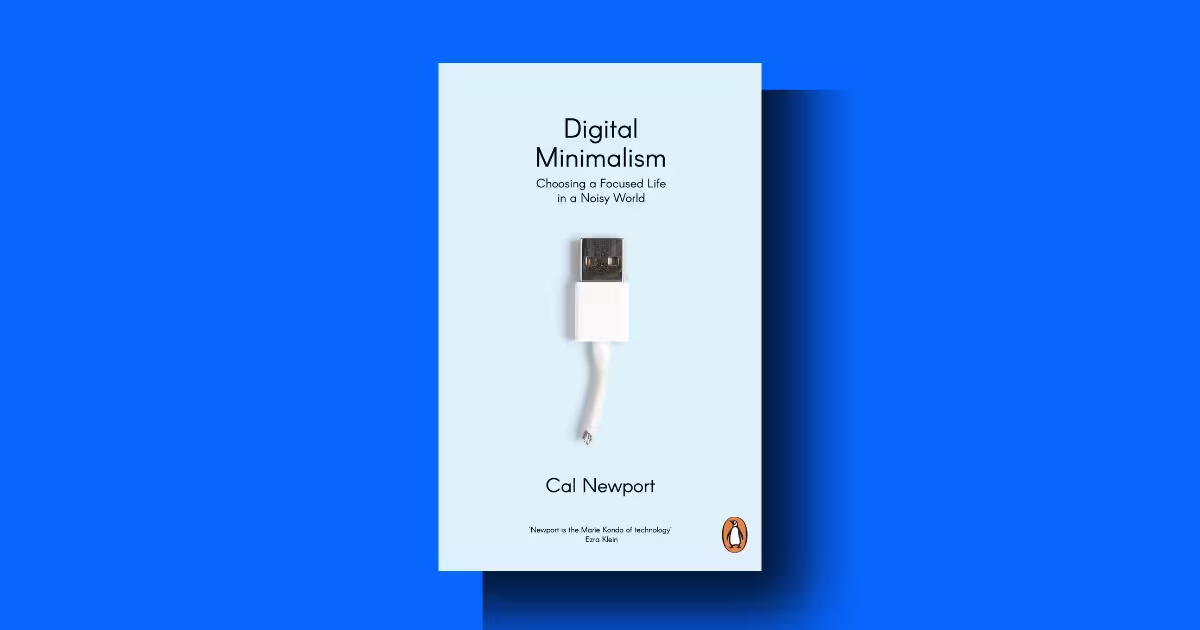
Do you ever feel like your smartphone is running your life instead of the other way around? In Digital Minimalism, Cal Newport investigates how the attention economy turned our devices into slot machines—and provides a practical, science-backed way to reclaim your autonomy.”
Digital Minimalism by Cal Newport argues that we didn’t sign up for the digital lives we now lead—we were pushed into them by billion-dollar attention economy companies that exploit our psychological vulnerabilities. Newport offers a practical solution: a thirty-day “digital declutter” where you step away from optional technologies, rediscover meaningful offline activities, and then intentionally reintroduce only the tools that genuinely support your deepest values.
The book blends rigorous research with actionable advice, making a compelling case that **less technology, used more intentionally, leads to a better life.
Table of Contents
Introduction
Do you ever feel like your smartphone is running your life instead of the other way around?
If that question hits a little too close to home, you are not alone. According to a 2015 study by Common Sense Media cited in the book, teenagers were consuming media—including text messaging and social networks—nine hours per day on average. But this isn’t just a teen problem.
The average Facebook user spends around fifty minutes per day on the company’s products alone. That’s over six hours a week—nearly an entire workday—spent on a single platform.
Cal Newport’s Digital Minimalism: Choosing a Focused Life in a Noisy World (Portfolio/Penguin, 2019) arrives as a much-needed intervention. Newport is a full professor of computer science at Georgetown University who earned his PhD from MIT. He’s also the bestselling author of Deep Work and So Good They Can’t Ignore You. In other words, he’s not some Luddite shaking his fist at progress. He’s a technologist who understands exactly how these systems work—and how they’re working against us.
The book’s central thesis is simple yet profound: we didn’t sign up for the digital lives we now lead. As Newport writes, “We added new technologies to the periphery of our experience for minor reasons, then woke one morning to discover that they had colonized the core of our daily life”.
Background: The Problem Newport Identifies
To understand why Digital Minimalism matters, you first need to grasp what Newport calls the “lopsided arms race”. The technology we use today wasn’t designed to serve us—it was designed to exploit us.
Newport introduces us to Tristan Harris, a former Google engineer who became a whistleblower after realizing how the attention economy was manipulating users. Harris compares checking your phone to playing a slot machine. Every time you pull out your device, you’re gambling on whether you’ll find something rewarding. This is no accident. As Harris explains, “Apps and websites sprinkle intermittent variable rewards all over their products because it’s good for business”.
Sean Parker, Facebook’s founding president, admitted as much in 2017:
“The thought process that went into building these applications… was all about: ‘How do we consume as much of your time and conscious attention as possible?’ And that means that we need to sort of give you a little dopamine hit every once in a while”.
Newport argues that this isn’t just about wasted time—it’s about autonomy. “It’s not about usefulness, it’s about autonomy,” he writes. The technology industry has systematically undermined our ability to choose how we spend our attention.
Digital Minimalism Summary
The Philosophy of Digital Minimalism
Newport defines digital minimalism as:
“A philosophy of technology use in which you focus your online time on a small number of carefully selected and optimized activities that strongly support things you value, and then happily miss out on everything else”.
This isn’t about quitting technology altogether. It’s about being intentional. Digital minimalists “constantly perform implicit cost-benefit analyses”. They ask: Does this tool actually support something I deeply value? And is it the best way to do so?
The Three Core Principles
Newport’s philosophy rests on three principles:
- Clutter is costly – Every app and service you adopt comes with a hidden cost in terms of your time and attention. These costs compound.
- Optimization is important – Choosing a technology is only the first step. You also need to think carefully about how you’ll use it.
- Intentionality is satisfying – The act of being selective about your tools brings satisfaction, often more than what you lose from the tools you avoid.
The Digital Declutter
Digital Minimalism‘s most practical contribution is the “digital declutter” —a thirty-day process for resetting your relationship with technology.
Here’s how it works:
- Take a thirty-day break from optional technologies in your life.
- During this break, explore and rediscover activities you find satisfying and meaningful.
- At the end, reintroduce optional technologies starting from a blank slate. For each one, ask: What value does it serve? Is it the best way to serve that value? How will I constrain its use?
Newport conducted an experiment with over 1,600 volunteers who attempted this process. The results were striking. Participants reported feeling like a “psychological weight” had been lifted.
The Importance of Solitude
One of the most compelling chapters explores solitude—defined not as physical isolation but as a state where “your mind is free from input from other minds”.
Newport argues that we’re experiencing what he calls “solitude deprivation”. The smartphone has made it possible to banish solitude entirely from our lives. “It’s now possible to completely banish solitude from your life,” he warns.
The consequences are serious. Newport cites research showing that rates of teen depression and suicide have “skyrocketed” among the first generation raised on smartphones. Jean Twenge, a San Diego State University psychologist, concluded that “much of this deterioration can be traced to their phones”.
Reclaiming Conversation
In another powerful chapter, Newport tackles the distinction between connection and conversation. Drawing on MIT professor Sherry Turkle’s work, he argues that “likes” and comments are poor substitutes for real interaction.
The research backs this up. Studies show that heavy social media use correlates with increased loneliness. As researcher Holly Shakya explained, “replacing your real-world relationships with social media use is detrimental to your well-being”.
Newport’s solution is radical but logical: stop clicking “like”. He argues that these tiny interactions train your brain to accept low-quality connection as a substitute for genuine conversation.
High-Quality Leisure
Perhaps the most unexpected insight is Newport’s argument about leisure. He contends that many people’s digital addiction is actually a symptom of a lack of meaningful offline activities.
Drawing on Aristotle and the financial independence movement, Newport argues that active, demanding leisure is more satisfying than passive consumption. He profiles people like Pete Adeney (Mr. Money Mustache), who finds joy in building and creating rather than scrolling.
Newport writes: “People have the need to put their hands on tools and to make things. We need this in order to feel whole”.
Digital Minimalism Analysis
This is an important book—perhaps the most important book you’ll read about technology and modern life.
Newport succeeds where many others fail because he doesn’t moralize. He’s not telling you that technology is evil or that you’re weak for using it. Instead, he’s explaining why these tools are so hard to resist and giving you a practical path forward.
Digital Minimalism is deeply researched. Newport draws on psychology, neuroscience, economics, and history to build his case. The chapter on the Amish, for example, is a masterclass in showing how intentional communities have navigated technology for centuries.
What I found most compelling is Newport’s argument that digital minimalism isn’t really about technology—it’s about the quality of your life. The goal isn’t to use less technology for its own sake. It’s to create space for the things that actually matter: relationships, creativity, solitude, and meaningful work.
What Works
The digital declutter is a brilliant framework. It’s concrete, actionable, and backed by real-world testing. Newport’s decision to run an experiment with over 1,600 people gives the advice credibility that most self-help books lack.
The attention economy analysis is also excellent. Newport explains how companies like Facebook and Google built their fortunes on capturing attention. Understanding this helps readers see their phone use not as a personal failing but as a response to billion-dollar manipulation.
The solitude chapter is particularly timely. In a world where we’re never truly alone, Newport makes a compelling case for reclaiming time for thought.
Where It Falls Short
That said, the book has its weaknesses.
Some readers find Newport’s tone prescriptive. One reviewer noted that Newport “never experienced phone addiction himself” yet prescribes solutions with confidence. It’s worth noting that Newport has never had a social media account. This outsider perspective can be both a strength and a limitation.
The advice can feel out of reach for certain groups. Critics have noted that Newport “underestimates just how valuable a lifeline social media can be for isolated people with marginalized identities”. If you rely on social media for community or professional networking, his prescriptions may seem too drastic.
The book sometimes repeats itself. As one Amazon reviewer put it, “The same thing is repeated over and over in different ways”. The core ideas could have been presented more concisely.
The philosophy is secular and individualistic. A reviewer for Modern Reformation noted that Newport’s emphasis on “personal values” as the ultimate guide is philosophically shallow. He asks: “Which values? Why certain values over others? Why not values that maximize constant social media use?”
Strengths and Weaknesses
Strengths
- Practical and actionable – The digital declutter provides a clear, step-by-step process.
- Well-researched – Newport draws on psychology, neuroscience, and economics.
- Balanced – He’s not anti-technology; he’s pro-intentionality.
- Timely – The book addresses a crisis that’s only getting worse.
Weaknesses
- Repetitive – Some ideas are rehashed multiple times.
- Prescriptive – Newport’s tone can feel dogmatic.
- Limited perspective – His advice may not work for everyone, especially those who rely on social media for community.
Comparison with Similar Works
Digital Minimalism sits alongside several other books exploring technology’s impact on our lives:
- Deep Work (also by Newport) – Focuses on professional productivity rather than personal life.
- Irresistible by Adam Alter – Explores the science of behavioral addiction in more depth.
- Reclaiming Conversation by Sherry Turkle – Focuses specifically on how technology affects communication.
- The Attention Merchants by Tim Wu – Provides a broader historical view of the attention economy.
What sets Digital Minimalism apart is its practical focus. While other books diagnose the problem, Newport offers a specific, actionable solution.
Conclusion
Who should read this book?
If you’ve ever felt like your phone is controlling you, read this book. If you’ve tried to cut back on social media but failed, read this book. If you want to live a more intentional life in an increasingly noisy world, read this book.
That said, Digital Minimalism isn’t for everyone. If you’re already a light technology user, you may find the advice obvious. If you rely on social media for community or professional networking, some of Newport’s prescriptions may feel extreme.
But for the vast majority of us—who check our phones 85 times a day, who scroll through social media for hours, who feel anxious when we’re separated from our devices—this book offers a path forward.
Newport ends with a powerful note:
“Because of technology, I’m a better human being than I ever was before”.
That’s the goal. Not to reject technology, but to use it in a way that actually makes our lives better.
My recommendation: Read this book. Then, do the thirty-day digital declutter. It won’t be easy, but as Newport shows, it just might change your life.







