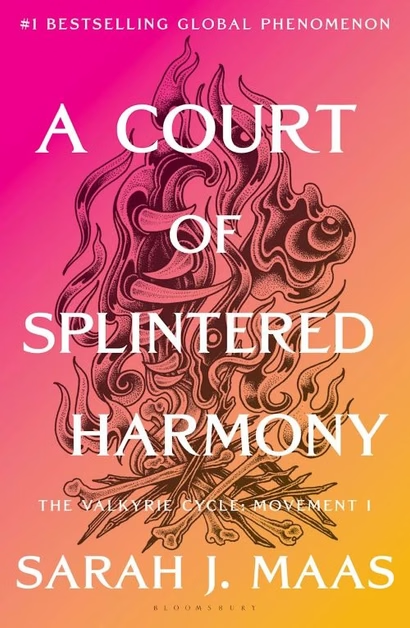
A Court of Splintered Harmony by Sarah J. Maas asks a surprisingly intimate question for a fantasy about a possible war. How tightly can you hold someone you love before they need you to let go? I kept thinking about a ribbon long after I finished this sixth ACOTAR book, published October 27, 2026.
It gave me a better reason to read this opening movement now than any promise about what happens in the next one. Publication details ·
Quick verdict
Verdict: Worth reading now for the Archeron sisters. Their arguments changed my mind about each of them at least once.
Ratin: 4/5
Best for: Returning readers who enjoy family scenes as much as court politics.
Main strength: A single ceremony looks different depending on whose hands you watch.
Main weakness — Several diplomatic conversations repeat a dilemma before anyone can act on it.
In brief: Chapters 14–17 are the reason I give this four stars. A public ritual takes a frightening turn, and Feyre later reconsiders an order she gave in good faith. That revision is more satisfying than a straightforward victory would have been. The central political and romantic questions carry forward.
What is A Court of Splintered Harmony about?
Feyre and Rhysand are trying to prevent an invasion of human lands while preparing for their son Nyx’s naming ceremony. Meanwhile, Nesta lives with the consequences of lending a dangerous magical object to Bryce, and Azriel wants a say in a part of his life his High Lord regards as court business. Maas calls this volume Movement I of a four-movement story.
That explains both its unusually concentrated family drama and the abrupt place it stops.
Is A Court of Splintered Harmony worth reading now?
Yes, especially if you remember what it felt like to be the last person at a family gathering to hear something everybody else already knew. Maas is very good at making that experience sting. My favorite early detail is almost embarrassingly practical.
Feyre has had absorbent cloth sewn into her formal clothes. She has a baby to feed and a room of hostile people to face, and only one of those commitments can be scheduled. That small adjustment tells me more about her working life than another paragraph about the burden of her crown.
Voice and pace. Feyre speaks in first person. The narration moves close to other characters in third person, a switch that makes some of Feyre’s well-meant decisions look quite different from the receiving end. Lucien gets an especially effective turn.
He can walk into a beautiful house, picture himself living there, and hate the place for precisely that reason. The story moves quickly when somebody enters a room. It slows when everybody stays seated and names the allies they still need.
Who should read it? I would start with the earlier ACOTAR books. Readers already invested in Nesta and Cassian get something unusually specific here, the awkwardness of two people who know how to save each other’s lives and have forgotten how to ask how the other spent the evening. Readers who need a settled romance or a completed campaign may prefer to wait.
Spoiler warning. The recap below reveals the naming ceremony, the bedroom confrontation and both parts of the ending. Skip to the final recommendation for a spoiler-free verdict.
What happens in the plot, and how does Movement I end? Summary
The movement ends with two departures. Nesta reaches the Prison and loses Gwydion the moment she enters, while Elain persuades Mor to take her to Vallahan. To understand why the second departure hit me harder, go back to the first child in the book who has to ask permission to leave a room.
A child learns what makes him useful
Long before Azriel gathers intelligence for the Night Court, he listens from inside a cell. He has so little access to the outside world that he measures growing up by how far his wings reach across it. A weekly breakfast buys him an hour with his mother.
Even then he carries the trays, one small piece of work he can take off her hands. His own hands still bear the scars his half brothers gave him.
The family has made an ordinary visit into a privilege, and the boy has learned to make himself useful inside that narrow allowance.
When Azriel hears his half brothers planning to hurt his mother, the peculiar education he has given himself finally serves him. He knows how to get out. The shadows help him reach her door before they do. He attacks them there, and it takes grown warriors to pull him away. His father sees something in the aftermath that changes the boy’s prospects immediately.
A son who can conceal himself and hear what other people miss could become an asset. Training at Devlon’s camp follows. Azriel leaves knowing exactly how little tenderness has figured in the decision.
As an adult he has become extraordinarily good at bringing powerful people the information they need. At Storr, Feyre and Rhys face a coalition whose ambitions threaten the humans on the Continent. Vallahan, Montesere and Rask have reasons to want a Made object, an artifact with exceptional magical power. The Night Court has its own arsenal. Feyre quietly checks the delegates for evidence of such an object and comes up empty. The distinction matters. She has good reason to fear what these rulers intend and very little evidence about what they can already do.
Azriel slips away to find out more on his own initiative. His absence becomes another problem waiting for the family at home.
Nesta already knows what it costs to exercise judgment on somebody else’s behalf. She trusted Bryce with the Mask. Azriel thinks that choice could have destroyed them all.
He has even stopped teaching the other women who trained alongside Nesta, although they had no part in the decision. Cassian follows Nesta when she leaves the meeting, but physical proximity buys them very little. Each thinks the other owes an account of what has gone wrong between them.
Nesta sets herself a private task. She tries to winnow to the Prison, ends up underwater and survives because Rhys pulls her out. For once, the man who has the most reason to distrust her is the one who knows how badly she needs help.
The invitations that bring everyone together
The court needs allies, and allies tend to want something.
Mor prepares to resume the work of diplomacy in Vallahan. Lucien offers a possible connection to the Autumn Court. Vassa lives under a curse that even Helion has been unable to lift.
During the visit to the human lands, Feyre learns that Rhys is still withholding from Lucien what he knows about his parentage. Rhys can imagine a future moment when telling him might be useful. It is much easier to understand Lucien’s anger later if you remember this conversation. People who say they value him keep finding strategic uses for things he might reasonably consider his own business.
Feyre, for her part, feels the imbalance. Lucien takes risks for people who seldom make him feel welcome.
She invites him to Nyx’s naming ceremony, aware that it will give him a chance to see Elain. I found the invitation generous the first time through. In retrospect, what catches my attention is how simple it feels to Feyre to offer somebody else’s company. She can decide who comes to her son’s ceremony. What the invitation might mean to her sister is a question that deserves a conversation of its own.
Meanwhile, Azriel and Elain have already tested the limits of Rhys’s authority over their attraction. The invitation puts all of them under the same roof.
Nesta spends an evening at the music hall without Cassian. Later she listens to a recording held by the Symphonia, a magical object that preserves music.
During a previous performance, in the pause between movements, it picked up Cassian telling her he loved her. She can recall the exact sound of a good moment whenever she likes. What she cannot do is ask the recorded voice how they got from that night to this one. It is an economical piece of storytelling in a book that sometimes takes the long way around an emotion.
The whole separation is audible in the difference between having those words and having someone there to say them.
At the temple, Gwyn rehearses with the priestesses for the Equinox.
The scales on the altar hold carefully arranged feathers, stones, cinders and water. Somebody has taken the trouble to make the two sides hang evenly. Clotho gives Nesta a ribbon for the ceremony, and Nesta wonders how much effort its making cost those injured hands.
In the political chapters, meanwhile, Feyre and Rhys consider what they might do if nobody will help protect the human territories. A wall starts to look like an answer.
By the time the guests gather, the book has offered three ways to make people safe: negotiate an agreement, raise a barrier, tie people together. The ceremony puts the smallest of those solutions to a test.
What the ribbon does during the attack
The naming begins slowly enough for Feyre to get bored.
The detail is funny because the occasion matters so much to her. Then family members step forward to offer their wishes for Nyx. Mor wishes him truth. Cassian wishes him friends with enough honesty to tell him when he falls short. He returns to his place without looking at Nesta.
From Feyre’s position near the altar, affection and estrangement are visible in the same few seconds. When Nesta comes forward, the baby smiles at her and she smiles back.
Then she blinks. Feyre knows her sister well enough to recognize a warning before Nesta has found anything to say.
Feyre orders the ribbon taken off. It binds her, Rhys and Nyx together, and something dangerous is approaching. Rhys tries his power on it and calls for a knife. There is every reason, from where these parents stand, to want their hands free. Before they can free themselves, Bryaxis floods the temple with darkness. The people inside experience different terrors. Feyre hears her baby suffering and cannot reach the child she imagines in that darkness. Knowing that a fear has been put into her mind does little to blunt it.
Maas makes that distinction matter later, when Feyre has enough distance to ask where her child actually was during those terrible seconds.
Nesta finds a way to fight. She calls Ataraxia to her hand, swings at Bryaxis and then runs into a problem no amount of courage can solve. Her formal dress will barely let her bend. She hits a pew face-first. I liked that embarrassing, painful collision because the scene remembers what everyone dressed for that morning.
Bryaxis gets away and heads for the House of Wind. Feyre and Nesta give chase, convinced that the priestesses in the library need warning. They reach the doors expecting to be rescuers. Clotho is already there, able to tell them precisely where the creature has gone.
Nesta realizes the song she heard in rehearsal was calling lost sisters home. Bryaxis answered, and Clotho counts her among those entitled to return.
That recognition changes the chase: the sisters thought they were following a predator to its next victims, while the priestesses understood the same journey as a homecoming. Clotho claims authority over the library and extends its protection to Bryaxis. Feyre can scarcely accept the idea that the thing that terrorized her baby gets to call any part of this place home. She sets a deadly condition on its leaving. The sisters go, and Nesta hears locks turn behind them. Later, Feyre thinks again about the ribbon she wanted cut.
While the visions blinded her and Rhys, it kept them physically connected to Nyx. Would she have dropped him otherwise?
Maas lets Feyre ask the question without pretending anyone can know the answer. Clotho has both protected this mother’s child and made a decision the mother finds nearly unbearable. A Court of Splintered Harmony earns its title for me right there.
A bedroom door and two departures
Lucien comes to Elain’s room after the ceremony. We have just spent time in his head, long enough to feel the ache of being a guest in the kind of house he would have chosen for himself. Opening the door, he finds Elain and Azriel naked together.
Elain later says they had not had intercourse. That distinction matters to her and does little to soften what Lucien has seen. The disturbance brings the household running.
Suddenly an intimate decision has an audience that includes her family, her mate and the rulers of the court. Almost everyone has something urgent to say. Elain gets remarkably little room to finish a thought.
Lucien drops the Veritas orb and withdraws his help. If they want information from the Autumn Court or proof of Koschei’s plans, they can get it themselves.
Azriel makes a cruel remark even as his shadows register Lucien’s hurt. Lucien hurls fire and tackles him. Azriel strikes back before the others separate them. Later Azriel sends Erebos to follow him. The spy can make a convincing case that his court needs to know what Lucien does next.
I could also hear the boy from the prelude in that order. Faced with the unbearable knowledge that another person can act outside his sight, Azriel reaches for the skill that has always made him useful. Understanding the impulse made me more uneasy about what he does with it.
The sisters spend part of the night together. By morning Nesta and Elain are capable of saying things they may spend years wishing they could take back. Elain wants the freedom to judge for herself what her human life and her love for Graysen meant.
Nesta sees a family on the edge of war and an ally they have just lost. When Elain brings up the Mask, she finds the place where she knows she can hurt her sister.
Feyre stays behind with Nesta. I was glad of that quiet aftermath. Someone has to sit in the room with the swords on the floor and the sister who sounded so certain until the door shut.
In the final chapter, Nesta returns to the cliff. Amren talks to her about will, and this time Nesta reaches the Prison. Gwydion lights her way inside, then disappears from her grasp. There is no metallic sound of a dropped sword.
The absence of that sound is how Nesta realizes the Prison has taken it. The chapter then turns to Mor, who is leaving for Vallahan. Elain asks to go along.
She offers political reasons, including the message it would send for Feyre’s sister to travel there, and her abilities as a Made Seer could help locate the object the court seeks. Finally, she admits how badly she needs to leave. Mor listens to both arguments and holds out her hand.
The two women depart together. A Court of Splintered Harmony stops before we learn what the Prison wants or what Elain will find. Her choice of where to spend tomorrow is the one answer the ending gives her outright.
Why do the ribbon and the shadows belong in the same story?
Both give vulnerable people a way to survive a moment when their own senses are insufficient. Azriel learns from what stone and shadow tell him beyond his cell. A ribbon keeps a baby within his parents’ grasp when fear makes sight useless.
What interests me is what happens when the emergency passes. Feyre can look back and change her mind about Clotho’s gift. Azriel, dispatching a spy after Lucien, struggles to imagine a point at which it would be right to stop watching.
The Symphonia offers a gentler version of that problem. It gives Nesta what most grieving partners might wish for, the precise inflection of a loved voice on a good evening. Its limitation is also exact. A recording can answer only the question you brought to it the first time.
I found Nesta and Cassian most moving when they finally risk speaking badly to each other in the present. A remembered declaration is lovely. A clumsy new conversation might actually take them somewhere.
Where does Maas’s storytelling work best?
Maas is at her best when an object means one thing to the person holding it and something else a page later. She trusts the reader to remember the ribbon.
I wish she trusted us quite as much with the map.
Once I understood why the human lands needed allies, successive conversations about who might offer help brought diminishing returns. The Summer Court earns its space when Cresseida questions what her people owe strangers.
Her question gives the disagreement a voice I can remember. Lists of reluctant territories rarely do.
Compared with the earlier Azriel bonus scene reproduced here, the main narrative also makes secrecy feel more costly. In the bonus material, the fate of a necklace leaves room for private speculation. In chapter 20, a door opens and people outside the romance acquire reasons of their own to care.
I preferred the second scene. Even Lucien leaving an object on the floor changes what the court can reasonably ask of him next.
What does the Night Court reveal about protection and choice?
It shows how easily a family can organize itself around someone’s safety while leaving that person out of the conversation.
A useful real-world comparison comes from SAMHSA’s guide to trauma-informed practice, which treats safety, collaboration, and a person’s voice and choice as distinct principles. Reading the temple and bedroom scenes with that distinction in mind helped me name my discomfort.
Everybody can sincerely care about Elain and still make it difficult for her to speak.
Five lessons I took from these scenes
- Ask what the person wants before offering access to them. Feyre’s invitation to Lucien is kindly meant. A conversation with Elain might have revealed a cost her sister had overlooked.
- Give the person at the doorway time to answer. Clotho knows where Bryaxis has gone. Feyre and Nesta arrive shouting warnings that make it hard to hear what she already knows.
- Revisit the order that felt obvious during the emergency. I trust Feyre more when she thinks again about cutting the ribbon. She can admit how little she saw.
- Let care be practical. Staying beside Elain buys her a night of company. Her sisters can offer that before they agree about anything else.
- Allow a person more than one reason for leaving. Elain has something to offer the mission and wants distance from home. Mor gives both reasons a hearing.
Three short passages worth a second look
- “I hated Storr.” Feyre’s first sentence is deliciously undiplomatic. The reader gets the blunt reaction that the people at the negotiating table will never hear.
- “Your authority ends at this doorway, High Lady.” Clotho gives authority a physical limit. Feyre can cross a continent in an instant, yet here a few inches of floor are enough to stop her.
- “I can’t stay here” is Elain’s plainest argument. I believed her political case already. This admission is what made me want Mor to say yes.
Final recommendation
Read it now if what you love about ACOTAR is the instant someone you thought you understood does something you dislike, and you still have to sit with them at dinner.
I’d give it 4/5 for the naming ceremony and its aftermath alone. If your pleasure comes from seeing the campaign through or finding out whom someone finally chooses, save it for a longer read alongside the next movement. Author’s note
Reader FAQs
Is this ACOTAR 6 or the first Valkyrie Cycle book?
Both descriptions refer to this volume. Bloomsbury lists it as the sixth ACOTAR installment and as Movement I of The Valkyrie Cycle. Publisher’s series guide · Book listing
Should I read the Azriel bonus chapter first?
Yes. In the opening letter, Maas recommends reading it before Movement I. It is printed at the back, so an ebook reader can easily pass it on the way in.
Does the bonus scene take place after the ending?
Its placement can give that impression, but Maas identifies the three pieces at the back as previously published bonus material. Chapter 24 is where Movement I ends.
Which book comes next?
Bloomsbury lists A Court of Forgotten Melody for January 12, 2027. The opening letter explains that the next volume brings Movements II and III together.
A Court of Splintered Harmony

A Court of Splintered Harmony by Sarah J. Maas asks a surprisingly intimate question for a fantasy about a possible war. How tightly can you hold someone you love before they need you to let go? I kept thinking about a ribbon long after I finished this sixth ACOTAR book, published October 27, 2026.
URL: https://www.sopranu.com/a-court-of-splintered-harmony-review/
Author: Sarah J. Maas
4