

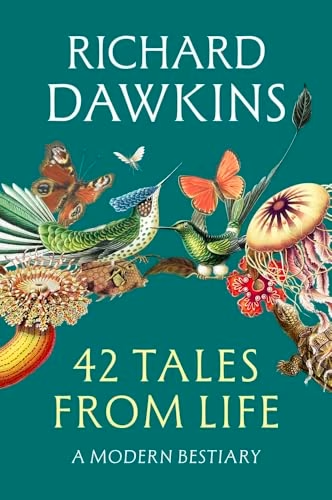
42 Tales From Life: A Modern Bestiary is Richard Dawkins’s illustrated collection of 42 short essays, each one hung on a plate by the German zoologist Ernst Haeckel, and yes, it is worth reading if you like your natural history with a strong argument attached. I finished it convinced that its real subject is not animals at all. It is myths.
Dawkins uses octopuses, slime moulds, orchids and barnacles to knock down a run of popular ideas that sound lovely and turn out to be wrong: that trees altruistically feed each other through fungal networks, that a spider building a decoy of itself must be self-aware, that new animal phyla burst into being overnight in the Cambrian, that some living animals sit “higher” on an evolutionary ladder than others.
Where he succeeds, 42 Tales From Life is the sharpest thing he has written in years. Where he drifts, it reads like a brilliant dinner guest who will not let you go home. Below you will find a full tale-by-tale summary, my verdict, and who I think should actually buy it.
What are the key takeaways from 42 Tales From Life?
- Format: 42 self-contained essays (“Tales”), plus a prologue, an essay on Haeckel himself and an epilogue on alien life. Each Tale opens with a Haeckel plate, mostly from Kunstformen der Natur (Art Forms in Nature), which was issued in sets between 1899 and 1904.
- Core claim: Natural selection is “a ruthless economist.” Nearly every strange form in the book, from a hummingbird’s colours to a pitcher plant’s slippery lip, is a finely balanced cost-benefit trade-off.
- Second claim: Physics and development constrain what selection can build. Dawkins, a lifelong “functionalist,” gives the “structuralists” (D’Arcy Thompson, Brian Goodwin) more credit here than in any earlier book.
- Myths he dismantles: the Cambrian “phylum-level leap,” the Wood Wide Web as tree altruism, spider self-awareness from decoys, the “evolutionary scale,” and the idea that copepods exist “to be eaten.”
- Big ideas worth remembering: the evolution of evolvability, Grafen’s honest-signal maths, the Parker-Baker-Smith model of why eggs are big and sperm are small, Raup’s three-number “cube” of shell shapes, and Dawkins’s guess that bats may “hear in colour.”
- Main flaw: digressions. Dawkins warns early that if digressions irritate you, “you may find you are reading the wrong book.” He means it.
- Verdict: 4.2/5. Best for readers who already enjoy popular evolutionary biology and want a beautiful, argumentative companion volume.
Quick verdict: Is 42 Tales From Life good?
A lavish, quarrelsome and frequently dazzling Darwinian bestiary that turns Haeckel’s 19th-century plates into 42 arguments about how life really works. Recommended for fans of The Ancestor’s Tale, Ed Yong and anyone who has stared at an octopus and felt slightly outclassed.
Should you read it?
| Pros | Cons |
|---|---|
| Haeckel’s plates are reproduced beautifully, and each Tale earns its picture | Very uneven lengths: some Tales run a page, others feel like a chapter of a textbook |
| Clear explanations of hard ideas (honest signalling, anisogamy, evolvability, morphospace) | Digressions pile up; there is no “bold thematic arrow,” as Dawkins himself admits |
| Strong, well-aimed myth-busting (Cambrian explosion, Wood Wide Web, spider “self-awareness”) | The Desmid’s Tale leaps from algae to human sexual behaviour on thin data and will divide readers |
| Personal touches: sand collected at Dog’s Bay, Oxford tutorials, a bat-sonar chat with a radar physicist | Haeckel’s racism and fraud claims get only brief treatment |
| Fresh speculations clearly labelled as speculation (snowflake radiolarians, bats hearing in colour) | Occasional swipes at social anthropologists feel like old scores being settled |
What is it about?
Dawkins takes 42 of Haeckel’s illustrations, from cephalopods and radiolarians to bats and frogs, and uses each one as a starting point for a short essay on a general lesson in evolutionary biology. The animal tells the Tale, but the Tale is usually about something bigger: symmetry, segmentation, sex, deception, what counts as an individual, or whether life on other planets would look like ours.
Rating
⭐ 4.2 / 5
Who will love 42 Tales From Life, and who may bounce off it?
If you have read The Selfish Gene or The Blind Watchmaker and still enjoy the feeling of a familiar idea suddenly snapping into place, you will love this, because Dawkins keeps returning to his big themes (the gene’s-eye view, the extended phenotype, arms races) through creatures you probably never thought about.
Biology teachers, A-level and undergraduate students, natural history illustrators and Haeckel admirers will get real value from it, and it makes a handsome gift for a curious teenager who already likes science. Readers who want a single narrative, like a history of life told in order, may bounce off, since the 42 Tales can be read in any order and the epilogue openly concedes there is no through-line.
Readers who find Dawkins abrasive will find the same voice here, especially in the Tales where he names and corrects other scientists.
And if you want a field guide or a species-by-species reference, this is not that book; Haeckel’s pictures are prompts, not catalogues.
Who wrote 42 Tales From Life, and when was it published?
42 Tales From Life: A Modern Bestiary is by Richard Dawkins, the evolutionary biologist born in Nairobi in 1941 who held Oxford’s Simonyi Professorship for the Public Understanding of Science from 1995 to 2008 and who coined the word “meme” in The Selfish Gene (1976).
In the US, it was published by Yale University Press on 20 October 2026 at 368 pages. In the UK it came out from Head of Zeus under its Apollo imprint on 5 November 2026, a £30 hardback that specialist bookseller NHBS lists with 140 colour illustrations. An audiobook edition is also available.
Context. This is popular science in the essay-collection tradition, sitting between a coffee-table art book and a set of tutorial essays. Dawkins’s credentials need little introduction: he has written about evolution for half a century, including The Extended Phenotype (1982), The Ancestor’s Tale (2004, with Yan Wong) and The Genetic Book of the Dead (2024).
His announcement of 42 Tales From Life framed it simply: natural selection is a blind watchmaker, yet its products can be astonishingly beautiful, and Haeckel captured that beauty.
Purpose. The thesis appears in the Prologue. Medieval bestiaries drew moral lessons from mostly fictional animals. Dawkins wants to draw “Darwinian” lessons from real ones, insisting that “scientific reality, if you know where to look, is way stranger than legend.”
Each Tale is a lesson about life in general that one particular organism happens to teach.
What background do you need before reading 42 Tales From Life?
You need two pieces of context, both supplied by the book.
The first is the format. In The Ancestor’s Tale, Dawkins and Yan Wong walked backwards through time like Chaucer’s pilgrims, with each newly joining lineage telling a “Tale” that carried a broader biological point (the Grasshopper’s Tale on race, the Marsupial Mole’s Tale on convergence).
This book borrows that device but drops the pilgrimage. The binding thread is now Haeckel’s art. Dawkins says that when he counted the plates that provoked a Tale, they came to exactly 42, a number any Douglas Adams fan will recognise.
Adams, he notes, once told him he wanted to go back to university to study zoology.
The second is Haeckel himself, who gets his own opening Tale. Dawkins calls him Darwin’s “German rottweiler,” a pugnacious populariser who met Darwin at Down House in October 1866 and jabbered in broken English until both men burst out laughing. Haeckel trained as a doctor, set his consulting hours before 6 a.m. so patients rarely came, and then devoted himself to zoology, naming huge numbers of species and producing, by Dawkins’s rough estimate, around 3,000 detailed drawings.
Dawkins does not whitewash him: Haeckel embraced Social Darwinism and racial superiority theories, pushed the discredited “biogenetic law” that embryos replay their ancestry, and dabbled in Lamarckism. The art, however, influenced Klimt and Munch and inspired René Binet’s gateway to the 1900 Paris World Fair.
What happens in 42 Tales From Life? A complete tale-by-tale summary
Tales 1 to 5: Martians, beauty, breeding, weapons and gaits
1. The Cephalopod’s Tale (“Are these the Martians?”). A Berkeley colleague once opened a lecture with “These are the Martians,” and Dawkins runs with it. Cephalopods pass their food through a ring-shaped brain, use swivelling jet propulsion (Japanese flying squid even glide), and distribute their nervous system so that fewer than 30 per cent of an octopus’s neurons sit in the brain, against more than 99 per cent in ours. Each arm has its own skill.
The showpiece is the skin, a living video screen.
Three layers do the work: chromatophores (elastic bags of red, yellow and brown pigment pulled open by radiating muscles under fast nervous control), iridophores (stacks of reflecting plates that produce blues and greens in about three seconds), and a white base layer. Octopus cyanea changes its pattern more than 150 times an hour while foraging, sometimes within 200 milliseconds.
Yet cephalopods have only one type of opsin, which should make them colour-blind. Dawkins describes an unsupported theory that they read colour from chromatic aberration by shuttling the lens back and forth, and he stresses it has no direct evidence.
Their skin also carries opsins and reacts to light when detached. He closes by quoting Sherrington’s “enchanted loom” image of the brain and wondering whether an octopus thinks with its skin.
2. The Hummingbird’s Tale (“Why so beautiful?”). Hummingbird shape is aerodynamics: the ruby-throated hummingbird crosses about 500 miles of the Gulf of Mexico, fattening from about 4 grams to 6, so its fuel is roughly a third of take-off weight, the same proportion as a Boeing Dreamliner on a London to Perth run. Natural selection is “a ruthless economist,” and many birds die on the way.
Colour is a different matter: sexual selection. Eggs are costly and sperm cheap, so males compete. John Endler’s guppy transplants showed bright males evolving in predator-free streams and drab ones where predators lurk.
Dawkins then walks through the great debate: Darwin’s “female whim,” Fisher’s 1930 runaway model, Zahavi’s handicap principle (bright colours advertise that a male can afford the cost), Hamilton’s “glowing plumage means glowing health,” and Alan Grafen’s mathematical rescue of Zahavi, which shows that a stable system emerges where males signal honestly and expensively and females believe only costly signals. Dawkins declines to pick a winner.
3. The Tale of Darwin’s Pigeons (“Where’s the experimental evidence?”). The only Tale not headed by a Haeckel plate (it uses Darwin’s own pigeon illustration). The German pathologist Rudolf Virchow demanded experimental proof of evolution; Haeckel replied that artificial selection by breeders was exactly that experiment, run for millennia.
Dawkins adds the University of Illinois maize experiment started by CG Hopkins in 1896 and still running, selecting lines for high and low oil and protein. A neat aside: a peacock’s display is made of back feathers, so it is a “train,” not a tail.
4. The Antelope’s Tale (“On Growth and Form”). Horns and antlers are sexually selected weapons, and their wildly varied, often spiral shapes suggest display more than killing. Lorenz explained ritual fighting as “good for the species”; Dawkins rejects that and points to John Maynard Smith’s Evolutionarily Stable Strategy instead.
The Tale then turns to D’Arcy Thompson: a rhino horn curves into a logarithmic spiral because its front grows faster than its back, antelope spirals come from left-right growth gradients, and antlers are best seen as a curved sheet with parts eaten away.
5. The Lizard’s Tale (“Why do horses gallop and kangaroos bound?”). This is where Dawkins makes peace with “structuralism.” Brian Goodwin compared animal forms to whirlpools, which can only spiral clockwise or anticlockwise.
Maynard Smith’s version: selection might shape an albatross wing and an eagle wing differently, but if development forced all wings to be rectangles, you would get the best possible rectangles. Ant lion pits are a real case, since their slope is set by sand’s angle of repose. Gaits work the same way.
The lizard walk is a fish’s side-to-side wave on land; birds and ostriches kept the alternation on two legs; mammals bent the spine up and down and invented the gallop; dolphins still “gallop” through water with horizontal flukes, and are outpaced by marlin and swordfish because they could not cross back.
A kangaroo bound is a gallop with the arms subtracted. His summary: “‘Commitment’ really is a thing in evolution.”
Tales 6 to 8: Tiny skeletons and visible evolution
6. The Foram’s Tale (“Indexing evolution”). Dawkins went to Dog’s Bay in Connemara in July 2024, jam-jarred its white shell sand back to Oxford, and confirmed under a microscope what Robert Lloyd Praeger described in 1937: a beach made of foraminiferan tests, with 124 species and varieties recorded there. Forams are single-celled amoeboids with shells; at least 6,000 living species and about 40,000 fossil ones are known.
Because they are so plentiful, oil geologists use them as date-stamps. Dawkins rattles off the succession of Cretaceous foram species, promising never to mention those stage names again.
7. The Radiolarian’s Tale (“Living snowflakes?”). Radiolarians build silica skeletons that look like a maharajah’s lanterns. D’Arcy Thompson thought soap-film physics explained them, and Dawkins gives him “game and set” with the fossil Callimitra agnesae, which looks exactly like a bubble blown inside a wire tetrahedron. Then comes his self-described heresy.
Snowflakes are unique because each one falls through its own sequence of microclimates. Might many of Haeckel’s thousands of radiolarian “species” (an Anderson monograph credits him with 3,508 new ones) actually be individual variants?
Haeckel once wrote to his fiancée about finding twelve new species in a single day. Dawkins admits: “I really can’t decide whether I’m serious or not.”
8. The Diatom’s Tale (“Evolution as it happens”). Diatoms are photosynthesising single cells with silica skeletons that fossilise readily. A mud core from Yellowstone Lake shows Stephanodiscus niagarae at 14,000 years ago changing gradually into S. yellowstonensis by about 10,000 years ago, with every intermediate preserved.
The contrast is the flatworms: around 25,000 species, yet almost no fossils. Gaps in the record are expected, not suspicious.
Tales 9 to 11: Segmentation and the evolution of evolvability
9. The Worm’s Tale (“Segmentation and modularity”). “Worm” is a hopelessly vague word, and Haeckel (like Dawkins’s own 1960s tutors) wrongly linked annelids to arthropods. Molecular taxonomy puts them in different superclades; segmentation evolved independently at least three times, in annelids, arthropods and vertebrates.
After a palate-cleanser about the Palolo worm of Samoa, whose detachable egg-filled rear ends swarm to the surface on a predictable day each year, Dawkins sets out his 1989 idea of the evolution of evolvability.
Mutation is random only in not being aimed at improvement. Embryologies that build in constraints, such as bilateral or five-way symmetry, or segment-by-segment repetition, mirror a useful mutation everywhere at once instead of waiting for each side or segment to catch up. Clades with such embryologies get better at evolving, just as individuals get better at surviving.
10. The Trilobite’s Tale (“Segmentation goes back a long way”). A short Tale. Trilobite segments often shrink steadily toward the rear, which Dawkins reads as “a single extra line of code,” probably a chemical gradient. Trilobites and eurypterids (some 2.5 metres long) died in the end-Permian Great Dying.
11. The Decapod’s Tale (“Serial toolkit”). A shrimp or lobster is a train whose carriages have been customised: Dawkins lists 19 pairs of appendages from antennules to uropods, each a modification of one shared design. Crabs push “tagmatization” further, and the crab body plan evolved several times (carcinization). He also notes, in passing, that boiling lobsters alive is hard to defend.
Tales 12 and 13: Starfish plumbing and the logic of symmetry
12. The Starfish’s Tale (“Nature’s plumbers”). Dawkins recalls an undergraduate week spent dreaming about starfish hydraulics. Sea water enters through the madreporite, flows via the stone canal to a ring canal and out along each arm to hundreds of bulb-topped tube feet.
How do the tube feet agree on a direction? One theory is “go with the flow,” a democracy like a starling murmuration or a honeybee swarm choosing a home (Martin Lindauer once watched a deadlocked swarm split in two). Some Linckia starfish have torn themselves apart when arms pulled opposite ways. The rival theory says the nervous system decides.
GA Kerkut’s 1953 nerve-cutting experiments showed coordination needs the radial nerve, and located a control centre at each of the five junctions with the nerve ring: if a starfish has a brain, it has five. Then the twist: Hox gene studies suggest starfish express head genes all over, so a starfish is “nothing but head.”
13. The Sand Dollar’s Tale (“Doing it with mirrors”). A tidy primer on symmetry: bilateral, biradial, radial (with a rare three-way case in the Ediacaran Tribrachidium) and spherical. Top-to-bottom asymmetry is universal because up and down are different worlds; a front end follows from moving; left-right symmetry avoids going in circles. The fiddler crab’s giant claw shows sexual selection overriding utility.
Sand dollars and heart urchins, which plough through sand, have drifted back toward bilateral symmetry, which makes them a “double doubling back,” like tortoises that returned to the sea and then to land again.
Tales 14 to 20: Cnidarians, individuality and symbiosis
14. The Sea Anemone’s Tale (“Miniature harpoons”). Anemones are fixed polyps with one opening that serves as mouth and anus. Their cnidocytes fire nematocysts, harpoons that turn inside out and stay tethered.
15. The Jellyfish’s Tale (“Introducing the medusa”). A medusa is an upside-down anemone that drifts. Tentacles can exceed 30 metres. Plankton migrate vertically every day (spotted by Second World War sonar), and jellyfish follow. In Palau’s Jellyfish Lake, about 20 million Mastigias track the sun from end to end, probably for their symbiotic algae.
16. The Hydroid’s Tale (“The many-headed”). Obelia alternates between asexual polyps and sexual medusae, which are separate individuals, unlike a caterpillar and butterfly. Hydra buds new polyps. If buds never detached, would the result be one animal or a colony?
17. The Siphonophore’s Tale (“What is an individual?”). The Portuguese Man o’ War is a fusion of specialised zooids (float, feeding polyps, reproductive medusae, stinging tentacles up to 30 metres) that cannot live apart.
Julian Huxley’s 1912 test of individuality was division of labour among mutually dependent parts. Dawkins proposes that an unequivocal individual meets at least two of three criteria: its parts are physically joined, mutually dependent, and genetically identical. The Man o’ War meets all three. As he puts it, “Words are our servants, not our masters.”
18. The Choanoflagellate’s Tale (“Nine plus two”). A brief Tale introducing the flagellum’s universal “9+2” microtubule pattern, shared by cilia and sperm tails, and a nice joke that “supercilious” comes from the Latin for eyebrow.
19. The Dinoflagellate’s Tale (“Vital partners of corals”). Dinoflagellates are regularly asymmetric, spin through water on two perpendicular flagella, glow blue when disturbed (Dawkins remembers a friend’s footprints lighting a Florida beach), cause red tides, and live inside corals as zooxanthellae.
20. The Coral’s Tale (“Island builders”). Corals and humans are the only animals that have redrawn the world map. Reefs reportedly house a quarter of marine species in under a tenth of 1 per cent of ocean area. Dawkins covers Darwin’s subsidence theory of atolls, the bright colours of reef fish, and cleaner fish (208 species) and shrimps (51 species), whose clients spare them because both stay loyal to one cleaning station.
The sobering ending: a one to two degree warming can drive out the zooxanthellae, and, by his figures, about half the world’s reefs have been lost since 1950. He suggests the symbiosis may be fragile because it is “not entirely amicable” on both sides.
Tales 21 to 23: Fungi, lichens and brainless problem solvers
21. The Mushroom’s Tale (“The Wood Wide Web”). Fungi are closer to animals than plants. A mushroom is just the fruiting body of a mycelium that can span more than a kilometre, an “inverse intestine” that digests the world from outside. Leaf-cutter ants have farmed one fungus for perhaps 10 million years. Most plants depend on mycorrhizae for minerals.
Dawkins is openly sceptical of the popular story that trees share food and warnings through this network. Following Merlin Sheldrake’s Entangled Life, he argues the fungi, not the trees, are the active agents, keeping both partners alive and “taxing rich trees to support poor trees” in their own interest. “Trees aren’t doing favours to one another.”
22. The Lichen’s Tale (“Ultimate togetherness”). A lichen is a fungus transfigured by an alga or cyanobacterium into something resembling neither. Lichens host other microbes and even tardigrades, survive drying, liquid nitrogen and radiation 12,000 times the lethal human dose, and can live more than 8,000 years.
The puzzle Dawkins cannot fully resolve: his rule says partners that share reproductive packages become true cooperators (like mitochondria), yet most lichen partners part company to reproduce. He calls lichens a “worrying exception.”
23. The Slime Mould’s Tale (“Brainless mathematician?”). Cellular slime moulds aggregate via cyclic AMP into a slug of up to 100,000 amoebae; acellular ones form a giant multinucleate plasmodium.
Physarum solves mazes, escapes U-shaped traps by avoiding its own slime trail (an external memory that experimenters fooled by smearing slime everywhere), approximates the Tokyo-area rail network when oats are placed on 36 satellite towns, and finds efficient Travelling Salesman routes. Dawkins wonders whether any science-fiction alien could be stranger.
Tales 24 to 27: Deep time, the Cambrian myth, the ladder myth and the sister of all animals
24. The Brachiopod’s Tale (“Exploding error”). Brachiopods look like clams but are an unrelated phylum. Lingula is a near “living fossil.”
The Cambrian (starting about 541 million years ago) saw hard-bodied animals appear over roughly 20 million years, probably fuelled by rising oxygen and calcium and an escalating predator-prey arms race (he weighs the “life-dinner principle” against his own “grass-doesn’t-run-away” principle).
Then the attack. “The Cambrian explosion has become a fashionable myth.” Stuart Kauffman, Richard Leakey and Roger Lewin, and above all Andrew Parker in In the Blink of an Eye, are quoted implying that whole phyla appeared in single “long-jump” mutations.
Dawkins traces the error to Stephen Jay Gould’s Wonderful Life and dismantles it with two images: a gardener complaining that a tree no longer sprouts new boughs, only twigs; and viable animals as rare oases in a desert of unviable forms, where Fisher’s microscope argument shows big mutations almost never land anywhere habitable.
25. The Sponge’s Tale (“What is primitive?”). Sponges pump water in through pores and out through the osculum, driven by choanocytes that look like choanoflagellates. The glass sponge Euplectella, the Venus flower basket, is the most beautiful skeleton in the animal kingdom. Haeckel named one sponge primitivus; Dawkins treats the word with suspicion.
26. The Old Oak Tree’s Tale (“Kicking away the ladder”). Haeckel drew life as a gnarled oak with man at the top. Dawkins says there is no “evolutionary scale” among living animals. People blur four different measures: primitive (resembling the shared ancestor), complex (how long a book describing it would need to be; a lobster beats a millipede, or “bongololo”), clever, and human-like.
These do not line up: a horse’s foot is simpler than ours but less primitive. Sponges even top two rankings, longevity and regeneration (Henry Van Peters Wilson pushed one through silk in 1907 and it reassembled). But evolution within a lineage often is progressive, as arms races show.
27. The Ctenophore’s Tale (“Who is the sister of us all?”). After explaining “sister group” and “outgroup,” Dawkins reviews a 2023 Nature paper by DT Schultz and colleagues comparing chromosome-level gene order.
It places comb jellies, not sponges, as the sister group to all other animals. That would mean either comb jellies invented nerves and muscles independently or sponges lost them, and the sponge genome does contain unexpressed nerve and muscle genes. He leaves the question open.
Tales 28 and 29: Why two sexes, and why a web is no proof of a mind
28. The Desmid’s Tale (“Why two sexes?”). Desmids have equal-sized gametes (isogamy) and two mating types. The Parker, Baker and Smith (PBS) model shows that if zygote success rises steeply enough with size, selection becomes disruptive and favours very big and very small gametes that pair with each other: eggs and sperm. Nancy Knowlton’s survey of volvocine algae fits the prediction that more cells mean more anisogamy.
Dawkins then draws out behavioural consequences (choosier females, competing males, showy males) and cites Clark and Hatfield’s campus experiments, in which most men but no women accepted an invitation to bed from a stranger.
He acknowledges women have good reason to fear strange men, and suspects both explanations reinforce each other. This is the Tale most likely to start arguments.
29. The Spider’s Tale (“Silk road to solecism”). Dawkins named the spider’s web one of his “Seven Wonders” for the BBC. Jumping spiders leap hydraulically about fifteen body lengths; orb weavers rebuild their webs, often in under an hour, and he walks through construction step by step (kite-line span, Y-frame, scaffolding spiral, sticky spiral, glue beadlets that stop the trampoline effect).
The “solecism” is a conservation article claiming that Cyclosa spiders building decoys of themselves proves self-awareness. No, Dawkins says: stick caterpillars and potoos look like branches because ancestors who did survived. Behaviour is an organ, a web is an extended phenotype, and the spider’s building behaviour is the “embryology” of the web.
He applies the same logic to the anthropologist Marshall Sahlins, who argued kin selection could not work in cultures without fractions. “The kidney has not taken a course in integral calculus.”
Tales 30 to 32: Embryos, our tunicate cousins and puppet-string neurons
30. The Embryo’s Tale (“Where Haeckel went too far”). Haeckel’s embryo plates exaggerated similarities, and his “ontogeny recapitulates phylogeny” has been replaced by heterochrony, changes in developmental timing.
Paedomorphosis, where adults keep juvenile traits, is illustrated by the axolotl (34 were shipped to Paris in 1864, and some unexpectedly turned into salamanders), by chihuahua skulls that resemble a wolf cub’s, and by our own domed heads.
Walter Garstang, the versifying marine biologist, argued that evolution often branches off from larvae, and Dawkins sides with him against Haeckel.
31. The Sea Squirt’s Tale (“The vertebrates’ secret sister?”). Sea squirt larvae have a notochord and dorsal nerve cord. Garstang thought vertebrates descend from such a larva that began breeding without settling. Molecular evidence confirms tunicates, not lancelets, are our sister group. “Molecules don’t lie.”
32. The Nudibranch’s Tale (“Pulling neuronal puppet strings”). Nudibranchs steal stinging cells from the cnidarians they eat and advertise them with warning colours. Tritonia flees starfish with a half-minute swimming convulsion.
Dennis Willows identified about fifty giant, individually nameable neurons; stimulating cell 15 or 24 withdraws all gills, cell 1 only the left ones. An isolated brain can generate the swimming rhythm by itself, as cricket nymphs too young to sing can generate song patterns.
Tales 33 and 34: Plants that eat animals and flowers that lie
33. The Pitcher Plant’s Tale (“Plants that eat animals”). Carnivorous plants hunt for nitrogen and phosphorus, not energy. Venus flytraps need two touches. Pitchers (evolved at least three times) use nectar and a slippery rim. Inside live “nepenthephiles,” mites and maggots that chew prey into digestible pieces, possibly paid in oxygen pumped in by the pitcher’s chlorophyll-rich lining.
Best of all: some Nepenthes rims are slippery only when wet, so ants feed safely in dry spells, recruit nestmates, and fall in after rain. Ulrike Bauer’s Borneo experiments confirmed intermittently wet pitchers catch more ants. “Even in the kingdom of plants, the ways of natural selection are Machiavellian indeed.”
34. The Orchid’s Tale (“Mendacity and magic bullets”). Plants cannot walk because their root systems are vast (one rye plant’s roots plus fungi cover about 400 square metres), so they borrow animal wings as delivery drones, usually paying in nectar or pollen. Grasses use wind; Dawkins predicts, untestably, that a million windless years would make grasses evolve showy flowers.
Orchids, more than 30,000 species, cheat: roughly a third deceive their pollinators. Bee orchids lure males with fake female scent; Cryptostylis can make wasps ejaculate; Dracula mimics a fungus; spider orchids, according to Adam Karremans’s 2023 book, trick spider-hunting wasps into a fruitless nectar search rather than a sting; bucket and slipper orchids trap bees in “Goldilocks” tunnels (Darwin tested one five times with the same bee); hammer orchids slam male wasps against pollen with a hinged dummy female; some orchids make wasps drunk on alcoholic nectar.
It ends with Darwin’s 1862 prediction of a moth with an 11-inch tongue for Angraecum sesquipedale, confirmed in 1903 as Xanthopan morganii praedicta, and Wallace’s comparison with the discovery of Neptune.
Tales 35 to 37: Armour, spirals and morphospace
35. The Tortoise’s Tale (“Hole up or flee”). Prey can fight, hide, run or armour up, but cannot excel at both running and armour. Camouflage and running mix, with a finely tuned “flight-initiation distance.” Dawkins backs Zahavi’s reading of springbok stotting as a message to predators. The general lesson is that prey compete against each other, not the predator: “you survive because someone else does not.”
36. The Ammonite’s Tale (“The spell of the spiral”). A mollusc shell keeps its baby self at the centre and grows as a logarithmic spiral, which Dawkins checks by measuring Haeckel’s ammonite.
David Raup showed in 1966 that three numbers, which Dawkins renames flare, verm and spire, describe any shell, so all shells fit inside a cube that is mostly empty. Slipper limpets live in sex-changing stacks; heteromorphic ammonites seem to have broken out of the cube entirely.
37. The Gastropod’s Tale (“Making tracks through morphospace”). Evolution is a walk through that cube. Dawkins describes his own breeding program for computer shells, adds dimensions for elliptical cross-sections, shows how teardrop shapes come from “encroachment,” and presents Vermicularia, a snail that wanders off into the cube’s “badlands” and makes a living as a filter feeder.
He ends with D’Arcy Thompson’s coordinate transformations, which only work between homologous structures.
Tales 38 to 40: The most numerous animals, floating boxes and unrecognisable crustaceans
38. The Copepod’s Tale (“Staple of the plankton”). Possibly more than 10²¹ copepods exist, the main second link in ocean food chains. Dawkins’s point: they do not exist “to be eaten”; selection favours those that avoid it.
39. The Cowfish’s Tale (“Neutral buoyancy”). A teleost is a Cartesian diver, adjusting gas in its swim bladder. A boxfish’s armour has just enough cartilage between plates to allow the roughly 1 per cent volume change needed. Cuttlebones and nautilus shells do the same job.
40. The Barnacle’s Tale (“How far can you go?”). Darwin spent 1846 to 1854 on barnacles, and Dawkins enjoys the probably-apocryphal story of a Darwin child asking where a friend’s father “does his barnacles.” Darwin already knew in 1843 that true classification is genealogy. A barnacle is a shrimp lying on its back, kicking food into its mouth; Sacculina is a root-like parasite inside crabs, identified as a crustacean only by its larva. “In the end, even the wildest barnacle cannot quite outrun its history.”
Tales 41 and 42: Seeing with sound, jumping with springs
41. The Bat’s Tale (“Gargoyles and echoes”). When Donald Griffin and Robert Galambos announced bat echolocation in 1940, a scientist shook Galambos by the shoulders in disbelief. Griffin’s bats dodged wires 0.12 millimetres thick. Some bats deafen themselves between shrieks, perhaps up to fifty times a second, a trick Dawkins later learned radar engineers had independently invented. Noctuid moths power-dive when they hear ultrasound.
How do bats avoid jamming each other? Dawkins’s answer: only your own echoes make sense against your existing model of the world, like following one voice at a cocktail party. He proposes a cleverer version of the Gray and Wedderburn split-ear experiment.
Then two bold claims: bats probably experience a world model similar to a swallow’s, so Thomas Nagel’s bat may be less alien than assumed; and bats might “hear in colour,” reusing old colour labels for echo textures, which he suggests could be indirectly tested by stimulating the brains of colour-blind men.
42. The Frog’s Tale (“Jumpers and gliders”). A frog is a salamander rebuilt for jumping, a lesson from HK Pusey’s Oxford lectures: a short spine, a unique hinged ilio-sacral joint, and elastic tendons that deliver seven or eight times raw muscle power.
Insects go further with resilin; the Issus bug synchronises its legs with literal gears and hits 500g (Malcolm Burrows’s discovery). Flying frogs glide over 15 metres; Dawkins measures Haeckel’s plates and finds a bat has about nine times the frog’s flight surface relative to body length. Webbing is easy to evolve: just switch off the cell death that normally carves fingers apart.
Frog tongues are “reversibly adhesive.” Lettvin’s “bug detector” cells live in the retina; Sperry’s skin-graft frogs wiped the wrong spot. Metamorphosis is genes switching wholesale, which Dawkins compares to Sweden’s “Dagen H” switch to right-hand driving on 3 September 1967.
The Epilogue: What would alien life look like?
Dawkins admits there is no grand arrow through the 42 Tales, only renewed astonishment at selection’s finely judged economics, now complemented by D’Arcy Thompson’s structuralism. He then asks which features would recur on other worlds. Carbon chemistry and digital, high-fidelity genetics seem likely; DNA and our genetic code do not. Sex may be a local quirk. Segmentation and modular building probably recur.
Eyes are a near certainty wherever there is light (Michael Land counts nine eye designs, all used on Earth), and echolocation would evolve on a foggy planet. Following Martin Rees, he expects any contact to come from the artifacts of a civilisation, not its living members. His “thus we see”: “The anaesthetic of familiarity dulls our sensitivity.”
What are the key arguments in 42 Tales From Life? A thematic overview
Reading all 42 Tales back to back, I count six arguments that keep resurfacing.
- Life is economics. Fuel loads in hummingbirds, cheap sperm versus costly eggs, the energy price of running versus armour, nectar as currency. Almost every adaptation is a trade-off, and natural selection prices every gram.
- Selection works inside physical limits. The Lizard’s, Antelope’s, Radiolarian’s and Gastropod’s Tales give real ground to structuralism. Selection chooses among “attractors,” and once a lineage commits (gallop, bound, armour, metamorphosis), halfway houses lose.
- Beware lovely stories. The Cambrian leap, tree altruism, spider self-awareness, the evolutionary ladder: in each case Dawkins shows how a vivid metaphor outran the evidence.
- “Individual” is a fuzzy word. Siphonophores, corals, lichens, slime mould chimeras and spider webs (as extended phenotypes) all test where an organism ends.
- Lineages, not just individuals, can improve. The evolution of evolvability and arms races explain why progress is real within lineages but meaningless as a ranking of living species.
- Earth already holds the aliens. Octopus skin, starfish plumbing and slime moulds are stranger than most science fiction, and the epilogue turns that into a genuine argument about life elsewhere.
Is 42 Tales From Life worth reading? My critical verdict
42 Tales From Life is a luminous, combative and occasionally maddening book, the work of an old master who still writes about a starfish’s tube feet as if he had discovered them this morning.
Does Dawkins support his arguments with evidence? Mostly, yes. He names his sources (Hanlon, Endler, Grafen, Kerkut, Willows, Bauer, Schultz, Karremans) and, importantly for trust, he flags his own speculations: the chromatic aberration theory, snowflake radiolarians, bats hearing in colour, the windless-grass prediction. Some figures, such as the coral losses since 1950, are given without much discussion in the main text.
Does it fulfil its purpose? It does what the Prologue promises: real animals, Darwinian lessons, reality stranger than legend. It contributes less new science than The Extended Phenotype did, but it is a genuine contribution to how evolution is taught, especially in its clear handling of the functionalist and structuralist debate.
What did I enjoy most?
The myth-busting Tales are the best writing in the book, particularly the Brachiopod’s Tale, where the “boughs versus twigs” image makes the absurdity of overnight phyla instantly obvious.
The Pitcher Plant’s and Orchid’s Tales are pure pleasure, packed with experiments I had never heard of. I loved the small personal scenes: the Dog’s Bay sand, the Oxford tutorial essay, the stranger on the Oxford train who explained “sesquipedalian.”
And the pairing with Haeckel works far better than a gimmick should; each plate made me look harder at the text.
What frustrated me?
42 Tales From Life is uneven. The Choanoflagellate’s and Copepod’s Tales are barely essays, while the Bat’s Tale spends pages on split-ear word experiments that drift away from bats.
The Desmid’s Tale makes a big jump from gamete size to human sexual behaviour, resting partly on a small 1980s campus study; Dawkins does note the obvious alternative explanation, but readers expecting a broader evidence base will be unsatisfied.
Haeckel’s racism and the long controversy over his embryo drawings get a couple of paragraphs, which feels light for a book built on his work.
And the swipes at social anthropologists, while funny, read like an old quarrel.
Why does the Wood Wide Web scepticism matter right now?
This is the part of 42 Tales From Life I keep thinking about. Dawkins’s doubt about “talking trees” is not just Selfish Gene loyalty. In 2023, Justine Karst and colleagues published an analysis in Nature Ecology & Evolution reporting that claims about common mycorrhizal networks had drifted away from the field evidence.
According to a media summary of the paper, unsupported statements rose to about a quarter of citations on network structure and almost half on network function, and the idea that mother trees warn their offspring had no peer-reviewed support.
The same year, a sweeping coral crisis began: NOAA confirmed a fourth global bleaching event in April 2024, and by April 2025 the International Coral Reef Initiative put the share of reefs exposed to bleaching-level heat at 84 per cent.
Put those beside the Mushroom’s and Coral’s Tales and five lessons emerge.
- A beautiful metaphor is a hypothesis, not a finding. “Wood Wide Web” was a great phrase; it was never evidence of cooperation.
- Ask whose interests a behaviour serves. Dawkins’s switch from “trees helping trees” to “fungi managing their own economy” is a portable test you can apply to any feel-good nature story.
- Partnerships can be fragile when the partners’ interests differ. His explanation of coral bleaching as an “uneasy” symbiosis is a useful way to read reef news.
- Citation chains can manufacture certainty. The Karst analysis shows how a handful of early papers became a cultural fact. Check the original study before sharing the headline.
- Wonder does not need exaggeration. Slime moulds really do approximate rail networks; spiders really do rebuild webs daily. The true stories are strange enough.
Lines worth keeping
- “Scientific reality, if you know where to look, is way stranger than legend.” (Prologue)
- “Natural selection is a ruthless economist.” (The Hummingbird’s Tale)
- “Words are our servants, not our masters.” (The Hydroid’s and Siphonophore’s Tales)
- “The Cambrian explosion has become a fashionable myth.” (The Brachiopod’s Tale)
- “The kidney has not taken a course in integral calculus.” (The Spider’s Tale)
- “In the end, even the wildest barnacle cannot quite outrun its history.” (The Barnacle’s Tale)
- “The anaesthetic of familiarity dulls our sensitivity.” (Epilogue)
What did other reviewers say?
Early reception is limited because the book is only weeks old. Kirkus called it “a zany reverie about the power of Darwinian evolution,” enjoying the images and digressions while noting the Tales meander.
A book blogger at Books by Your Bedside found it technical but enjoyable and praised how the illustrations bring the text to life.
Early readers on NetGalley described it as a miscellany to return to. I could not find major newspaper reviews at the time of writing, so I cannot report a broader critical consensus yet.
Which books are like 42 Tales From Life?
The Ancestor’s Tale (Dawkins and Yan Wong, 2004). The template for this book, with a stronger narrative spine. Read it first if you want structure.
The Genetic Book of the Dead (Dawkins, 2024). The immediate predecessor, and the source of the “double doubling back” idea revisited in the Sand Dollar’s Tale.
Wonderful Life (Stephen Jay Gould, 1989). The book Dawkins blames for the Cambrian myth. Reading both gives you the full debate.
Entangled Life (Merlin Sheldrake, 2020). The fungal book Dawkins openly recommends; more lyrical, less adversarial.
On Growth and Form (D’Arcy Wentworth Thompson, 1917). The structuralist classic that haunts a dozen of the Tales.
An Immense World (Ed Yong, 2022) and Other Minds (Peter Godfrey-Smith, 2016). Better on animal senses and octopus minds respectively, though less concerned with evolutionary argument.
What sets 42 Tales From Life apart is the combination: art book, myth-busting manual and personal essay collection in one volume.
Should you buy 42 Tales From Life? Final thoughts
Yes, if you already enjoy popular evolutionary biology and want something to dip into, argue with and leave open on the coffee table.
It suits biology students, teachers, nature writers, Haeckel admirers and long-time Dawkins readers. General readers will enjoy most of it, though they should expect the occasional stretch of technical detail. Specialists will find little new data but plenty of sharp framing.
The book’s lasting value is its insistence that the truth about life is stranger than our favourite stories about it, and that checking those stories is part of the wonder, not the enemy of it.
42 Tales From Life: A Modern Bestiary
42 Tales From Life: A Modern Bestiary is Richard Dawkins's illustrated collection of 42 short essays, each one hung on a plate by the German zoologist Ernst Haeckel, and yes, it is worth reading if you like your natural history with a strong argument attached. I finished it convinced that its real subject is not animals at all. It is myths.
URL: https://www.sopranu.com/42-tales-from-life-review-richard-dawkins/
Author: Richard Dawkins
4.2







