
Last updated on October 19th, 2026 at 07:35 am
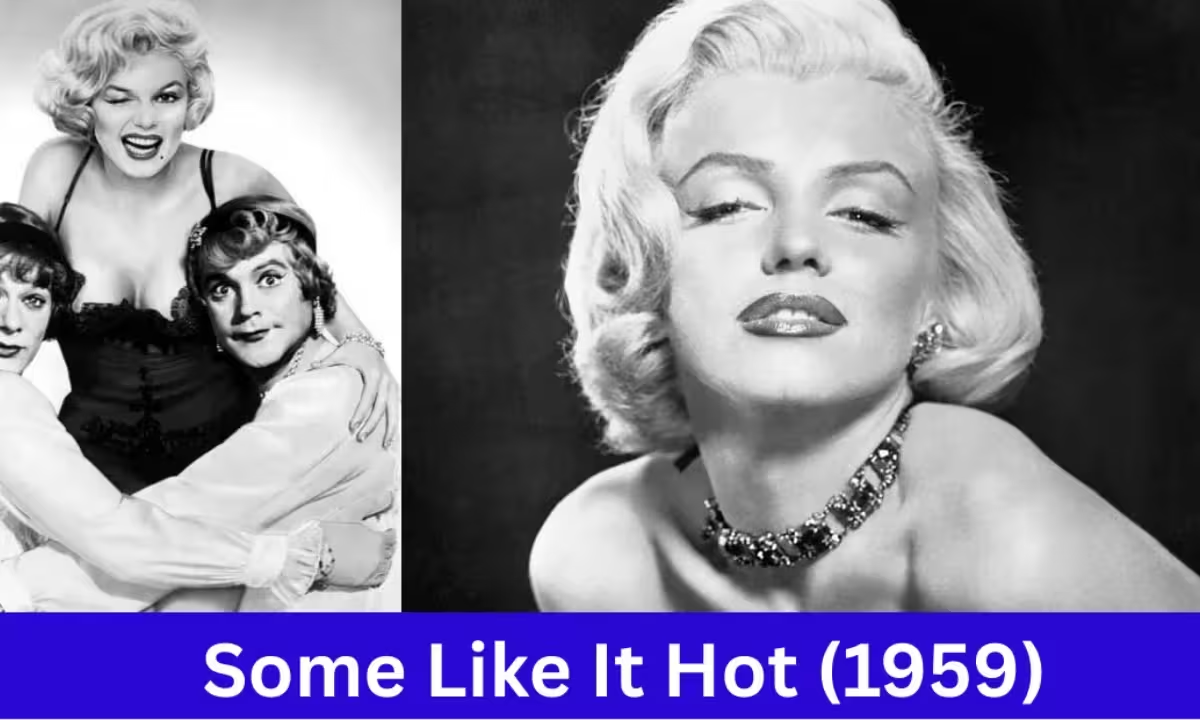
Some Like It Hot 1959 is the Billy Wilder farce that a Catholic review board called smut, that Kansas tried to trim, and that 253 critics across 52 countries later put at the top of a BBC Culture list of the best comedies ever made. It stars Marilyn Monroe, Tony Curtis, and Jack Lemmon, and it reached American theaters in March 1959. I give it 4.5 out of 5.
The jokes still land, the last line still stings in the best way, and the one real stumble is a gangster plot that a Sight and Sound archive review singles out as the weakest part.
Table of Contents
Some Like It Hot at a Glance
What it is: a 1959 black-and-white crime comedy directed, produced, and co-written by Billy Wilder. Two broke jazz musicians witness a mob killing and hide in an all-female band.
Why people still talk about it: the AFI ranked it first on its funniest American films list in 2000, and a 2017 BBC Culture poll placed it first as well.
The fresh angle: the AFI Catalog file preserves a Legion of Decency complaint, a two-month Kansas delay, and a Memphis adults-only ruling. The same file says most 1959 reviews were positive, which corrects the popular “mixed reviews” story.
Awards: one Oscar from six nominations (Costume Design, black-and-white) and three Golden Globes.
Best parts: the Lemmon and Curtis double act, Monroe’s Sugar, and a script that builds to one of the most quoted last lines in American film.
Weak spot: the mob subplot, which is more functional than funny.
My rating: 4.5 out of 5. Watch it, whether you are a casual viewer or a classic film fan.
Honesty note: a few details differ between sources (the 47 takes line, Monroe’s ten percent deal, the running time, the release date). I flag each one where it appears.
Quick facts
| Detail | What the sources say |
|---|---|
| Director | Billy Wilder |
| Screenplay | Billy Wilder and I. A. L. Diamond, from a story by Robert Thoeren and Michael Logan (AFI) |
| Stars | Marilyn Monroe, Tony Curtis, Jack Lemmon, with George Raft, Pat O’Brien, Joe E. Brown (Wikipedia) |
| Release | March 19, 1959 per Wikipedia. The AFI lists a New York opening on March 29, 1959 |
| Running time | 121 minutes per Wikipedia, 120 minutes per the AFI |
| Format | Black and white |
| Budget and gross | $2.9 million budget, $25 million in North America (Wikipedia, citing The Numbers) |
| Studio | The Mirisch Company, distributed by United Artists |
What is Some Like It Hot 1959 about?
Some Like It Hot is a Prohibition-era farce about two out-of-work jazz musicians who see a gangland murder in Chicago and escape by joining an all-female band headed for Florida (AFI). Wilder wrote it with I. A. L. Diamond, and the pair had worked on it for about a year.
The raw material was older than Wilder’s version. The AFI says the plot came from a 1951 German film, Fanfaren der Liebe, whose musicians posed as gypsies and Black men before posing as women. Wilder and Diamond dropped the first two disguises. Wikipedia credits an earlier French film, Fanfare of Love, from 1935. I cannot settle which one deserves credit as the ancestor, but one Wikipedia mirror says the gangster subplot was Wilder’s own addition.
The period setting came late. Diamond wrote that they first imagined a modern story, then decided poverty was too weak a reason for men to put on dresses. He suggested a historical setting to make female impersonation easier for audiences to accept, and Wilder came up with the jazz age and a gangland killing.
Even the title is a musician’s joke. In the jargon of the time, playing jazz “hot” meant improvising rather than playing it sweet or straight. The massacre in the film is loosely based on the St. Valentine’s Day Massacre of February 14, 1929, in which seven associates of George “Bugs” Moran died. Moran was not there, and Al Capone was in Florida.
Who was cast, and who almost was?
Tony Curtis was signed first. United Artists then pushed Wilder to find a bigger name than Lemmon for the second lead, and Wilder approached Frank Sinatra, who never made an appointment. A Wilder biography cited by the AFI says he also approached Anthony Perkins, and a modern source says Danny Kaye was considered. Wikipedia adds that Jerry Lewis was offered the part and declined because he did not want to do drag.
Mitzi Gaynor was in mind for Sugar until Monroe wrote to Wilder hoping they could work together again after The Seven Year Itch.
The AFI says she agreed after studio executive Harold Mirisch offered her ten percent of the gross. Wikipedia says ten percent of the profits. Both sources agree on the figure, and they differ on what it applied to.
Once Monroe signed, Wilder could finally sign Lemmon, who had given a verbal agreement while under contract to Columbia. Joe E. Brown was brought out of semi-retirement to play Osgood.
The gangsters were cast with real gangster-film veterans: George Raft, Pat O’Brien, and George E. Stone. Wilder reportedly wanted Edward G. Robinson, but a long dispute with Raft kept him away. Robinson’s son, Edward G. Robinson Jr., played the coin-flipping gunman instead.
How was it made, and is the 47 takes story true?
Filming ran from early August to November 12, 1958 at Samuel Goldwyn Studios, and the Florida hotel scenes were shot at the Hotel del Coronado near San Diego.
Wilder shot in black and white because early color tests made Curtis and Lemmon look “unacceptably grotesque” in drag. Monroe’s contract called for color, and she agreed to the change after seeing the tests. Moviefone’s roundup says the tests made the pair look green and ghastly.
Then there is the number 47. The AFI says Monroe needed 47 takes for the line “Where’s that bourbon?”, which was finally shot with her back to the camera. Wikipedia says it was the line “It’s me, Sugar” that took 47 takes because she kept scrambling the word order. Based on the available data, I cannot tell you which line it was. The shared number at least suggests that a famously painful 47-take line existed.
Wilder never pretended the shoot was easy. He joked in 1959 that nobody would pay to see his Aunt Minnie, who was always punctual, and he also said Monroe played her part wonderfully.
Two craft details I like. First, Curtis came up with the idea that Shell Oil Junior should imitate Cary Grant’s speech. Moviefone reports that Grant later joked that he does not talk like that. Second, Lemmon reportedly stopped taking lessons from a coach after a week because he wanted to play a man trying to walk like a woman. That choice shows in the performance.
What did the censors actually say about Some Like It Hot?
This is the part most competing articles skip, and it is the reason I chose this angle. The AFI Catalog quotes the studio correspondence kept in the MPAA and PCA files at the Academy library.
On March 5, 1959, Monsignor Thomas F. Little of the National Catholic Legion of Decency wrote that the film contained material “seriously offensive” to Christian and traditional standards. He saw a clear inference of homosexuality and lesbianism, called the dialogue “outright smut”, and found the costuming offensive.
The reply is the surprise. On March 18, Production Code head Geoffrey Shurlock answered that there had been no adverse reaction so far and plenty of praise.
He pointed out that women dressed as men and men dressed as women had been theater staples since As You Like It and Twelfth Night. He did not defend Monroe’s costumes (AFI).
Local boards were less relaxed. Kansas delayed distribution for two months after its Board of Review refused to approve the picture without cutting more than one hundred feet, mostly from the love scene between Sugar and Shell Oil Junior. Memphis first rejected the film, then agreed to pass it as adults only. Slashfilm has a good short piece on the Kansas episode.
Wikipedia says the film was made without Production Code approval and that its success is considered one of the reasons the code was retired. I would treat that last claim as a widely repeated judgment and not a proven chain of cause and effect.
Some Like It Hot plot summary
Act one, Chicago, February 1929. Federal agent Mulligan raids a speakeasy run by the bootlegger “Spats” Colombo after a tip from small-time gangster Toothpick Charlie. Saxophonist Joe and bass player Jerry slip out as the raid starts, then lose their coats and their bet at the bookie.
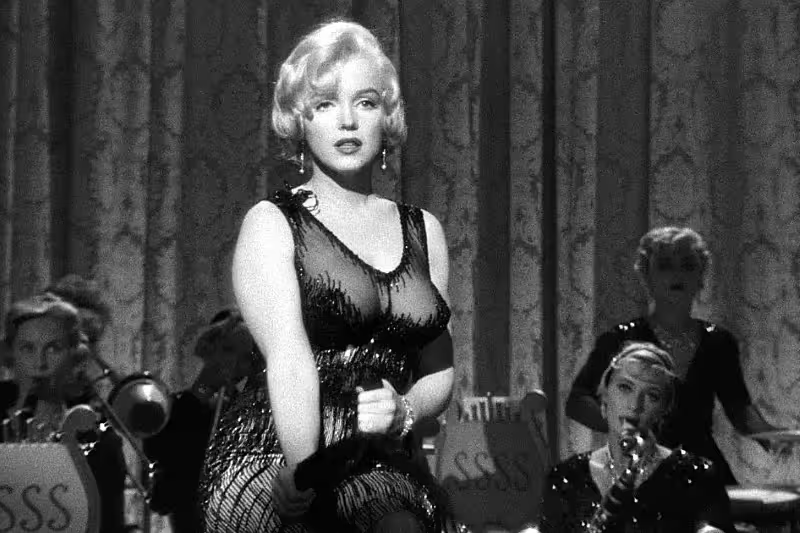
At an agent’s office the only open job is with an all-girl band going to Florida, which they refuse. They take a one-night college dance gig in Urbana, and Joe talks a secretary named Nellie Weinmeier into lending her car. At the garage where they pick it up, they walk in on Spats’s men gunning down Toothpick Charlie and his crew.
Spats spots them, but the dying Charlie distracts him, and the pair escape. Joe argues that no part of Chicago is safe now, phones the agent in a falsetto, and takes the band job. Joe becomes Josephine and Jerry becomes Daphne.
Act two, the train and the hotel. On the train they meet Sweet Sue’s band and its singer and ukulele player, Sugar Kane Kowalczyk, who is sneaking bourbon from a flask. When the flask drops during rehearsal, Jerry claims it, and that night Sugar thanks him by climbing into his berth. A party breaks out.
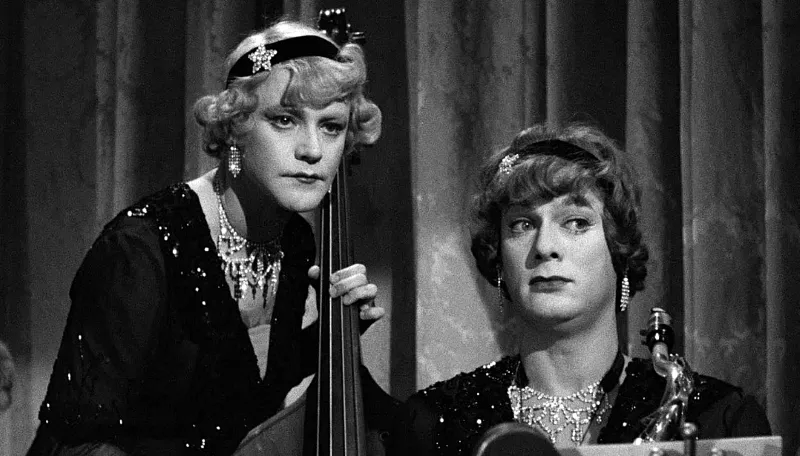
Joe is drawn in too, and Sugar tells him she has sworn off tenor sax players and dreams of a sensitive millionaire who wears glasses.
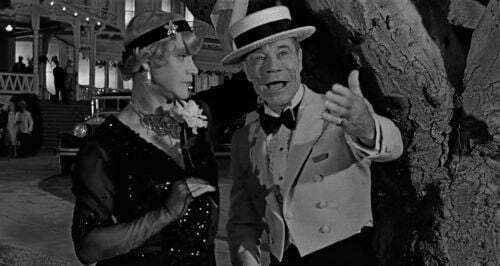
At the Florida hotel, a wealthy and much-married man named Osgood Fielding III starts chasing Daphne. Joe steals a suitcase of clothes and glasses, poses as Junior, heir to the Shell Oil fortune, and wins Sugar’s attention. He then convinces her that a shock in his youth left him impotent and that nothing has cured him. Sugar sets out to fix this.
While Jerry keeps Osgood busy dancing a tango, Joe and Sugar use Osgood’s yacht. By dawn Jerry is back, delighted and engaged, planning to reveal himself after the wedding and collect alimony from an annulment. Osgood has given him a diamond bracelet.
Act three, the mob arrives. A “convention” of gangsters gathers at the hotel under the cover of an opera society, led by Little Bonaparte.
Spats arrives too, and he works out who the two musicians are when he finds bullet holes in Jerry’s bass. Joe, trying to leave quietly, phones Sugar and says Junior must go to Venezuela for an arranged marriage. He sends the bracelet to her as a goodbye gift.
The pair flee and hide under a banquet table, where Bonaparte presents Spats with a giant birthday cake. A gunman bursts out of it and kills Spats and his men.
Joe and Jerry run again. Joe hears Sugar singing a lament to lost love, climbs onstage as Josephine, and kisses her. Sugar realizes Josephine and Junior are the same person and follows them to the dock, where Osgood waits with a boat.
Joe pulls off his wig, admits he is a liar and a phony, and Sugar says she does not care. Meanwhile Jerry lists every reason he cannot marry Osgood: he smokes, he is not a natural blonde, he cannot have children.
Osgood shrugs each one off. Jerry finally tears off his wig and says, “I’m a man!” and Osgood answers, “Well, nobody’s perfect!” .
Why does the comedy work so well, and where does it wobble?
The engine is a double disguise. Joe and Jerry are hiding from killers, which gives every scene stakes, and each of them is also lying to a person he has come to like. The script keeps those pressures in constant contact. Steven Cohan’s book-length study praises the film’s “near perfect comedic structure”, and I agree. A gag in the first ten minutes (the bass, the coats, the falsetto phone call) is usually paid off later.
The film also changes gears at the right moment. For most of its length it is a farce about wigs and close calls. Then Joe, as Josephine, watches Sugar sing a song of heartbreak and drops the act to comfort her. Roger Ebert called the movie “one of the enduring treasures of the movies”.
He argued elsewhere in the same review that the leads think they want only sex or only money, and are startled to discover they want each other. I think that is the film’s real secret. Under the cross-dressing, it is a love story about two people who lie their way into the truth.
Now the wobble. A Sight and Sound archive review by Peter John Dyer thought the gangster sequences were the weakest part. He said there was too much random detail and that one blood-bath could have gone.
He even singled out the Capone-style reunion dinner, well acted but unrelated, as a set piece that could have been done more simply. I half agree.
The mob plot is thinner than the romance, and some of its gags (the coin-flipping thug is a nod to Raft’s own Scarface) are for film buffs. In contrast, the cake scene is a perfect piece of pressure release, and the dinner gives the third act its ticking clock. Without it, Joe and Jerry would have no reason to run to the boat.
The Los Angeles Times review was also lukewarm. Under the headline “Not as Hot as Expected,” it was unsure what kind of comedy this was (AFI).
That uncertainty is, to me, the film’s strength. It is a gangster picture, a musical, a romance, and a screwball chase at once.
How good are the performances?
Jack Lemmon as Jerry/Daphne. Lemmon earned an Oscar nomination for the role and a Golden Globe. His Daphne starts as a panicking man in heels and ends as someone who is, for a moment, genuinely happy to be wanted. It was the first of seven films he made with Wilder.
Tony Curtis as Joe/Josephine/Junior. Curtis has the hardest job, playing three levels of fakery. His Cary Grant voice is silly on purpose, and the LA Times reviewer disliked it. I find it the funniest thing he does, because Joe is a bad liar who keeps getting away with it.
Marilyn Monroe as Sugar Kane. Monroe won a Golden Globe, and Wikipedia says she saw Sugar as another “dumb blonde” before taking the part. Her work is far subtler than that label. Sugar is funny, wounded, and hopeful in the same scene, and she sings “I Wanna Be Loved by You” and “I’m Through with Love” with a real ache.
The supporting cast. Joe E. Brown’s Osgood is unbothered in a way that makes the last scene work. George Raft and Edward G. Robinson Jr. play gangsters with a wink. Nehemiah Persoff’s Little Bonaparte, according to the Sight and Sound archive review, was chillingly well acted.
The chemistry I remember most is between the two men. The train party and the tango with Osgood (Wikipedia) both depend on Lemmon and Curtis reading each other’s panic.
What is Some Like It Hot really about?
On the surface it is about disguise. Underneath, it is about the price of performing a self to get what you need. Joe lies to get money, work, and a woman. Jerry lies to survive.
Sugar, in her own way, performs too, because she has built a “dumb girl” image to cope with men who keep leaving her. The BBC’s Nicholas Barber summed the film up as an anthem in praise of tolerance and the possibility of transformation.
Sexual politics run through every scene. An encyclopedia entry on the film says much of its best comedy comes from looking at sexual identity. In 1959, that was risky enough to trigger the Legion of Decency letter described above. The film’s answer is its last line. Osgood does not need Jerry to be anything other than what he is, and the movie never makes him explain why.
Modern audiences read that moment in several ways, as a joke about a lonely eccentric, as an unspoken queer romance, or as pure farce. I think the film earns all three readings because Wilder and Diamond left the line open.
I would not call the film spotless. Joe’s impotence con is manipulative, and it works because Sugar is kind. The movie lets him off with a confession and a kiss. A modern viewer can enjoy the scene and still notice that it rewards a man for a long lie. I think the film is stronger when you hold both thoughts.
How does Some Like It Hot compare with Tootsie?
It set the template that later disguise comedies keep borrowing from, and I think few have matched its mix of fear, farce, and real feeling.
TCM’s Rob Nixon lists the overlaps with Tootsie (1982): an entertainer cross-dresses to get work, a man learns what a woman wants and uses it to win her, he ends up nervously sharing a bed with a female co-star, and the experience makes him more sensitive (TCM).
Nixon calls these similarities, not a proven line of descent. He also notes that Frankie Avalon and Dwayne Hickman in Ski Party (1965) clearly studied Lemmon and Curtis.
The Hofstra Chronicle draws a useful line between the films. In Tootsie and Mrs. Doubtfire (1993), the plot depends on a disguise that has to hold up. In Some Like It Hot, the point is watching the men stumble, not believing in them. I agree. Nobody is fooled by Daphne except Osgood, and that is the joke.
The Birdcage (1996) took the next step. TCM says it showed that on-screen gay life could be upbeat and hilarious. Wilder’s film keeps its queer possibilities in subtext, while The Birdcage puts them up front. Neither approach cancels the other.
Wilder was also working inside a tradition older than film. The Golden Globes’ history of the subject says cross-dressing was a theatrical staple since medieval England, and Shakespeare used it in As You Like It and Twelfth Night, the same plays Shurlock named in his 1959 letter.
As for Wilder’s other work, he and Monroe had previously made The Seven Year Itch (1955), and he and Lemmon followed this film with The Apartment (1960). A film studies site lists Double Indemnity (1944) among his other credits, which shows how far he could swing between genres.
The story keeps returning to the stage, too. The musical Sugar opened on Broadway in April 1972 and ran for 505 performances. A touring revival in 2001 used the original title and starred Curtis as Osgood. The 2022 Broadway musical, with a book by Matthew Lopez and Amber Ruffin and music by Marc Shaiman, closed on December 30, 2023 after four Tony wins.
How did audiences and critics react, then and now?
Audiences loved it, and the early reviews were better than the legend says. The AFI notes that many modern sources call the 1959 reviews mixed, yet most were positive.
The story of the first preview is worth knowing. According to Diamond, the first screening at the Bay Theatre in Pacific Palisades drew a conservative, middle-aged crowd that barely responded. Two nights later, a second preview at the Village Theater in Westwood Village, filled mostly with university students, was enthusiastic. I find that detail oddly comforting. A great comedy can die in the wrong room.
Variety called it “probably the funniest picture of recent memory”. The New Republic’s Stanley Kauffmann called it a lulu. Time Out, Entertainment Weekly, and others followed in later decades, and Wikipedia lists No. 7 on Time Out’s 1998 poll and No. 9 on Entertainment Weekly’s 1999 list.
The money followed. Wikipedia reports that after opening in several cities in the week ended March 24, 1959, the film expanded to 100 theatres for Easter, became the number one film in the country, and stayed there for three weeks. In its first month it grossed $2,585,120 from 96 engagements, and The Numbers puts its domestic total at $25 million against a $2.9 million budget. As of the Wikipedia snapshot I checked on October 18, 2026, Rotten Tomatoes showed 95 percent positive from 73 critics, and Metacritic showed 98 out of 100 from 19 critics. Those numbers can change, so check the live pages before you quote them.
Who is it for? Casual viewers will find it easy. It is quick, funny, and cheerful in tone, and it needs no knowledge of the period. Film buffs get a masterclass in plotting, a Lemmon and Wilder partnership at its starting point, and a case study in censorship.
People who dislike farce, or who find female impersonation unamusing in any form, may not enjoy it. The BFI lists a 12 certificate, and the film includes two staged gangland killings, so I would treat it as suitable for older teens and adults.
The black-and-white photography is not a barrier, and as the color-test story shows, it was a deliberate choice.
What awards and honors did it win?
| Body | Result |
|---|---|
| Academy Awards | One win (Costume Design, black-and-white) and five more nominations: Actor (Lemmon), Art Direction, Cinematography, Director, and Screenplay |
| Golden Globes (17th ceremony, 1960) | Best Motion Picture, Comedy; Best Actor, Musical or Comedy (Lemmon); Best Actress, Musical or Comedy (Monroe) |
| WGA and BAFTA | FilmAffinity lists a Writers Guild award for best comedy screenplay and a BAFTA for Lemmon as best foreign actor |
| National Film Registry | One of the first 25 films inducted, in 1989 |
| AFI 100 Years…100 Laughs | Ranked first, in 2000 |
| AFI 100 Years…100 Movies | 14th on the original list, 22nd on the 2007 update |
| AFI 100 Movie Quotes | “Well, nobody’s perfect” at No. 48 |
| BBC Culture comedy poll, 2017 | First place, from 253 critics in 52 countries |
| Sight and Sound, 2022 | Tied for 38th with Breathless and Rear Window |
Two details deserve more attention than they usually get. The BBC’s own write-up says the film won largely because of critics from Europe, East Asia, and Latin America, and a summary of the results says American and Canadian critics would have put Dr. Strangelove first. S
eparately, RNZ notes that it is still the only pure comedy in the Sight and Sound top 50.
What can a 1959 farce teach us today?
It teaches that most of us perform some version of ourselves to get through the door, and that the people worth keeping are the ones who stop caring when the act slips. That is my reading, and I hold it loosely.
Start with the premise. Joe and Jerry do not dress as women out of conviction. They do it because they are broke, and because the alternative is a bullet. Many people change their voice, their clothes, or their opinions to get hired, even when the stakes are smaller.
The film’s quiet point is that the version of you that wins the job is not always the version that gets loved. Joe learns this the hard way. He builds Junior from a stolen suitcase and a borrowed accent, and Sugar falls for something real behind it.
The film’s answer to that problem is its last line, and the history of the line moves me. Diamond and Wilder wrote “Nobody’s perfect” as a placeholder, meaning to replace it, and never found anything better. Wilder later chose a variation for his own tombstone. I
f you write for a living, there is a lesson in that. Sometimes the plain line you scribbled to keep moving is the best thing you will ever write. Finishing beats polishing.
The line also works as a model for how to treat people. Osgood does not argue with Jerry, demand an explanation, or ask for an apology. He just keeps the engagement. The BBC’s Nicholas Barber called the film a celebration of tolerance and acceptance, and the final scene is that argument in its smallest form.
New generations keep rereading it, too. Cohan’s study says the film’s textual richness allows it to be viewed differently across generations.
The 2023 Tony for J. Harrison Ghee, described by New York Theatre Guide as one of the first non-binary performers to win a Tony Award, shows how a story from 1959 can take on new meaning. That same guide says the musical changes some characterizations, which is what a living classic should invite.
A caution to finish. Joe’s long lie to Sugar should not be copied, and the film is too comfortable with it. I enjoy the movie while noticing that its hero is rewarded for deceit. The confession on the dock matters because it is the moment the film stops flattering him. I think comedy ages best when it builds on desire and fear, not topical jokes, and that may explain why a 1959 farce is the only pure comedy in the Sight and Sound top 50.
Which lines from the film are worth remembering?
I keep these brief on purpose. They are the film’s lines, quoted for review.
“Well, nobody’s perfect!” Osgood’s reply on the boat in the final scene, after Jerry reveals he is a man. The AFI ranks it No. 48 among American movie quotes.
“It’s me, Sugar.” The line Wikipedia says took 47 takes, though the AFI attaches the number to a different line.
“I always get the fuzzy end of the lollipop.” Sugar’s lament, which Slashfilm lists among the film’s most memorable quips and the Sopranu archive page also records.
“Men who wear glasses are so much more gentle and sweet and helpless.” Sugar’s description of her dream millionaire, which in the train scene where she confides in Joe, and which Joe then exploits by borrowing a pair of glasses.
What are the pros and cons?
| Pros | Cons |
|---|---|
| A tightly built script in which early gags pay off later (Cohan) | The gangster plot is the weakest part, as the Sight and Sound archive review argues |
| Lemmon, Curtis, and Monroe, all at the top of their form (Golden Globes) | Joe’s impotence con is manipulative, and the film forgives it quickly |
| One of the most quoted last lines in American film (AFI list) | Sugar is partly built from a “dumb blonde” type, which Monroe herself saw as another “dumb blonde” role |
| A sharp black-and-white look, with an Oscar-winning costume design | Some viewers will not enjoy female impersonation as a comic device |
| Warm and funny enough for first-time classic viewers | A two-hour running time (AFI) with a slow-ish mob thread in the middle |
Should you watch Some Like It Hot 1959?
Yes. It is one of the rare comedies that survived its own reputation. It was condemned by a Catholic review board, trimmed by Kansas, nearly lost at its first preview, and then voted the best of its kind by two major polls.
The Sight and Sound critic’s complaint about the gangsters is fair, and Joe’s con deserves a raised eyebrow, but neither damages the film’s heart. If you have one evening for a classic comedy, this is a safe, rewarding choice.
My rating: 4.5 out of 5.
Best for: first-time classic film viewers, fans of Billy Wilder, Lemmon, or Monroe, anyone curious about the Hays Code era, and writers who like carefully plotted farce. Less suited to: viewers who dislike farce or who want a modern treatment of gender and identity.
Frequently asked questions
Is Some Like It Hot 1959 in black and white?
Yes. Wilder shot it in black and white after color tests made the drag makeup look grotesque.
Did it win Best Picture?
No. The AFI lists six Oscar nominations and one win, and Best Picture is not among them.
Is it based on a true story?
Not really. The murder is loosely based on the 1929 St. Valentine’s Day Massacre, but the characters and the band plot are fictional.
Why was Kansas upset?
The state’s Board of Review wanted more than one hundred feet cut, mostly from the love scene between Sugar and Shell Oil Junior, and distribution there was delayed for two months.
Related reading on Sopranu
I checked the site for related pieces. These titles appear in the site’s film archive. I could confirm the titles, not their full text, so please check that each page still matches the link text before publishing.
- Casablanca (1942): The Romance That Never Goes Out of Style, a classic romance from the same studio era
- The Rules of the Game (1939): Jean Renoir’s Classic Explained, a social satire that also sits in the Sight and Sound conversation
- 101 best films you need to see, the site’s wider list, where the older Some Like It Hot post is already filed
Some Like It Hot

Director: Billy Wilder
Date Created: 2026-11-05 22:51
4.5
Pros
- Tightly built script; Lemmon, Curtis, and Monroe at their best; a classic last line; Oscar-winning costumes; warm and quick
Cons
- Weaker gangster subplot; Joe's manipulative con; Sugar's "dumb blonde" shading; female impersonation may not suit every viewer







