
Last updated on January 15th, 2026 at 11:54 pm
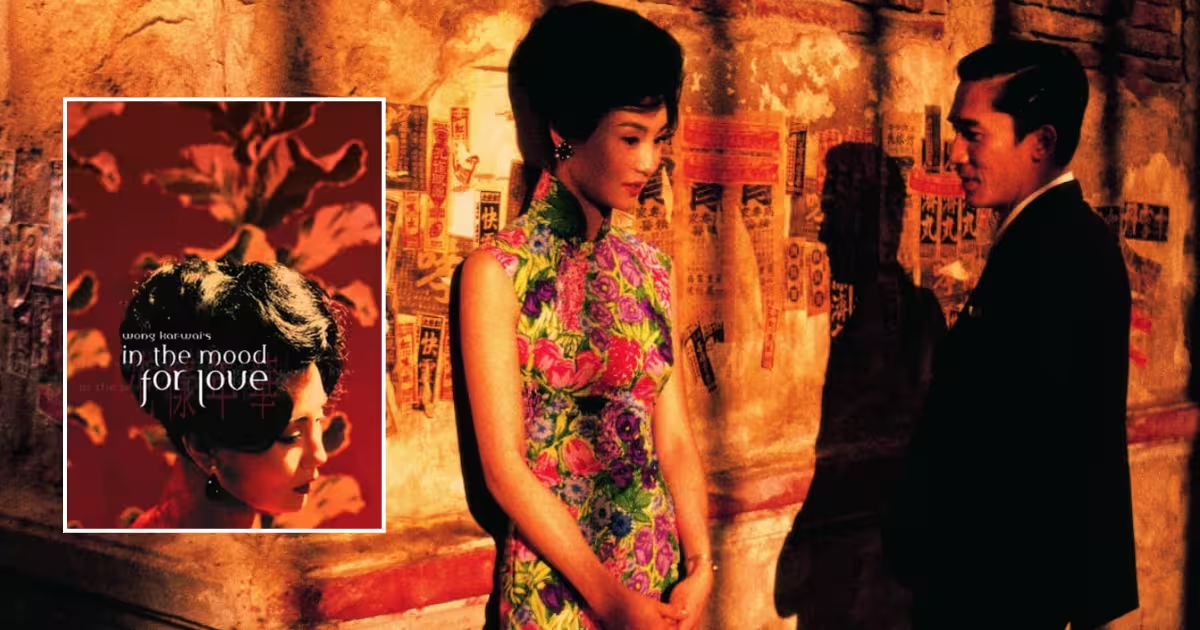
If you’ve ever wondered how a film can make two people walking to a noodle stall feel like the most suspenseful romance on earth, In the Mood for Love (2000) is the answer.
In the Mood for Love is a Chinese romantic drama film about a married woman, Mrs Chan, and a married man, Mr. Cow, who became friends to discover their spouses’ involvement in infidelity, but rather fell in love with each other. Mr Chan was having an affair with Mr Chow’s wife who often stays at work and Mr Chan who often stays abroad on his business trip.
The theme coincides with the latest viral news about a woman who fell in love with her husband’s girlfriend’s husband. But for lack of courage of Chow, Su Li-zhen’s love did not result in marriage.
Table of Contents
1. Introduction
Wong Kar-wai’s In the Mood for Love is a Hong Kong–French romantic drama that premiered at Cannes in May 2000, and it has somehow become both a cinephile touchstone and a film people whisper about like a private memory.
It stars Maggie Cheung and Tony Leung Chiu-wai as neighbours in 1962 Hong Kong whose spouses are having an affair.
When I think about it now, I don’t remember “plot” first—I remember fabric, wallpaper, cigarette smoke, and the ache of almost saying the thing you mean.
I came to it expecting a famous love story and left feeling like I’d watched two people negotiate dignity in the middle of heartbreak.
It’s one of those films where the camera seems to breathe with the characters, so even silence feels like dialogue.
And while it’s often called “romantic,” my lasting impression is that it’s really about restraint—how it can be noble, and how it can also quietly ruin you.
What follows is my personal, spoiler-heavy walk through the film, written for anyone searching “In the Mood for Love ending explained” and hoping for something more human than a summary.
2. Background
The film is set in British Hong Kong in 1962, among Shanghainese expatriates living in tight rented rooms where neighbours are always within earshot.
At Cannes, Tony Leung won Best Actor, which mattered not just as a trophy but as an international signal that Hong Kong cinema could be both stylish and devastatingly adult.
Decades later, the film’s reputation hardened into something like consensus: the BFI notes its “top five placement” in the Sight and Sound Greatest Films of All Time poll, where it sits in fifth place.
Because bbc.com is blocked to me here, I can’t cite BBC Culture directly, but Vanity Fair reports that the BBC’s critics’ poll placed the film at number two on its “100 Greatest Films of the 21st Century” list.
Basic facts are unusually clean for a Wong film: it runs about 98 minutes.
And the soundscape is part of the seduction—Nat King Cole’s Spanish-language songs drift through the story like borrowed warmth you can’t keep.
Critics’ aggregate sites still read like a victory lap: Rotten Tomatoes shows a 92% critics score, and Metacritic lists a score in the high 80s.
Box-office reporting varies by tracker and release set: Box Office Mojo lists worldwide grosses around the low tens of millions for tracked releases, while The Numbers reports a worldwide total around $14 million, so I can’t confirm a single “definitive” number without caveats.
Before we go further, consider this a full spoiler warning—because the power of In the Mood for Love (2000) is inseparable from where it finally leaves its characters.
Top Cast at a Glance
Tony Leung Chiu-wai as Chow Mo-wan — a lonely journalist in 1960s Hong Kong who discovers his wife is having an affair with his neighbor’s husband, leading him to form a deep, restrained romantic connection with the betrayed wife next door.
Maggie Cheung as Su Li-zhen (Mrs. Chan) — an elegant secretary who realizes her husband is cheating with her neighbor’s wife, gradually developing profound unspoken feelings for the man renting the adjacent room.
Key Supporting:
Rebecca Pan as Mrs. Suen — the friendly yet intrusive Shanghainese landlady who adds social pressure and period texture.
The film’s power lies almost entirely in the magnetic, subtle chemistry between the two leads.
3. In the Mood for Love plot summary
In 1962, Chow Mo-wan and Su Li-zhen move into neighbouring rooms in a crowded apartment building where privacy is basically a fantasy and everyone’s life leaks into the hallway.
Chow is a journalist who keeps odd hours, and Su works as a secretary, and both are introduced as people already practising loneliness inside marriage.
Their spouses are present mostly as absence—voices off-screen, schedules that don’t match, the kind of “busy” that starts to feel suspicious.
Because the landlady and neighbours are sociable and watchful, Chow and Su spend a lot of time politely navigating shared spaces, learning each other’s habits in the way neighbours do when walls are thin.
The first real crack appears through objects: Chow notices his wife has a handbag that’s hard to get, and Su recognises a tie on her husband that matches one Chow owns.
Neither of them wants to be the paranoid spouse, but the coincidences stack up until denial becomes harder than truth.
Once they accept what’s happening, they do something both tender and dangerous: they start trying to reconstruct how the affair began, almost like two grieving detectives rehearsing the crime.
At first, their re-enactments feel like a coping mechanism—if they can understand the betrayal, maybe it will hurt less.
Chow invites Su to help him write a martial-arts serial, which becomes their socially acceptable excuse to spend time together.
But in a building full of eyes and gossip, even two people talking too softly can look like a scandal, and they begin to sense that “innocence” isn’t something others will grant them.
So Chow rents a hotel room—not for sex, not for an affair in the obvious sense, but for privacy, which in this story is almost as intimate.
In that hotel room, what grows between them is mostly made of pauses: they share meals, drafts of stories, half-finished sentences, and the mutual understanding that they are standing at the edge of becoming the people who hurt them. They keep returning to the line they don’t want to cross, repeating it like a prayer, and yet the very repetition proves how badly they want what they’re refusing.
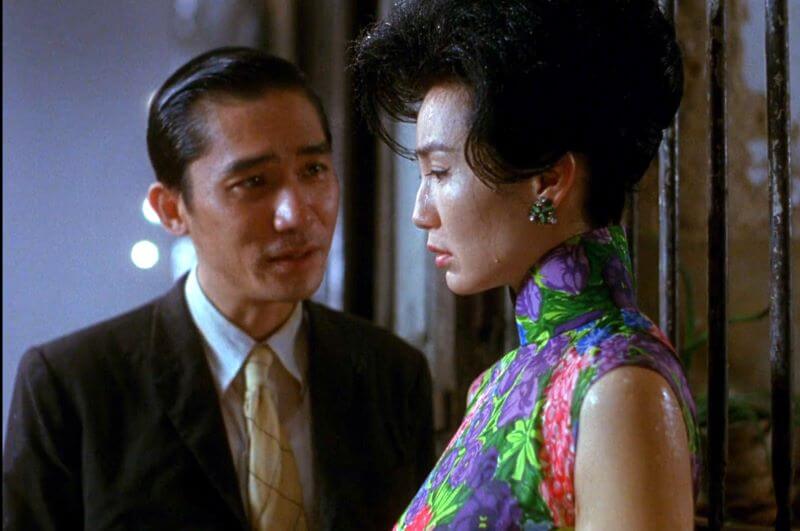
Their relationship becomes a strange double-life: publicly they are careful, formal, “proper,” and privately they are practicing emotional honesty with the one person who can truly understand their humiliation.
And this is where Wong’s cruelty—his emotional accuracy—kicks in, because closeness without permission doesn’t stay neutral; it either becomes love, or it becomes a wound.
As they continue to roleplay conversations—how the cheating spouses might have confessed, how desire might have been voiced—Su begins to flinch at what they are doing, as if the performance is turning real in a way she didn’t agree to.
Chow seems more willing to let the bond deepen, not because he’s reckless but because he’s starving for a love that doesn’t lie to him.
Then opportunity arrives wearing the mask of escape: Chow receives a job offer in Singapore and asks Su to come with him.
She agrees, which is the film’s quiet thunderclap, because the most disciplined person in the story finally admits—at least to herself—that she wants a different life.
But she arrives too late to meet him, and instead of a dramatic confrontation, we get something more brutal: an empty room and a woman breaking down in private, the way real regret usually happens.
This is the turning point where the film stops asking “will they?” and starts asking the sadder question: “what does love become when timing fails?”
After Chow relocates, time passes in fragments—like memory does—and Su later visits his apartment in Singapore, calling him and saying nothing when he answers.
When Chow later notices signs she had been there, the moment lands like a ghost story: proof of love, delivered too softly and too late to change anything.
Years later, both circle the old neighbourhood like people returning to a place where their younger selves are still waiting, and fate pulls a final trick by letting them miss each other again—physically close, existentially separated.
The ending crystallises the film’s philosophy in a mythic gesture: Chow travels to Cambodia during the Vietnam War era and visits Angkor Wat, where he whispers his secret into a hollow and seals it, as if love is something you must bury to survive.
Then in 1966, during the reign of Prince Norodom Sihanouk, Mr Chow went to Cambodia. Then he found a hole in the wall of Banteay Samré site to tell his secrets that he could not tell Mrs Chan. His secrets lied buried inside the whole with straw.
That final act is not about forgetting—it’s about containment, the way some feelings don’t end so much as they get stored inside you, packed away behind a wall you pretend is solid.
And if you’re looking for a clean “ending explained,” mine is this: they don’t choose each other in the practical sense, but they also never truly return to who they were before, because the cost of restraint is that it preserves love in amber, beautiful and unlivable.
4. In the Mood for Love analysis
1. Direction and Cinematography
Wong Kar-wai’s vision captures repressed desire through a dreamlike lens.
He tells the story with deliberate restraint, using lingering shots and slow-motion sequences to evoke unspoken emotions. The fragmented narrative mirrors memory and lost time.
Visual motifs like narrow corridors and rain-soaked streets heighten intimacy and isolation.
Notable techniques include rich color palettes dominated by reds and greens, frame-within-frame compositions, and reflective surfaces that suggest hidden truths.
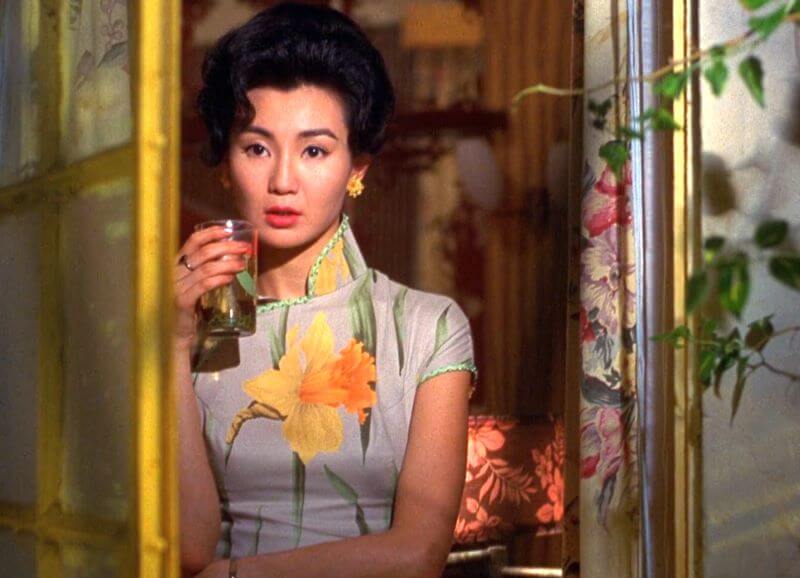
The cinematography, primarily by Christopher Doyle with contributions from Mark Lee Ping-bin, creates a hypnotic rhythm through handheld intimacy and precise long takes. Maggie Cheung’s ever-changing cheongsams become visual poetry, symbolizing fleeting beauty.
2. Acting Performances
Maggie Cheung and Tony Leung Chiu-wai deliver career-defining performances of quiet devastation.
Cheung conveys volumes through posture and glance alone, her restrained elegance masking deep longing. Leung brings brooding melancholy, his subtle expressions revealing inner turmoil. Their chemistry is electric yet chaste, built on glances and near-touches rather than overt passion.
Standout moments include the hotel room rehearsals where they role-play their spouses’ affair, blurring reality and fantasy.
The supporting cast, particularly Rebecca Pan as the landlady, adds authentic period texture without overshadowing the leads. Their unspoken connection feels profoundly real, making the film’s emotional restraint possible.
3. Script and Dialogue
Wong Kar-wai’s screenplay thrives on understatement and implication rather than exposition.
Strengths lie in its poetic minimalism—dialogue is sparse, letting silence and gesture carry the emotional weight. The pacing is deliberately slow, building tension through repetition and anticipation. Weaknesses may appear in its elliptical structure, which demands patience from viewers.
The dialogue feels authentic to 1960s Hong Kong’s social constraints, full of polite deflections and coded meanings.
Overall, the script masterfully conveys profound emotion through what remains unsaid.
4. Music and Sound Design
The score perfectly complements the film’s melancholic tone of longing and nostalgia.
Shigeru Umebayashi’s recurring “Yumeji’s Theme” waltz becomes a leitmotif for unfulfilled desire, its strings swelling during moments of near-intimacy. Nat King Cole’s Spanish-language tracks add exotic melancholy, contrasting with the characters’ restrained reality.
Zhou Xuan’s title song evokes lost Shanghai glamour. The sound design emphasizes ambient details—rain, footsteps, mahjong tiles—that heighten isolation.
These elements create an immersive atmosphere where music often expresses what characters cannot.
5. In the Mood for Love Themes and Messages
The film explores unconsummated love as both tragedy and preservation of beauty.
Central themes include the passage of time (“flowery years”), social restraint in 1960s Hong Kong, and the weight of unspoken secrets.
Chow and Su’s decision not to act on their feelings, despite mutual attraction, reflects Confucian-influenced propriety and fear of becoming like their cheating spouses.
The Angkor Wat ending literalizes burying secrets, suggesting some emotions are too precious to express. Broader commentary touches on exile, memory, and how societal norms shape personal desire.
Today, in an era of instant gratification, the film asks whether restraint can make love more meaningful.
Comparison
In the Mood for Love refines themes from Wong’s earlier Days of Being Wild while anticipating 2046’s fragmented time structure.
Compared to Chungking Express or Fallen Angels, it trades frenetic energy for contemplative stillness. Against other unrequited love stories like Brief Encounter, it feels more sensual despite greater restraint.
What sets it apart is its fusion of visual splendor with emotional austerity—no other film makes longing feel this beautiful.
It falls short only for viewers seeking plot-driven narratives rather than mood pieces.
Its influence on filmmakers like Barry Jenkins and Sofia Coppola underscores its unique status in modern cinema.
5. Audience Appeal/Reception
This arthouse masterpiece primarily appeals to cinephiles and fans of slow cinema.
Casual viewers may find its deliberate pacing challenging, but patient audiences discover profound rewards. It’s particularly resonant for those interested in Asian cinema, fashion, or stories of repressed emotion.
Major awards include:
- Cannes Best Actor (Tony Leung)
- Technical Grand Prize
- Multiple Hong Kong Film Awards
- International critics’ prizes
- Consistent ranking among the greatest films of the 21st century (e.g., #5 in 2022 Sight & Sound poll)
6. In the Mood for Love quotes
“[T]he role of Tony in the film reminds me of Jimmy Stewart’s in Vertigo. There is a dark side to this character. I think it’s very interesting that most of the audience prefers to think that this is a very innocent relationship.
These are the good guys, because their spouses are the first ones to be unfaithful and they refuse to be. Nobody sees any darkness in these characters—and yet they are meeting in secret to act out fictitious scenarios of confronting their spouses and of having an affair.
I think this happens because the face of Tony Leung is so sympathetic.” — Wong Kar-wai
“When someone had a secret, they would climb a mountain, carve a hollow in a tree, whisper the secret into it, and seal it with mud.” — Ancient story retold in the film
7. Pros and Cons
| Pros | Cons |
|---|---|
| Stunning, poetic visuals | Deliberately slow pacing |
| Extraordinary lead performances | Minimal plot development |
| Evocative score and atmosphere | Demands patient viewing |
| Profound emotional resonance | Sparse dialogue may frustrate |
| Timeless exploration of longing | Not for action-oriented viewers |
8. Personal Insight
In 2026’s hyper-connected world, In the Mood for Love feels more relevant than ever.
The film’s core lesson—that some desires are more powerful when left unfulfilled—stands in stark contrast to today’s dating app culture of instant matching and immediate gratification.
Chow and Su’s restraint preserves the purity of their connection, suggesting that consummation might diminish its magic. This resonates deeply in an era where relationships often feel disposable, and social media encourages constant performance of intimacy rather than genuine longing.
Modern audiences, bombarded with explicit content, may find the film’s sensuality through suggestion revolutionary.
Its meditation on time’s passage speaks to contemporary anxieties about aging in a youth-obsessed digital age. The title’s “flowery years” metaphor reminds us that beauty and possibility are fleeting, yet memory can preserve them eternally.
In conservative societies today, the film’s exploration of propriety versus passion remains poignant, while in liberal ones, it questions whether we’ve lost something valuable in our pursuit of total freedom.
Ultimately, Wong Kar-wai teaches that true intimacy sometimes lives in the spaces between words and touches.
The film’s enduring power lies in validating the beauty of unspoken love, offering comfort to anyone who’s ever held back feelings to preserve their sanctity. In our age of oversharing, it quietly advocates for the dignity of restraint.
In the similar vein, I liked the way In the Mood for Love shows life and presents. The scenes were serene, and slow but addictive, as they must be in a natural setting. For me, that’s what makes the film riveting and realistic. It gives a sense of authenticity of life in the unfettered race of survival.
The race of life must be slowed down to realise its beauty, and simple uncomplicated to enjoy it. Marriage, children and unbridled expectations make our lives complicated
Apart from its romantic side, I thoroughly was spellbound to see how genuinely and flawlessly Maggie Cheung acted as Mrs Chan. Not only fascinatingly beautiful she is, but she also upholds life to its true essence, considering the circumstances of a woman dissatisfied by her married life and a timid lover, much like Ashley Wilkes in Gone with the Wind.
I replayed the scene many times where she was rehearsing with Mr Chow to prepare him to depart from her.
At the end of the act, when she saw that Mr Chow was really walking away, she turned her face towards the wall and looked completely emptied while gazing at the emptiness of life without someone to love and be loved.
I think I would always force myself to remember their conversation regarding married life. “Everything changes when you marry”, said Mr Chow. “l didn’t know married life would be so complicated! When you’re single, you are only responsible to yourself. Once you’re married, doing well on your own is not enough”, agreed Mrs Chan.
Nevertheless, In the Mood for Love is a great movie, especially for those who like to enjoy something slow, poignant, inconspicuous and yet profound. Love just happens the way it happened between Mr Chan and Mrs Chow, and Mr Chow and Mrs Chan.
The way Chow stared at her, as a night lover stares at the moon with an unfathomable and unquenchable thirst, and Su Li-zhen looked at him, I feel like what human beings need is something pleasant beside them to look at.
They need something or someone looks at cravingly, pleadingly as if in it lies the eternity, the life and the death. Because it gives us a sense of our own value through being valued by being loved by others.
It helps us to be happy and joyful. I must quote what John Keats said, “a thing of Beauty is a joy forever.” Simplicity is beauty, falling in love with what is beautiful makes us think beautifully.
9. Conclusion
In the Mood for Love stands as one of cinema’s most beautiful meditations on desire, restraint, and the ache of what might have been.
A must-watch for anyone who appreciates visual storytelling and emotional depth—essential viewing for cinephiles, highly recommended for patient audiences seeking profound romantic cinema.
Rating: 5/5 stars







