
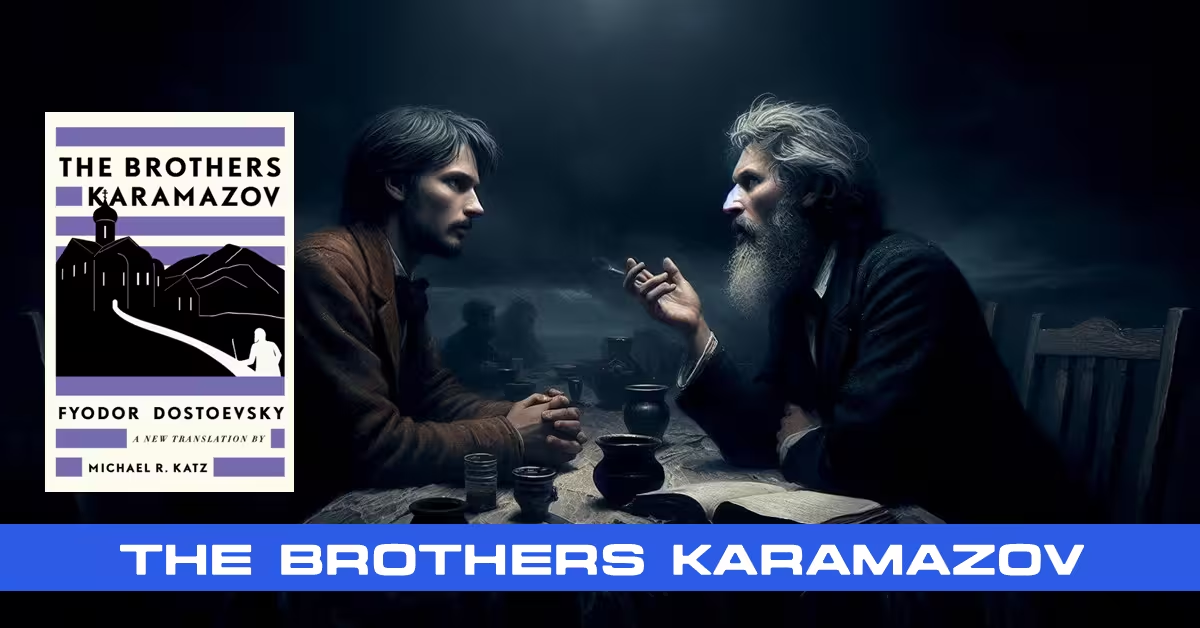
Last updated on October 24th, 2026 at 03:44 pm
The Brothers Karamazov is Dostoevsky’s sixteenth and final novel, a murder story that doubles as an argument about God, and the short answer to whether it is worth the effort is yes, provided you accept what it does to you. It tires you with monastery debates, drunken confessions and a courtroom that runs for chapters.
Then it quietly moves the guilt for one killing off a single suspect and onto everybody who wanted it, said it, allowed it or looked away.
I finished it feeling accused. That is the angle this review follows: not only who killed old Fyodor Karamazov, but why the book will not let any reader stay innocent.
Table of Contents
At a Glance
What it is: a family tragedy, a whodunit and a philosophical debate in one book. It was serialized in The Russian Messenger from January 1879 to November 1880, and Dostoevsky died less than four months after it finished.
The plot in one line: the brutal landowner Fyodor Pavlovitch Karamazov is murdered. His hot-blooded son Dmitri (Mitya) is convicted of it, but the real killer is the epileptic servant Smerdyakov, who believed he was acting on the intellectual Ivan’s ideas. Gentle Alyosha is left to hold what remains of the family together.
The killer: Smerdyakov struck the blow with a paper-weight and confessed it to Ivan, then hanged himself. Mitya is sentenced to twenty years of penal servitude anyway.
The big idea: responsibility in this novel is shared. Zossima’s line that everyone is responsible for everyone is the moral engine, and Ivan’s “everything is lawful” is the poison it is meant to cure.
The famous chapter: “The Grand Inquisitor” (Book V, Chapter V), Ivan’s prose poem about Christ returning to Seville and being arrested by the Church.
My rating: 4.5 out of 5.
Who will love The Brothers Karamazov, and who may bounce off it?
If you enjoy novels where people argue until three in the morning and the argument actually costs them something, you will love this one, and so will anyone who wants a crime plot with real moral weight underneath.
Readers of Crime and Punishment who want the larger, looser, more forgiving version of that book will feel at home. People who enjoy courtroom drama will get a trial that is both tense and quietly absurd.
You may bounce if you need fast plotting, because the murder does not happen until well past the midpoint, and long stretches before it are given to a monk’s life story and a boys’ schoolyard feud.
You may also bounce if religious argument bores you, since about a quarter of the book is people debating faith, suffering and freedom. Start it when you have patience and a few uninterrupted weeks, not when you are looking for a weekend thriller.
Introduction
The Brothers Karamazov (Russian: Brat’ya Karamazovy) was written by Fyodor Dostoevsky, who was born in Moscow in 1821, arrested in 1849 over the Petrashevsky circle, and spent years in a convict prison in Omsk before he wrote the major novels of his late period.
Those prison years show up in the book, because Mitya’s trial and the convict life he faces afterward are drawn by a man who knew what penal servitude looked like. Dostoevsky died in 1881.
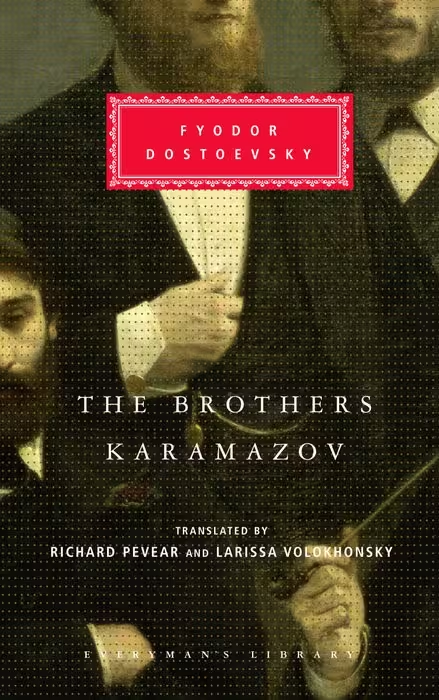
The edition I worked from is the Constance Garnett translation, the version that has endured for more than a hundred years, with the Pevear and Volokhonsky version as its best-known rival.
Is The Brothers Karamazov worth reading? Quick verdict
Quick Verdict: A sprawling, exhausting, morally merciless novel that turns a murder case into a trial of every reader. Recommended for patient readers of literary crime and big-idea fiction.
Rating: 4.5 / 5
What is it about? Three brothers and an illegitimate half-brother live in the shadow of their cruel, clownish father. When he is killed, suspicion falls on the sensual eldest son, while the truth runs through the intellectual middle son’s ideas and the servant who took them literally.
Underneath the plot sits the old question of whether anything is forbidden if God does not exist.
Should you read it?
| Pros | Cons |
|---|---|
| One of the great characters in fiction in Fyodor Pavlovitch, a monstrous man you cannot look away from | Slow first half, with long digressions before the murder |
| The Grand Inquisitor chapter is a short masterpiece you can read on its own | Heavy religious argument that some readers will find tiring |
| A real murder mystery with a real trial and a wrong verdict | Dozens of Russian names and nicknames for each person |
| An ending that is hopeful without being sentimental | Women characters are intense and vivid but often defined by what the men want |
| Moral questions that stay with you for weeks | Some secondary plots, such as the Hohlakov subplot, feel loosely tied |
What is the historical background of the novel?
The novel grew out of a much older ambition and a private grief. Dostoevsky made his first notes in April 1878 and folded in material from an unfinished project called The Life of a Great Sinner, and in May 1878 his three-year-old son Alyosha died of epilepsy, a condition inherited from his father.
He gave that boy’s name to the gentlest Karamazov, and the loss of a child sits behind Ivan’s furious chapter on suffering children and behind the grief of Captain Snegiryov. The setting is a provincial Russian town, and much of the writing took place in Staraya Russa, which inspired the town in the book. Dostoevsky had also planned a sequel, so what we have is the first half of an unfinished design.
It also matters that the book arrived in a Russia still arguing over modernization, atheism and the authority of the Church. Sigmund Freud called it “the most magnificent novel ever written”, and Lapham’s Quarterly reports that Albert Einstein, according to C. P. Snow, called it the supreme summit of all literature.
Those are large claims, but after finishing it I understand why people make them.
The Brothers Karamazov plot summary
The family and the monastery (Part I, Books I to III)
The narrator introduces Fyodor Pavlovitch Karamazov, a landowner and professional buffoon who has been married twice and cares for none of his children. His first wife, Adelaida Miusov, bore him Dmitri, nicknamed Mitya, and then left. Fyodor Pavlovitch more or less forgot the boy, and the servant Grigory looked after him until relatives took over.
His second wife, the meek Sofya, gave him two sons, Ivan and Alexey, called Alyosha, before she died. Those boys also drifted from relative to relative.
Living in the household as cook is a fourth son, Smerdyakov, the child of the village holy fool Lizaveta, who died in childbirth. Grigory and his wife Marfa raised him. Smerdyakov suffers from epilepsy and grows into a cold, resentful young man.
As adults, Mitya, an army officer, returns to the town to fight his father over the inheritance from his mother, and Ivan, a university-educated sceptic, comes from Moscow.
Alyosha, who is about twenty, has become a novice at the local monastery under the elder Zossima, a revered holy man. To settle the inheritance quarrel, the family agrees to meet at Zossima’s cell. The meeting is a disaster.
Fyodor Pavlovitch clowns and insults everyone, Mitya arrives late and bursts out with the cry “Why is such a man alive?”, and Zossima bows to the ground before Mitya, a strange gesture that Alyosha will understand only later. The scene ends in a shameful lunch at the Father Superior’s table.
In Book III, Mitya pours out his troubles to Alyosha in the garden.
He is engaged to the proud Katerina Ivanovna, whom he met through her father’s disgrace, and he is hopelessly in love with Grushenka, a local beauty whom his father also wants. Katerina had once entrusted him with three thousand roubles to post to her sister, and he squandered it on a wild spree with Grushenka at Mokroe.
Now he needs three thousand to restore his honour, and he believes his father owes him that much from his mother’s estate. Mitya also admits that he would kill his father if he could not contain himself.
In these chapters Smerdyakov argues religion with Grigory, and Ivan begins to speak with him as a thinker, which flatters the servant and does damage later.
Lacerations, rebellion and a monk’s life (Part II, Books IV to VI)
Book IV is a series of humiliations. Alyosha is sent to look after affairs and meets a group of schoolboys throwing stones at a sick boy, Ilusha.
It turns out that Ilusha’s father, Captain Snegiryov, was dragged by the beard out of a tavern by Mitya, and the boy has never forgotten. Alyosha tries to give the captain money from Katerina, and the captain throws it down and tramples it, then breaks into tears.
Alyosha also becomes close to Lise Hohlakov, a sharp, lame girl who proposes to him, while her mother, Madame Hohlakov, hovers over both of them.
Book V is the philosophical centre. Ivan takes Alyosha to a tavern and explains why he cannot accept God’s world. He lists cases of cruelty to children and refuses harmony built on a child’s suffering, saying he must “most respectfully return Him the ticket.” Then he tells Alyosha a poem he has composed, “The Grand Inquisitor.” Christ returns to sixteenth-century Seville at the height of the Inquisition, heals a blind man and raises a dead girl, and is arrested by the aged Cardinal Grand Inquisitor.
In the night the Inquisitor visits the cell and tells Christ that He was wrong to refuse the three temptations in the wilderness, that people cannot bear freedom, and that the Church has corrected His work with miracle, mystery and authority.
Christ says nothing, kisses the old man on his bloodless lips, and the Inquisitor, shaken, opens the door and tells Him to go and never come again. Alyosha answers by kissing Ivan, and the brothers part with unresolved tenderness.
Book V closes on the trap that will catch the family. Fyodor Pavlovitch keeps three thousand roubles in an envelope for Grushenka, and he has set up secret knocking signals with Smerdyakov so she can be let into the house.
Smerdyakov, who now has the signals, the layout of the house and the sleeping habits of everyone in it, plants a thought in Ivan: that Fyodor Pavlovitch needs protection, that Mitya is dangerous, and that Ivan should go away to a nearby village, Chermashnya, on a business errand for his father.
Ivan hesitates, hates himself, and in the end leaves for Moscow, which is the same as leaving the door open. He says goodbye with a feeling that something dirty has been agreed without words.
Book VI belongs to Zossima, who is dying. His life story is told in the form of recollections. He remembers his older brother Markel, who in dying young came to believe that “every one is really responsible to all men for all men and for everything.” Zossima also recalls a duel he refused to fight after he realised his own cruelty, and a mysterious visitor who confessed to a murder years before.
His teaching, that active love is a hard thing, becomes the counterweight to Ivan’s rebellion.
Corruption, the night of the murder and the arrest (Part III, Books VII to IX)
Zossima dies, and everyone expects a miracle. Instead, his body begins to decay faster than ordinary corpses, and the scandal shakes the monastery.
Father Ferapont, a fanatic ascetic, gloats. Alyosha is wounded in his faith. The cynical seminarian Rakitin takes him to Grushenka, expecting to watch the saint fall. But Grushenka, who has been waiting for a letter from a former lover, tells Alyosha the story of an onion, about a wicked old woman whose one good deed, giving an onion to a beggar, could not save her. Alyosha’s honest kindness moves her, and she cries.
He leaves, goes back to Zossima’s coffin, hears the Gospel of Cana of Galilee being read, falls asleep and dreams of the wedding feast. He walks out into the night, kneels, kisses the earth and is changed.
Book VIII follows Mitya through one terrible evening.
He runs through the town trying to raise three thousand roubles. He goes to the merchant Samsonov, who sends him on a fool’s errand to a priest-merchant named Lyagavy, and Mitya finds the man drunk and useless. He returns in despair.
Hearing that Grushenka has left her house, he runs to his father’s garden, sees Fyodor Pavlovitch at the window, taps the signal and, when his father opens the window, nearly goes through with it. At this moment Grigory catches him on the fence, and Mitya strikes the old man with a brass pestle he had taken from Grushenka’s house and runs. He believes he has killed Grigory.
He goes to Mokroe, where Grushenka is meeting her former lover, a Polish officer, and in the end she sees that she loves Mitya. They celebrate in a frantic party. At dawn the police arrive and arrest him for killing his father.
Book IX is the preliminary investigation. The prosecutor Ippolit Kirillovitch and the investigator Nikolay Parfenovitch examine Mitya, who is covered in blood and holding a great deal of cash.
Fyodor Pavlovitch has been found dead in his room with his head broken, an empty envelope on the floor, and the three thousand roubles gone. Mitya explains that he had already spent half of Katerina’s money at Mokroe and sewed the rest, fifteen hundred, in a pouch around his neck, which is why he has money at all.
Nobody believes him. Grigory says the garden door was open, and the signals are known only to Mitya and Smerdyakov, who is lying in a fit.
In the last chapter Mitya has a dream of a starving peasant woman and a crying baby, and he accepts that he must suffer for them all, even though he did not kill his father.
Ivan, the devil, the trial and the ending (Part IV, Books X to XII, and the Epilogue)
Book X returns to the boys. Kolya Krassotkin, a proud thirteen-year-old, befriends Alyosha, and the schoolboys, once cruel to Ilusha, gather at his bedside as he sickens. The healing of that feud runs in parallel to the family’s collapse.
Book XI is Ivan’s breakdown.
He visits Smerdyakov three times. In the first meeting, Smerdyakov hints that he knows more than he says. In the second, he suggests that Ivan wanted his father dead and left him as bait. In the third, Smerdyakov confesses everything. He says that he faked a fit, that he struck Fyodor Pavlovitch three times with a paper-weight, that he took the money from behind the icons, and that he hid it in the hollow of an apple tree. He then produces the three thousand roubles.
He says he did it because Ivan taught him that everything is lawful. Ivan staggers out, promises to tell the court everything, and that night is tormented by a hallucination of a shabby gentleman, the devil, who taunts him with his own arguments.
Alyosha arrives with news that Smerdyakov has hanged himself, leaving a note saying he destroyed his own life willingly so as to blame nobody.
Ivan is falling into brain fever.
Book XII is the trial, and it is the most gripping stretch of the novel. The town is packed. The prosecutor builds a psychological portrait of Mitya as a typical, violent Karamazov.
The defence lawyer Fetyukovich counters with an elegant speech that argues there was no money, no robbery and perhaps no murder by Mitya at all. Ivan breaks into the courtroom raving, produces the money and shouts that he incited Smerdyakov, asking “Who doesn’t desire his father’s death?”
The court sees a madman. Then Katerina Ivanovna, who had been defending Mitya, hands the judges a drunken letter Mitya once wrote predicting that he would kill his father.
That letter looks like a prophecy. The jury convicts, and the town’s peasant jurors, who stood firm, send Mitya to twenty years of penal servitude.
The Epilogue runs quietly. Mitya lies ill in the prison hospital, and Alyosha and Ivan plan an escape. Katerina, who still loves the idea of Mitya, visits Ivan, who is lying delirious in her care. Katerina and Mitya meet and forgive each other, and Grushenka plans to follow Mitya to Siberia.
Then comes Ilusha’s funeral. At the stone where the boy is buried, Alyosha speaks to the schoolboys and asks them to remember the dead boy and to remember each other, to “not be afraid of life,” and the boys answer with the last words of the book: “Hurrah for Karamazov!”
How does The Brothers Karamazov end, and who really killed Fyodor?
Smerdyakov physically killed Fyodor Pavlovitch, and he confessed it only to Ivan, who then fell apart before he could prove it in court.
Mitya is innocent of the murder, yet guilty of having wanted it, of having beaten Grigory, and of a lifetime of cruelty, which is why the book allows him to accept his sentence as a kind of purification.
Ivan is guilty of an idea that someone acted on. Alyosha is the only brother who carries no blood, and his final speech turns the novel from a case closed into a question handed to the reader.
Who are the key characters, and how do they change?
The four brothers are not four personalities so much as four answers to the same question, which is what a person does with the Karamazov appetite for pleasure, power and excess.
Zossima calls it “baseness” in the family, and Dmitri jokes that every Karamazov carries an insect of lust inside. The question is who tames it, and how.
Fyodor Pavlovitch Karamazov is the most vivid of them and the least redeemed. He plays the fool because it protects him, he abuses everyone he can, and he is afraid. His fear of Mitya and his greed over Grushenka put him in the room where he dies. He does not change, which is the point: he is the fixed star that the others orbit and push against.
Dmitri (Mitya) is the sensualist with a conscience. He is capable of sudden generosity and of savage violence, and he spends the whole novel in a fever of shame about money he took from Katerina.
His change is the quietest and the deepest. After the dream of the starving baby, he accepts that he must suffer, and at the end he says a new man has risen in him. What I admire is that Dostoevsky refuses to pretend Mitya is simply wronged. He beat Grigory with a pestle and he wished his father dead. The novel asks us to feel both facts at once.
Ivan is the intellectual, and I think he is the book’s real tragedy.
He is proud, cold on the surface and tortured underneath. His great argument against God and his “everything is lawful” are not villainy, they are honest despair. Yet he leaves town while Smerdyakov plans, and he lets the thought stand. Ivan’s descent into brain fever, his devil, and his raving in court are the price of an idea he never meant to be taken literally.
He is the character I argued about longest with myself.
Alyosha is the one who looks naive and turns out to be the strongest. He is not a saint in the plaster sense. He loses faith for a night when Zossima’s body decays, and he lets Rakitin lead him to Grushenka half hoping to sin. What he does well is stay present, and that matters more than any speech.
By the end, he has become the person the other brothers confess to, and the one the boys follow.
Smerdyakov is the most unsettling figure.
He is the bastard son, the cook, the epileptic, humiliated by everyone and flattered only by Ivan’s attention. He takes Ivan’s philosophy and acts on it with the cold logic of a man who has never been loved. His suicide note, saying he does it to blame no one, is the strangest moral gesture in the book.
Zossima is the counterweight to Ivan. His answers are not arguments but a way of living: ask forgiveness of the servants, bow to suffering, treat everyone as responsible for everyone.
Then his body decays, and the book lets that shock stand. Katerina Ivanovna and Grushenka are the two women the men fight over, and both are more than prizes.
Katerina’s pride is destructive and her false testimony nearly ruins Mitya, while Grushenka’s onion story shows a woman who understands mercy better than anyone in the monastery.
Themes and symbols in The Brothers Karamazov
The central theme is shared guilt. The novel starts as a whodunit and ends as a lesson in complicity. Mitya wanted the murder and nearly carried it out, Ivan allowed it to happen, Smerdyakov performed it, and Alyosha could not prevent it.
Zossima’s creed, that everyone is responsible to all for all, is not a vague sentiment here. It is the only description that fits the facts of this family.
The second theme is free will against determinism, and Ivan’s formula is the hinge. Early in the book, Dostoevsky’s novel is described as a work that deals with God, free will and morality, and the monastery scene is where Ivan states that there is no virtue without immortality. Smerdyakov takes that as permission.
What strikes me is that the book does not answer Ivan with an argument. It answers him with a funeral, a trial and a group of schoolboys.
The third theme is the suffering of children and the problem of evil. Ivan collects true stories of cruelty to children and concludes that no future harmony can pay for a single tortured child. It is a monstrous chapter to read and the strongest case against God I have met in fiction.
Dostoevsky then lets Alyosha answer only with a kiss, which is either inadequate or exactly right, depending on the day you ask me.
The fourth is freedom against authority, which is the Grand Inquisitor. The old Cardinal argues that people want bread, mystery and a master more than they want freedom, and that the Church has therefore taken their freedom from them for their own good. Christ answers with silence and a kiss. Many readers see this as a warning about every system, religious or political, that promises comfort in exchange for obedience.
The fifth is justice and the judicial error of Book XII.
The jury is not stupid. It convicts because the story hangs together, because the drunken letter looks like a prophecy, and because Mitya behaves like a guilty man. The chapter title says it all: a wrong verdict can feel completely reasonable from inside.
Symbols worth noticing:
The onion (Book VII): one small kindness is the only thing that could have saved the wicked woman, and it saves Alyosha and Grushenka from despair that night.
Cana of Galilee (Book VII): Alyosha’s dream of the wedding feast gives him joy instead of horror, and it reverses the mood of the decaying corpse.
Zossima’s decaying body: it tests whether faith needs a miracle.
The stones: the schoolboys throw stones at Ilusha, and later they gather at the stone where he is buried. The same object moves from cruelty to remembrance.
The three thousand roubles: the sum links Katerina’s honour, Mitya’s shame, Fyodor’s lust and Smerdyakov’s plan. Money is the ordinary thing behind the extraordinary ideas.
“Beauty”: Mitya’s remark that beauty is terrible, and that “the battlefield is the heart of man” (Book III, Chapter III) sums up the novel’s fear of desire and its respect for it.
Evaluation: what do I make of The Brothers Karamazov?
The Brothers Karamazov is an unruly, scalding and strangely tender novel that turns a murder into a mirror and holds it in front of you until you stop asking who did it and start asking who did not.
Strengths: what works
The characters are alive, even the minor ones. Fyodor Pavlovitch, Grushenka and Captain Snegiryov all stay in the mind after the book is shut. The trial is better than most modern courtroom fiction, because it is as interested in how people persuade each other as in what really happened.
The Grand Inquisitor is a self-contained masterwork that you can read in an evening. And the ending, with the boys at the stone, gives the book a warmth that surprised me after a thousand pages of dread.
Weaknesses: what drags
The first half is slow, and the narrator’s habit of apologising for digressions does not make them shorter. Madame Hohlakov and the Lise subplot feel loosely tied to the main story.
The women often exist through what the men want, though Grushenka and Katerina push hard against that. And you do need patience with Russian names, since each person has several, and with some long speeches that feel more like sermons than conversation.
Impact and controversy: why do people argue about this book?
Freud called it the most magnificent novel ever written and wrote a 1928 essay, “Dostoevsky and Parricide,” arguing that the novel’s father-murder reflected the author’s own guilt over his father’s death.
That reading is still debated. Most researchers say Freud’s diagnosis of Dostoevsky’s epilepsy as hysterical is wrong, and the novel’s own text tells us Dostoevsky’s epilepsy was real and inherited. For me, the impact is not the theory but the mood: I finished the book and kept noticing small cruelties I had been willing to ignore.
Comparison with similar works
Crime and Punishment is tighter and faster, and it follows a single guilty mind, whereas this book spreads guilt across a family. Dostoevsky’s late novels also include The Idiot, Demons and The Adolescent, and most readers treat The Brothers Karamazov as the culmination.
If you want a shorter, sharper study of a conscience facing death, Tolstoy’s The Death of Ivan Ilyich is the usual companion. For courtroom philosophy, nothing else quite does what Book XII does.
Adaptation: how do the screen versions compare?
The best-known English-language version is the 1958 MGM film directed by Richard Brooks, starring Yul Brynner as Dmitri, Maria Schell as Grushenka, Claire Bloom as Katerina and Lee J. Cobb as Fyodor, released in New York on 20 February 1958.
It was nominated for the Palme d’Or at Cannes, and Cobb received an Oscar nomination. One review puts it at about 145 minutes of screen time for nearly a thousand pages, which means it necessarily drops Smerdyakov’s inner life and most of the philosophy.
A Soviet adaptation by Ivan Pyryev, listed in study resources as a Soviet-era film that was nominated for an Oscar, runs far longer, and one blog puts it at 232 minutes. Sources describe it variously as a 1968 series and a 1969 film, so check the release you find. I could not verify box-office figures for any adaptation, so I am not quoting one.
Personal insight: what can The Brothers Karamazov teach us about wrongful convictions and shared responsibility?
Mitya is innocent of the murder and still convicted because the story against him is coherent. That is not only fiction. As of June 2025, the National Registry of Exonerations listed 3,698 known exonerations in the United States since 1989.
In its first report, the registry’s earliest cases averaged about 11 years in prison each before release, and by 2013 it found that 52 percent of the wrongful convictions it tracked involved perjury or false accusation, rising to 65 percent in homicide cases. The book shows how that happens, and it offers five lessons I find useful:
- A neat story is not proof. The jury trusts the narrative, so test the evidence before the plot.
- Ideas travel. Ivan never lifted a hand, yet his words armed someone else, so watch what you hand to people who have been starved of respect.
- Shared responsibility is not equal guilt. Zossima’s creed asks us to answer for each other, not to confuse the killer with the bystander.
- Small kindness repairs more than argument. The onion and the boys at the stone do what Ivan’s logic cannot.
- Do not lie to yourself first. Every brother’s catastrophe begins with a story he tells himself.
What are the best quotable lines in The Brothers Karamazov?
All lines are from the Garnett translation, quoted briefly with their location. They contain spoilers.
- “Why is such a man alive?” (Mitya, Book II, Chapter VI)
- “There is no virtue if there is no immortality.” (Ivan, Book II, Chapter V)
- “Love in action is a harsh and dreadful thing compared with love in dreams.” (Zossima, Book II, Chapter IV)
- “Above all, don’t lie to yourself.” (Zossima, Book II, Chapter II)
- “Beauty is a terrible and awful thing!” (Mitya, Book III, Chapter III)
- “I most respectfully return Him the ticket.” (Ivan, Book V, Chapter IV)
- “I don’t want harmony.” (Ivan, Book V, Chapter IV)
- “Every one is really responsible to all men for all men and for everything.” (Markel, retold in Book VI)
- “Who doesn’t desire his father’s death?” (Ivan in court, Book XII, Chapter V)
- “Hurrah for Karamazov!” (the boys, Epilogue, Chapter III)
Conclusion: should you read The Brothers Karamazov?
Yes, if you want a novel that argues with you, and you are prepared to be implicated by it. It is long, it drags in places and it asks for faith in a form you might not share.
Yet it also contains one of the best trials in literature, a chapter on freedom and authority that has outlived its century, and an ending that makes sense of the grief behind it. I recommend it to readers of Crime and Punishment, to anyone who enjoys philosophical fiction and to people who want to understand why this book is still quoted by novelists, psychologists and physicists. My rating is 4.5 out of 5.
The Brothers Karamazov
The Brothers Karamazov is Dostoevsky's sixteenth and final novel, a murder story that doubles as an argument about God, and the short answer to whether it is worth the effort is yes, provided you accept what it does to you. It tires you with monastery debates, drunken confessions and a courtroom that runs for chapters.
URL: #
Author: Fyodor Dostoevsky
4.5
Pros
- Unforgettable characters; the Grand Inquisitor chapter; a gripping trial; a hopeful ending
Cons
- Slow first half; heavy religious debate; many Russian names; loosely tied subplots







