
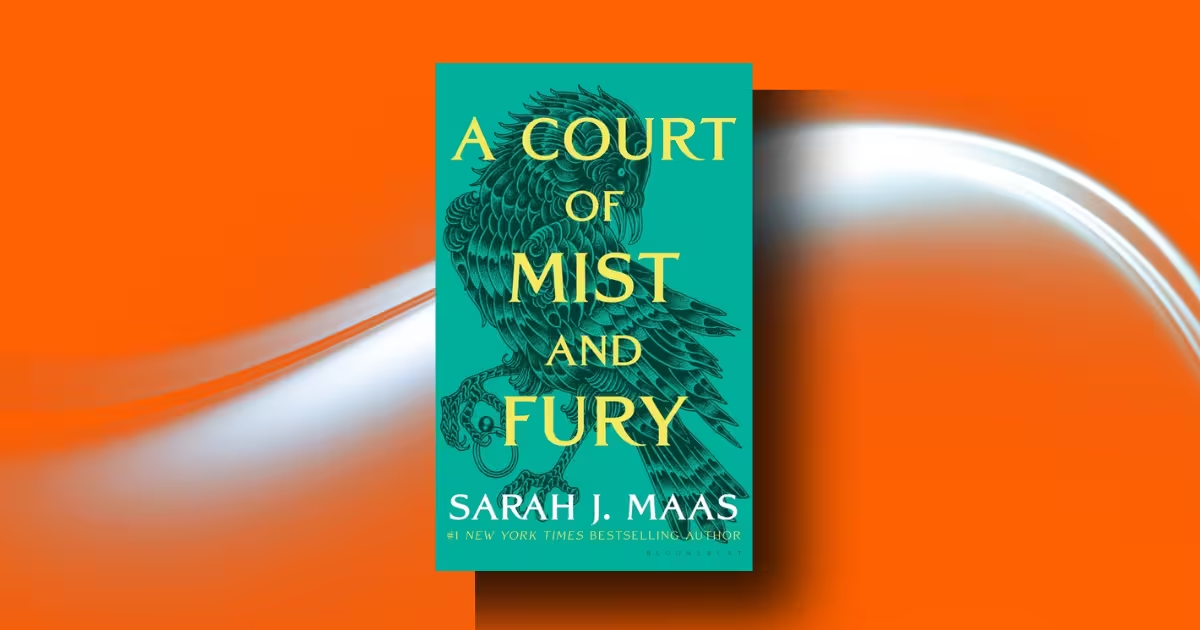

Did you ever wonder why a love story can feel wrong even when nobody has stopped saying “I love you”? That is why A Court of Mist and Fury stayed with me: it understands that healing is not being protected inside a beautiful cage—it is being trusted with the door open.
A Court of Mist and Fury is the story of Feyre Archeron learning that survival is not the same as living, and love is not real unless it gives you room to choose.
A Court of Mist and Fury is best for readers who enjoy romantasy, morally complicated love stories, trauma recovery arcs, found family, magical politics, “touch her and die” energy, and slow emotional rebirth.
Not for: readers who dislike explicit romance, long emotional processing, dramatic mate-bond mythology, or major relationship reversals after book one.
Table of Contents
1. Introduction
A Court of Mist and Fury by Sarah J. Maas is the second novel in the A Court of Thorns and Roses series.
The official Sarah J. Maas page describes it as the sequel in which Feyre survives Amarantha but returns to the Spring Court with a human heart that cannot forget what she did to save Tamlin’s people.
The series list places A Court of Mist and Fury as the 2016 follow-up to A Court of Thorns and Roses, with later books continuing the ACOTAR world.
2. Background
The story begins after the trauma of “Under the Mountain.” Feyre has survived death, been Made into High Fae, and returned to Tamlin’s Spring Court, but emotionally she is still trapped in the dungeon she escaped.
The book opens with nightmares, vomiting, guilt, and a frighteningly honest admission that she does not feel whole. One of the earliest repeated survival phrases is simply: “Real. Real.”
Outside the book, ACOTAR’s popularity has become part of the modern romantasy boom. PEOPLE reported in 2024 that the #ACOTAR hashtag had more than 1.3 million TikTok videos, which is a useful signal for search demand and reader curiosity.
That is why a high-traffic review should not merely ask, “Is Rhysand better than Tamlin?” The stronger AEO question is: What does ACOMAF teach about love, trauma, consent, and freedom?
3. A Court of Mist and Fury Summary
Feyre begins the novel in the Spring Court, supposedly approaching the happiest moment of her life: marriage to Tamlin. But the opening mood is not bridal joy. It is bodily panic.
She wakes from nightmares, vomits, counts breaths, and repeats to herself that she is real and alive. She has escaped Amarantha, but Amarantha has not escaped her. Tamlin is damaged too, yet their shared silence becomes its own prison. They do not heal together; they avoid together.
At first, Tamlin’s protectiveness looks understandable. He lost Feyre once. He heard her neck break. He knows enemies could use her against him. But Maas slowly turns that protection into suffocation.
Feyre wants to help rebuild villages, train, leave the manor, do something useful. Tamlin says no. Lucien sympathizes but obeys. Ianthe wraps Feyre in ceremony, clothing, symbolism, and political performance. Feyre is praised as savior, bride, blessing, and ornament, but not treated as a full person.
The wedding scene is the first major rupture.
Feyre walks toward Tamlin in a gown she hates, surrounded by watching courtiers and red petals that recall blood. She panics. She silently begs someone to save her. Rhysand arrives and calls in the bargain from the first book: one week per month with him at the Night Court. On the surface, it is a scandalous interruption.
Underneath, it is rescue from a vow Feyre cannot speak herself out of.
At the Night Court, Feyre expects horror. Instead, she finds beauty: moonstone, mountains, jasmine, starlight. Rhys begins teaching her to read and shield her mind. That matters because Feyre’s illiteracy almost killed her Under the Mountain, and her open mind leaves her vulnerable.
He also tells her war is coming. Hybern is preparing to move against Prythian and the human lands. The private romance plot expands into a geopolitical plot: the wall, the Cauldron, the Book of Breathings, ancient powers, and the coming destruction of both fae and human worlds.
When Feyre returns to the Spring Court, Tamlin’s fear worsens. He interrogates her about the Night Court. He hides information. He ignores her need for training.
When Feyre’s power erupts and she begins to break under confinement, Tamlin locks her in the manor. That is the moment the book stops asking whether his love is enough. It asks whether love without freedom is still love at all.
Mor rescues Feyre and brings her fully into Rhysand’s world.
This is where the book changes temperature. Velaris, the hidden City of Starlight, becomes the emotional heart of the novel. Feyre meets the Inner Circle: Mor, Cassian, Azriel, and Amren. They are not decorative side characters. They are a chosen family of survivors, warriors, exiles, and damaged people who still know how to laugh around a dinner table.
For Feyre, that table is as important as any battlefield.
Rhysand’s own mask begins to fall. The terrifying High Lord of the Night Court is revealed as someone who has spent years playing monster to protect Velaris. He endured Amarantha, manipulated enemies, and let the world hate him because his hidden city and people mattered more than his reputation.
Feyre slowly understands that the Night Court has two faces: the brutal Court of Nightmares used for politics, and the real court of dreamers he protects.
The plot then moves into missions. Feyre and Rhys visit dangerous beings like the Bone Carver. They seek information about the Cauldron and the Book of Breathings.
They deal with the mortal queens, hoping to secure human cooperation against Hybern. The Summer Court arc brings glamour, diplomacy, theft, and betrayal. Feyre is not only healing; she is becoming useful, powerful, and politically awake.
The romance develops through trust rather than possession.
Rhys does not simply desire Feyre; he invites her into competence. He trains her, argues with her, gives her information, and allows her to choose. This is why the love story works for me. It is not that Rhys is flawless.
He is manipulative, secretive, theatrical, and dangerous. But the book’s emotional contrast is clear: Tamlin tries to keep Feyre safe by reducing her life; Rhys tries to keep her alive by expanding it.
The mating bond becomes central after Rhys is injured and Feyre feels an instinctive, terrifying need to protect him. When the truth comes out, Feyre is angry that Rhys knew before she did. Yet the revelation reframes the whole book: his actions at the wedding, his restraint, his pain, and his fear of forcing the bond on her.
The cabin sequence matters because Feyre is alone enough to think. She paints again. She imagines a life in Velaris. She sees not just a lover but a future self.
That future is interrupted by violence.
Hybern’s forces attack Velaris. Feyre kills the Attor and becomes not merely Feyre Cursebreaker, but a defender of the city. Her power is now practical, frightening, and chosen. She is no longer being passed between courts; she is standing for a home.
The final act in Hybern is brutal. The plan is to nullify or steal the Cauldron, but the group is trapped. Tamlin appears, having allied himself with Hybern because he believes he is rescuing Feyre from Rhys. Ianthe’s betrayal becomes clear. The mortal queens betray everyone too.
Feyre’s sisters are dragged into the conflict and Made into Fae against their will. Elain emerges altered, and Lucien realizes she is his mate. Nesta’s transformation is even more ominous: she seems to take something from the Cauldron itself, marking her as a future force.
The ending is one of Maas’s strongest reversals. Feyre pretends Rhys has broken the bond and that she wants to return to Tamlin. In reality, she is going back to the Spring Court as a spy. Tamlin thinks he has recovered his bride; Hybern thinks the Night Court has been weakened; Feyre and Rhys know the truth.
Secretly, before the final separation, Rhys made Feyre High Lady of the Night Court. The girl who was told “There is no such thing as a High Lady” ends the book as one.
4. A Court of Mist and Fury Analysis
4.1 Characters
Feyre Archeron is the emotional center. Her arc is not from weak to strong; she was already strong. Her arc is from surviving to choosing. In the beginning, she is praised by everyone and understood by almost no one.
By the end, she has language, power, political purpose, friends, love, and a role she actively claims.
Rhysand works because the book makes him morally complicated before it makes him romantic. He is not a simple savior. He is a ruler who weaponizes reputation, hides tenderness behind cruelty, and understands trauma because he has lived inside it. His most important gift to Feyre is not desire; it is agency. His statement “You remain your own person” is basically the moral hinge of the romance.
Tamlin is tragic because the book does not portray him as a cartoon villain at first. He is traumatized, afraid, and genuinely attached to Feyre. But he confuses love with containment. He wants peace, order, and safety so badly that he stops seeing Feyre as a person who needs air.
Lucien is one of the saddest characters here. He sees more than he admits and cares more than he acts. His loyalty to Tamlin makes him morally compromised, even when he knows Feyre is deteriorating.
Ianthe represents institutional manipulation. She understands symbols, rituals, dress, public image, and religious authority. She is the person who can make a cage look sacred.
Mor, Cassian, Azriel, and Amren form the architecture of chosen family. They give the book its warmth. Their dinner-table scenes are not filler; they are proof that power does not have to make people lonely.
Nesta and Elain are transformed late, but their forced Making changes the whole series. Nesta’s rage and Elain’s mating bond with Lucien open future conflicts about consent, power, and identity.
4.2 Themes and Symbolism
Trauma and the body: Feyre’s trauma is physical before it is verbal. She vomits, freezes, avoids rooms, fears colors, and loses the ability to paint. Maas makes trauma visible through repetition and sensory detail.
Love vs possession: The central question is not “Who loves Feyre more?” It is “Whose love lets Feyre remain alive inside herself?” Tamlin protects by narrowing. Rhys protects by preparing.
Freedom and consent: The book repeatedly contrasts command with choice. Feyre is dressed, displayed, hidden, and locked away in Spring. In Night, she is trained, informed, and asked.
Reading as power: Rhys teaching Feyre to read is not a cute side plot. It repairs a vulnerability that nearly killed her. Literacy becomes survival, dignity, and political readiness.
Velaris as symbol: Velaris is not just a pretty city. It is the self Rhys hides from the world and the home Feyre did not know she was allowed to want.
Painting as recovery: Feyre’s inability to paint shows emotional numbness. When she paints again, especially at the cabin, it means the future has become imaginable. That is why the tiny phrase “A future” lands with such force.
War and the divided world: Rhys’s warning, “War is coming, Feyre,” turns the romance into a survival question for Prythian and the human realm.
5. Evaluation
For me, A Court of Mist and Fury is a marvelous, emotionally intelligent romantasy novel because it understands a painful truth: sometimes the person who saved you once can become part of what you need saving from next.
Strengths
The greatest strength is Feyre’s healing arc. Maas gives the reader romance, politics, magic, and desire, but the deeper engine is recovery. The second strength is the Inner Circle. They make the Night Court feel lived-in, not merely invented. The third strength is the reversal of book-one expectations. Tamlin’s decline is controversial, but dramatically effective.
Weaknesses
The pacing can feel indulgent in the middle. Some readers may feel the Tamlin-to-Rhys emotional transition is too sharply tilted in Rhys’s favor. Also, the mate-bond device may not work for readers who prefer romance without destiny mechanics.
Impact / Controversy
The book has cultural heat beyond fandom. The American Library Association listed A Court of Mist and Fury among the Top 13 Most Challenged Books of 2022, tied at number 10, with the cited reason being claims of sexual explicitness.
That controversy partly explains why the book is often discussed not only as fantasy romance, but as part of wider debates about young readers, adult content, censorship, and library access.
Comparison with similar works
Compared with many Beauty-and-the-Beast-style romantasy stories, ACOMAF is more interested in the aftermath of the fairy-tale ending than the enchantment itself.
It also resembles dark Hades-and-Persephone retellings in mood, but its emotional argument is more modern: the underworld is not the danger if it is where the heroine finally has autonomy.
6. Contemporary Educational Relevance: 5 Lessons
The most important contemporary lesson of A Court of Mist and Fury is that safety without autonomy can become another form of harm.
This matters far beyond fantasy. In families, relationships, schools, and institutions, people often justify control by calling it protection. Feyre’s story challenges that. Healing requires care, but it also requires information, mobility, consent, literacy, friendship, and meaningful work.
First, trauma survivors need agency, not just shelter.
Second, love should expand a person’s life, not shrink it. Third, literacy is power; Feyre’s reading lessons are a reminder that education can become self-defense.
Fourth, censorship debates around books like ACOMAF show why context matters: the ALA says many challenges are based on reports from libraries and media coverage, and its 2025 data showed thousands of unique titles challenged across the U.S.
Fifth, chosen family can be educationally important because it models community after isolation. Feyre heals not because one man loves her, but because a whole circle makes room for her to become herself.
7. Quotable Lines
- “Real. Real.” — the smallest possible survival prayer.
- “There is no such thing as a High Lady.” — the sentence the ending overturns.
- “War is coming, Feyre.” — the romance becomes political.
- “You remain your own person.” — the book’s clearest ethic of love.
- “A future.” — Feyre’s healing becomes imaginable.
8. Conclusion
A Court of Mist and Fury is not just the book where many readers switch from Tamlin to Rhysand. It is the book where Feyre switches from endurance to selfhood. That is why it remains so addictive and so argued-over. It gives readers the fantasy of immense love, yes, but also the deeper fantasy of being believed, trained, trusted, and allowed to choose.
I would recommend it to romantasy readers, ACOTAR fans, readers interested in trauma recovery arcs, and anyone who likes fantasy where the emotional stakes are as high as the political ones.