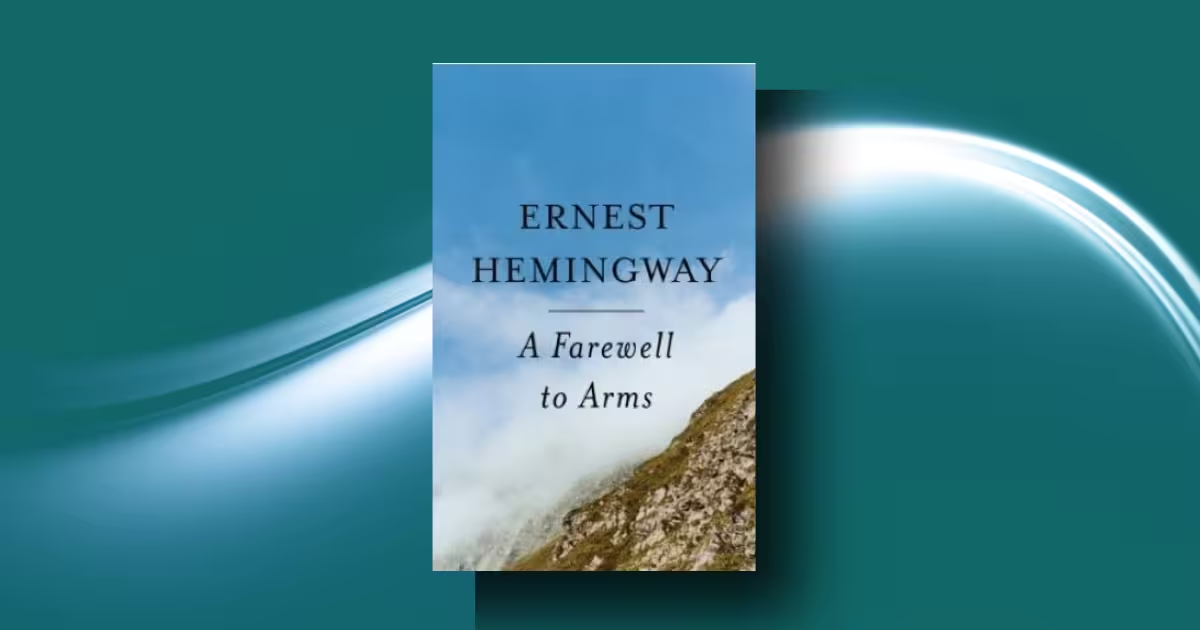

Did you ever finish a book and find yourself unable to speak for an hour, not because you lacked words, but because the book had somehow stolen your own voice and replaced it with something raw and tender? That is precisely what happened to me when I closed A Farewell to Arms.
I sat by the window, watching ordinary rain fall on an ordinary street, yet nothing felt ordinary anymore.
Hemingway had not just told me a story. He had, through some terrible literary alchemy, transplanted an ache into my chest that I knew would never fully dissolve. This novel is not a book you read. It is a wound you consent to receive, a slow, deliberate breaking of your own heart in the name of understanding something essential about love and loss.
If you have ever wondered why we keep returning to stories about war when we claim to despise it, or why the simplest sentences can sometimes devastate us more than the most elaborate poetry, then let me walk you through this extraordinary novel the way I experienced it — not as a critic performing an autopsy, but as a fellow traveler who has walked through Hemingway’s rain and emerged changed.
War strips away every illusion about honor and glory, leaving only the raw truth that loving another person is the sole act of defiance that makes our inevitable suffering bearable.
A Farewell to Arms is best for readers who crave emotional authenticity over sentimentality, who understand that the most powerful feelings are often conveyed through restraint, and who are prepared to sit with ambiguity rather than demand tidy resolutions.
If you need fast-paced action, clearly defined heroes and villains, or a comforting narrative arc where love conquers all, this book will frustrate you deeply.
But if you are willing to let Hemingway’s iceberg prose work on you — where seven-eighths of the meaning lies beneath the surface — you will emerge profoundly moved.
Table of Contents
1. Introduction
Ernest Hemingway’s A Farewell to Arms was published in 1929, emerging from the cauldron of the author’s own experiences as an ambulance driver on the Italian front during World War I.
The novel, set primarily between 1916 and 1918, follows Frederic Henry, an American lieutenant serving in the Italian ambulance corps, and his tortured love affair with Catherine Barkley, an English nurse.
What makes A Farewell to Arms enduring is not its war scenes, though those are rendered with terrifying precision, but its unflinching examination of how human beings attempt to construct meaning — through love, through duty, through sheer stubborn persistence — in a universe that seems fundamentally indifferent to their efforts.
Hemingway dedicated the novel to his second wife, Pauline Pfeiffer, but the emotional fire that fuels its pages comes from his own wartime wounding and his earlier relationship with Agnes von Kurowsky, an American nurse who cared for him after he was hit by a mortar shell.
She rejected his marriage proposal, and Hemingway transmuted that personal devastation into one of the most haunting love stories ever penned.
The title itself, drawn from a sixteenth-century poem by George Peele, signals the novel’s dual preoccupation: farewell to the instruments of war, yes, but also farewell to the embrace of love, to the very idea that happiness can be sustained in a world governed by chance and violence.
2. Background: The Historical Wound Beneath the Fiction
To truly grasp A Farewell to Arms, one must understand the particular horror of the Italian front in World War I.
Between 1915 and 1918, Italy fought a brutal campaign against Austria-Hungary along the mountainous northeastern border, a theater characterized by alpine warfare so savage it defies modern comprehension.
Soldiers clung to sheer rock faces, dug trenches into glaciers, and died by the tens of thousands in battles over ridges that offered no strategic advantage whatsoever.
The Battle of Caporetto, depicted in the novel’s devastating retreat sequence, was a historical reality: in October 1917, German and Austro-Hungarian forces smashed through the Italian lines near the town of Caporetto (present-day Kobarid, Slovenia), triggering a catastrophic retreat that saw hundreds of thousands of Italian soldiers flee or surrender.
Hemingway captures this chaos with documentary precision, having researched the campaign exhaustively and walked the ground himself.
More personally, Hemingway was wounded on July 8, 1918, at Fossalta di Piave, while distributing chocolate and cigarettes to Italian soldiers.
A trench mortar shell exploded nearby, embedding over two hundred fragments in his legs. He was eighteen years old. His convalescence in a Milan hospital, his romance with nurse Agnes von Kurowsky, and his subsequent disillusionment all filter directly into the novel’s bones.
Frederic Henry, the narrator, is not Hemingway — Hemingway was far younger, far more naïve when he entered the war — but he is a projection of what Hemingway feared he might have become: a man hollowed out by violence, clinging to love as the last available meaning, only to have that love annihilated by the same cosmic indifference that governs the battlefield.
The historical backdrop matters because Hemingway was not inventing tragedy for literary effect; he was distilling actual horror into prose so spare it burns.
3. A Farewell to Arms Summary
BOOK ONE: The World Before the Breaking
The novel opens with one of the most famous paragraphs in American literature, a deceptively simple description of the landscape in the late summer of that year.
Hemingway writes: “In the late summer of that year we lived in a house in a village that looked across the river and the plain to the mountains. In the bed of the river there were pebbles and boulders, dry and white in the sun, and the water was clear and swiftly moving and blue in the channels.”
This opening establishes the novel’s fundamental rhythm: the world is beautiful, detailed, sensually present, while violence hums in the background like distant thunder. Troops march past, dust coats the leaves of the trees, and the flashes of artillery at night resemble summer lightning, though the nights remain cool and there is no feeling of a storm coming.
The juxtaposition is deliberate and devastating. Beauty and horror coexist, each making the other more acute.
We meet Frederic Henry, an American who has volunteered to serve in the Italian ambulance corps before America’s entry into the war.
He lives in a house in Gorizia, a town that has been “captured very handsomely” but whose surrounding mountains remain stubbornly in Austrian hands. Henry moves through the early chapters as a detached observer, drinking wine with his fellow officers, visiting the brothels that have been established for the troops, and enduring the baiting of the unit’s priest.
The captain torments the priest with crude jokes: “Priest every night five against one,” he declares, spreading his fingers to illustrate the supposed sexual depravity of the clergy. Henry participates in the mockery without conviction, and his conversations with the priest reveal a deeper spiritual hunger that he cannot yet acknowledge.
The priest represents something Henry instinctively respects but cannot embrace — a belief in love, in God, in the idea that life might hold meaning beyond the next bottle of wine.
When spring arrives, Henry returns from leave to find Rinaldi, his roommate and closest friend, enthusiastically announcing that he is in love with a nurse named Miss Barkley. Rinaldi, a gifted surgeon whose bravado masks a growing exhaustion with the endless flow of wounded men, insists that Henry accompany him to the British hospital to make a good impression.
This seemingly casual invitation sets the entire tragedy in motion.
Catherine Barkley is introduced standing in a garden, carrying a thin rattan stick that belonged to a boy she was engaged to marry — a boy killed on the Somme. The stick is the first of many talismans of loss that accumulate throughout the novel.
Catherine confesses that she and her fiancé had grown up together, that they were engaged for eight years, and that she foolishly refused to marry him before he left because she thought it might be bad for him. “He could have had anything he wanted if I would have known,” she says. “I would have married him or anything. I know all about it now.”
Henry and Catherine’s early encounters are characterized by a strange, game-like quality.
He pursues her without genuine feeling, treating seduction as a pleasant distraction from the tedium of war. He kisses her and she slaps him, then immediately apologizes, and in that moment, something shifts. Catherine declares: “This is a rotten game we play, isn’t it?” She recognizes the performance before Henry does. When he insists that he loves her, she replies with devastating clarity: “You don’t have to pretend you love me. That’s over for the evening.”
Yet within pages, she is allowing herself to be drawn into the illusion, telling him, “You will be good to me, won’t you? Because we’re going to have a strange life.”
The war intrudes violently.
Henry is sent to the front at Plava, where an offensive is planned. He supervises the ambulance posts and endures the most harrowing experience of his life. While sitting in a dugout with four drivers, eating cold macaroni and cheese and drinking wine, a trench mortar shell strikes.
Hemingway renders the explosion in prose that mimics the disorientation of trauma: “There was a flash, as when a blast-furnace door is swung open, and a roar that started white and went red and on and on in a rushing wind. I tried to breathe but my breath would not come and I felt myself rush bodily out of myself and out and out and out.” Henry comes back to consciousness to find Passini, one of his drivers, screaming with both legs smashed above the knee. “One leg was gone and the other was held by tendons and part of the trouser and the stump twitched and jerked as though it were not connected.”
Passini dies before Henry can apply a tourniquet. Henry himself has been severely wounded, his knee destroyed, and as he is transported away from the front, an English ambulance driver remarks with dark humor that Henry is “the legitimate son of President Wilson.”
BOOK TWO: The False Spring of Love
Henry is evacuated to an American hospital in Milan, where the care is initially comical in its incompetence.
The night nurse weeps because she cannot read Italian, and the doctor has gone to Lake Como and cannot be reached. But Catherine Barkley appears, transferred to the same hospital, and their relationship transforms into something authentic and consuming. Hemingway writes: “When I saw her, I was in love with her. Everything turned over inside of me.”
This is the turning point. The game is over.
What began as a performance has become the only reality Henry can believe in.
Their summer in Milan is rendered in passages of extraordinary tenderness. Henry undergoes surgery on his knee, performed by the cheerful Dr. Valentini, who promises to make him “better than new.” Catherine works night duty so they can be together, and they construct a private world inside the hospital room.
They make love, they talk, they plan imaginary futures. Catherine declares: “There isn’t any me. I’m you. Don’t make up a separate me.” This merging of identities becomes the central article of their faith. When Henry worries about the war and his eventual return to the front, Catherine insists: “I’ll say just what you wish and I’ll do what you wish and then you will never want any other girls, will you?” She offers a vision of love as total surrender, a mutual annihilation of separate selves that might protect them from the world’s cruelty.
They go to the races with friends, they dine at the Gran Italia, they walk through the galleries of Milan, and they make plans for a convalescent leave at Pallanza on Lago Maggiore.
But the real world intrudes in the form of jaundice, which strikes Henry and leads Miss Van Campen, the hospital superintendent, to discover his cache of empty liquor bottles. She accuses him of deliberately drinking himself sick to avoid returning to the front, and she cancels his leave. Then Catherine reveals she is pregnant.
Henry’s response is characteristically restrained — “You’re pretty wonderful” — but his internal monologue reveals the depth of his devotion and his fear. They make plans for the baby’s birth and for a future after the war, plans that shimmer with the particular poignancy of hopes we know, as readers, cannot survive.
BOOK THREE: The Retreat and the Separate Peace
Henry returns to the front in the autumn of 1917, just as the Austro-German offensive smashes through the Italian lines.
The retreat from Caporetto is depicted in a long, hallucinatory sequence that stands among the most powerful anti-war writing in English. The roads are clogged with troops, trucks, carts, and fleeing civilians. Rain falls incessantly. Discipline dissolves.
Henry commands a small convoy of ambulances, accompanied by drivers Piani, Bonello, and Aymo, and the journey becomes a descent into chaos.
They become stuck on a muddy secondary road.
Two sergeants of engineers, whom they have picked up, refuse to help extricate the vehicles and attempt to desert. Henry draws his pistol and fires, wounding one. Bonello finishes the job with two shots to the head, crowing: “I never killed anybody in this war, and all my life I’ve wanted to kill a sergeant.” The casual brutality of the scene is shocking, yet Hemingway presents it without editorial comment.
This is what war does. It renders killing ordinary.
They abandon the ambulances and proceed on foot, heading for the Tagliamento River. They cross flooded fields, dodge German bicycle troops, and witness the execution of an Italian sergeant by his own countrymen. Aymo, the most gentle of the drivers, is shot through the neck by Italian rear-guard troops firing wildly into the dark. He dies in the mud. Bonello, spooked by the randomness of death, decides to allow himself to be captured, walking off into the farmland with a wave.
Henry and Piani continue alone, eventually reaching the Tagliamento, where they encounter the most chilling scene in the novel.
At the bridge, military police — “battle police,” they call themselves — are pulling officers out of the retreating column and summarily executing them for desertion.
Henry watches a gray-haired lieutenant-colonel, separated from his troops through no fault of his own, be interrogated and shot. The officers conducting the executions have “that beautiful detachment and devotion to stern justice of men dealing in death without being in any danger of it.” When Henry is seized and accused of being a German in Italian uniform, he acts on pure instinct.
He breaks free, plunges into the river, and clings to a piece of timber, letting the current carry him away. He has made what he calls “a separate peace” — a private declaration that the war is over for him, that his obligations to the Italian army have been annihilated by its own madness. “Anger was washed away in the river along with any obligation,” he reflects. “I was through. I wished them all the luck.”
BOOK FOUR: The Brief Sanctuary and the Inevitable Blow
Henry makes his way to Milan in civilian clothes, a deserter in a country where deserters are shot.
He finds that Catherine has been transferred to Stresa, and he follows her there, rowing across the stormy lake to reach her hotel. Their reunion is joyous, but the shadow of discovery hangs over them. Catherine is now visibly pregnant, and Henry’s desertion makes him vulnerable to arrest.
When the barman, Emilio, warns him that the authorities plan to arrest him in the morning, they flee again, rowing across Lake Maggiore in the darkness, heading for neutral Switzerland.
The rowing sequence is Hemingway at his finest.
The physical reality of the journey — the cold water, the blistered hands, the makeshift sail from an umbrella — grounds the escape in tangible detail, while the emotional stakes remain sky-high. Catherine, calmly practical, steers the boat while Henry rows. They land in Switzerland, bluff their way through customs with talk of winter sports, and settle into a wooden chalet above Montreux.
For a few precious months, they have what Catherine calls “a fine life.” They walk in the snow, they drink hot wine with lemon, they play chess by the stove, and they wait for the baby.
Catherine tells Henry: “I want us to be all mixed up. I don’t want you to go away. I just said that. You go if you want to. But hurry right back. Why, darling, I don’t live at all when I’m not with you.”
BOOK FIVE: The Catastrophe
Catherine’s labor begins in the early hours of a March morning. They go to the hospital in Lausanne, and what follows is a harrowing, almost clinical account of a childbirth gone terribly wrong.
Catherine endures hours of agony, the gas providing only intermittent relief. When the delivery stalls, the doctor recommends a Caesarean section, and Henry consents. But the baby is stillborn, the cord wrapped around its neck. Henry sees the child — “He looked like a skinned rabbit with a puckered-up old-man’s face” — and feels nothing. “I had no feeling for him. He did not seem to have anything to do with me.”
Then Catherine begins to hemorrhage.
The doctors cannot stop the bleeding. Henry sits in the hallway, praying to a God he does not believe in: “Don’t let her die. Oh, God, please don’t let her die. I’ll do anything for you if you won’t let her die.” He goes into her room, and Catherine, gray-faced and dying, tells him: “I’m going to die. I hate it.”
She asks him not to do their things with another girl, not to say the same things, then immediately contradicts herself: “I want you to have girls, though.”
She is trying to free him, even in death. She dies, and Henry walks back to the hotel in the rain. The novel’s final line, devastating in its restraint, reads: “After a while I went out and left the hospital and walked back to the hotel in the rain.”
4. A Farewell to Arms Analysis
4.1. A Farewell to Arms Characters: The Architecture of Loss
Frederic Henry is one of literature’s most enigmatic narrators. On the surface, he seems almost pathologically detached. He drinks heavily, pursues casual sex, and treats the war with a kind of ironic distance.
Yet Hemingway carefully reveals the sensitivity beneath the carapace. Henry’s conversations with the priest, his genuine grief at Aymo’s death, his desperate prayers in the hospital corridor — these moments betray a man who feels everything intensely but has learned, through trauma, to armor himself in numbness.
His arc is not a conventional hero’s journey but a slow, painful opening. Catherine cracks him open, and the novel charts both the beauty and the danger of that vulnerability.
Catherine Barkley has been criticized by some readers — and by some feminist critics — as a male fantasy, a woman who exists only to love and serve her man. This reading fundamentally misunderstands Hemingway’s project. Catherine is not a passive vessel; she is actively constructing a philosophy of love that will allow her to survive.
Her declaration that “there isn’t any me” is not an abdication of self but a strategic merging. She has already lost one love to the war. She knows, with terrible clarity, that individual identity is fragile, that the self alone cannot withstand the world’s assault.
By merging her identity with Henry’s, she creates a larger, more defensible unit. Her tragedy is that even this strategy cannot save her.
The universe is indifferent to human strategies.
Rinaldi serves as Henry’s foil and mirror. Where Henry retreats into love, Rinaldi retreats into work. “I never think. No, by God, I don’t think; I operate,” he declares. By the novel’s end, he is exhausted, possibly syphilitic, and utterly broken. He represents the impossibility of pure professionalism as a defense against horror.
The priest offers still another alternative: faith, hope, the belief that meaning can be found in service and love of God. Henry respects the priest but cannot follow him. “I am afraid of Him in the night sometimes,” he admits. The priest’s gentle faith represents a path not taken, a possibility that haunts the novel’s margins.
4.2. A Farewell to Arms Themes and Symbolism
Rain is the novel’s dominant symbol, and Hemingway uses it with extraordinary precision.
A Farewell to Arms opens in dry weather, but rain arrives with the cholera epidemic: “At the start of the winter came the permanent rain and with the rain came the cholera.” Rain accompanies every major catastrophe. It falls during the retreat from Caporetto. It falls during the rowing escape across Lake Maggiore. Catherine confesses: “I’m afraid of the rain because sometimes I see me dead in it.”
And in the end, she does die, and Henry walks away in the rain. Rain represents the indifferent universe, the forces beyond human control that wash away our careful constructions.
The separate peace is the novel’s central philosophical concept.
When Henry escapes from the battle police by plunging into the river, he declares: “I had made a separate peace.” This is not merely desertion. It is a metaphysical declaration. Henry is rejecting not just the Italian army but the entire apparatus of war, patriotism, and collective violence.
His peace is separate because it is private, personal, constructed around his love for Catherine. The tragedy is that the universe does not recognize separate peaces. The world will find you, even in your private sanctuary, and demand its due.
Love as religion permeates the novel. Catherine tells Henry: “You’re my religion. You’re all I’ve got.” In a world where traditional faith has been shattered by the war’s senseless slaughter, romantic love becomes the last available source of transcendence.
Henry and Catherine’s relationship is not just a romance; it is an act of worship, a desperate assertion that meaning exists because they have created it together. The novel asks whether such created meaning can survive, and its answer is devastating.
5. Evaluation
A Farewell to Arms is a masterpiece of emotional devastation, a book that achieves its extraordinary power through Hemingway’s radical commitment to understatement. Where a lesser writer would reach for melodrama, Hemingway gives us a childbirth gone wrong in sentences so simple they cut like surgical instruments.
Where another novelist would moralize about war, Hemingway simply shows us a retreat collapsing into chaos and asks us to draw our own conclusions. This restraint is not coldness; it is the deepest form of respect for the reader’s intelligence and emotional capacity.
The strengths of the novel are legion. The prose is a revolution in English style — stripped of adjectives, built on concrete nouns and active verbs, capable of conveying immense feeling through accumulation rather than declaration.
The love story is tender and credible, two damaged people constructing a fragile shelter against the storm. The war sequences are terrifyingly vivid, rendered with the authority of someone who has been under fire.
And the ending is, quite simply, one of the most powerful in all of literature. It leaves you hollowed out, staring at the wall, unable to speak.
The weaknesses, such as they are, reflect Hemingway’s limitations as well as his era. Catherine Barkley, however much I defend her agency, does at times feel less fully realized than Henry. Her devotion can seem so total as to be uncanny.
The novel’s treatment of other women — the prostitutes, the nurses — is often dismissive or coarse. And Hemingway’s famous stylistic restraint can, in less certain passages, tip into monotony. But these are quibbles against a work of staggering achievement.
The impact of this novel on me was visceral. I finished it and felt physically hollow.
Hemingway had shown me love at its most beautiful and death at its most arbitrary, and the juxtaposition left me with an ache that felt almost like grief. I thought about Catherine’s final words: “It’s just a dirty trick.” Yes.
That is what it feels like.
The world plays dirty tricks on us, and our love, however fierce, does not protect us from them. But the novel also suggests that the love is worth it.
The brief months in the Swiss chalet, the conversations in the Milan hospital, the feeling of being “all mixed up” with another person — these are not negated by the ending. They are made more precious by it.
In comparison with similar works, A Farewell to Arms stands alongside Erich Maria Remarque’s All Quiet on the Western Front as one of the definitive World War I novels, though Hemingway’s focus on love rather than comradeship gives it a different resonance.
Compared to his own later work, For Whom the Bell Tolls, this novel is more personal, more intimate, less overtly political.

The film adaptations — the 1932 version starring Gary Cooper and the 1957 remake with Rock Hudson — both struggle to capture the novel’s interiority, though the 1932 film is generally considered the more successful.
6. Personal Insight with Contemporary Educational Relevance
The theme that resonates most powerfully with contemporary readers is the psychological toll of trauma, what we might now recognize as post-traumatic stress disorder.
When Henry describes his experience of being blown up — “I felt myself rush bodily out of myself” — he is describing dissociation in language that predates the clinical terminology.
The novel’s entire emotional landscape — the drinking, the emotional numbness, the desperate cling to love as an anchor — reads like a case study in combat trauma. Hemingway, who suffered from what was then called “shell shock” and eventually died by suicide in 1961, understood this territory intimately.
This makes A Farewell to Arms urgently relevant for modern students. According to the U.S. Department of Veterans Affairs, approximately 11-20% of veterans who served in Iraq and Afghanistan experience PTSD in a given year.
The novel offers not a clinical study but something arguably more valuable: an immersive experience of what it feels like to have your sense of safety, meaning, and self shattered by violence.
When students read about Henry’s separate peace, about his flight from the battle police, they are engaging with questions that remain painfully current: What do we owe to institutions that betray us? How do we reconstruct meaning after trauma?
Can love truly serve as a counterforce to violence?
External resources that enrich this discussion include the Hemingway Foundation’s educational materials and the National Endowment for the Humanities’ “Hemingway and War” curriculum.
For understanding the psychological dimensions, the National Center for PTSD offers accessible frameworks that can be productively cross-referenced with the novel’s depictions of trauma responses.
7. A Farewell to Arms Quotes
“In the late summer of that year we lived in a house in a village that looked across the river and the plain to the mountains.”
“I was blown up while we were eating cheese.”
“When I saw her I was in love with her. Everything turned over inside of me.”
“There isn’t any me. I’m you. Don’t make up a separate me.”
“I had made a separate peace.”
“Abstract words such as glory, honor, courage, or hallow were obscene beside the concrete names of villages, the numbers of roads, the names of rivers, the numbers of regiments and the dates.”
“The world breaks every one and afterward many are strong at the broken places. But those that will not break it kills. It kills the very good and the very gentle and the very brave impartially.”
“I’m going to die. I hate it.”
“After a while I went out and left the hospital and walked back to the hotel in the rain.”
8. Conclusion
A Farewell to Arms is not a comfortable book, nor was it meant to be. Hemingway wrote it to wound, to strip away the comforting lies we tell ourselves about war, about love, about the possibility of lasting happiness. He succeeded almost too well.
The novel leaves you with the sensation of having been physically struck — and, strangely, grateful for the blow. It is a book that honors the fragility of human connection precisely by refusing to pretend that connection can protect us from the world’s cruelty.
I recommend this novel to readers who have known loss and are prepared to see that loss reflected back at them with unflinching clarity. It is for those who understand that the most powerful emotional experiences in literature often come not from what is said but from what is held in reserve.
It is for students of history who want to understand World War I not as a series of dates and battles but as a shattering of human souls.
And it is for anyone who has ever loved someone and feared — as we all fear, whether we admit it or not — that love might not be enough.
Read it on a rainy day, if you can. Hemingway would approve.