

Last updated on January 13th, 2026 at 05:20 am
Do you ever wonder how one heartbreaking choice can ripple through lives, families, and even entire generations, leaving echoes that never truly fade? That question hit me hard while reading Khaled Hosseini’s And the Mountains Echoed.
And the Mountains Echoed‘s best idea here is this: family bonds aren’t just about blood or proximity—they’re fragile, enduring threads that shape us through sacrifice, loss, and quiet acts of love, no matter how far apart life pulls us.
Research backs this up strongly. The book sold over three million copies in its first five months after release in 2013, becoming an instant New York Times bestseller.
On Goodreads, it holds a solid 4.07 average rating from more than 300,000 readers, with many calling it emotionally devastating yet profoundly hopeful. Studies on migration and family separation (like UNHCR reports on Afghan displacement) show real-world parallels: forced separations cause lifelong trauma, guilt, and identity struggles, much like the characters here.
And the Mountains Echoed is best for readers who crave deeply emotional, character-driven stories about family, loss, and redemption—especially if you’ve loved Hosseini’s earlier works or books like The Kite Runner. You’ll benefit if you’re patient with interconnected narratives and don’t mind tears.
Not for: Those wanting a fast-paced, linear plot or constant action. If you prefer straightforward stories without multiple perspectives or jumps across decades and countries, this might feel scattered and leave you frustrated.
Table of Contents
1. Introduction
And the Mountains Echoed is Khaled Hosseini’s third novel, published in 2013 by Riverhead Books in the US and Bloomsbury elsewhere.
Coming after the massive successes of The Kite Runner (2003) and A Thousand Splendid Suns (2007), it was one of the most anticipated books of the year—and it delivered in spades.
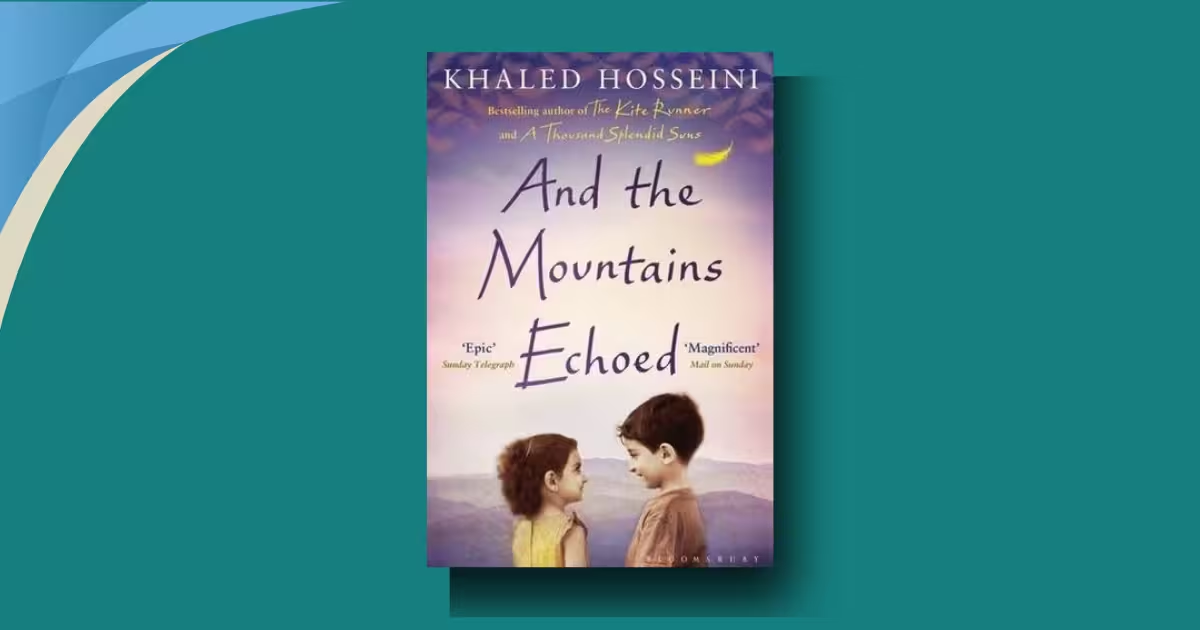
I remember picking it up shortly after release, drawn by that haunting cover of a father carrying a child across misty mountains, and I couldn’t put it down.
Hosseini, an Afghan-American author and physician, weaves another tapestry of Afghan lives touched by war, poverty, and migration, but this time with a broader, more ambitious scope.
2. Background
The novel spans from 1952 to 2010, covering Afghanistan’s turbulent history: the relative calm before the Soviet invasion, the wars, the Taliban era, and post-2001 reconstruction.
Hosseini doesn’t dive deep into politics—instead, he uses this backdrop to explore personal stories. Born in Kabul himself, he draws from real Afghan folklore (like the opening div tale) and the experiences of displaced families.
The historical context feels authentic because it’s lived-in: drought-stricken villages, the exodus during invasions, the diaspora in places like Paris and California. It’s not a history lesson, but the wars quietly shape every character’s fate, much like how real Afghan families have been fractured over decades.
3. And the Mountains Echoed Summary
When I first opened And the Mountains Echoed, that opening fable gripped me immediately.
In Fall 1952, in the poor village of Shadbagh, father Saboor tells his children—10-year-old Abdullah and 3-year-old Pari—a bedtime story as they prepare for a journey to Kabul.
The tale is about Baba Ayub, a farmer who loves his youngest son Qais most of all (the boy with the little bell around his neck, jingling as he runs into his father’s arms). A monstrous div visits the village, demanding one child from each tapped roof or all of them if refused. Baba Ayub, heartbroken, draws lots and sacrifices Qais.
Years later, consumed by grief, he journeys to the div’s fortress, faces trials, and discovers Qais alive and happy in a paradise, having forgotten his old life.
The div offers to return him, but Baba Ayub chooses to let Qais stay happy, asking only for oblivion himself—so the div erases his memory of Qais. As Saboor finishes: “Your son does not remember you… This is his life now, and you saw for yourself his happiness.”
This fable foreshadows the gut-wrenching core: Saboor, widowed and remarried to Parwana, can’t feed his family after a harsh winter kills their baby.
With step-uncle Nabi’s arrangement, he sells Pari to the wealthy, childless Wahdati couple in Kabul—Suleiman and the poetic, restless Nila. Abdullah, who has essentially raised Pari since their mother’s death (collecting feathers for her, calling her his “world”), begs to come along. In Kabul, he realizes the truth when Nila takes Pari, promising a better life.
Abdullah clings to Pari’s tin box of feathers, devastated. Saboor drags him away, echoing his own rule: no crying in Kabul.
We then flash back to Parwana’s youth (Spring 1949). Identical twins with brother Nabi, Parwana always lived in beautiful Masooma’s shadow. Both loved Saboor, but Masooma was betrothed to him.
In a fit of jealousy, Parwana pushes Masooma from an oak tree, paralyzing her for life. Masooma, bitter at first, later begs Parwana to leave her in the desert to die so she can marry Saboor guilt-free. Parwana does, haunted forever, and bears Saboor’s son Iqbal.
Nabi, working as chauffeur for the Wahdatis in Kabul, is secretly in love with Nila (who’s unhappy in a likely loveless, possibly gay marriage with Suleiman). Learning Nila is infertile (from a botched procedure), Nabi suggests buying Pari for money to help his sister. The sale happens; Nabi is banished from Shadbagh in shame.
Years pass. Suleiman suffers a stroke, becoming paralyzed. Nila, unable to cope, flees to Paris with young Pari. Nabi stays as devoted caregiver to Suleiman for decades, discovering through sketches that Suleiman loved him platonically/romantically.
Their bond deepens into profound companionship; Nabi eventually helps Suleiman end his life peacefully.
In Paris, Pari grows up as Pari Wahdati, unaware of her origins. Nila, depressed and alcoholic, sees Pari as a “performance” and burden, has affairs, and commits suicide in 1974 after a raw interview exposing her emptiness.
Meanwhile, other interconnected lives unfold. In 2003, Afghan-American cousins Idris and Timur visit Kabul. Idris, a doctor, bonds deeply with Roshi, a young girl horribly maimed (face cleaved) by her uncle who murdered her family in a drug-fueled rage.
Idris promises to fund her US surgery but backs out from guilt and fear; flashy Timur steps in and pays. Roshi recovers, is adopted by tough Bosnian nurse Amra, becomes a surgeon, and writes a bestselling memoir dedicated to Amra and Timur.
Greek plastic surgeon Markos works in Kabul, motivated by childhood guilt over a disfigured friend; he rents Nabi’s old house.
In modern Shadbagh-e-Nau (developed over the old village), young Adel idolizes his “self-made” father, a powerful commander. He befriends Iqbal’s son Gholam (from the old family), only to learn his father is a brutal warlord who stole land, bribed judges, and likely killed resisters like Iqbal. Disillusioned, Adel questions everything.
Nabi dies, leaving a letter to Markos confessing everything and revealing Pari’s true origins to her (now an adult professor in Paris, married with three kids, widowed).
Finally, in 2010 California, elderly Abdullah—having fled Afghanistan, opened a restaurant called Abe’s Kabob House, married, and named his daughter Pari—suffers dementia.
His daughter Pari cares for him. The original Pari (now 61) flies from France after Nabi’s letter. They meet; she reads him the old fable, shows the feather tin he kept all his life. But Abdullah doesn’t fully recognize her—his memory echoes the div’s mercy, sparing him pain but leaving the sisters’ reunion bittersweet.
Young Pari finds connection through caring for her father, and the echoes continue.
The book closes on quiet hope amid irreversible loss.
4. And the Mountains Echoed Analysis
4.1. And the Mountains Echoed Characters
Hosseini’s characters feel achingly real—flawed, complex, and evolving through choices. Abdullah is the emotional core: devoted brother turned quiet, enduring man, his lifelong ache for Pari palpable (“She was his world”).
Pari (the sister) grows from joyful toddler to accomplished but vaguely empty woman, her forgotten childhood a void until the end.
Nabi’s quiet redemption—arranging the sale out of misguided love, then decades of selfless care for Suleiman—is heartbreakingly nuanced. Parwana’s guilt over Masooma drives her entire life; Masooma’s self-sacrifice is both noble and tragic.
Nila is brilliantly unlikeable yet pitiable—beautiful, talented, but cruelly distant (“I learned that the world didn’t see the inside of you…”).
Suleiman’s unspoken love for Nabi adds layers of unspoken queer longing in conservative Afghanistan. Idris’s cowardice contrasts Timur’s bravado; Roshi’s resilience shines.
Even minor ones like Adel (innocent to disillusioned) or Markos impact deeply. Relationships—sibling (Abdullah/Pari, Parwana/Masooma), parental, unrequited—drive everything.
4.2. And the Mountains Echoed Themes and Symbolism
The central theme is separation and its echoes—how one act (the sale) ripples outward, fracturing families while forging unexpected bonds. Sacrifice recurs: Baba Ayub’s, Parwana’s, Nabi’s, even Idris’s failure. Guilt and redemption intertwine; memory is both gift and curse (Abdullah’s dementia as ironic mercy).
Symbolism abounds: feathers represent fragile beauty and lost childhood (Abdullah’s collection, the peacock feather he sacrifices shoes for). The div fable bookends the novel, mirroring real separations.
The oak tree (Masooma’s fall) symbolizes jealousy and consequences.
Mountains echo choices across time and distance. Interconnectedness shines—every character touches the core story, showing how lives entwine globally. Hosseini integrates these masterfully, never preachily.
5. Evaluation
Strengths/Positive Experiences: The emotional depth wrecked me—in the best way. Hosseini’s prose is lyrical yet accessible, vivid descriptions pulling you into dusty Shadbagh or snowy Kabul.
Characters linger long after; the interconnected structure feels innovative, like life itself. Moments like Abdullah keeping the feathers or Nabi’s letter broke me. It’s more mature than his earlier books, broader in scope.
Weaknesses/Negative Experiences: Some threads feel underdeveloped (Idris/Roshi could be its own novel).
The jumps across perspectives and time can confuse initially, and the sheer number of characters dilutes focus on Abdullah/Pari for stretches. Pacing slows in the middle.
Impact: This book resonated deeply—I sobbed at the ending, thinking about my own family and how distance or time can erode bonds. Intellectually, it made me reflect on privilege, guilt, and how we rationalize harm.
Comparison with Similar Works: Less linear than The Kite Runner (redemption-focused) or A Thousand Splendid Suns (female resilience).
More like The God of Small Things or Middlesex in multi-generational sprawl, or Yunus’s A Fortune-Teller Told Me for interconnected fates. Ambitious but not quite as tightly gripping as his first two.
6. Personal Insight with Contemporary Educational Relevance
Reading this in 2026, with Afghanistan’s ongoing crises, hit differently. The book’s core—family separation due to poverty, war, migration—mirrors real Afghan lives today.
According to UNHCR data, over 5.2 million Afghans remain refugees or in refugee-like situations, with millions more internally displaced.
Since 2021, economic collapse and restrictions have forced countless families to make impossible choices: send children abroad for safety, split to survive, or face starvation.
One statistic stands out: in 2024-2025, hundreds of thousands returned from Pakistan under duress, often fracturing families further.
Hosseini’s story teaches empathy—those “echoes” of loss aren’t abstract. In classrooms or discussions, it educates on migration’s human cost: trauma ripples generations, like Abdullah’s dementia or Pari’s vague emptiness. It reminds us aid workers (like Markos or Amra) and diaspora returnees face moral dilemmas daily.
Ultimately, it’s a call for compassion: separations aren’t just statistics; they’re lifelong aches.
7. And the Mountains Echoed Quotes
- From the opening fable: “Baba Ayub lifted his youngest son into his arms, and Qais, who had blind trust in his father, happily wrapped his arms around Baba Ayub’s neck… crying for Baba to let him back in, and Baba Ayub stood there, muttering, ‘Forgive me, forgive me,’ as the ground shook with the div’s footsteps.”
- Nila to young Pari: “Beauty is an enormous, unmerited gift given randomly, stupidly.”
- Nabi’s letter: “I suspect the truth is that we are waiting, all of us, against insurmountable odds, for something extraordinary to happen to us.”
- On love: “It was the kind of love that, sooner or later, cornered you into a choice: either you tore free or you stayed and withstood its rigor even as it squeezed you into something smaller than yourself.”
- Closing reflection: “They say, Find a purpose in your life and live it. But, sometimes, it is only after you have lived that you recognize your life had a purpose, and likely one you never had in mind.”
8. Conclusion
And the Mountains Echoed left me shattered yet strangely hopeful—it’s a masterpiece of quiet devastation and human resilience. Hosseini proves again he’s a master storyteller, turning pain into something luminous.
I highly recommend it to fans of emotional literary fiction, multicultural stories, or anyone who’s experienced family distance. It’s significant because it humanizes Afghanistan beyond headlines, reminding us bonds endure even when broken. If you want a book that lingers, that makes you hug your loved ones tighter—this is it. Worth every tear.