
Last updated on November 4th, 2026 at 09:13 pm
As I Lay Dying by William Faulkner turns a burial journey into an uncomfortable question: when a family calls something its duty, who does the work? First published in 1930, the novel follows the Bundrens as they prepare to bury their mother, Addie. My reading centres on the distance between a promise and the people expected to carry it out.
That distance makes this difficult, sometimes painfully funny book worth reading.
Quick verdict
Verdict: A demanding, disturbing family novel whose formal difficulty earns its place. I recommend reading it with attention to who performs the practical work behind each declaration of love.
Rating: 4.5/5, an editorial assessment.
Best for: Readers interested in morally complicated families, experimental fiction, and close reading.
Main strength: Different voices make the same act appear loving, cruel, necessary, or absurd.
Main weakness: Abrupt changes of speaker and dense interior passages can interrupt emotional involvement.
In brief: A poor Mississippi family carries Addie Bundren’s coffin toward Jefferson, where she wants to be buried. As I Lay Dying contains 59 monologues spoken or thought by 15 characters.
My central argument is that family duty becomes dangerous when the person directing it does not bear its greatest costs. Cash’s numbered explanation of his coffin construction offers an early example: he expresses care through exact physical work rather than an affectionate speech. Publisher’s reading guide
What is As I Lay Dying about?
As I Lay Dying is about the Bundren family’s attempt to fulfil Addie’s wish to be buried with her relatives in Jefferson. Her husband, Anse, and their children undertake a journey that brings private needs into conflict with a shared obligation.
Other people’s accounts complicate what the family says about itself.
The essential background is practical. The Bundrens depend on farm work, animals, tools, neighbours, and roads that cannot be taken for granted. In the opening sections, even the decision to leave a dying woman briefly is entangled with the money a delivery could earn.
I find that material pressure more useful to understanding the book than treating its characters as puzzles with one symbolic answer.
Is As I Lay Dying worth reading?
Yes, I think it is worth reading if you can tolerate uncertainty while a scene gradually becomes clear. Its rewards come from revising your judgement, sometimes after you have become quite confident that you understand someone.
Writing style and narrative voice
Faulkner gives the speakers different rhythms and habits of attention. Cash lists reasons for a construction choice; Vardaman tries to understand death through a fish; Darl describes what he perceives in language that can be difficult to separate from speculation.
These are different ways of processing experience, rather than interchangeable narrators supplying information.
My advice is to establish the physical action before solving every image. Identify the speaker, ask where the body or wagon is, and notice what that speaker wants. A confusing passage often becomes less intimidating once its practical situation is secure.
Characters and pacing
I find Cash especially affecting because his attention has an object. Boards must fit. A load must balance. Someone must do the job properly. Jewel’s anger creates a different impression: in his early section, he resents the public spectacle around his mother’s decline and imagines protecting her from everyone watching.
Both responses can be read as care, although neither offers easy comfort.
The pacing can feel slow because the novel keeps returning to the meaning of an action instead of simply proceeding to the next one.
I consider that deliberate pressure, though readers who mainly want an uninterrupted story may find it tiring.
Pros and cons
| What works for me | What may frustrate readers |
|---|---|
| The family’s competing explanations keep moral judgement active. | Important information can arrive well after the event it explains. |
| Ordinary objects carry emotional weight without needing a speech. | Some abstract passages require rereading. |
| The humour makes the grief more troubling rather than less serious. | As I Lay Dying offers little emotional reassurance. |
Who should read it?
I would recommend it to readers willing to hold sympathy and anger together. It also suits a discussion group because disagreement about a character is often more productive than agreement about a theme. Readers seeking a gentle account of mourning should approach it with different expectations.
Spoiler warning: Everything from Section 3 through Section 7 reveals major developments and the ending. Skip to Section 8 for a spoiler-free recommendation. The discussion includes bodily injury and sexual exploitation.
What happens in As I Lay Dying, and what does the ending mean?
The Bundrens eventually bury Addie, but completing the journey does not repair the family: Darl is taken away, Cash is badly injured, Dewey Dell remains without the help she sought, and Anse introduces a new wife.
The following summary retells the principal events in three instalments, while keeping uncertain motives separate from actions the novel establishes.
The beginning, the death, and the promise
The story begins while Addie Bundren is still alive but approaching death. Outside the house, Cash works on the coffin she will occupy. His labour is audible from her room, so the preparations for her burial become part of her final hours. Darl notices his brother’s workmanship, while Jewel resents the noise and the people gathering around their mother.
Before the journey has even started, the same activity already looks different depending on who describes it. Cash’s useful, careful work can also appear painfully exposed.
Anse presents himself as burdened by misfortune. He has promised to take Addie to Jefferson for burial with her own family, and he insists on respecting the arrangements she wanted.
Yet he also allows Darl and Jewel to make a delivery that will earn money while she is dying.
The decision mixes economic need, reluctance, hope, and delay. I do not read it as a simple scene in which everyone knowingly abandons her. They argue about how sick she is and whether she will survive until the brothers return.
Dewey Dell has another crisis that she cannot comfortably bring into the room. She is pregnant after her involvement with Lafe. Her thoughts keep circling the possibility that someone, especially a doctor, could help her.
This does not mean her mother’s death means nothing to her.
It means her own fear occupies the same mental space as the household emergency. Faulkner lets the reader encounter that confusion from inside it, without giving Dewey Dell a calm explanation that she could deliver to the others.
Addie dies while Darl and Jewel are away. Darl nevertheless narrates the death scene, a feature of the novel that makes his knowledge difficult to account for in ordinary realistic terms. Anse’s thoughts turn almost immediately to getting teeth. Meanwhile, Vardaman struggles to connect the mother who was alive with the body that remains.
The fish he has caught and cut up becomes part of his effort to understand what it means for a living thing to cease being itself.
Vardaman directs his distress toward Peabody, the doctor, associating his arrival with the death. He drives off the doctor’s team. Later, fearing that his mother cannot breathe inside the closed coffin, he bores holes through its lid; some pierce her face. His attempt to help becomes another injury. Cash’s construction and the child’s destructive intervention thus sit disturbingly close together: both are responses to Addie, but neither can restore the person they have lost.
Rain makes the intended burial journey much harder. The family cannot simply take the expected route because flooding has damaged the crossings.
They set out with the coffin, and the trip begins to depend on decisions about roads, animals, accommodation, and assistance. Anse continues to describe their purpose as a promise that must be honoured.
For me, this is where the book’s central tension becomes physical: the commitment belongs to the whole family, but the effort required to keep it is not evenly distributed.
The river and the price of continuing
The Bundrens encounter people who provide information and help, even as the journey starts to seem unreasonable to observers. Anse dislikes the idea of being beholden, yet his family depends repeatedly on other households.
This contradiction matters because accepting aid is not itself the problem. The problem is his insistence on imagining independence while others absorb inconvenience and risk. The accounts from outside the family make it harder to accept his preferred version of what they are doing.
At the flooded river, the crossing becomes a disaster. The wagon meets the force of the water and a floating log, and the mules drown. The coffin must be saved, Cash is injured, and the tools on which he depends are scattered into the river. Jewel’s determination is practical and dangerous here. He helps rescue the coffin, while the men work to recover what they can.
A family mission that could have been described abstractly as devotion now has a visible price in damaged bodies, lost animals, and threatened livelihoods.
Cash’s broken leg is especially serious because it has been injured before and because his work depends on physical ability. His concern for his tools is therefore more than an eccentric preference for possessions. They are connected to his competence and future work. The effort to retrieve them is one of the journey’s acts of useful solidarity.
It complicates any claim that the family is incapable of care, even though care and dangerous decisions continue to exist alongside each other.
At this point, Addie receives her own section. Although she is already dead in the journey’s chronology, her voice takes the narrative back into her earlier life, marriage, and motherhood. She describes loneliness and a deep suspicion of words such as love. She also explains her relationship with the minister Whitfield and reveals that Jewel is his son.
Her account changes the reader’s understanding of Jewel’s place in the family and the feelings surrounding him.
Addie connects her burial demand with resentment and revenge after Darl’s birth. That connection makes it impossible for me to treat the promise as an entirely innocent instruction whose meaning Anse later corrupts. Nevertheless, her monologue is not a complete explanation of every later disaster. She does not script the flood, Cash’s treatment, or the choices her children make.
Whitfield’s following section supplies another kind of evasion: he intends to confess, learns she is dead, and accepts his intention as enough without making the confession to Anse.
The family stays with Armstid, and Cash’s leg receives improvised treatment. Continuing requires another team. Anse makes a deal with Snopes that involves farm equipment, money, and Jewel’s horse; Cash’s saved money is among the resources drawn into it. Jewel is furious at the loss of an animal he worked to acquire for himself. He leaves with the horse, but the horse is subsequently delivered to complete the trade. Jewel later rejoins the family on foot.
The burial progresses by consuming something that had represented his separate effort and independence.
As the days pass, Addie’s body deteriorates. Buzzards gather, and the smell makes the family’s presence intolerable to people they encounter.
In Mottson, a marshal urges them to move on. Dewey Dell separately approaches the druggist Moseley, hoping to buy something to end her pregnancy with the money Lafe supplied. Moseley refuses and tells her to marry. Her attempt to find help therefore produces a moral lecture rather than the outcome she wants.
The family also obtains cement to immobilise Cash’s leg.
Cash says that he can endure the remaining journey, but the others proceed with their plan, and he participates in discussing the mixture. The cement initially feels cold. Later, the leg becomes hot and swollen, and their efforts to ease it do not solve the problem. The scene is painful partly because Cash keeps minimising his suffering.
His willingness to bear discomfort makes it easier for the people around him to continue.
The fire, the burial, and the ending explained
At the Gillespie property, the family’s ordeal reaches another crisis. Darl tells Vardaman that their mother wants to be hidden from human sight and allowed to lay down her life. Later, the barn containing the coffin catches fire. Jewel helps rescue animals and then saves the coffin, suffering burns.
Subsequent narration establishes that Darl set the fire, and that Vardaman saw him. I read the act as an attempt to end the degrading journey, but it also endangers other lives and destroys someone else’s property. Its understandable emotional origin does not make it harmless.
Once the family reaches Jefferson, the burial still takes precedence over Cash’s medical care. Darl proposes taking him to Peabody, but Cash agrees to finish the burial first. Anse borrows spades from a woman whose house contains a graphophone.
The delay at her home seems minor when it occurs, but it later becomes part of the ending’s preparation.
Faulkner does not give the burial the kind of extended emotional release that might settle the journey’s meaning. The family’s other decisions immediately press around it.
After Addie is buried, men take Darl into custody to send him to Jackson. Cash explains the family’s choice in relation to Gillespie’s threatened response to the fire.
Dewey Dell attacks Darl during the struggle, and Jewel is violently hostile. Cash is troubled and recognises that judgements about sanity depend partly on other people’s agreement. Yet he participates in the decision. Darl is particularly hurt that Cash did not warn him.
His removal is therefore both a response to a dangerous act and a scene of family betrayal.
Peabody finally examines Cash and angrily condemns what has happened to his leg. He anticipates serious lasting damage. Meanwhile, Dewey Dell tries another drugstore, where MacGowan pretends to be a doctor. He uses the promise of treatment to obtain sexual access to her.
She later tells Vardaman that she knows it will not work. The novel provides no successful resolution to her pregnancy. Anse also takes the money she has been trying to protect, overcoming her resistance by invoking what he has provided as her father.
The final surprise belongs to Anse. He appears with new teeth and the woman from whom he borrowed the spades, introducing her as Mrs Bundren. She carries a graphophone, and Cash imagines music at home while regretting Darl’s absence.
The family has accomplished its stated task, but its members do not return equally restored. Anse has gained; others have surrendered health, possessions, security, or belonging. I do not think the text proves that he planned the marriage before setting out.
The more disturbing reading is that he can turn even this catastrophe toward his own comfort.
What do the characters and symbols reveal about family duty?
They reveal that a shared obligation can conceal radically unequal sacrifices. This is my interpretive framework, rather than a claim that every character acts from one motive.
Main characters, relationships, and motivations
| Character | What the narrative establishes | What I take from it |
|---|---|---|
| Addie | Her monologue connects marriage, motherhood, resentment, and the burial request. | She deserves a hearing without being turned into an ideal mother. |
| Anse | He directs the journey and draws on his children’s resources. | Authority can survive repeated dependence on others. |
| Cash | He builds the coffin and continues with an injured leg. | Reliability can become a reason others expect too much. |
| Darl | He sets the fire and is sent away after the burial. | Perception and destructive action can coexist. |
| Jewel | He saves the coffin and relinquishes his horse. | Love may be physically unmistakable but verbally hostile. |
| Dewey Dell | She seeks help with her pregnancy and is exploited. | A family’s public emergency can hide a member’s private danger. |
| Vardaman | He connects his mother with the fish and struggles to understand Darl’s departure. | Adults’ explanations do not necessarily make loss understandable. |
Central themes: A promise with an uneven bill
My most useful reading question is simple: who authorises the next sacrifice, and whose resource is being spent? At different stages, the answer involves Cash’s body, Jewel’s horse, a neighbour’s hospitality, and Dewey Dell’s money.
These are not interchangeable costs. A lost possession, a damaged leg, and a violated trust cannot be settled by announcing that the burial is complete.
This reading also changes how I understand Anse’s language. When Dewey Dell resists giving him money, he invokes feeding and sheltering her. Earlier care becomes an argument for present entitlement.
The scene asks whether family membership gives a person unlimited access to another member’s resources. My answer is no, but the novel makes the pressure behind that demand distressingly audible.
Symbols and their meaning
The coffin: It is first an object made carefully for Addie, then a burden around which the living reorganise themselves. I read its changing function as a test of whether preserving a ritual can become more important than protecting people.
The horse: Jewel’s work to acquire it and his eventual loss of it make the animal a particularly sharp image of individual effort absorbed into family obligation. It also carries his ferocious attachment, so I would not reduce it to money alone.
The fish: Vardaman’s equation between mother and fish is an attempt to think through death using something he has seen change. I hear a child making the wrong connection because an adequate explanation is unavailable to him.
The tools and cement: Both belong to practical problem-solving, but they have very different consequences. Tools support Cash’s competence; cement applied to his body exposes the limits of treating a human need as a makeshift repair.
That contrast is my reading of the recovery and treatment scenes.
Critical evaluation
Overall critical judgement
I rate the novel highly because its form makes moral certainty difficult in a productive way. Hearing more voices does not simply produce a fairer account. It reveals how easily people interpret another person’s distress in terms that serve themselves.
Strengths: What works best
The best structural decision, for me, is delaying Addie’s account until the journey is well underway. By then, readers have watched other people interpret her. Her own language disrupts the comforting idea that a dead mother must become a stable source of family unity.
The monologue does not tidy her up.
Cash’s voice is another strength. His attention to making things properly provides an ethical vocabulary as well as a practical one. When he reflects on Darl’s removal, that vocabulary encounters a situation he cannot make right by being careful with his hands. I find the limits of his decency as affecting as the decency itself.
Weaknesses: What could be better?
My main reservation concerns emotional distance. Some passages are so occupied with the workings of perception that I feel further from the immediate distress. I would not prescribe simpler prose as a correction, because the strange language is integral to the book.
Still, admiration does not require pretending that every difficult passage is equally rewarding.
Emotional and intellectual impact
What troubles me most is how suffering becomes routine. Cash’s repeated minimisation of pain does not stop the journey; it helps the journey continue. The reader has to recognise an injury that the injured person declines to insist upon.
That is a more unsettling achievement than simply presenting a selfish father. It implicates the habits of endurance and accommodation that can allow selfishness to operate.
Comparison with similar books
For a next Faulkner reading, I would pair this novel with The Sound and the Fury. The publisher’s guide groups them as family-centred experiments in narrative, while identifying the burial journey here as a comparatively clear plot line.
My reason for suggesting the pairing is to compare how a recognisable physical task helps a reader navigate fragmented voices. Publisher’s reading guide.
Difficult material and the screen adaptation
Readers should expect degrading treatment of a corpse, serious injury, and sexual exploitation. Those are textual features, not evidence of a documented censorship controversy, and I would not invent a controversy to fill a review template.
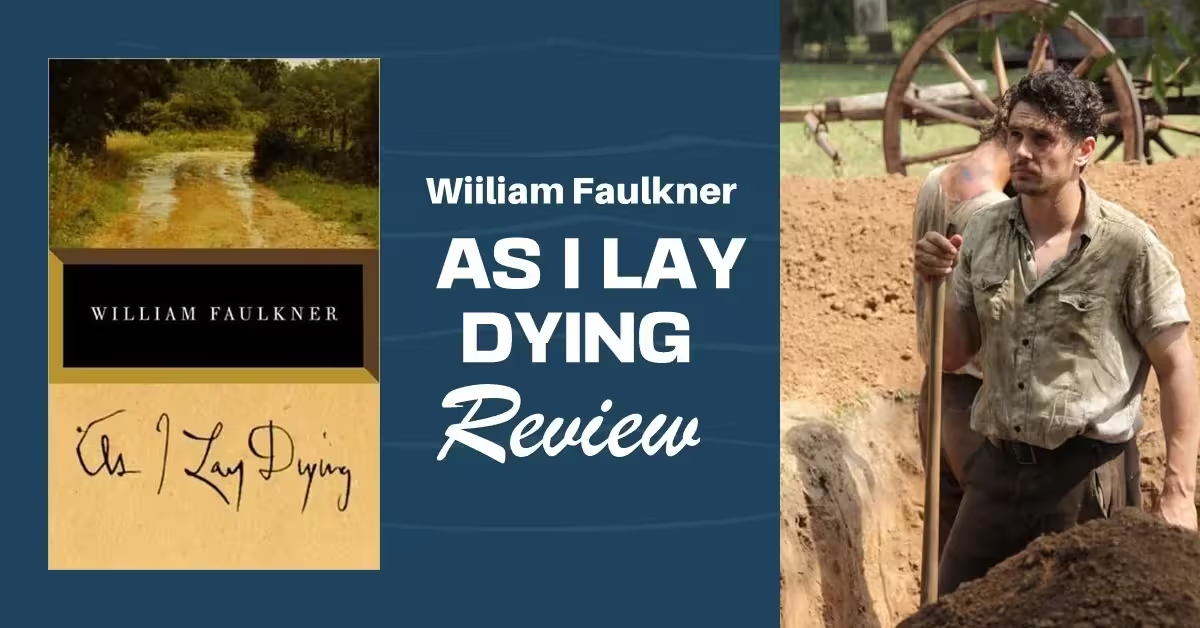
James Franco directed a film adaptation selected for Cannes’ Un Certain Regard in 2013. I have not assessed the film scene by scene here, so I would not claim that it improves or weakens particular performances or scenes.
The useful comparison question is how cinema represents thoughts that the novel leaves inside a speaker’s language. Festival de Cannes.
What does As I Lay Dying reveal about unequal care work?
The novel helps me distinguish a family’s declared commitment from the distribution of work that sustains it. Cash’s labour and injury make that distinction concrete: his willingness to continue is repeatedly easier to accept than his need for care is to address.
This is a literary comparison, not an assertion that a burial journey is equivalent to modern caregiving. Still, the scale of family care gives the question contemporary force. The National Alliance for Caregiving and AARP’s 2025 research estimates that 63 million American adults provided ongoing care to adults or children with a medical condition or disability. 2025 executive summary.
What connects the two for me is the question of whose needs become secondary when a family says it must carry on. The novel provides no policy programme, and a modern survey cannot prove an interpretation of fiction. Together, however, they give us a reason to ask about work that family language can make easy to overlook.
Five specific lessons from the book
- Identify the actual worker. Anse’s promise and Cash’s labour are different contributions.
- Notice the quiet person’s cost. Cash’s endurance should not be mistaken for an absence of pain.
- Keep private emergencies visible. Dewey Dell’s need does not disappear because the family has a public mission.
- Reassess a harmful plan. Continuing is not automatically the most faithful response to an obligation.
- Judge the outcome broadly. Completing a burial does not settle what happened to the living.
These are my conclusions from the journey, not rules Faulkner explicitly gives his readers. [Treatment and closing sections,
Selected quotes and why they matter
“My mother is a fish.”
Vardaman. The whole section is this single sentence. I read it as an urgent act of association, not a random absurdity. The child has evidence of death but no adequate language for it. [Source][p61].
“words are no good”
Addie. This brief phrase belongs to her account of childbirth and language. It challenges the gap between an experience and the word that supposedly contains it. Her argument is especially disturbing in a novel where everyone depends on language to explain themselves.
“Now I can get them teeth.”
Anse’s speech in Darl’s section. The timing makes the line cruel: his wife has just died. I hear a private wish surfacing before the public language of bereavement can conceal it.
“Meet Mrs Bundren”
Anse’s speech in Cash’s final section. A family title survives while the woman associated with it has changed. For me, that abrupt introduction is more cutting than a long explanation of Anse’s selfishness would have been.
Final recommendation
I recommend As I Lay Dying to readers who want a family novel that resists easy sympathy. Its difficulty is real, but the practical question at its centre is accessible: what happens when people praise an obligation without accounting for what it asks of each person?
If you prefer a single narrator, clear motives, and comforting resolution, it may be a frustrating choice. If you are willing to reread and revise your judgement, it offers a powerful way to think about love, work, and the demands made in their names.
Frequently asked questions
Is As I Lay Dying hard to read?
Yes, it can be. The speakers change, and the book uses interior monologues rather than a neutral narrator to explain everything. I recommend tracking the speaker and immediate physical action before interpreting every image. Publisher’s reading guide.
How many narrators does it have?
It has 15 narrators across 59 monologues. Publisher’s reading guide.
Is the book only about grief?
No. I also read it as a novel about labour, family authority, language, and conflicting needs. Addie’s monologue and Cash’s practical concerns are especially useful starting points for that reading.
Why does Addie want to be buried in Jefferson?
She wants burial with her own family there. Her monologue also connects the request to resentment and revenge within her marriage, which complicates a purely sentimental explanation.
Does Dewey Dell get the help she needs?
Spoiler: No successful abortion is established. MacGowan exploits her under the pretence of treatment, and she afterwards says she knows it will not work.
Why is Darl sent away?
Spoiler: He sets fire to Gillespie’s barn, and the family agrees to have him sent to Jackson. Cash connects that decision with the threat of a lawsuit. The novel also questions how people decide who is sane; it does not provide a reliable basis for assigning Darl a modern clinical diagnosis.
As I Lay Dying
As I Lay Dying by William Faulkner turns a burial journey into an uncomfortable question: when a family calls something its duty, who does the work? First published in 1930, the novel follows the Bundrens as they prepare to bury their mother, Addie. My reading centres on the distance between a promise and the people expected to carry it out.
URL: https://www.sopranu.com/as-i-lay-dying-faulkner-analysis
Author: William Faulkner
4.5







