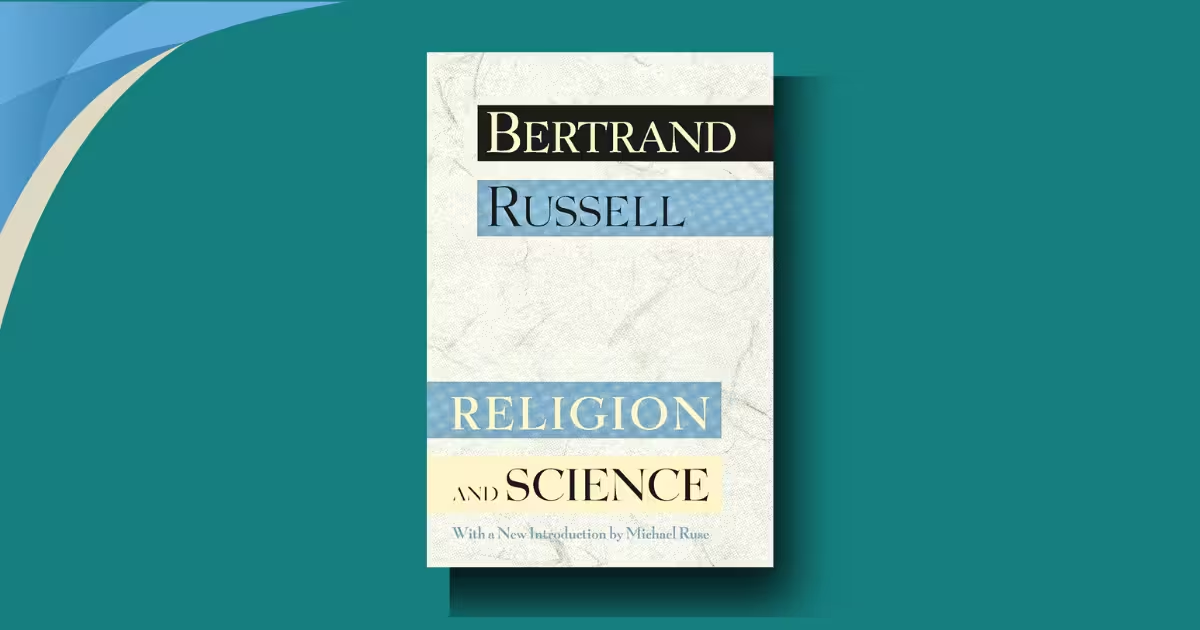

Did Bertrand Russell already win the argument you had with a relative at dinner last month, nearly ninety years before either of you were born? I think he did. Reading Religion and Science convinced me that most of what we now call a culture war over science and belief is a rerun with better special effects, and the original script was written in 1935 by a mathematician who had already gone to prison once for his opinions.
Religion and Science is Bertrand Russell’s short, dense history of every major fight between organized Christianity and scientific discovery, from Copernicus to quantum mechanics.
Across ten chapters, Russell shows that whenever a specific factual claim of theology met a specific finding of science, science won, every single time, and he backs that claim with dates, names, and numbers rather than slogans.
Religion and Science turns philosophical in its second half, tackling free will, mysticism, cosmic purpose, and ethics, and it ends with a warning that reads eerily well today: new political religions can persecute just as viciously as the old theological ones did. It is short, it is quotable, and it is not gentle with any side.
Read Religion and Science if you are the kind of person who wants receipts, not vibes, in a religion versus science conversation, or if you are studying the history of ideas and want one compact primary source instead of ten secondary ones. It also rewards readers who already loved Darwin’s On the Origin of Species and want the theological fallout explained afterward.
Skip it, or at least do not read it alone, if you want a 2026-current picture of science and faith. Russell wrote before the Big Bang model was confirmed, before DNA was mapped, before Vatican II, and before most of the twentieth century’s interfaith science dialogue happened.
Religion and Science also spends nearly all its attention on Christianity, with only passing mentions of Judaism, Islam, and Eastern traditions, so treat it as a Christianity-and-science history rather than a survey of world religion.
Table of Contents
Introduction
Religion and Science was written by Bertrand Russell and first published in 1935 as part of Oxford University Press’s Home University Library, a series built to hand general readers a short, expert introduction to a big subject.
The edition still in print today carries a later introduction by philosopher of science Michael Ruse, added to connect Russell’s original argument to debates that arrived after his death in 1970.
Russell needs almost no introduction, but here is the short version anyway, because it matters for how much weight to give his claims.
He was a British mathematician, logician, and philosopher, co-author with Alfred North Whitehead of Principia Mathematica, and winner of the 1950 Nobel Prize in Literature for what the committee called his defense of humanitarian ideals and free thought.
He called himself an agnostic rather than an atheist, and that distinction actually shows up in how carefully this book argues, since Russell is far more interested in what can be shown than in what he personally wants to be true.
The book’s purpose is stated almost immediately and never really wavers: to trace, chapter by chapter, the specific points where Christian doctrine made a factual claim about the world and where science later tested that claim and won.
Russell is not trying to prove God does not exist. He is trying to show a pattern, and then, in the final chapter, to warn that the pattern is about to repeat itself in a new and more dangerous form.
Background
Context matters here more than usual. Russell wrote this book in 1935, two years after Hitler took power in Germany and roughly fifteen years into Stalin’s Soviet Union. That timing is not incidental.
By the time you reach the book’s final pages, you can feel Russell watching two new ideological systems build their own inquisitions in real time, and he says so directly.
Knowing that this book was written in the shadow of both fascism and Stalinism, rather than as abstract Sunday-afternoon philosophy, changes how you read every chapter that comes before it.
Religion and Science Summary
Chapter I, Grounds of Conflict, sets the terms. Russell defines religion, socially, as having three parts: a church, a creed, and a code of personal morals, and he argues the creed is where the real fighting with science happens.
He contrasts the medieval method, reasoning downward from accepted authority such as the Bible or Aristotle, with the scientific method, reasoning upward from observed facts toward a provisional, always-correctable theory.
Thomas Aquinas gets treated as the strongest version of the theological case, not a strawman, which sets an honest tone early. Russell closes the chapter by admitting that religion as a private feeling, a way of caring about human suffering and human destiny, can survive science untouched.
It is the factual claims that are in danger, not the emotion behind them.
Chapter II, The Copernican Revolution, is where Religion and Science turns into genuinely gripping history. Russell traces heliocentrism back to Aristarchus of Samos in the third century BC, then to Copernicus, who lived from 1473 to 1543 and sat on his own manuscript for decades out of fear, eventually dedicating it to the Pope as a shield.
What surprised me most is that Protestants attacked the idea before Catholics organized against it. Russell quotes Calvin demanding to know who would dare place Copernicus’s authority above the Holy Spirit’s.
Then comes Galileo, tried by the Inquisition in 1633, forced onto his knees to recite a confession that he would, in his own words, abjure, curse, and detest the errors he had proven true, kept under house arrest, blind by 1637, and dead in 1642, the same year Isaac Newton was born.
The chapter closes on something I had never heard before: the Church’s parallel, decades-long insistence that comets were weather phenomena inside Earth’s atmosphere rather than heavenly bodies, a position defended in print as late as 1673 and only settled by Halley and Newton in the 1680s.
Chapter III, Evolution, opens with Archbishop Ussher’s calculation that creation happened in 4004 BC, and a Cambridge vice-chancellor’s claim that he could narrow it to 9 a.m. on October 23. From there Russell walks through geology’s slow break from Biblical catastrophism, including naturalist Buffon, who was forced by the Sorbonne’s theology faculty to publicly recant his own findings about mountain formation in 1749. Then Darwin: On the Origin of Species in 1859, natural selection borrowed conceptually from Malthus’s economics of population pressure, and the 1860 British Association debate where Bishop Wilberforce called natural selection flatly incompatible with the word of God and, in most tellings, lost the exchange to Thomas Huxley.
Russell does not let the chapter end on a triumphant note. He points out that evolution proves no law of cosmic progress at all, only an upward and downward drift, with entropy slowly winning in the long run.
Chapter IV, Demonology and Medicine, is the chapter that made me put the book down and just sit with it for a minute.
Russell documents disease treated as demonic punishment, relics credited with cures (the bones of Saint Rosalia, venerated for centuries in Palermo, turned out on examination to belong to a goat), and the witch trials, where Germany alone executed roughly 100,000 people between 1450 and 1550 by Russell’s count, mostly by burning, on charges that trace directly back to a Biblical verse commanding that a witch not be suffered to live.
He also tracks the same resistance pattern into medicine: anatomical dissection blocked for centuries, smallpox inoculation preached against as defiance of divine judgment, and childbirth anesthesia opposed in 1847 on the grounds that Genesis promised women pain in labor.
He even cites a 1930s papal encyclical still arguing against birth control on Biblical authority, which is Russell’s way of showing this is not only medieval history.
Chapter V, Soul and Body, gets philosophically technical, tracing the concept of an immortal soul from Pythagorean and Platonic roots into Christian doctrine, then dismantling the metaphysical idea of “substance” that Aquinas and later Descartes relied on.
Russell’s own example is almost funny: Aquinas seriously debated what happens at the resurrection of the body if a cannibal’s flesh is made of other people’s bodies. Russell uses the collapse of “substance” in both philosophy and physics to argue that personal identity is really just memory and habit strung together, which means there is no fixed soul-thing to survive death.
He is careful to call this probable rather than proven, but he does not soften the conclusion much either.
Chapter VI, Determinism, is the most technically demanding chapter, and also, in my opinion, the most quietly impressive. Russell builds a precise, testable definition of determinism using the speed of light and a bounded sphere of prediction, then walks through physicist Arthur Eddington’s argument that quantum uncertainty at the atomic level might rescue human free will.
Russell is not convinced, and he explains why using an analogy about coin tosses and gas molecules that is genuinely clear for a topic this abstract. His conclusion is refreshingly humble: neither strict determinism nor free will can currently be proven, so science should stay honestly uncertain rather than dogmatic in either direction.
Chapter VII, Mysticism, treats the testimony of mystics like evidence in a courtroom. Russell notes that mystics across traditions largely agree on three claims: the universe is one indivisible unity, evil is an illusion caused by seeing a part as separate from the whole, and time itself is not fully real.
He then shows that this agreement collapses the moment mystics get specific, since Catholic visions of the Virgin Mary do not match Chinese Taoist doctrine or Islamic revelation. His verdict, which I found genuinely generous for an agnostic, is that mystical experience expresses emotional importance rather than literal fact, and that stripped of its metaphysical claims, it still has real value, comparable to what great music or contemplation gives a person.
Chapter VIII, Cosmic Purpose, is where Russell takes on the last respectable religious argument of his era, that evolution itself proves the universe has a direction and a goal.
He separates this into three versions: theistic (a Creator planned it from outside), pantheistic (the universe itself is a kind of unfolding God, argued here through physiologist J. S. Haldane’s Hegelian framework), and emergent (purpose builds itself gradually and unpredictably, argued by philosopher Samuel Alexander and echoing Henri Bergson).
Russell picks all three apart, but the strongest moment is when he brings in physicist James Jeans’s meditation on entropy: the universe will run down in roughly a million million years, and, in Jeans’s own words, with universes as with mortals, the only possible destination is the grave.
Russell’s closing jab is the sharpest line in the book: humans calling themselves the crowning purpose of the cosmos is exactly as self-flattering, and exactly as unprovable, as lions or ants making the identical claim about themselves.
Chapter IX, Science and Ethics, lays out Russell’s own, admittedly personal theory that when someone says “this is good,” they are not stating a fact that could be true or false, they are expressing a wish that everyone shared their desire.
He shows how “conscience” gives contradictory verdicts to different people (it told George III he could not grant Catholic emancipation, and told other people the opposite), which he uses as evidence that conscience is trained, not divinely implanted. The Bentham-versus-Nietzsche contrast lands hard here: one built an ethics from “everyone’s pleasure counts equally,” the other from “only the great man matters,” and Russell shows plainly that no scientific experiment can settle which one is correct.
His conclusion is careful: science cannot decide values, not because science has a blind spot, but because value questions cannot be decided by any method at all.
Chapter X, Conclusion, is short and, read in 2026, unsettling in a way I was not expecting from a ninety-year-old philosophy book. Russell reviews the historical record and grants that Christianity is better off having lost most of these battles. Then he pivots to two live warnings.
First, scientific technique has started outrunning the cautious, self-correcting spirit that produced it, handing governments and industry what he calls a feeling of limitless power without the humility that real scientific thinking requires.
Second, and this is the line that stuck with me longest, new political religions in Germany and Russia had already begun punishing intellectual dissent with the exact same certainty and cruelty the old Inquisition once used against Galileo.
Russell’s closing sentence argues that new truth is uncomfortable, especially to the holders of power, but remains the most important achievement of our intelligent, wayward species.
Religion and ScienceAnalysis
What struck me most, reading this as someone who reviews a lot of nonfiction, is how well Russell supports his claims in the historical chapters.
Every date, every named figure, every institution he mentions checks out against the historical record, and he is transparent about his main source, Andrew Dickson White’s History of the Warfare of Science with Theology, rather than hiding his research trail. Religion and Science earns its authority the old-fashioned way: specificity.
A hundred thousand executions in a hundred-year window in one country carries more weight than any general claim that “the church persecuted scientists.”
Where Religion and Science gets shakier, by Russell’s own admission, is in the second half. He is upfront that his theory of ethics as “subjective,” meaning moral statements express desires rather than facts, was different thirty years earlier in his career, and he does not claim science backs this particular conclusion the way it backs the Copernicus or Darwin chapters.
I respect that honesty, but it does mean chapters six through nine function more as one very smart man’s philosophy than as settled science, and readers should hold them a little more loosely than the historical material.
Does Religion and Science fulfill its stated purpose?
Mostly, yes. It sets out to trace where theology and science collided and to show who won, and it does that with real rigor. Where it goes further than promised, and does it well, is the final chapter’s pivot from science-versus-religion to science-versus-any-dogma, including secular ones.
That reframing is the book’s real gift to a 2026 reader, because the specific theological fights over comets and Genesis feel historical now, but the fight over who gets to punish disagreement with official truth does not feel historical at all.
Strengths and Weaknesses
What I loved most is the sheer density of concrete detail packed into such a short book.
Every few pages there is a fact I wanted to text to someone: the goat bones venerated as a saint’s relic, Napoleon asking Laplace why his physics book left out God and getting the reply that he had no need of that hypothesis, the fact that Newton himself was devoutly religious even as his physics quietly ended theological astronomy.
I also respected that Russell keeps turning his scrutiny back on his own side. He does not let secular ideology off the hook once he reaches 1930s Germany and Russia, which keeps the book from ever feeling like a one-sided pamphlet.
What bothered me, and what a reader should know going in, is how Christianity-centered the whole project is. Rae West’s independent reading of this text makes a fair point that Russell barely touches Judaism or Islam and gives almost nothing to Hindu or Buddhist thought outside a brief mysticism comparison.
For a book with “Religion” in the singular, unqualified title, that narrowness is a real gap.
I also found the tonal shift jarring: chapters two through four read like propulsive narrative history, while chapters five through nine slow into dense analytic philosophy, and a reader expecting the whole book to move at Galileo-trial pace may stall around chapter six.
Comparison With Similar Works
If you want the primary source behind Russell’s third chapter, go read Darwin’s On the Origin of Species directly, then come back to Russell for the theological fallout Darwin himself mostly avoided discussing in public.
Readers who want the flip side of this argument, a serious contemporary case for faith rather than against it, should look at Ross Douthat’s Believe, which directly engages Darwin, Copernicus, and quantum mechanics from the opposite conclusion.
Russell also name-checks Nietzsche directly, tracing Hitler’s ideals back to him with visible discomfort, so pairing this with our review of Beyond Good and Evil fills in exactly where that influence came from.
And since Russell spends real energy dismantling Kant’s idea of the unknowable “thing-in-itself” in his chapter on soul and body, our Critique of Pure Reason guide is worth reading alongside it if that section slows you down. For broader context on how this debate has developed since Russell’s death, we also cover it directly in our piece on the relationship between science and religion today.
Conclusion
Religion and Science earns its place as a genuine classic, not because it settles the argument, Russell himself would tell you no book can, but because it gives you the receipts for a debate most people only have in slogans.
I would recommend it without hesitation to anyone building a serious personal library on the history of ideas, to philosophy students who want one compact primary text instead of ten paraphrased ones, and to general readers who liked Darwin’s Origin of Species and want to understand what happened next. I would pair it, not replace it, with something written after 1970 if you specifically want the state of science and faith today.
And I would tell anyone who only remembers this book as “the one where science beats religion” to read all the way to the final chapter, because that is not actually the point Russell is making by the end.