
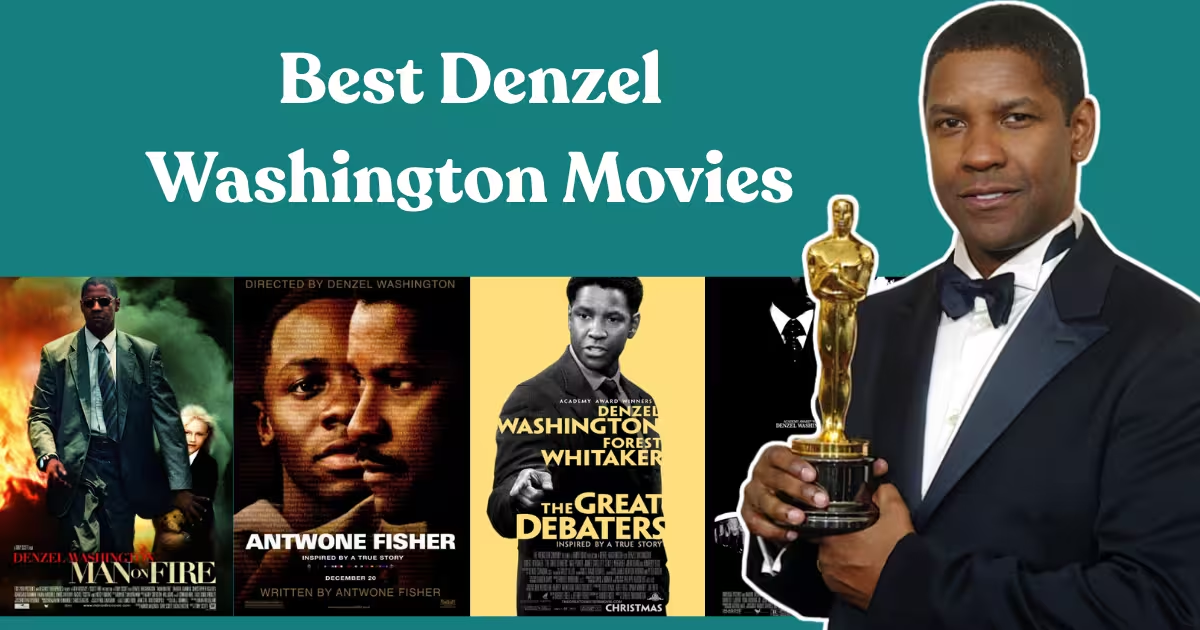
Why does one actor’s filmography double as a crash course in twentieth-century American history, and why does almost nobody mention that half of it is only loosely true? I am talking about the best Denzel Washington movies.
I started keeping a running list of Denzel Washington movies a few years ago, mostly because I kept losing arguments with my brother about which one was actually his best work. Somewhere around the fifth rewatch of Malcolm X, I noticed a pattern nobody was talking about in the usual ranked lists floating around the internet.
A huge chunk of his most celebrated roles are based on real people: Rubin Carter, Frank Lucas, Melvin Tolson, Herman Boone, Antwone Fisher, the men of the 54th Massachusetts Infantry.
So this list isn’t just ranking performances. It’s checking, film by film, how much of what you’re watching actually happened, and how much of it is Hollywood doing what Hollywood does.
Table of Contents
Overview
I ranked Denzel Washington’s 15 best movies using award recognition, box office performance, critical reception, and cultural staying power. Then, for every biopic and true-story drama on the list, I dug into what the historical record actually says.
A few of these films hold up remarkably well against the facts.
A couple of them, according to the very people they’re based on, get quite a lot wrong. Either way, Washington’s performances are the throughline that makes all fifteen worth your time. Here they are, from number 15 to number 1.
How I Built This Ranking
I didn’t just go by gut feeling, and I didn’t copy the same fifteen titles every other site recycles in the same order. I weighed four things for each film: Academy Award and Golden Globe recognition, box office return relative to budget, how critics and audiences have judged it over time (using Rotten Tomatoes scores where available), and, for the based-on-a-true-story entries, how the film measures up against court records, biographies, and statements from the real people involved or their families.
That last piece is the part most “best of” lists skip entirely, and it’s the one I found most interesting to research.
One quick note before we get into it. You’ll notice these fifteen span nearly four decades, from 1989’s Glory to 2021’s The Tragedy of Macbeth. That range is itself remarkable. Not many actors are still landing Oscar nominations more than thirty years after their first win.
Best Denzel Washington Movies
15. Man on Fire (2004)
Denzel plays John Creasy, a burned-out former CIA operative and Force Recon Marine who takes a bodyguard job in Mexico City and turns into a one-man war machine after his young charge, played by Dakota Fanning, is kidnapped. Director Tony Scott gives the whole thing his signature jittery, sun-bleached visual style, and it’s not subtle in the slightest.
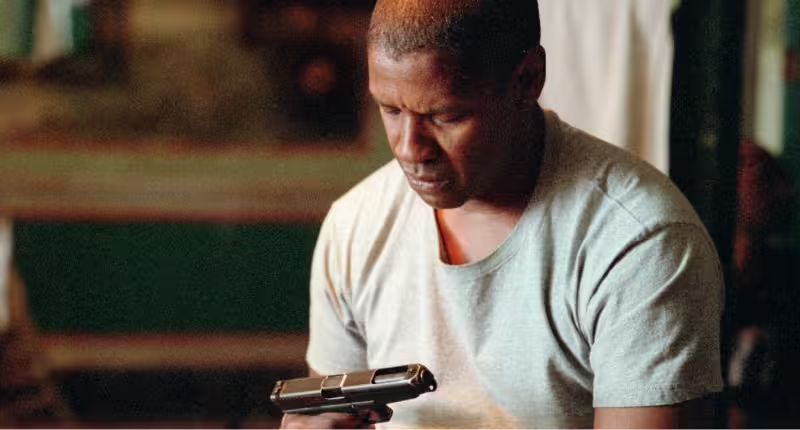
Here’s the truth-check angle, though: unlike most of the films further up this list, Man on Fire isn’t based on real events at all. It’s adapted from A.J. Quinnell’s 1980 novel of the same name, which had already been turned into a 1987 film starring Scott Glenn before Washington and Scott got their hands on it.
According to Wikipedia’s production data, the 2004 version grossed roughly $130.3 million worldwide against a budget in the $60 to $70 million range, and reviews at the time were genuinely split, praising Washington’s intensity while criticizing the film’s length and brutality.
Fifteen isn’t a knock on quality so much as a reflection of where it sits next to the true stories and Oscar-caliber work stacked above it.
14. Remember the Titans (2000)
This is the one people put on for their kids, and honestly, it earns that spot. Washington plays Herman Boone, the real high school football coach who took over a newly integrated team in Alexandria, Virginia, in 1971 and, against a lot of resistance, turned it into a state championship squad.
Wikipedia lists the film’s budget at $30 million against a box office haul of $136.8 million, which made it one of the more profitable sports dramas of its decade.
Where does it stand on accuracy? Generally decent, though not perfect. The broad strokes of Boone’s coaching, the team’s integration, and the championship season are accurate, but several individual character arcs and specific scenes were altered or invented for dramatic effect, a fairly typical move for a Disney sports drama built for a family audience.
Washington’s performance is what keeps it from feeling like a simple inspirational template. He plays Boone with a controlled intensity that never tips into cliché, even when the script occasionally does.
13. Antwone Fisher (2002)
This one matters for a different reason: it’s Denzel Washington’s directorial debut, and he didn’t just direct it, he starred in it too, playing Navy psychiatrist Jerome Davenport opposite newcomer Derek Luke as the title character.
What makes this film unusually trustworthy on the accuracy front is that Antwone Fisher wrote the screenplay himself, based on his own memoir, Finding Fish.
According to Wikipedia‘s production figures, it ran on a modest $12.5 million budget and brought in $23.4 million at the box office, a small but respectable return for a character study with no action set pieces and no star-driven marketing hook beyond Washington’s name.
I’ll admit this is the film on this list I recommend most to people who’ve never seen it. It doesn’t get talked about the way Training Day or American Gangster does, but the two-hander scenes between Washington and Luke carry more emotional weight than almost anything else in his filmography.
12. Flight (2012)
Robert Zemeckis directs Washington as Whip Whitaker, an airline captain who performs a near-impossible crash landing, saves nearly everyone on board, and is hailed as a hero right up until the investigation reveals he was drunk and high while flying the plane.
The film is loosely inspired by the real 1976 crash of Alaska Airlines Flight 261, though the plot itself, and Whitaker’s alcoholism arc, is fictional rather than a direct retelling.
According to Wikipedia’s box office data, Flight earned $161.8 million worldwide against a $31 million budget, a strong return for an adult drama without franchise backing.
It also brought Washington his sixth Oscar nomination, this time for Best Actor, and the film picked up a second nomination for John Gatins’s original screenplay. What sticks with me watching it again is how unflinching it is about addiction. Washington doesn’t play Whitaker as a tragic hero.
He plays him as a man in denial, which is a much harder note to hit convincingly.
11. The Great Debaters (2007)
Washington’s second film as director, and his first time directing himself in a role based on a real historical figure: Melvin B. Tolson, the poet and professor who coached the debate team at Wiley College, a historically Black college in Texas, during the 1930s.
Oprah Winfrey’s production company, Harpo Productions, backed the project, and Forest Whitaker co-stars as the father of one of the young debaters.
Wikipedia lists the budget at $15 million against a box office total of $30.2 million, a modest theatrical run that undersold how well the film was received critically.
As for accuracy, the film compresses and dramatizes real events, including a famous 1935 debate against a top university team, though several details, including which school the Wiley team ultimately debated, were changed for the screen. Even with those liberties, the core of Tolson’s story and Wiley’s debate program’s real achievements holds up.
10. Training Day (2001)
If you ask most casual fans to name Washington’s best movie, this is probably in their top three, and it’s the film that won him his second Academy Award, this time for Best Actor, at the 74th Academy Awards.
He plays Alonzo Harris, a corrupt LAPD narcotics detective who spends one long, increasingly deranged day breaking in a rookie played by Ethan Hawke, who earned his own Oscar nomination for Best Supporting Actor.
According to Wikipedia’s production data, the film ran on a $45 million budget and grossed $104.9 million worldwide, a solid if not spectacular commercial performance that has since been dwarfed by its reputation.
It currently sits around a 74 percent critics’ score and an 89 percent audience score on Rotten Tomatoes, per Collider’s reporting on the film’s recent streaming resurgence. What makes this one worth revisiting is how much fun Washington is clearly having playing against type.
He’d spent over a decade as Hollywood’s moral center, and here he gets to be the most charismatic villain in the room.
9. Philadelphia (1993)
This is a film I keep coming back to, not because Washington’s performance is his flashiest, but because of what the role required of him. He plays Joe Miller, a homophobic personal injury lawyer who reluctantly agrees to represent Andrew Beckett, played by Tom Hanks, in a wrongful termination suit after Beckett’s law firm fires him for having AIDS.
Director Jonathan Demme, fresh off winning Best Picture for The Silence of the Lambs, built the film specifically to reach a mainstream audience that Hollywood hadn’t yet tried to talk to about the AIDS crisis.
According to Wikipedia’s box office figures, Philadelphia earned $206.7 million worldwide against a $26 million budget, a genuine commercial triumph for a drama tackling subject matter most studios were avoiding entirely in 1993.
Hanks won the Best Actor Oscar for his performance, and Bruce Springsteen’s “Streets of Philadelphia” took Best Original Song. Washington himself wasn’t nominated, but his arc, a man who has to publicly confront his own prejudice in real time, gives the film its emotional spine.
Not everyone loved the film’s approach; playwright and activist Larry Kramer criticized it at the time for softening the realities of the gay community it was portraying, a fair point worth knowing before you watch it.
8. Crimson Tide (1995)
A submarine standoff thriller directed by Tony Scott, with Washington and Gene Hackman locked in a battle of wills over whether to launch nuclear missiles based on a possibly-outdated order.
Wikipedia notes the story unintentionally parallels a real, and genuinely terrifying, incident during the Cuban Missile Crisis involving the Soviet submarine B-59, whose officers came within one dissenting vote of launching a nuclear torpedo.
The film itself is fiction, not a dramatization of that event, but knowing the historical echo makes the tension land differently. Wikipedia’s production numbers put the budget at $53 million against a worldwide box office of $157.4 million, a healthy hit for 1995.
Quentin Tarantino did an uncredited dialogue pass on the script, which explains why some of the exchanges between Washington and Hackman crackle the way they do. Their scenes together are a masterclass in two actors refusing to blink first, on screen or off.
7. Fences (2016)
Washington directs and stars in this adaptation of August Wilson’s Pulitzer Prize-winning play, playing Troy Maxson, a former Negro Leagues baseball player turned Pittsburgh garbage collector whose bitterness over a career cut short by segregation poisons his relationships with his wife and sons.
Viola Davis, reprising her Tony-winning stage role, won the Best Supporting Actress Oscar for her performance, and per Variety‘s coverage of the ceremony, she became the second person in Academy history to win a Tony and an Oscar for the same role in different categories.
According to Wikipedia’s box office data, Fences brought in $64.4 million against a $24 million budget. It’s not a flashy adaptation.
Washington keeps the camera close and mostly indoors, trusting August Wilson’s dialogue to do the heavy lifting, and it does. This is as close as the list gets to pure theater on film, and it earned Washington his seventh Oscar nomination for acting.
6. Malcolm X (1992)
Spike Lee’s sprawling, three-hour-plus biographical epic, adapted from The Autobiography of Malcolm X, is widely considered one of Washington’s best performances, and a lot of people, myself included, still think he should have won the Oscar for it.
He didn’t. He lost Best Actor at the 65th Academy Awards, though he did take home the New York Film Critics Circle Award for Best Actor that same year, according to Wikipedia’s awards summary.
The production itself became almost as dramatic as the film. Warner Bros. cut off funding partway through filming over disputes about the runtime, and Lee has spoken publicly about how difficult that period was for him, eventually finding a way to finish the film despite the shortfall, according to ScreenRant’s reporting on Lee’s own account of the ordeal.
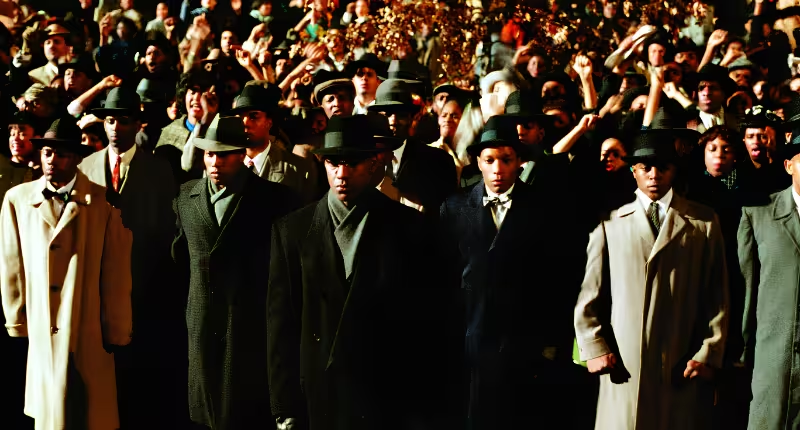
On the accuracy front, the film draws directly from Malcolm X’s own words in the autobiography, co-written with Alex Haley, which gives it a stronger claim to authenticity than most biopics, even though some historians have noted the book itself was shaped partly by Haley’s interpretation.
Wikipedia lists the box office at $73 million against a $35 million budget, a modest return that doesn’t come close to reflecting the film’s lasting influence; it was added to the National Film Registry in 2010 for being “culturally, historically, or aesthetically significant.”
5. The Hurricane (1999)
Norman Jewison directs Washington as Rubin “Hurricane” Carter, the middleweight boxer wrongly convicted of a 1966 triple murder in Paterson, New Jersey, who spent nearly two decades in prison before his conviction was overturned. Washington won the Golden Globe for Best Actor in a Drama for the role and picked up an Oscar nomination as well.
This is the film on the list with the most well-documented accuracy problems. Critics and journalists at the time pointed out that the movie invents or exaggerates several plot elements, including the extent to which the trial’s outcome was driven by racism versus other factors in the actual case record, according to reporting collected on the film’s Wikipedia page.
Carter himself, at the film’s premiere, reportedly joked when asked about being played by Washington that he “didn’t know I was that good-looking,” which at least suggests he didn’t take the dramatic license personally.
Wikipedia lists the budget at $50 million against a $74 million box office return, a fairly thin margin for a film with that production cost. I still think it’s worth watching, just maybe with a follow-up read of the actual case afterward.
4. Inside Man (2006)
Washington reteams with Spike Lee for a heist thriller that’s less interested in the heist itself than in the psychological chess match between Washington’s hostage negotiator and Clive Owen’s meticulous bank robber, with Jodie Foster circling both of them as a power broker with her own agenda.
The coverage of the film’s recent streaming success, it earned roughly $186 million worldwide against a $45 million budget, making it one of the more commercially successful entries on this entire list relative to its cost.
There’s no true-story angle to check here since the plot is entirely fictional, which actually makes it a nice palate cleanser after several biopics in a row. What holds up is the writing.
Russell Gewirtz’s script keeps you guessing about what’s actually being stolen until the very end, and Washington plays the negotiator with a wry, unbothered confidence that makes even the film’s slower stretches enjoyable.
3. The Tragedy of Macbeth (2021)
Joel Coen’s first solo directorial effort without his brother Ethan is a stark, black-and-white adaptation of Shakespeare’s play, shot almost entirely on stylized soundstages, with Washington playing the title role opposite Frances McDormand’s Lady Macbeth.
According to Deadline’s coverage, Washington’s Best Actor nomination for this role made him, at the time, the most nominated Black actor in Oscar history with ten total acting nominations across his career.
There’s obviously no true-story check to run on a four-hundred-year-old tragedy, but there is something worth noting about the box office: Wikipedia lists the theatrical gross at just $524,779, since the film was primarily released through Apple TV+ rather than a wide theatrical run.
That tiny number tells you nothing about the film’s quality and everything about how differently prestige films get distributed now compared to when Washington started his career.
At 66 years old at the time of filming, he brought a weary, calculating quality to Macbeth that younger actors in the role rarely manage, according to critics quoted in Gold Derby’s Oscar coverage of the film.
2. American Gangster (2007)
Ridley Scott directs Washington as Frank Lucas, the real Harlem drug trafficker who smuggled heroin into the United States hidden in the coffins and uniforms of American soldiers returning from Vietnam, building an empire that, according to Collider’s reporting on the true story, generated over $400 million before Lucas’s arrest.
Russell Crowe plays Richie Roberts, the detective who eventually brought him down and, strangely enough, became his friend afterward.
According to Wikipedia’s box office data, the film earned $269.8 million worldwide against a $100 million budget, making it one of Washington’s biggest commercial successes.
On accuracy, this is where I have to be direct with you: it’s not close to a faithful account. Sterling Johnson Jr., the federal judge who prosecuted the real Frank Lucas, told reporters the film was “1 percent reality and 99 percent Hollywood,” according to the film’s
Wikipedia entry, and several former DEA agents even filed a defamation lawsuit over how they were portrayed, though it was ultimately dismissed.
None of that takes away from Washington’s performance, which is coiled, quiet, and genuinely frightening in a way his villain roles rarely get to be.
1. Glory (1989)
The film that started it all, at least in terms of his Oscar history. Edward Zwick’s Civil War drama tells the story of the 54th Massachusetts Infantry Regiment, one of the Union Army’s first Black regiments, and Washington plays Private Trip, a fictional composite character rather than a specific historical figure, unlike Matthew Broderick’s Colonel Robert Gould Shaw, who was real.
Washington won the Academy Award for Best Supporting Actor for the role, making him, at the time, only the second Black actor to win an Oscar for a Best Supporting performance, and the film took home three of its five total nominations, according to Simple English Wikipedia’s summary of the ceremony.
According to Wikipedia’s release data, Glory opened in limited release in December 1989 before expanding wide in February 1990, ultimately earning around $27 million against an $18 million budget, a solid if unspectacular commercial run for a war drama with no major stars at the time beyond Broderick’s name recognition from Ferris Bueller’s Day Off.
What earns it the top spot on this list isn’t the box office, though. It’s the fact that this is the performance where you can watch Washington become the actor he’d spend the next three decades proving himself to be, and everything else on this list, in some way, traces back to it.
A Personal Note on Watching All Fifteen Back to Back
I’ll be honest, doing this deep of a rewatch changed how I see Washington’s career. Going in, I expected the ranking to be dominated by the loud, quotable performances, the Training Days and American Gangsters. Instead, what stuck with me most were the quieter, less flashy roles: the psychiatrist in Antwone Fisher, the debate coach in The Great Debaters, the garbage collector in Fences.
Those are the films where Washington isn’t performing charisma. He’s performing restraint, which is a much harder thing to do convincingly for two hours.
There’s also something worth saying about the true-story pattern I mentioned at the start. Roughly half of this list is based on real people, and the accuracy varies wildly, from Antwone Fisher, which is about as close to a documentary as a Hollywood drama gets since the subject wrote it himself, to American Gangster, which a federal judge publicly called mostly fiction.
That range tells you something about how differently studios treat “based on a true story” depending on whether the goal is education, entertainment, or, in most cases, some uneasy mix of both. If you take one thing from this piece beyond the ranking itself, let it be that: watch the biopics, enjoy them, and then go read about the real people afterward.
It’s worth the extra half hour.
Frequently Asked Questions
What is Denzel Washington’s highest-rated movie?
Critical consensus varies by source, but Glory, Malcolm X, Training Day, and Fences consistently rank among his highest-rated work across major review aggregators, according to Rotten Tomatoes’ own retrospective coverage of his filmography.
How many Oscars has Denzel Washington won?
Two competitive Academy Awards: Best Supporting Actor for Glory in 1990 and Best Actor for Training Day in 2002, according to Sportskeeda’s summary of his award history. He has been nominated ten times total for acting, the most of any Black actor in Oscar history as of his nomination for The Tragedy of Macbeth.
Which Denzel Washington movies are based on true stories?
Of the films on this list, Glory, Malcolm X, The Hurricane, Remember the Titans, Antwone Fisher, The Great Debaters, and American Gangster are all based on real people or events, with varying degrees of factual accuracy.
Is American Gangster historically accurate?
Not especially. The federal prosecutor who helped convict the real Frank Lucas has publicly stated the film is mostly Hollywood invention layered over a small amount of fact, according to reporting included in the film’s Wikipedia entry.
References
- Wikipedia: Glory (1989 film), Malcolm X (1992 film), Training Day, Philadelphia (film), Crimson Tide (film), Fences (film), The Hurricane (1999 film), Inside Man, The Tragedy of Macbeth (2021 film), American Gangster (film), Flight (2012 film), The Great Debaters, Antwone Fisher (film), Remember the Titans, Man on Fire (2004 film)
- Collider: reporting on American Gangster‘s true story and box office context, and on Spike Lee’s account of funding Malcolm X
- Deadline: coverage of Denzel Washington’s tenth Oscar nomination for The Tragedy of Macbeth
- Variety: coverage of Viola Davis’s Best Supporting Actress win for Fences
- Gold Derby: Oscar predictions and critical reception coverage for The Tragedy of Macbeth
- Sportskeeda: summary of Denzel Washington’s Academy Award and Golden Globe history







