Last updated on August 23rd, 2026 at 06:01 pm
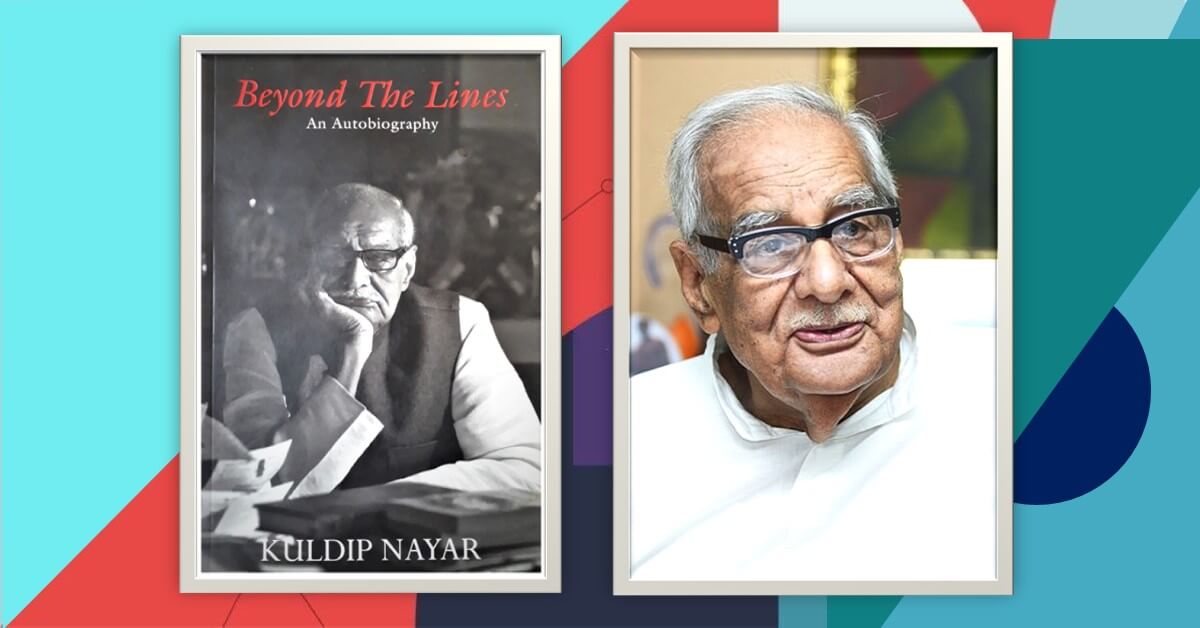
Kuldip Nayar’s autographical book Beyond the Lines is an outstanding account of the birth of three nations in the Indian subcontinent: India, Pakistan and Bangladesh. In it, he minutely expounds on how the British Raj encountered resistance prompted by freedom-loving Indians and eventually had to end its colonialism by partitioning the Indian subcontinent along religious lines, in 1947. This is a book, I think, that can change how you viewed subcontinental politics before.
Kuldip Nayar, as a journalist, former information officer of the Indian government, former Indian ambassador to the UK and a member of Rajya Sabha personally witnessed many pre and post-partition events; and, inspired by Mahatma Gandhi, he took part in the freedom struggle of India and worked or came in close proximity with the great leaders of the three countries.
Beginning with the partition, Kuldip Nayar was privileged either to work with or had been a close friend of Mahatma Gandhi, Muhammad Ali Jinnah, Jawaharlal Nehru, Abul Kalam Azad, Lal Bahadur Shastri, Indira Gandhi, Rajiv Gandhi, Jayaprakash Narayan, Morarji Desai, V.P. Singh, Narasimha Rao, L.K. Advani, Sheikh Mujibur Rahman, Pakistan’s nuclear scientist Abdul Qadir Khan and Manmohan Singh.
Table of Contents
Introduction
The book is titled Beyond the Lines: An Autobiography by Kuldip Nayar. It was first published in India in June 2012 by Roli Books under its Lotus Collection imprint.
Context of Beyond the Lines
Kuldip Nayar wasn’t just any journalist. He was a witness to history. Born in Sialkot (now in Pakistan) in 1923, he was a 24-year-old law graduate when the subcontinent was partitioned. He began his career in Urdu journalism in Delhi and went on to become a giant in the field, editing the Statesman and the Indian Express.
He founded the United News of India (UNI) news agency and later served as India’s High Commissioner to the United Kingdom. His career gave him an intimate, often unprecedented, view of the country’s political elite.
Beyond the Lines is his account of that journey. It’s the story of modern India as seen through the eyes of a man who was both a participant and a chronicler of its most pivotal moments.
Purpose of Beyond the Lines
Nayar is upfront about his goal: he was writing a “contemporary history of India, Pakistan, and Bangladesh”. His purpose wasn’t just to tell his own story, but to document the events he had witnessed “from the time they came into existence”.
He wanted to present an honest and frank account of what he knew, from the inside, about the creation of three nations and the leaders who forged them.
Background
To understand the book, you need to understand the author. Nayar’s life was a mirror of the subcontinent’s tumultuous 20th century. He grew up in a composite culture in Sialkot, a city in undivided Punjab, where Hindus, Muslims, and Sikhs lived together. His family, as he describes it, “blended the traditions of Sikhism and Hinduism”.
This world was shattered in 1947. The Partition of India forced him and his family to flee their home and migrate to India as refugees. This foundational trauma shaped his worldview, giving him a deep-seated commitment to secularism and an unwavering belief in the necessity of peace between India and Pakistan.
This background is crucial because it explains not just his politics, but his journalistic passion for uncovering the truth and holding power to account.
I cannot help but mention a few striking features or events of Beyond the Lines below:
Beyond The Lines summary and some noteworthy events
Beyond the Lines is a wonderful chronology of historical facts like partition, the two-nation theory, the division of geographical territory between India and Pakistan, the atrocities committed between Hindus and Muslims during the Partition, the assassination of Mahatma Gandhi, Indira Gandhi, Rajiv Gandhi, the death of Nehru, Lal Bahadur Sastri, the Sino-India war of 1962, the Indo-Pak war of 1965, the Independence war of Bangladesh in 1971, the Operation Bluestar on Sikh in 1984, the Kargil war and the Gujarat Riot of 2002.
Beyond The Lines opens not with Nayar’s birth, but with a moment that would define the subcontinent: the passage of the Pakistan Resolution in Lahore in 1940. He was there, a 16-year-old student, witnessing the fervor of the crowd.
This sets the stage for the central tragedy of his life and the book: the Partition of India.
Nayar’s account of Partition is deeply personal. His family initially chose to stay in Sialkot, believing that Muslims would remain in India and Hindus in Pakistan. He vividly describes the chaos and violence that ensued. He recounts a harrowing journey as a refugee, a 24-year-old traveling to India with just Rs 120 his mother gave him.
He writes of seeing “so much blood and destruction in the name of religion” that he made a vow to himself to fight for a secular India.
One of the most poignant passages describes the moment he saw Jinnah, the founder of Pakistan, fly over the divided Punjab. Upon seeing the streams of refugees, Jinnah struck his hand to his forehead and said despairingly, “What have I done?”.
This moment, as Nayar reveals, was a closely guarded secret, told to his wife and later shared with the author. It’s a powerful illustration of the human cost of political decisions.
Nayar doesn’t shy away from assigning blame. He interviews Lord Mountbatten and Cyril Radcliffe, the man who drew the border. He learns that Radcliffe had initially awarded Lahore to India but changed his mind, and that Mountbatten’s haste in advancing the date of independence led to unforeseen bloodshed.
The partition of India
Born in Sialkot, Pakistan, Kuldip Nayar and his family had to flee after the announcement of the Partition on 12 August 1947. He writes, “
Trouble began almost simultaneously on both sides of the new border on 13 August. Lahore and Amritsar got engulfed after the killing of Sikhs at Rawalpindi and of Muslims in the Sikh-ruled states in East Punjab. Soon it became a bloodbath, with furious mobs roaming the bazaars with weapons. People went on a rampage of killing, looting, and kidnapping, especially of women and children, and setting homes ablaze, Even the sky of the relatively quiet Sialkot was radiant. We helplessly watched the fires in the distance.”
The Partition cost 1 million lives, and 20 million were displaced from Hindu, Muslim and Sikh communities.
90 per cent of Muslims supported the partitioning of India on the basis of religion which gave birth to the Pakistan Resolution on 23 March 1940. Jinnah’s support for a nation for Muslims was clear in his speech:
“Hindus and Muslims belong to two different religions, philosophies, social customs, and literature. They neither intermarry, inter-dine, and, indeed, they belong to two different civilizations that are based mainly on conflicting ideas and conceptions. To yoke together two such nations under a single state, one as a numerical minority and other as a majority, must lead to growing discontent and final destruction of any fabric that may be so built for the government of such a state”.
Ultimately, “Mountbatten selected 15 August”, says the author, “because it was the day when the Japanese surrendered to the Allies, ending the WWII…. He hoped to associate Britain’s surrender to India”. The Partition was the greatest tragedy humanity had ever witnessed. It severed the entire shared cultural fabric of thousands of years of Hindus, Muslims and Sikhs.
Jinnah’s dream for a tolerant, progressive and modern Pakistan has been faded over time as, right after his death leaders like Liaquat Ali Khan, Ayub Khan, Yahya Khan, Zia-Ul-Haq and Zulfikar Ali Bhutto lacked his stature and the state has become a purely Islamic one. In Pakistan, there is almost no religious minority now.
Mahatma Gandhi assassination
An extremist, Nathuram Godse, shot Mahatma Gandhi dead on 30 January 1948 at Birla House. While the extremist Hindus were trying to build a Hindu nation, he was instead fasting to pressurise New Delhi to transfer the assets due to Pakistan after the Partition. Pakistan demanded $75 million, one fifth against $375 million, left behind in Pakistan by Hindus and Sikhs.
Pakistan did not join India in mourning Gandhi’s assassination. Even Jannah’s reaction was lukewarm.
After the dispute regarding the boundary came the dispute about the language of the Union of India. English was proposed to be the language of the Union and Hindi, the official. It remains the only language linking the north and south, east and west. After the division of the country based on religion, divisions on the basis of different languages of India became almost inevitable during Nehru’s days.

You may like Outliers review
Outliers: The Story of Success by Malcolm Gladwell presents to the world that whatever we achieve and whatever success we are entitled to are the results of opportunities, time, age, and the condition we are borne in. They mostly are dependent on our attitude and our dependency on one another. Continue reading.
Sino-India War
Regarding India’s sour relations with China, Beyond the Lines reveals an unpopular account on the real fallout. The unfriendly relations between the two countries later resulted in the Sino-India war of 1962, when Pakistan played its role of a ‘pawn of the great power’.
In 1962 China occupied 12,00 square miles of Indian territory while India encroached 4,00 square miles of territory belonging to China. Nehru ordered General P.N. Thapar to evict the Chinese from the post they had built in Indian territory. Without re-organising, unprepared and without re-equipping the army, Defence Minister Krishna Menon was obdurate to attack China.
The Chinese attack came on 20 October in the Ladakh area. By the end of October, the Indian Post at Dhola fell and the post at Bondi fell on November 19, 1962. Once asked for help from the US with armament, the US blamed India for lacking a combative spirit to confront China. However, China decided a ‘unilateral withdrawal’ of forces on November 21. The Statesman speculated that ‘they wanted to punish India, not occupy it’.
The general and prevailing perceptions are to blame P.N. Thapar for the defeat of India. He was dubbed as a coward but Kuldip Nayar exonerates him of the guilt that the nation puts on him. Because he had already revealed to Nehru that the army was in bad shape, and he became a victim of Defence Minister Krishna Menon.
Nehru and Kashmir
At the demise of Jawaharlal Nehru, 27 May 1964, Kuldip Nayar, for that matter says, “A man of the world, a man of the masses, a master of the written and spoken word; innumerable images flashed through my mind at this death. I was stirred by his thoughts which combined the modern with tradition. I went back to his Discovery of India to read: ‘Life is a continuous struggle of man against man, of man against his surroundings; a struggle on the physical, intellectual, and moral plane out of which new things take shape and fresh ideas are born.
Lal Bahadur Shastri became prime minister of India after Nehru’s death. Ayub Khan, President of Pakistan was in power.
The US supplied arms to Pakistan to use against India during the Indo-Pak war over the Rann of Kutch, which India won. Russia had not yet supplied arms, but the Soviet Union had welcomed the Pakistani leader to Moscow and made Rawalpindi believe that if it ever came to a conflict between India and Pakistan, the USSR remain neutral.
Ayub Khan and Shastri agreed upon the Tashkent Declaration in Moscow. They both agreed, “that all personnel of the two countries shall be withdrawn not later than 25 February 1966”.
On January 10, 1966, Shastri died in Tashkent. That night he was considering visiting Pakistan at Ayub Khan’s instance ‘to tea in Islamabad’. He called at his residence to speak about the Tashkent Declaration. He asked his eldest daughter, Kusum, tum ko kaisa laga? In reply, she said she did not like it. The telephone call appeared to have upset Shastri.
His assistants saw him at the door saying ‘Where is the doctor sahib?’ with great difficulty. He died that moment with a racking cough. However, on October 2, 1970, Shastri’s birthday, his family complained that he was poisoned.
Indira Gandhi
Split of the Congress Party
After the death of Lal Bahadur Shastri, the author writes, “for the first time in the history of the Congress parliamentary party there was a contest for leadership. Indira Gandhi secured 355 votes, and Morarji Desai 165”. However, “she wanted power for herself; and collective leadership was something she totally opposed”, and ‘for that reason was immediately in conflict with the ‘old guards.’
The syndicate expelled her from the Congress party, and she intern blessed the meeting of the members who were on her side, 441 of 705 elected members.
The elderly Congress leaders found her indisciplined and ‘too dictatorial’. The elderly Congress leaders, known as ‘the syndicate’ tried to stop her from splitting the Congress. They blocked her nominee Jagjivan Ram for the presidency. But when their nominee of choice N. Sanjiva Reddy, was defeated, she had got V.V. Giri, an indipendent nominee elected instead of Jagjivan Ram.
The old guards or the Syndicate wanted to take disciplinary action against her for defeating the party’s official candidate for the presidency. And finally, the Congress split into two halves: with the syndicates, the Old Congress, and with Indira Gandhi, the New Congress.
By then, Yahya Khan seized power from Ayub Khan in Pakistan.
Bangladesh Independence War
The Roots of Disintegration
East Pakistan and West Pakistan, though united by Islam, were worlds apart in language, customs, and lifestyle. Nayar cites General Ayub Khan’s recollection: “In 1952, West Pakistan’s order to make Urdu the national language sparked immense resentment in East Pakistan, who taunted that Bengali was closer to Sanskrit and hence to Hinduism.” This cultural alienation, compounded by West Pakistan’s economic exploitation and political subjugation, steadily eroded East Bengal’s loyalty to the federation.
Sheikh Mujibur Rahman’s Awami League championed greater autonomy through its “Six-Point Program.” In the 1970 general elections, it won a landslide victory, 167 out of 169 East Pakistani seats, securing an absolute majority in the national parliament. However, West Pakistan’s leaders, Zulfikar Ali Bhutto and military ruler General Yahya Khan, refused to transfer power.
After the National Assembly election (17 December 1970), the Awami League chief Sheikh Mujibur Rahman demanded provincial autonomy and prime ministership on the basis of his majority in the National Assembly.
President Yahya Khan and the defeated Prime Minister Zulfikar Ali Bhutto considered Sheikh Mujibur Rahman’s demands as a secessionist stand to divide Pakistan. He was arrested, and the Agartala Conspiracy case was fabricated against him, and the Awami League was declared unlawful, and a military crackdown by Islamabad followed, resulting in murder, rape and plunder.
On March 25, 1971, they launched a brutal military crackdown, arresting Mujib and banning the Awami League.
The Refugee Crisis and India’s Strategic Calculus
The Pakistani military’s “Operation Searchlight” unleashed a reign of terror—murder, rape, and plunder—sending millions of refugees streaming into India. Nayar reveals a critical strategic decision: India resolved to support the East Pakistani uprising and actively facilitate the creation of Bangladesh, thereby ensuring that “no power could ever attack India from that side.”
Consequently, India’s Border Security Force began training and arming the Mukti Bahini (liberation fighters).
“New Delhi began giving assistance to Bangladesh guerrillas in terms of training and arms, much as Pakistan had done when some Nagas and Mizos rose in revolt against the Government of India. The Border Security Force (BSF), led by military officers, gave them a helping hand. This would ensure that no power would attack India from that side”, writes Nayar.
What surprises me is that Hossain Shahid Suhrawardy, who was Bengal Chief Minister during the Great Calcutta killing of 1946 by Pakistan forces, and one of the leaders to demand a separate nation for Muslims, this time openly sided with secularism, and Sheikh Mujibur Rahman, for that matter.
Sheikh Mujibur Rahman’s demand, “we want to be brothers of West Pakistan, not its slaves”, was fuelled by the exploitation and discrimination against East Pakistanis.
Bhutto refused to attend the National Assembly session fixed for March 3, 1971, and President Yahya postponed the session which resulted in an ‘uncontrollable chain of events’, and the session was fixed for 26 March.
However, before attending the session, he demanded, on 7 March 1971, a withdrawal of all military personnel to their barracks as well as the lifting of martial law, and immediate transfer of power to the elected representatives of the people.
India’s Military Preparation and the Mujibnagar Government
By October 1971, the Indian government had clearly decided that war was inevitable. New Delhi recognized Bangladesh’s provisional government and established a joint command integrating the Mukti Bahini with the Indian Army.
Nayar offers a candid critique of the Indian press during this period: it indulged in “grossly exaggerated” war reports, and its “credibility was severely dented.” This spontaneous, jingoistic reporting amounted to a form of informal self-censorship driven by nationalist fervor.
Pakistan’s Preemptive Strike and Indian Jointmanship
On December 3, 1971, Pakistan’s air force launched a preemptive strike, bombing India’s Pathankot airbase. Indira Gandhi’s immediate reaction was: “Thank God Pakistan has attacked.” India was fully prepared. The Indian Air Force bombed Chittagong and Dhaka airports, neutralizing Pakistan’s eastern air wing, while the Navy imposed a total maritime blockade.
Nayar notes that India’s three service chiefs had previously agreed that General Manekshaw would be the overall commander, vowing to keep all inter-service differences “within the four walls of the meeting room.”
The Battle for Dhaka and the Surrender
The US was expecting a settlement between West and East Pakistan. Secretary of State Henry Kissinger made a hush-hush visit to New Delhi in July 1971. New Delhi announced its recognition of Bangladesh on December 6, 1971, and set up a joint command of the Mukti-Bahini and Indian forces.
Indian forces outflanked Pakistani defensive positions, bypassing fortified strongholds like Jessore to race directly toward Dhaka. At the war’s climax, the United States dispatched the Seventh Fleet, led by the nuclear-powered aircraft carrier Enterprise, into the Bay of Bengal, a clear act of gunboat diplomacy to intimidate India. However, with Soviet diplomatic backing, New Delhi pressed on for a swift conclusion.
Even though the US stated that it would remain neutral in any armed conflict between India and Pakistan, it considered sending arms when asked by Pakistan. President Nixon first sent a ‘warning’ and then ordered the Seventh Fleet to go to the Bay of Bengal, led by nuclear-powered aircraft carrier Enterprise.
But the news was unwittingly revealed to an Indian embassy official in Moscow and the news flew to New Delhi, sabotaging the US plan.
Jacob, who was spearheading the operation, received a telephone call from a US diplomat the day before the surrender that both Niazi, commander of the Pakistan forces in the East, and Forman Ali, deputy martial law administrator, had submitted the ceasefire proposal to the US.
On December 16, 1971, Pakistan’s Eastern Commander, Lieutenant General Niazi, surrendered along with 93,000 troops. Nayar uncovers a striking detail: the surrender negotiations were handled by Major General J.F.R. Jacob, an Indian officer of Jewish descent. Jacob later revealed that New Delhi deliberately staged a public surrender before the people of Dhaka, intending “to humiliate Islamabad by showing that a Muslim country had laid down arms before a Jew.”
Fighting was still on between Mukti Bahini forces and the Pakistani army while General Jacob negotiated surrender with Niazi at his headquarters. With 93,000 troops, he surrendered to the Indian Army in the full view of the public on 15 December 1971.
Mujib’s Release and the Birth of Bangladesh
Bhutto released Sheikh Mujib from captivity. Nayar interviewed both men and presents a fascinating contrast: Bhutto claimed Mujib swore on the Quran to maintain some federal link with Pakistan, while Mujib angrily retorted, “Bhutto is a liar. “
Nayar’s early portrait of independent Bangladesh is bittersweet. The people walked with “pride writ large on every face,” yet the war’s destruction was staggering—approximately 3 million killed and 10 million uprooted. Nayar poignantly asks: “Why has Pakistan not apologized for the atrocities committed by its army? If the US apologized to Japan for Hiroshima and Nagasaki, why not Pakistan?”
Mujib’s Rule and Assassination
Kuldip says, “Bangladeshis would have found it difficult without India’s support and it would have taken them somewhat longer, but their determination and capacity to suffer should never be underestimated”. Independence came to Bangladesh at a cost of 3 million people’s lives and 10 million people’s displacement.
Though beloved as the “Bangabandhu” (Friend of Bengal), Mujib proved a poor administrator. Nayar quotes Bhutto’s prescient warning: “He is a good leader but a bad administrator.” Struggling with economic ruin and political infighting, Mujib grew authoritarian—abolishing all political parties, introducing a one-party state, and shutting down all but four newspapers.
“But the pro-Pakistani elements in the army had not reconciled themselves to the snapping of all ties with Karachi. On 15 August, the same date India and Pakistan came into being, this group staged a coup and murdered Sheikh Mujibur Rahman and his entire family at their residence at Dhanmondi, Dhaka, using six tanks, given by Egypt to Bangladesh.
On August 15, 1977, a group of pro-Pakistan army officers stormed his Dhanmondi residence and murdered Mujib and his entire family. Nayar notes that India had previously warned Mujib of an assassination plot, but he scoffed: “Who in Bangladesh would kill me?”
The coup had the blessing of the then military General Zia-Ur-Rahman. He told the conspirators that he would not lead the coup but if they succeeded, he would back them. He assumed power and protected the perpetrators of the crimes”, Kuldip Nayar narrates.
“Zia met the same fate as Mujib did, and in a similar way. On 30 May 1981, the ambitious Maj. Gen. Abul Monjur staged a coup and killed Zia who was then the president. All this was carried out with the reported blessing of the then Army Chief H.M. Ershad who took over the reins of government.”
Kuldip further adds: “The first time I met Khalida Zia was in her house at the cantonment. She was surrounded by her advisors and their sole target was Hasina. They were careful not to say anything against India, although their pro-Pakistan slant marked them out. I would meet both Hasina and Khalida whenever I visited Dhaka.
Khalida brings religion into all her agitations and is very close to the Jamat-e-Islami, which has polluted the secular ethos of Bangladesh and criticises Sheikh Mujibur Rahman for founding Bangladesh by defeating Pakistan.
The Shimla Conference: The Peace That Failed to Flower
India’s Strategic Posture
With 93,000 prisoners of war and captured territory, India held strong cards. Nayar advised Indira Gandhi to return both the prisoners and the land immediately to earn goodwill. India ultimately used territorial concessions as a key bargaining chip at the negotiating table.
The summit between Indira Gandhi and Z.A. Bhutto was held in Shimla from June 28 to July 2, 1972. The fundamental disagreement was simple: India wanted to convert the ceasefire line into the international border, while Bhutto vehemently opposed any such permanent territorial concession. Bhutto’s priority was the return of POWs and captured territory.
The Agreement and the Controversial “Oral Understanding”
After protracted deadlock, the Shimla Agreement was finally signed at 12:40 AM on July 3, 1972. Key provisions included respecting the Line of Control and resolving all future disputes bilaterally.
Nayar reveals a highly controversial detail: Indira’s principal secretary, P.N. Haksar, told him that an oral agreement existed whereby Bhutto privately accepted the ceasefire line as the de facto international border. However, Bhutto requested it not be in writing, fearing a military coup back home if he appeared to “sell” Kashmir. Ultimately, Bhutto’s close associates opposed it, and he abandoned the commitment.
Nayar soberly reflects: even if written, it would have been a “Treaty of Versailles“—a humiliation Pakistan would never have truly accepted.
The Legacy of Shimla
Nayar argues that India won a crucial principle at Shimla: the establishment of bilateralism as the sole framework for resolving disputes. This effectively sidelined the United Nations on Kashmir. Yet, the Agreement remained largely on paper.
The underlying tragedy, Nayar suggests, is that for Pakistan, “if it were to sort out its problems with India, then what excuse would it have to explain its economic backwardness and other domestic problems?”
The Emergency and The Rise of Opposition
Indira Gandhi remained in power for 11 years, including 2 years of The Emergency, 1975-1977. Her totalitarian attitude towards power gave rise to a strong Opposition. The Janata Party took shape with the slogan parivartan, led and organised by Jayaprakash Narayan, the Socialist. Comprising various political parties, Janata Party was constituted.
Being the longest chapter of the book The Emergency and After brings forth numerous affairs relating to politics, Indira Gandhi, Sanjoy Gandhi, gagging of the press, censorship on news, the Election in March 1977.
People, at last, had a chance to take revenge on the Congress or punish Indira Gandhi. Unlike in the election of 1971 when the party bagged 350 seats, in the 1977 election the Congress secured only 153 seats. Morarji Desai became prime minister from the Janata Party. But, it did not last long. Indira Gandhi returned to power through the general election held in 1980.
During the Janata Party’s reign, the Soviet Union landed in Kabul, Afghanistan. Taliban came into the scene by the time. Being concerned about the Soviet Union’s presence in Kabul, the US was able to convince Pakistan’s martial law administrator Zia-ul-Haq to create a force of fundamentalists who would fight in the defence of Islam, against the Soviet Union.
Bound by its goal, the US created a Frankenstein. Kuldip says that the US literally opened up its treasury to fund and arm Pakistan and fundamentalists. This was the time when Al-Qaeda came into existence to fire up the Taliban. The Janata Dal government lasted from 1977 to 1979.
Operation Bluestar and Indira Gandhi’s assassination
The chapter of Beyond the Lines regarding Operation Bluestar by Indian security forces on Sikhs at Amritsar Golden Temple in 1984 is another shocking aspect of religious fanaticism. 800 Sikhs were killed in broad daylight just because of a few Sikh terrorists demanding an independent Khalistan, a separate country for Sikhs, took to the Golden Temple.
The nation, in Indira Gandhi’s helm, unleashed the carnage in a view to getting rid of the Sikh vision of an independent country. Fuelled by anger, the Sikh fanatics eventually inflicted greater damage to the country. Indira Gandhi was assassinated by Sikh guards, Beant Singh and Satwant Singh, of her residence, 1 Safdarjung Road, on 30 October 1984.
After her assassination, Rajiv Gandhi became Prime Minister of India. His time as a Prime Minister marred with incidences like The Bhopal Gas Tragedy that killed 20,000 people on 2-3 December of 1984; the agitation by All Assam Student’s Union (AASU) demanding the Bangladeshi migrants infiltered the area to be expelled; the rise of ULFA (United Liberation Front of Assam); charges of corruption regarding $285 million worth defence contract with Swedish arms company, Bofors; and Tamil Tigers (LTTE).
After all, India’s Peacekeeping Mission in Sri Lanka irked the Tigers to assassinate him on 21 May 1991. A female Tiger suicide bomber, Thenmozhi Rajaratnam, known as Gayatri, assassinated him at Sriperumbudur, Chennai.
Fall of the Congress and the rise of the BJP
The Congress could not muster the majority in the 9th general election in 1989. It won 197 seats with 40 per cent votes. In a coalition with Janata Dal and BJP, V.P. Singh became prime minister.
I personally like the implementation of the recommendation of the Mandal Commission Report on Other Backward Classes (OBS). Risking his prime-ministership, V.P. Singh had implemented the recommendation for OBC’s reservations in government jobs and admission to institutions of higher education.
Nayar says, “ V.P. Singh’s rule will be remembered because it was he who stopped the Rath Yatra led by L.K. Advani from Somnath temple to Ayodhya (25 September 1990). BJP’s intention was clearly to polarise a populist society and indeed the Rath Yatra did result in a deep gulf developing between Hindus and Muslims”. However, the government did not last long, fell on 10 November 1990, and the Congress returned to power under the leadership of Narasimha Rao as prime minister. Because of the lack of a majority, the Congress needed the support of the parties.
Narasimha Rao’s government will always be remembered or held responsible for the demolition of Babri Masjid, on 6 December 1992 by the BJP and RSS. He connived with the demolition.
In the 1996 general election, the BJP secured 161 seats tailed by the Congress with 140, led by Sonia Gandhi. As a result, the Congress had to form a 15-party minority government with Deve Gowda as Prime Minister. Gowda’s known contribution was the Ganga water-sharing accord signed between him and Bangladesh on 12 December 1996. However, Deve Gowda, as Prime Minister, was short-lived, from June 1996 to April 1997.
I.K. Gujral remained in power as Prime Minister from April 1997 to March 1998. As the 1999 election gave no party an absolute majority, the BJP opted for a coalition, and the regional parties joined the BJP-sponsored coalition, the National Democratic Alliance (NDA).
The friendly ambience Vajpayee government built with Pakistan, during the BJP, it plummets because it released terrorists at Kandahar on 31 December 1999. Hindutva and religious fanaticism grew rapidly in this period. Ordered by the then Chief Minister, now Prime Minister, Narendra Modi, the killing of Muslims during the Gujarat Riot took place on 28 February 2002.
Those killed were 800, according to the official figure.
Regarding Indian Muslims, there are a few words that Kuldip Nayar has to say, “Nearer home, take Kashmir. You find Muslims of different countries participating in spreading violence in the Valley, but no Muslims from elsewhere in India. Even their support for autonomy is lacking. The silence of Indian Muslims on such issues is often misunderstood, yet they have seldom said and done anything which they feel does not represent their sense of the country.”
Then, in 2004, again, the Congress returned to power as the fervour of fundamentalism fuelled by BJP was defeated. Manmohan Singh, former finance minister, came to assume as Prime Minister.
Beyond The Lines Analysis
Beyond the Lines is an outstanding piece of political history, but as an autobiography, it is unusual. As one critic noted, it’s “actually Nayar’s India book,” not a traditional memoir. It is a book of immense value because of the author’s proximity to power.
His access to figures like Nehru, Shastri, and Indira Gandhi, and his ability to get scoops like the A.Q. Khan interview and the story of the Emergency’s end, make this a vital document.
Nayar effectively supports his arguments with a journalist’s eye for detail. He doesn’t just state opinions; he provides the evidence—the conversations, the letters, the documents—that backs them up.
He contributes meaningfully to the historical record by revealing events that would otherwise be unknown, such as Jinnah’s regret, the oral agreement at Shimla, and the internal debates that led to Operation Bluestar.
Beyond The Lines: Conclusion
Beyond the Lines is a great book of history relating to the birth of the three nations: India, Pakistan and Bangladesh. More than that, it’s a book of journalistic endeavour, political aspiration of politics, polity and the political ethos of politicians of the sub-continent from the point of view of a man severed from his roots, beloved homeland, Sialkot.
What I have just tried to do is a reproduction of what a great writer or journalist has elaborated in his book. I have come to know Kuldip Nayar through the project-syndicate columns I would read every week on The Daily Star, the leading English daily in Bangladesh.
I like the fact that I had to look up a dictionary every time I read his columns and the way he presents the events as an eyewitness of the time. I wish I had the time and endurance to study, not just read, all of the 15 books he authored in 50 years of his journalistic career.
I feel like I have finally earned a triumph over something great to be able to finish Beyond the Lines: An Autobiography, finally. The journey of more than a month with it taught me a great deal, either information or language. I will always treasure the book and come back to wherever I will have to reteach and remind myself about the subcontinent, the Partition, politics and journalistic ethics he espouses.
Yes, every reader, interested in the history of the subcontinent and its religious fanaticism and of course communal harmony between Hindus, Muslims and Sikhs must keep Beyond the Lines on his shelf.
Beyond the Lines (2012)
Kuldip Nayar’s autographical book Beyond the Lines is an outstanding account of the birth of three nations in the Indian subcontinent: India, Pakistan and Bangladesh.
URL: https://www.sopranu.com/kuldip-nayar-beyond-the-lines-1947-partition/
Author: Kuldip Nayar