Last updated on October 27th, 2026 at 11:00 pm
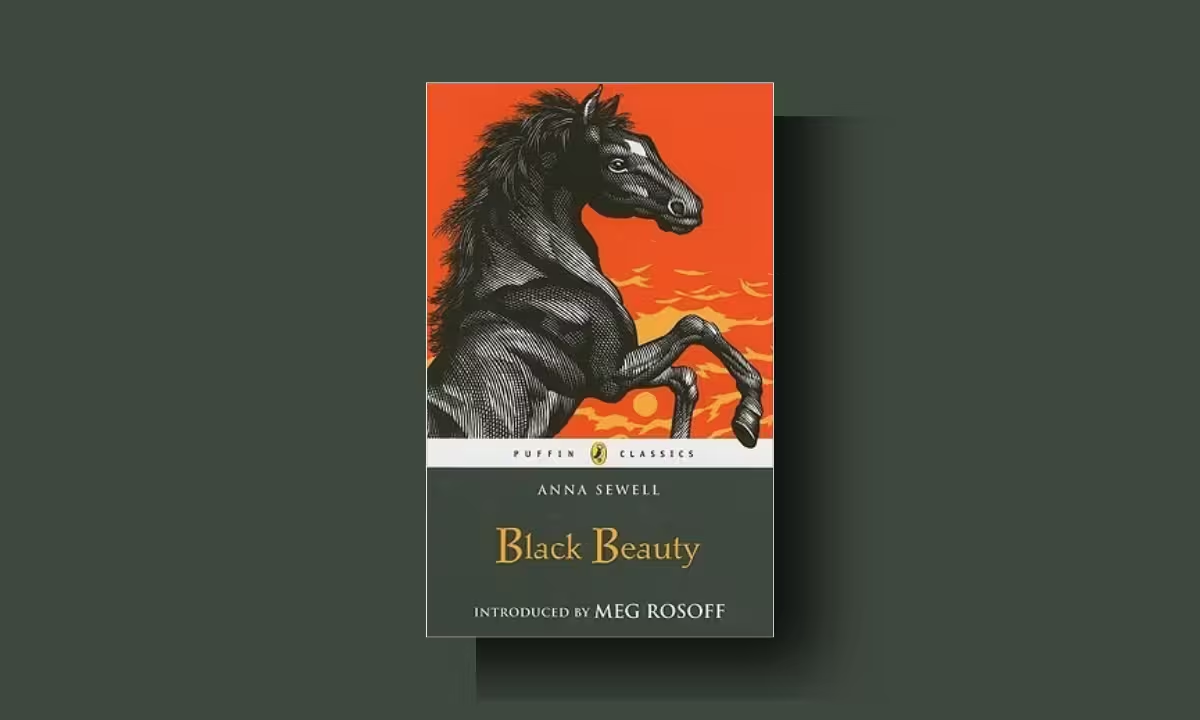
Black Beauty by Anna Sewell is a story told by a horse, and it is harder to read than its “children’s classic” label suggests. Over thirteen short chapters in the Oxford Bookworms retelling I read, a gentle black horse is bought, sold, whipped, overworked, nearly killed and finally rescued.
Sewell wrote it to encourage kindness toward horses, and the quick answer is yes: it is worth reading, mostly because it shows how much of animal cruelty comes from fashion, speed and carelessness rather than from villains.
A note on my copy before we start. I read the Oxford Bookworms Library Stage 4 retelling by John Escott (about 15,400 words, 1,400 headwords, OUP 2008). It is a simplified edition of Sewell’s 1877 novel, so page numbers and quotations below come from that retelling, not from the full Victorian text.
Table of Contents
At a Glance
What it is: A fictional autobiography of a horse in 1870s England, narrated by Black Beauty himself, who passes through about a dozen owners.
Core message: Good places make good horses, and cruelty is everybody’s business. Sewell said she wanted to “induce kindness, sympathy, and an understanding treatment of horses” (quoted in the Oxford Bookworms author note, p. 84).
Biggest surprise: Much of the cruelty is fashion, not malice: tight bearing reins, docked tails, drivers who whip “because it is fashionable.”
Ending: Black Beauty recovers at a horse fair, is bought by a kind farmer, and is reunited with Joe Green, the stable boy who once almost killed him by mistake.
Who should read it: Anyone who likes animal stories with a conscience, readers of Victorian social fiction, and English learners who want a real classic at a manageable level.
My rating: 4.5 out of 5.
Introduction
Black Beauty: His Grooms and Companions, the Autobiography of a Horse was published by Jarrold and Sons on 24 November 1877, when Anna Sewell was 57. It was her only book. She died on 25 April 1878, five months later, so she lived just long enough to see the first wave of success.
The edition I read is the Oxford Bookworms Library “Human Interest” Stage 4 retelling by John Escott, illustrated by Sally Wern Comport, with a glossary and reading activities at the back.
What is the quick verdict on Black Beauty?
Quick Verdict: A gentle, unsparing animal autobiography that treats a horse as someone who feels pain, and still hits harder than most modern novels on the same subject. Recommended for readers who can take a few brutal chapters in exchange for a hopeful ending.
Should you read Black Beauty?
Yes, if you want a short book with real moral force. The table below shows what worked and what did not for me.
| Pros | Cons |
|---|---|
| A horse narrator makes cruelty personal and hard to dismiss | The retelling moves fast, so some owners feel like sketches |
| Kind characters (John Manly, Jerry Barker) are as vivid as cruel ones | A few scenes of whipping and collapse are distressing |
| The fashion-cruelty theme (bearing reins, docked tails) still feels current | Nearly every human is either a saint or a bully |
| Short chapters, clear language, easy to finish in a weekend | Female characters mostly stand at the edges |
| A real, earned happy ending | Victorian class assumptions appear without comment |
What is Black Beauty about?
Black Beauty is a well-bred black horse who narrates his life from a happy childhood meadow, through good and terrible owners in the English countryside and London, to a peaceful old age. Each owner teaches him, and the reader, something about how animals are treated when nobody important is watching.
Rating
Rating: 4.5 / 5 (story and moral force 5/5, depth of character 3.5/5, readability 5/5)
Background
Anna Sewell was born in Great Yarmouth in 1820 to a Quaker family. As a teenager she hurt both ankles, and the injuries never healed properly, so she relied on horse-drawn carriages for the rest of her life. That is why a woman who could barely walk wrote the most famous book ever told by a horse. The Oxford Bookworms author note says she began writing it when she could no longer leave the house, and that the character was based on her brother’s horse, Bessie (p. 84).
On the money: sources disagree. The Norfolk Record Office blog says the manuscript was sold outright for £40, while the Orlando project at Cambridge says £20. I cannot settle that, so I am giving both.
Sewell wrote for adults. She meant the book for people who worked with horses, and it became a children’s classic afterwards. The bearing rein, a strap that forced a carriage horse to hold its head unnaturally high, was a symbol of that fashionable cruelty and the book helped turn opinion against it.
Black Beauty plot summary
Part one: the meadow and Birtwick Park (chapters 1 to 3)
The story opens in a pleasant field with a pond, where a young colt lives with his mother, Duchess, and six other young horses. Their master, Farmer Grey, is kind and calls the colt “Darkie” because of his dull black colour. Duchess warns him that the other colts are farm horses who have never learned manners. She wants him to grow up gentle, a willing worker who never bites or kicks, and he never forgets it.
When he is two, the horses hear hounds and watch a hare hunt run through the next field. The hare is killed, and two horses fall at the stream. A young rider, George Gordon, dies of a broken neck. The black horse who fell is so badly injured that a gun is brought to the field. Duchess knew him, and she never goes near that end of the meadow again. His name was Rob Roy, and the colt will learn later that he was his brother.
At four, the colt is trained. He learns the bit, the saddle, metal shoes, the heavy collar and blinkers. A fortnight in a field beside a railway cures his fear of trains. In May he leaves for Birtwick Park, the home of Mr Gordon (the dead rider’s family is a separate local landowner, and Mr Gordon is the new master).
John Manly, the head groom, rides him through the park, a gun goes off nearby, and the horse stays calm. Mr and Mrs Gordon name him Black Beauty.
James, the stable boy, says he would have called him Rob Roy “if it did not remind everyone of the past,” and John tells him that Duchess was the mother of both. So that is the secret of Duchess’s grief.
In the next stalls are Merrylegs, a fat, cheerful grey pony, and Ginger, a tall bad-tempered brown mare who bites. Ginger is not a bad horse.
She tells Beauty her history: rough training, a cruel young trainer named Samson, a London owner who drove her with a painful bearing rein and two sharp bits, a groom who hit her legs with a stable brush, and a bite that got her sold again. Her conclusion is bleak: she decides that men are natural enemies.
John and James treat her with patience, and she slowly softens. “Kindness is all she needs, poor thing,” John says (p. 17).
Part two: kindness, cruelty and a storm (chapters 4 and 5)
Life at Birtwick shows both sides of human behaviour.
Merrylegs explains why he once threw two boys off his back: they were riding him for an hour with sticks and would not accept that he was tired. He is careful with little girls and children, but he draws a line at whips. Old Sir Oliver explains his stump of a tail: it was cut for fashion when he was young, so now he can never brush flies off his back legs.
Mr Gordon confronts a builder named Sawyer for savagely whipping his pony and warns him that cruelty will ruin his name.
One autumn evening, a storm brings down a tree across the road. Mr Gordon and John must take a longer route home over a wooden bridge. At the bridge Beauty stops dead, and he refuses to move even when his master strikes him with the whip.
A man runs out of a house and shouts that the middle of the bridge has been swept away. Beauty has saved their lives. Mr Gordon says animals know things without thinking, and that people should make friends with them more often.
Part three: the fire and the ride for the doctor (chapters 6 and 7)
James is offered a job with Mr Gordon’s brother-in-law, and before he leaves he drives the master and mistress on a journey. At a hotel in a market town a careless stable hand smokes a pipe while carrying hay up a ladder. In the night the stable fills with smoke.
The young stableman panics, and the horses are too frightened to follow him. James walks in, speaks quietly, ties his scarf over Beauty’s eyes and leads him out. He goes back for Ginger. Two horses die under the fallen roof. Everyone suspects the pipe, though the man denies it.
Joe Green, aged fourteen and a half, comes to take James’s place.
One night the master rushes out with a letter, because Mrs Gordon is gravely ill. John rides Beauty hard through the dark, about twelve kilometres, to fetch Dr White. The doctor then takes Beauty to ride home, and when the horse finally reaches the stable, Joe, who is young and inexperienced, gives him cold water and no warm cloth. Beauty collapses with a chill and a painful illness.
John is furious but tender, and Joe is heartbroken. Mrs Gordon survives, and Beauty has saved her life. Joe learns fast after this, and later he confronts a drunk man whipping horses stuck in the mud with a cartload of bricks.
When he reports it to the police, John tells him what the book is really about: “cruelty is everybody’s business” (p. 36).
Part four: Earlshall Park and the end of Birtwick (chapters 8 and 9)
After three happy years the Gordons must leave England because Mrs Gordon’s health demands a warm country. Beauty and Ginger are sold to Lord Gray at Earlshall Park. John says goodbye to them for the last time. Lady Gray follows fashion and demands that their heads be pulled up tighter and tighter with the bearing rein.
Beauty suffers in silence, but Ginger finally rears and kicks herself out of the carriage and is never harnessed again. For four months Beauty pulls Lady Gray’s carriage with a sharp bit and a tight rein, and he hates it.
When Lady Anne rides Beauty and a nervous horse called Lizzie bolts, Beauty calls for help, then chases after her. She falls at a ditch, and Beauty’s persistence gets help to her in time.
Then comes the disaster. Reuben Smith, a skilled groom with a drinking problem, takes Beauty to town. Smith ignores a loose shoe, gets drunk, and rides home at a gallop in the dark. The shoe comes off, Beauty falls and cuts both knees, and Smith is thrown and killed.
Nobody blames the horse, but the scarred knees make Beauty unfit for a fashionable household, and he is sold. Ginger, ruined by hard riding, is also sold on.
Part five: the cab horse, the dealers and the last home (chapters 10 to 13)
Beauty passes through a series of owners. Mr Barry, who knows little about horses, has a groom named Filcher who steals the oats until the police catch his young son carrying them out. After a horse fair, Beauty is bought for twenty-five pounds by Jerry Barker, a London cab driver, and renamed Jack. Jerry never uses a bearing rein or a whip and refuses extra money for driving fast. “Extra money doesn’t pay for extra speed” (p. 53).
The family, Polly, Harry and Dolly, brush the cab and laugh in the stable. This is the happiest stretch since Birtwick.
One day Beauty meets Ginger again, pulling a broken-down cab, thin and sick. She says she wishes she were dead, and weeks later Beauty sees a dead horse in a cart and believes it is her.
Jerry gives a poor woman and her sick child a free ride to St Thomas’s Hospital, even making two rude men wait in his cab until they give up. But night work in freezing weather ruins his health, and after a New Year’s Eve wait in the snow he becomes dangerously ill.
His doctor says he can never drive a cab again, and the family moves to a country cottage. Beauty has to be sold.
A baker’s driver, Jakes, keeps him in a bearing rein until a passing woman persuades him to take it off on hills. After that Beauty is sold to Nicholas Skinner, a cruel cab owner, who works horses until they drop and then sells them for what he can get. At Ludgate Hill, with a heavy load of luggage, Beauty collapses. A young girl called Grace says it is all their fault.
The horse-doctor tells Skinner to rest him for ten days and sell him at the horse fair for more.
At the fair, a farmer and his grandson Willie notice his fine head and the kindness in his face. Five pounds changes hands. Over the winter, Beauty regains his strength in a field with oats, hay and carrots from Willie. In the summer, the farmer takes him to three ladies who need a gentle carriage horse.
The new groom notices a white star on the forehead, one white foot, and a white mark on the back, and shouts, “I’m little Joe Green, who almost killed you!” Joe, now a grown man with a black moustache, tells Miss Ellen that this is Mr Gordon’s old Black Beauty, and she promises to write to Mrs Gordon.
The ladies promise never to sell him. In the last lines, Beauty says he sometimes dreams he is back in the field at Birtwick, standing with old friends under the apple trees (p. 73).
Analysis
Who are the main characters in Black Beauty?
The main character is Black Beauty himself, a narrator who is loyal and quietly intelligent but rarely angry. His one rule, from his mother, is to be gentle and do his best, and he keeps it even when it hurts him. That is also the book’s smartest trick: he is almost too good, so the reader has to supply the anger on his behalf.
Ginger is the emotional centre. She is what Beauty could have become if he had been trained with a whip instead of kind words. Her story (pp. 14 to 17) is the book’s clearest argument that “bad horses” are made by bad treatment. She fights back, and she loses.
When Beauty meets her again, she says that if people are cruel and have no feelings, “there’s nothing we can do about it” (p. 59). Her death in the cart is the darkest moment, and the book lets it happen offstage, which makes it worse.
John Manly and Jerry Barker are the moral twins. Both are practical, humorous working men who treat a horse as a colleague. Jerry’s refusal to take extra money for speed and his free ride for a poor mother show what ordinary decency looks like.
Joe Green has the best arc: a clumsy boy whose mistake nearly kills Beauty, who grows into a man who stops a stranger’s cruelty and ends up as the groom who recognizes him.
The villains are less developed. Skinner and Samson are close to cartoon bullies, but Lady Gray is more interesting because she is not cruel on purpose. She wants her horses to look right.
What are the themes and symbols in Black Beauty?
Kindness as training. The master who trained Beauty used gentle words, and the result was a willing horse. Merrylegs puts it simply: good places make good horses (p. 18). The reverse is Ginger’s life.
Fashion as cruelty. I think this is the most overlooked theme. The bearing rein exists only to make horses look proud. Sir Oliver’s short tail is “all because of fashion” (p. 19). Jakes admits he would be laughed at without the rein because it is fashionable, and the stranger answers: “It’s better to start a good fashion than to follow a bad one” (p. 66).
Sewell is not mainly attacking sadists. She is attacking ordinary people who copy what everyone else does.
Bystanders and responsibility. Joe, Mr Grant, the gentleman who writes down a driver’s name, the woman on the hill: each person who steps in changes a horse’s day. The book turns “none of my business” into an accusation.
Class and work. Beauty drops from a gentleman’s carriage horse to a cab horse to a cart horse, and each step is a step down in status as well as comfort. Jerry’s family shows how poorly paid human work is tied to animal suffering, because a cab driver who takes the fast, cruel jobs earns more.
Symbols. The bearing rein stands for fashion without thought. The white star is Beauty’s identity, the thing that finally lets Joe recognize him. The meadow at Birtwick, where he stands under the apple trees, is the book’s version of home, and he returns to it in dreams.
Evaluation
Black Beauty is a plain, patient and morally exact little book, one that makes you angry at carriage fashion and then at yourself for how many everyday habits are the same thing.
Strengths
The horse-eye view works. A man whipping a pony at a park gate is more disturbing when the pony is describing what he saw.
The kind characters are specific. John’s quiet pride and Jerry’s laughing refusal of extra pay make goodness feel earned.
The structure suits a short book: each owner is a small lesson, and the reader moves on quickly.
Weaknesses
In the retelling, some owners vanish as soon as they appear (Mr Barry, Filcher, Jakes). This is a side effect of simplification.
Good and bad people are drawn in broad strokes. The sympathy is clear, but the psychology is thin.
Beauty is so patient that he occasionally feels more like a saint than a horse.
What impact and controversy did Black Beauty have?
It had a very large impact, and the details are worth getting right. Bernard Unti of the Humane Society of the United States called it “the most influential anticruelty novel of all time”. Mental Floss reports that campaigners such as the brewer Edward Fordham Flower, who opposed the bearing rein, and George Angell, who handed out copies for the Massachusetts SPCA, backed it quickly.
Author Jane Smiley told NPR in 2012 that once an animal has a point of view, it is hard to be cruel to it (via Horse & Rider).
Sales figures need care. The Oxford Bookworms note says it had sold more than twenty million copies by 1935 (p. 84), while Wikipedia gives a total of over 50 million copies in 50 languages, which I could not verify independently. On the controversy side, Wikipedia notes that it was banned in apartheid South Africa because the title contained the words “Black” and “Beauty.” A story that charming getting banned for its title is a bit mad.
I also want to be careful about one popular claim. Many sites say the book ended the bearing rein. The more cautious reading, and the one I trust, is that it hastened its decline. Fashion changed over time and many people pushed for it.
How does Black Beauty compare with similar books?
It sits close to Uncle Tom’s Cabin in method: a sympathetic victim passes from owner to owner, and each owner exposes one more form of cruelty. The Oxford World’s Classics edition even lists “slave narrative” among the ways the novel has been read.
For a modern comparison, think of the animal-point-of-view tradition that runs to Animal Farm, though Orwell uses animals as political stand-ins and Sewell uses a horse as a horse. Few books go as directly for the reader’s conscience.
Adaptations compared with the book
1994 film. The 1994 version was written and directed by Caroline Thompson, with Alan Cumming as the voice of Black Beauty, Sean Bean as Farmer Grey and David Thewlis as Jerry Barker. It keeps the autobiography framing. Rotten Tomatoes lists 74% from 19 reviews, and the Guardian’s Jonathan Romney found it gloomy and hard to warm to unless you love horses.
Box office was small: Box Office Mojo lists $4,630,377 domestic, while The Numbers shows a slightly lower $4,428,830.
Wikipedia says it did not recoup its budget.
2020 film. The 2020 Disney+ version, directed by Ashley Avis, changes almost everything: Beauty is a female wild mustang in the modern American West, narrated by Kate Winslet, and a teenager named Jo Green (Mackenzie Foy) replaces the stable boy.
The Hollywood Reporter called the voice-over tediously redundant. Rotten Tomatoes shows 48% from 46 reviews, according to Wikipedia. The same page says it left Disney+ in May 2023, so check where it streams now. I did not find a verified box-office figure for it because it was a streaming release.
If you want the book’s real argument, read the book. Both films keep the horse and lose most of the fashion theme.
A personal take with modern relevance: the bearing rein is still with us
The detail that keeps pulling me back is not the whipping. It is Lady Gray saying the horses’ heads “don’t look nice” (p. 39). She does not want to hurt anyone. She wants a certain look, and the pain is somebody else’s problem.
That pattern did not die in 1878. Look at flat-faced dogs. The World Small Animal Veterinary Association’s hereditary disease committee warned that breeding for ever-shorter noses has produced dogs whose health is compromised for the sake of “cuteness”, and one member said it is simply unethical to breed dogs that struggle to breathe. The UK data show how fast fashion moves.
The charity PDSA reported in June 2026 that, according to Royal Kennel Club registrations, French bulldogs fell to 7,750 in 2025 from a high of 54,074 in 2021, with a 37% drop again in early 2026. A trend can turn, and Black Beauty is evidence that stories help it turn.
Five lessons I take from this:
- Ask who pays for the look. If a style needs an animal (or a person) to be uncomfortable, someone is paying for it.
- Normal does not mean fine. Snorting pugs seemed normal, just like a horse straining under a rein.
- Step in early. Joe’s one sentence to a stranger led to a prosecution.
- Change your own habit first. The woman on the hill did not lecture Jakes. She showed him the rein worked better off.
- Check what you reward. Larry’s cab and Jerry’s cab cost the same, but only one horse lasted. Cheap speed has a hidden bill.
Quotable lines
All lines are from the Oxford Bookworms retelling by John Escott; page numbers are from that edition.
- “Kindness is all she needs, poor thing!” (John Manly about Ginger)
- “Good places make good horses.” (Merrylegs)
- “Cruelty is everybody’s business.” (John Manly to Joe)
- “Extra money doesn’t pay for extra speed.” (Jerry Barker)
- “I wish the end would come.” (Ginger)
- “It’s better to start a good fashion than to follow a bad one.” (a passer-by to Jakes)
- “I have no fields for sick horses.” (Nicholas Skinner)
- “My troubles are all over, and I am at home.” (Black Beauty)
Conclusion
Black Beauty works because it asks very little of its readers except attention. It does not lecture. It shows a horse standing at a bridge that is broken, a horse at the bottom of Ludgate Hill, and a horse who recognises a boy’s voice years later, and the arguments follow.
If you like animal stories with real stakes, Victorian social fiction, or short classics for a rainy weekend, read it. If violence toward animals is a hard line for you, expect chapters 9 to 12 to be difficult, although the ending is kind. The graded reader is a good entry point, and the full 1877 novel is worth trying afterward.
For me, it was an easy 4.5 out of 5.
Black Beauty

Black Beauty by Anna Sewell is a story told by a horse, and it is harder to read than its "children's classic" label suggests. Over thirteen short chapters in the Oxford Bookworms retelling I read, a gentle black horse is bought, sold, whipped, overworked, nearly killed and finally rescued.
URL: https://www.sopranu.com/black-beauty-anna-sewell-animal-cruelty/
Author: Anna Sewell
4.5
Pros
- Powerful horse-eye narration; vivid kind characters; timeless fashion-cruelty theme; short, readable chapters; earned happy ending
Cons
- Broad good-versus-bad characters; a few distressing scenes; fast pacing in the retelling