
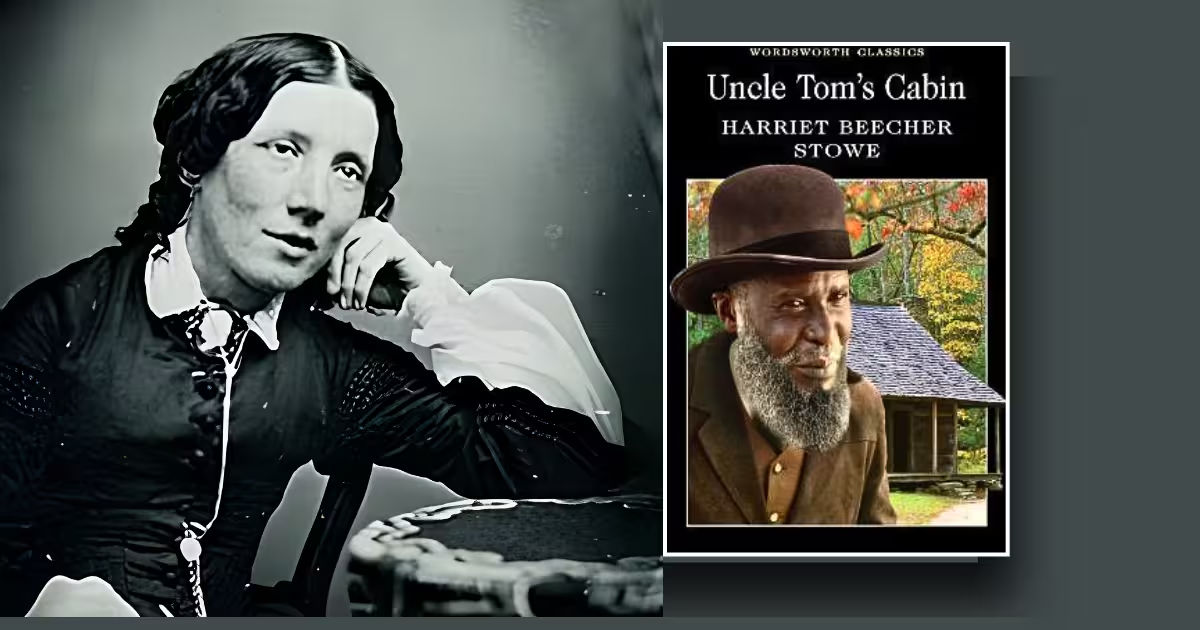
Did you know that a single novel published in 1852 sold 300,000 copies in its first year and helped ignite the American Civil War? That’s exactly what happened when Harriet Beecher Stowe released Uncle Tom’s Cabin into a nation already fracturing over slavery. I picked up this 1996 Modern Library edition expecting a dated piece of abolitionist propaganda.
What I found instead was a gripping, emotionally devastating story that forced me to confront how literature can actually change the world.
Overview
Uncle Tom’s Cabin is a deeply moving anti-slavery novel that follows Uncle Tom’s journey from Kentucky to a brutal Louisiana plantation, alongside Eliza’s desperate escape across the ice with her son.
The book exposes slavery’s cruelty through unforgettable characters, sparked international outrage, and remains a landmark of American literature that continues to challenge readers about race, faith, and human dignity.
Book Information
| Detail | Information |
|---|---|
| Title | Uncle Tom’s Cabin |
| Author | Harriet Beecher Stowe |
| Publication Date | March 20, 1852 |
| Publisher | Modern Library (1996 edition) |
| Original Publisher | John P. Jewett & Company |
| Pages | 438 |
| Genre | Historical Fiction, Anti-Slavery Novel, Sentimental Novel |
| Setting | Kentucky, Ohio, Louisiana, Mississippi River, Canada |
| Time Period | 1850s, pre-Civil War America |
Table of Contents
Historical Background
Before diving into the story, I need to share some context that made this book so explosive. When Stowe wrote Uncle Tom’s Cabin,” the Fugitive Slave Act of 1850 had just passed, requiring even free states to return escaped slaves to their owners. This law outraged many Northerners who had previously been indifferent to slavery.
Stowe, a white woman born in Connecticut on June 14, 1811, came from a prominent New England family. Her father, Lyman Beecher, was a well-known Congregational minister, and her brother Henry Ward Beecher became a distinguished preacher. Living in Cincinnati from 1832, she witnessed firsthand the misery of slaves just across the Ohio River in Kentucky.
Uncle Tom’s Cabin first appeared as a serial in the National Era, an abolitionist paper, in forty weekly installments between June 5, 1851, and April 1, 1852. When published as a book on March 20, 1852, it became an immediate phenomenon. By the end of the year, it had sold more than 300,000 copies in the United States alone.
When Abraham Lincoln met Stowe in 1862, he allegedly remarked: “So you’re the little woman who wrote the book that started this great war!”
Uncle Tom’s Cabin Summary
I want to walk you through this story as I experienced it, scene by scene. Fair warning: I’m revealing everything. If you haven’t read the book and want to discover it fresh, stop here and come back after you’ve finished.
Part One: The Kentucky Plantation
Uncle Tom’s Cabin opens in February, late in the afternoon, in a well-furnished dining parlor in P—, Kentucky. Two gentlemen are discussing business over wine. One is Mr. Shelby, a kind and relatively gentle slave owner. The other is Haley, a coarse, overdressed slave trader with “a swaggering air of pretension.”
Haley has come to collect on debts Mr. Shelby owes. Shelby can’t pay, so he must sell two of his most valuable slaves: Uncle Tom, a faithful, honest, Christian man who manages the entire farm “like a clock,” and Harry, the four-to-five-year-old son of Eliza, a young quadroon woman.
Here’s a moment that hit me hard. When the little boy Harry enters the room, he’s described with remarkable tenderness: “His black hair, fine as floss silk, hung in glossy curls about his round, dimpled face, while a pair of large dark eyes, full of fire and softness, looked out from beneath the rich, long lashes.” Shelby makes the child perform—dance, sing, imitate an old man with rheumatism, and both men laugh.
The parallel is devastating. In Shelby’s eyes, Harry is a pet to show off. To Haley, he’s merchandise. And to his mother? He’s everything.
Eliza enters the room looking for Harry, and Haley immediately appraises her value. “By Jupiter,” he tells Shelby, “there’s an article, now! You might make your fortune on that ar gal in Orleans, any day.” Shelby refuses to sell her, but when Haley presses for the boy, Shelby reluctantly agrees to think it over.
What makes this scene so unsettling is how normal it all seems. Shelby isn’t a monster. He’s a “fair average kind of man, good-natured and kindly.” But he’s in debt, and his principles collapse under financial pressure.
Part Two: Eliza’s Discovery and Escape
Eliza overhears part of the conversation and panics. She runs to her mistress, Mrs. Shelby, who reassures her: “Nonsense, child! to be sure, I shouldn’t. What do you talk so for? I would as soon have one of my own children sold.”
But Mrs. Shelby doesn’t know the truth. Her husband hasn’t told her yet.
That night, Eliza hides in the closet adjoining her mistress’s bedroom and hears everything. She learns that both Tom and Harry have been sold. With “pale, shivering, with rigid features and compressed lips,” she becomes a completely different person from the soft, timid creature she’d been before.
She writes a hurried note to Mrs. Shelby, packs a small bundle of clothes and Harry’s favorite toys, and wakes her sleeping boy. “A wicked man was coming to take little Harry away from his mother,” she tells him, “but mother won’t let him.”
In a “sparkling, frosty, star-light night,” she glides out of the house with Harry in her arms. Old Bruno, the Newfoundland dog, follows her for a while. She stops at Uncle Tom’s cabin and tells him the terrible news.
Tom’s reaction broke my heart. He “collapsed, rather than seated himself, on his old chair, and sunk his head down upon his knees.” When Aunt Chloe begs him to run too, he refuses. “No, no—I an’t going. Let Eliza go—it’s her right! … If I must be sold, or all the people on the place, and everything go to rack, why, let me be sold.”
Then come the tears. Stowe writes about Tom’s grief with an intimacy that feels almost invasive: “Sobs, heavy, hoarse and loud, shook the chair, and great tears fell through his fingers on the floor: just such tears, sir, as you dropped into the coffin where lay your firstborn son.”
She’s forcing her white readers to acknowledge that Black men love their families as deeply as they do. It’s a rhetorical strategy that runs throughout Uncle Tom’s Cabin.
Part Three: The Pursuit
When the Shelbys discover Eliza’s escape, Mrs. Shelby privately rejoices while Mr. Shelby worries about his honor. Haley is furious and demands help recovering “his property.”
Black Sam, one of the plantation workers, orchestrates a brilliant piece of resistance. He deliberately slows down the pursuit, setting up Haley’s horse to throw him, letting the other horses loose, creating chaos that delays the chase for hours. “I ‘spects it’s what you may call a faculty,” Sam explains to Andy. “Faculties is different in different peoples, but cultivation of ’em goes a great way.”
Meanwhile, Eliza has walked “many a mile from all traces of any familiar objects upon the open highway.” She reaches the Ohio River, but it’s early spring, swollen with ice. The ferry isn’t running.
Then she sees Haley approaching. In one of the novel’s most famous scenes, Eliza makes a desperate leap onto the floating ice, “vaulted sheer over the turbid current by the shore, on to the raft of ice beyond.” She stumbles, leaps, slips, springs upward again—”her shoes are gone—her stockings cut from her feet—while blood marked every step.”
A farmer named Mr. Symmes helps her up the Ohio bank. “You’re a brave gal, now, whoever ye ar!” he tells her. When she begs him not to tell anyone, he replies, “Go to thunder, gal! What do you take a feller for? In course not.”
Part Four: The Quaker Settlement
Eliza finds refuge with the Quakers, who run an underground railroad station. Rachel Halliday, a warm, motherly woman, takes her in. The Quaker settlement represents everything the slave system isn’t: community built on equality, mutual care, and genuine Christian values.
George Harris, Eliza’s husband, also makes his way to the settlement. He’s been working in a bagging factory and invented a machine for cleaning hemp, but his jealous master took him away and put him to the meanest drudgery. George has been branded in his right hand with the letter H.
The couple reunites at the Quaker house in a scene that made me emotional. George, Eliza, and little Harry sit together, finally safe, at least for the moment.
“I know all you say is true,” George tells Eliza. “You are a good child, a great deal better than I am; and I will try to do as you say. I’ll try to act worthy of a free man.”
But Phineas Fletcher brings news that slave catchers are closing in. A posse led by Tom Loker and Marks is hunting them.
The confrontation comes at the rocks. George stands on top and declares: “I am George Harris. A Mr. Harris, of Kentucky, did call me his property. But now I’m a free man, standing on God’s free soil; and my wife and my child I claim as mine.”
When the slave catchers try to climb up, George shoots Tom Loker. Phineas pushes Loker into a chasm. The posse retreats. George and his family escape to Canada.
Part Five: Tom’s Journey
While Eliza escapes, Tom is marched down to a slave warehouse in New Orleans. The ware house is kept neat and clean, property must look good for sale.
On the boat down the Mississippi, Tom meets a five-to-six-year-old girl named Evangeline St. Clare. She’s “the perfection of childish beauty,” with “deep spiritual gravity of her violet blue eyes.” Tom saves her when she falls overboard.
Eva’s father, Augustine St. Clare, buys Tom. St. Clare is a wealthy, cynical, but fundamentally decent man who hates slavery but can’t bring himself to change his life.
At the St. Clare plantation in New Orleans, Tom experiences a kind of paradise. The house is beautiful, with Moorish arches, a fountain, orange trees, and luxurious gardens. Tom becomes Eva’s special attendant and “a sort of patriarch in religious matters.”
St. Clare’s wife, Marie, is another matter entirely. She’s selfish, hypochondriacal, and completely indifferent to her slaves’ humanity. When Miss Ophelia St. Clare, Augustine’s cousin from Vermont, arrives to help manage the household, she’s horrified by the disorder and casual cruelty.
Part Six: The Little Evangelist
The heart of Uncle Tom’s Cabin is Tom’s relationship with Eva. She’s dying of consumption, but her faith is unshakeable. She reads the Bible to Tom and the other slaves, and her love transforms everyone around her.
“I can understand why Jesus wanted to die for us,” Eva tells Tom. “Because I’ve felt so, too. … when I saw those poor creatures on the boat … some had lost their mothers, and some their husbands, and some mothers cried for their little children … I’ve felt that I would be glad to die, if my dying could stop all this misery.”
Eva gives each slave a lock of her hair before she dies. Her death scene is heartbreaking: “A bright, a glorious smile passed over her face, and she said, brokenly,—’O! love,—joy,—peace!’ gave one sigh, and passed from death unto life!”
After Eva’s death, St. Clare begins to change. He reads the Bible. He starts the legal process to free Tom. But then he’s stabbed while trying to break up a fight in a café.
As St. Clare lies dying, he asks Tom to pray for him. Tom does, “with all his mind and strength, for the soul that was passing.” St. Clare dies calling for his mother.
Part Seven: Simon Legree
With St. Clare dead, his wife Marie refuses to honor his promises. She sells Tom to a brutal plantation owner named Simon Legree.
Legree is one of literature’s great villains. He’s a short, broad, muscular man with “round, bullet head, large, light-gray eyes” and hands “immensely large, hairy, sunburned, freckled, and very dirty.” He keeps two vicious overseers, Sambo and Quimbo, and treats his slaves like disposable machinery.
“I don’t go for savin’ niggers,” Legree boasts. “Use up, and buy more, it’s my way.”
On Legree’s plantation, Tom witnesses horrors that make the Kentucky plantation seem like paradise. The slaves are worked to exhaustion, starved, beaten. Women are sexually exploited. Families are torn apart.
Tom refuses Legree’s order to whip a sick woman named Lucy. “I think so, Mas’r,” Tom says. “The poor crittur’s sick and feeble; ‘twould be downright cruel, and it’s what I never will do, nor begin to. Mas’r, if you mean to kill me, kill me; but, as to my raising my hand agin any one here, I never shall,—I’ll die first!”
Legree beats Tom nearly to death. But Tom’s faith holds. “Mas’r Legree,” Tom says, “as ye bought me, I’ll be a true and faithful servant to ye. I’ll give ye all the work of my hands, all my time, all my strength; but my soul I won’t give up to mortal man.”
Legree’s response is chilling: “I’ll make ye give out, though, ‘fore I’ve done!”
Part Eight: The Martyrdom
George Shelby, now a young man, comes to Legree’s plantation to buy Tom back. But he’s too late.
Tom has been beaten to death for refusing to betray the hiding place of two escaped women, Cassy and Emmeline. As he lies dying, Tom tells George: “O, Mas’r George! Heaven has come! I’ve got the victory!—the Lord Jesus has given it to me! Glory be to His name!”
Tom’s last words: “Who,—who,—who shall separate us from the love of Christ?”
George buries Tom on a “dry, sandy knoll, shaded by a few trees” and kneels on the grave, swearing: “Witness, eternal God! … oh, witness, that, from this hour, I will do what one man can to drive out this curse of slavery from my land!”
Part Nine: The Reunions
Meanwhile, Cassy and Emmeline escape Legree’s plantation by hiding in the garret and playing ghost. They make their way to the Mississippi River, where they encounter George Shelby on a steamboat.
A French lady named Madame de Thoux is also on the boat. She reveals that she’s George Harris’s sister, sold south as a child. And Cassy discovers that Eliza is her long-lost daughter.
George Harris, Eliza, and their children have been living free in Canada for five years. The family reunites in Montreal.
George Harris decides to emigrate to Liberia, the African nation founded by freed American slaves. He writes: “It is with the oppressed, enslaved African race that I cast in my lot.” He wants “a people that shall have a tangible, separate existence of its own.”
Miss Ophelia takes Topsy back to Vermont. The girl grows up, becomes a Christian, and eventually becomes a missionary to Africa.
Uncle Tom’s Cabin ends with George Shelby freeing all his slaves in honor of Uncle Tom’s memory. “When you rejoice in your freedom,” he tells them, “think that you owe it to that good old soul … Think of your freedom, every time you see UNCLE TOM’S CABIN; and let it be a memorial to put you all in mind to follow in his steps.”
Uncle Tom’s Cabin Analysis
Characters
Uncle Tom
Tom is Uncle Tom’s Cabin‘s moral center, and honestly, he’s more complex than popular culture gives him credit for. He’s “a large, broad-chested, powerfully-made man, of a fully glossy black” with “a face whose truly African features were characterized by an expression of grave and steady good sense, united with much kindliness and benevolence.”
What makes Tom remarkable isn’t his passivity; he’s actually quite assertive in his faith. He refuses Legree’s orders, knowing it will cost him his life. He chooses to stay on the plantation rather than escape with Cassy because he feels called to minister to the other slaves.
Tom’s religion is practical, not abstract. He reads his Bible constantly, prays for his enemies, and forgives the men who beat him to death. He’s “a moral miracle,” as St. Clare says.
Eliza Harris
Eliza is the novel’s active heroine. Her escape across the ice is a symbol of maternal love overcoming impossible obstacles. She’s a quadroon, described as having “the same rich, full, dark eye, with its long lashes; the same ripples of silky black hair” as her son.
Eliza’s transformation from timid servant to determined fugitive is one of the novel’s most compelling arcs. When she overhears the Shelbys’ conversation, she becomes “an entirely altered being from the soft and timid creature she had been hitherto.”
George Harris
George is Uncle Tom’s Cabin‘s most overtly political character. He’s “bright and talented,” a mechanical genius who invented a machine for cleaning hemp. His speeches about freedom and justice are powerful: “What right has he to me? I’m a man as much as he is.”
George’s anger is righteous, and Stowe doesn’t condemn it. He fights back against the slave catchers and kills one of them. But he also learns from Eliza’s faith and eventually becomes a Christian.
Evangeline St. Clare
Eva is the novel’s Christ figure. She’s “the perfection of childish beauty,” with “deep spiritual gravity of her violet blue eyes.” Her death redeems her father and inspires everyone around her.
But Eva is also a critique of sentimental Christianity. She’s too good for this world; she can’t survive in it. Her death is beautiful, but it’s also a loss. The world isn’t ready for her kind of love.
Augustine St. Clare
St. Clare is the novel’s most complex character. He’s wealthy, witty, and cynical, but he hates slavery. He knows it’s wrong, but he can’t bring himself to do anything about it. “I’m one of the sort that lives by throwing stones at other people’s glass houses,” he admits, “but I never mean to put up one for them to stone.”
St. Clare’s conversation with Miss Ophelia about slavery is one of the novel’s intellectual high points. He argues that the system corrupts everyone involved: “The thing itself is the essence of all abuse!”
Simon Legree
Legree is the novel’s villain, but he’s not a cartoon. He’s a product of the system, a man whose brutality has been encouraged and rewarded. His backstory is tragic: he once had a loving mother who tried to save him from his worst impulses. But he rejected her, and now he’s trapped in a cycle of cruelty and self-destruction.
Legree’s death is appropriately horrifying. He raves about visions of his mother and dies in agony.
Cassy
Cassy is one of Uncle Tom’s Cabinl’s most fascinating characters. She’s a quadroon who was raised in luxury, fell in love with a white man, had two children, and was sold south when her lover’s gambling debts caught up with him. She watched her children being sold away and went mad.
Cassy’s story is a devastating indictment of slavery’s sexual exploitation. She’s Legree’s mistress, and she hates him with a passion that borders on homicidal. But Tom’s faith eventually softens her.
Topsy
Topsy is the novel’s comic relief, but she’s also a serious critique of slavery. She’s a wild, mischievous child who’s been abused so badly that she doesn’t know how to be good. “I never was born!” she tells Miss Ophelia. “Never had no father nor mother, nor nothin’. I was raised by a speculator, with lots of others.”
Topsy’s transformation under Eva’s love is one of the novel’s most hopeful moments.
Uncle Tom’s Cabin Themes and Symbolism
Christianity and Slavery
Uncle Tom’s Cabin‘s central theme is the incompatibility of Christianity and slavery. Stowe argues that true Christianity demands equality and compassion, while slavery is inherently cruel and dehumanizing.
Tom’s faith is the novel’s moral compass.
He reads his Bible, prays for his enemies, and forgives his murderers. His Christianity is active and transformative. By contrast, the slaveholders who claim to be Christians are hypocrites. The Reverend who quotes scripture to justify slavery is exposed as a fraud.
St. Clare articulates this theme directly: “What is it? Strip it of all its ornament, run it down to the root and nucleus of the whole, and what is it? Why, because my brother Quashy is ignorant and weak, and I am intelligent and strong,—because I know how, and can do it,—therefore, I may steal all he has.”
The Separation of Families
Stowe repeatedly emphasizes how slavery tears families apart. Eliza’s flight with Harry is driven by maternal love. Tom’s separation from his wife and children is one of the novel’s recurring sorrows. Cassy’s children are sold away from her. Lucy is separated from her husband and children.
Uncle Tom’s Cabin argues that this family separation is the worst evil of slavery. It’s not just physical suffering, it’s the destruction of love itself.
The North vs. The South
Stowe doesn’t simply condemn the South. She also criticizes Northern hypocrisy. Miss Ophelia, despite her abolitionist sympathies, initially recoils from touching Topsy. St. Clare points out that Northern prejudice is “an oppressor almost equally severe.”
The Quaker settlement in Ohio represents the ideal: a community where Black and white people live together in equality.
The Underground Railroad
Uncle Tom’s Cabin depicts the Underground Railroad as a network of Christian charity. The Quakers who help Eliza and George are acting on their religious beliefs. The system is illegal, but it’s morally right.
Symbolism
The Cabin: Uncle Tom’s cabin represents home, family, and dignity. It’s destroyed when Tom is sold, but its memory inspires George Shelby to free his slaves.
The Ice: Eliza’s crossing the ice symbolizes the desperate risks slaves took to escape. It’s dangerous, but it’s the only path to freedom.
The Bible: Tom’s Bible is his most precious possession. It represents his faith and his humanity.
Eva: Eva represents pure, selfless love. Her death is a sacrifice that redeems others.
Legree’s Plantation: The plantation represents the moral decay of slavery. It’s a place of cruelty, exploitation, and spiritual death.
Uncle Tom’s Cabin Evaluation
Uncle Tom’s Cabin is an extraordinary achievement—flawed, manipulative, and occasionally preachy, but also powerful, moving, and historically indispensable.
Strengths
Emotional Power: Stowe knows exactly how to pull your heartstrings. The death of Eva, Tom’s martyrdom, Eliza’s escape, these scenes are unforgettable. I cried more than once.
Characterization: Tom isn’t the passive stereotype he’s become in popular culture. He’s a man of deep faith and quiet courage. St. Clare is fascinatingly complex. Even Legree has a backstory.
Historical Importance: This book changed the world. It sold 300,000 copies in its first year, fueled the abolitionist movement, and helped start the Civil War. When Lincoln met Stowe, he reportedly said, “So you’re the little woman who wrote the book that started this great war!”
Moral Clarity: Stowe doesn’t equivocate. Slavery is evil, and Christians have a duty to oppose it. That clarity made the novel effective propaganda.
Weaknesses
Sentimentality: Stowe lays it on thick. Eva is too perfect, Tom is too saintly. The death scenes are designed to make you cry, and sometimes it feels manipulative.
Preachiness: Uncle Tom’s Cabin is didactic. Characters give long speeches about morality. The final chapter is essentially a sermon.
Racial Stereotypes: The novel reproduces some racist stereotypes, even as it condemns slavery. Topsy’s characterization is particularly problematic.
Pacing: The novel is long, and some sections drag. The subplot about the Quakers feels like a digression.
Simplification: The novel sometimes simplifies complex issues. The solution to slavery seems to be individual Christian conversion, which is naive.
Impact and Controversy
Uncle Tom’s Cabin was an immediate sensation. Within a year, it had sold more than 300,000 copies in the United States and over a million in Great Britain. It was translated into dozens of languages.
But Uncle Tom’s Cabin also sparked fierce controversy. Southerners denounced it as abolitionist propaganda. Pro-slavery writers rushed to publish rebuttals. In the South, the book was banned.
Stowe responded to her critics with A Key to Uncle Tom’s Cabin (1853), which provided documentary evidence for the novel’s claims.
The novel’s cultural impact is incalculable. It helped make abolitionism mainstream. It humanized slaves for white readers. It gave the abolitionist movement a powerful emotional weapon.
But the novel’s legacy is also complicated. “Uncle Tom” became a slur for Black people perceived as subservient to whites. The novel’s sentimental Christianity has been criticized as patronizing. Some Black writers have rejected the novel’s portrayal of Black passivity.
Comparison with Similar Works
Narrative of the Life of Frederick Douglass (1845): Douglass’s autobiography is a firsthand account of slavery, with none of Stowe’s sentimentality. It’s more reliable as history, but less emotionally accessible.
Incidents in the Life of a Slave Girl (1861): Harriet Jacobs’s autobiography focuses on the sexual exploitation of enslaved women. It’s more personal and more disturbing than Stowe’s novel.
The Adventures of Huckleberry Finn (1885): Mark Twain’s novel takes a different approach, using humor and satire to critique racism. It’s more subtle than Stowe’s work, but also more ambiguous.
Beloved (1987): Toni Morrison’s novel is a postmodern response to Stowe. It’s more psychologically complex, more aware of the trauma of slavery, and less optimistic about redemption.
Adaptations
Uncle Tom’s Cabin has been adapted countless times for stage and screen. The first theatrical adaptation appeared in 1852, the same year the novel was published. These adaptations often simplified the novel’s characters and themes, turning Tom into a passive saint and Eliza into a melodramatic heroine.
Uncle Tom’s Cabin (1903): The earliest known film adaptation was a silent short directed by Edwin S. Porter. It was one of the first films to feature Black actors.
Uncle Tom’s Cabin (1914): A feature-length silent film directed by William Robert Daly. It was controversial for its use of white actors in blackface.
Uncle Tom’s Cabin (1927): A silent film directed by Harry A. Pollard. It was the last major silent adaptation.
Uncle Tom’s Cabin (1965): A made-for-TV movie directed by Géza von Radványi. It was filmed in Yugoslavia and featured an international cast.
Uncle Tom’s Cabin (1987): A TV miniseries directed by Stan Lathan, starring Avery Brooks as Tom. It’s one of the more faithful adaptations.
None of these adaptations fully capture the novel’s complexity. Most simplify the characters and tone down the religious themes.
Personal Insights and Contemporary Relevance
The Power of Literature to Change the World
Uncle Tom’s Cabin is proof that a novel can change history. Stowe didn’t just write a story; she wrote a weapon. Her book mobilized public opinion, gave the abolitionist movement a powerful emotional tool, and helped make the Civil War inevitable.
The Danger of Stereotypes
Uncle Tom’s Cabin‘s legacy is complicated by the “Uncle Tom” stereotype. The term has been used to attack Black people perceived as subservient to whites. This is a distortion of the novel’s message, but it’s a real harm.
The Complexity of Moral Choice
Stowe’s characters face difficult moral choices. Tom chooses martyrdom. St. Clare knows slavery is wrong but can’t change his life. George Shelby eventually does the right thing. The novel asks us to consider what we would do in their place.
The Importance of Empathy
Stowe’s strategy was to make white readers empathize with Black characters. She wanted them to feel Eliza’s fear, Tom’s pain, Eva’s love. Empathy, she believed, could overcome prejudice.
The Limits of Sentimentality
Stowe’s sentimentalism is powerful but also limiting. She can make you cry, but she can’t make you think. The novel’s solutions—individual conversion, Christian love—seem naive today.
Five Lessons from Uncle Tom’s Cabin
1. Faith Can Sustain You Through the Worst Circumstances
Tom’s faith isn’t escapist. It gives him the strength to resist evil without becoming evil himself. He refuses to whip Lucy, even though he knows he’ll be beaten. He forgives his murderers. His faith is active and transformative.
2. Systems Can Corrupt Good People
Shelby is a kind man, but he sells Tom anyway. He’s trapped by debt and the system. The novel argues that slavery corrupts everyone involved, even the “good” slaveholders.
3. Love Is Stronger Than Fear
Eliza crosses the ice because she loves her son more than she fears death. Her love gives her impossible strength. The novel suggests that love can overcome even the most brutal systems.
4. Silence Is Complicity
St. Clare knows slavery is wrong, but he does nothing about it. His inaction is a form of complicity. The novel demands that readers take a stand.
5. Redemption Is Possible
George Shelby frees his slaves in honor of Tom’s memory. Cassy and Emmeline escape. George Harris builds a new life in Liberia. Uncle Tom’s Cabin ends with hope, even after all the suffering.
Uncle Tom’s Cabin Quotes
“Let—not—your—heart—be—troubled. In—my—Father’s—house—are—many—mansions. I—go—to—prepare—a—place—for—you.”
Tom reads this passage from the Bible as he’s being taken south. It’s his source of hope.
“I’m a man as much as he is. I’m a better man than he is.”
George Harris asserts his humanity in the face of slavery.
“The thing itself is the essence of all abuse!”
St. Clare on slavery.
“No! no! no! my soul an’t yours, Mas’r! You haven’t bought it,—ye can’t buy it! It’s been bought and paid for, by one that is able to keep it.”
Tom’s defiant response to Legree.
“O, Mas’r George! Heaven has come! I’ve got the victory!—the Lord Jesus has given it to me! Glory be to His name!”
Tom’s dying words.
“When you rejoice in your freedom, think that you owe it to that good old soul … Think of your freedom, every time you see UNCLE TOM’S CABIN.”
George Shelby’s final words to his freed slaves.
Conclusion
Reading Uncle Tom’s Cabin was a revelation. I expected a dated piece of propaganda. I found a powerful, moving, and surprisingly complex novel that still has the power to challenge and inspire.
The novel’s flaws are real. Stowe’s sentimentality can be overwhelming. Her racial stereotypes are problematic. Her solutions are naive.
But its strengths are equally real. Uncle Tom’s Cabin humanizes enslaved people in a way that was revolutionary for its time. It exposes the brutality of slavery without flinching. It argues that Christianity is incompatible with oppression.
Uncle Tom’s Cabin is not just a historical artifact. It’s a living document that still has something to say about race, faith, and justice. It reminds us that literature can change the world.
Recommended for: Fans of historical fiction, students of American literature, anyone interested in the history of slavery and abolitionism, readers who appreciate emotionally powerful storytelling.
Not recommended for: Readers who prefer subtle, understated fiction, those who are uncomfortable with overt religious themes, anyone looking for a balanced view of slavery.







