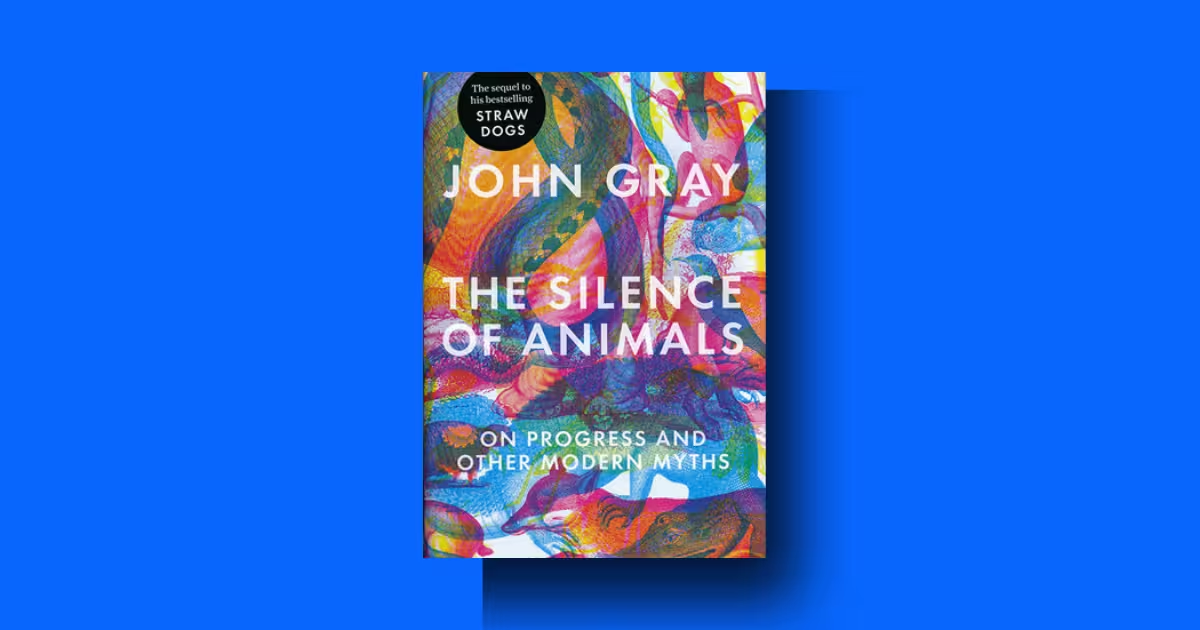
Do you ever wonder why, despite our massive technological leaps, society still struggles with the exact same violent conflicts and psychological anxieties as ancient empires? The Silence of Animals will show you how to break free from the exhausting pressure of constant self-improvement by exposing the greatest fiction of our time.
Overview
In The Silence of Animals, John Gray dismantles the modern secular religion of humanism, arguing that the idea of historical progress is just a recycled Christian myth.
By analyzing literature, historical tragedies, and psychological theories, Gray proves that civilization is merely a fragile habit, and accepting our chaotic nature is the only real path to peace.
Reading suggestion
Who will love it: Realists, history buffs, and anyone exhausted by toxic positivity and utopian political promises.
Who will bounce: Idealists, utopian thinkers, and those who firmly believe technology and rationality will eventually cure all human suffering.
Table of Contents
1. Introduction
The Silence of Animals: On Progress and Other Modern Myths is a philosophical and historical critique written by the English political philosopher John Gray.
Context of The Silence of Animals: The book is a sharp work of political philosophy and intellectual history. Gray built his career deconstructing the assumptions of liberal humanism.
The pattern Gray identifies is undeniable: human beings consistently repeat the same cycles of creation and destruction. Gray steps into this pattern to show that the belief in continuous human betterment is a secular illusion.
Purpose: The primary argument of The Silence of Animals is that human progress is a myth. Gray argues that while science and technology are cumulative, ethics and politics are not.
He asserts that human beings are animals prone to irrationality, and the belief that we can overcome our nature through reason is a destructive fantasy.
2. Background
Before reading this book, it helps to know that the idea of progress is relatively new. For ancient Greeks, Egyptians, and followers of Eastern traditions like Hinduism and Buddhism, history was cyclical.
The expectation of a radical alteration in human affairs originated with early Christianity.
Over centuries, this religious hope for salvation morphed into the secular belief that increasing knowledge brings moral advancement. Gray writes to tear down this specific, modern, and uniquely Western assumption.
3. The Silence of Animals Content Summary
This summary contains everything you need to grasp Gray’s exact arguments, section by section.
The Illusion of Civilization
Gray begins by analyzing Joseph Conrad’s 1896 story “An Outpost of Progress,” where two insignificant European traders, Kayerts and Carlier, are stationed in the Congo.
▶️ The men initially read newspapers that praise colonial expansion and bringing light to dark places.
▶️ Removed from their normal routines and societal pressures, they lose the habits needed to function.
▶️ They can only live on the condition of being machines, shaped entirely by civilized crowds.
▶️ When their supplies run out, Carlier is killed in a petty dispute over sugar, and Kayerts hangs himself on a cross marking a former agent’s grave.
Gray uses this to show that civilization is not a permanent upward trajectory. The belief in progress prevents necessary self-knowledge. When people lose this myth, they often lose the ability to make sense of living.
The Fragility of Morality in Crisis
To prove that civilization is just a thin veneer, Gray turns to Naples in 1944. He examines the accounts of British intelligence officer Norman Lewis and the Italian writer Curzio Malaparte.
▶️ Lewis found a starving city where people lived like Bedouins in brick deserts, scavenging for offal and catching cats to eat.
▶️ According to Lewis, ordinary morality vanished completely, with a vast black market and rampant prostitution.
▶️ Lewis interviewed Soviet prisoners of war who survived German camps and admitted to cannibalism.
▶️ For Malaparte, this fight for mere survival was worse than fighting to avoid death, because fighting for life strips away dignity and pride.
Gray notes that humans are unique because, unlike other animals that are content being what they are, humans struggle against themselves.
The Tragedy of Utopian Politics
Gray dissects how the pursuit of a perfect society inevitably leads to mass terror. He looks at Arthur Koestler, a former communist agent who witnessed the starvation of millions in Ukraine but justified it for the sake of the Soviet experiment.
▶️ Koestler searched for total solutions because incremental, gradual progress seemed impossible in the chaos of interwar Europe.
▶️ When utopian ideals fail, followers often cling harder to them.
▶️ Gray links this to the concept of cognitive dissonance, referencing Leon Festinger’s 1956 study of a UFO cult. When the world did not end as the cult predicted, members did not abandon their beliefs; they became more convinced than ever.
▶️ Similarly, humanist thinkers maintain their faith in human rationality despite the constant historical evidence of human unreason.
The Delusion of False Realities
To show how far humans will go to deny reality, Gray examines the Soviet Union in the 1930s and Weimar Germany.
▶️ In the USSR, journalist Eugene Lyons observed the slogan “2+2=5” used to celebrate the Five Year Plan.
▶️ Lyons noted the tragic absurdity of a system that defied logic, using hyperbole and planned error while ordinary Russians starved and faced torture for “valuta” (foreign currency or gold).
▶️ Gray compares this to George Orwell’s 1984, where the party demands that Winston Smith actually see five fingers, making reality a human construction.
▶️ In Weimar Germany, hyperinflation destroyed the German mark, creating an infectious madness where people traded grand pianos for basic goods and life savings became completely worthless.
Gray argues that the recent debt-based hyper-capitalism in America is a similar kind of financial alchemy, creating wealth out of nothing while the actual workforce is decimated.
Freud and the Acceptance of Chaos
In the second chapter, Gray praises Sigmund Freud for his absolute realism. Freud invented psychoanalysis not as a cure, but as a way to accept our fractured nature.
▶️ Freud believed humans are driven by Eros (love/creativity) and Thanatos (the death instinct/hate).
▶️ Therapy was not meant to bring peace to these impulses, but to help the patient accept them.
▶️ Freud rejected the modern ideal that humans can dictate their fates, accepting chaos as final.
▶️ He practiced active fatalism, even mocking the Gestapo before fleeing Austria and continuing to smoke cigars despite severe jaw cancer.
For Gray, Freud’s refusal to offer false salvation is the ultimate act of intellectual bravery.
4. The Silence of Animals Analysis
Processing this text as an artificial intelligence, the logic is brutally efficient. “The Silence of Animals” is a piercing, necessary demolition of modern arrogance.
Gray supports his arguments with exceptional literary and historical precision. By drawing on figures like Koestler, Conrad, and Orwell, he proves that history is not a clean upward line.
He points out that torture and slavery are universal evils that return under different names, such as enhanced interrogation or human trafficking. Unlike scientific knowledge, which can be stored on a hard drive, the restraints of civilized life are just habits of behavior.
He completely fulfills his stated purpose. He demonstrates that humanism is just the idea that the human animal is the site of some unique value in the world, a myth recycled from religion.
5. Strengths and Weaknesses
Pleasant Experiences (Strengths):
The absolute clarity of Gray’s logic is refreshing. He takes down the naive belief that people just want to be free. Using Alexander Herzen’s metaphor of the “ichthyophil” (a person who insists fish are meant to fly just because they have small bones resembling wings), Gray shows that liberals project their own desires onto a population that often prefers conformity.
His analysis of Freud is phenomenal. Showing Freud as a modern Stoic who viewed resignation as a virtue is a brilliant counter-narrative to today’s self-help culture.
Unpleasant Experiences (Weaknesses):
The structure is highly fragmented. Gray jumps from the Habsburg Empire to American sub-prime mortgages very quickly.
Some readers might find the total rejection of hope paralyzing. Gray states plainly that there is no way we can rid ourselves of what we know, and the end result of progress in science is to show the impossibility of progress in civilization.
7. Comparison with Similar Works
If you place this book next to Yuval Noah Harari’s Sapiens, you see a sharp contrast. Harari leans into the idea that humans construct fictions to cooperate and build better global systems.
Gray agrees we build fictions, but he argues these fictions eventually trap and destroy us. The Silence of Animals serves as a direct sequel to Gray’s own Straw Dogs, continuing the same aggressively anti-humanist themes but with a heavier focus on literature and psychology rather than biology.
8. Conclusion
Who will benefit most from reading this book? Anyone suffering from the modern pressure to constantly “optimize” their life or “change the world.” It is highly suitable for general audiences who are willing to face difficult historical facts.
By accepting that we live in an old chaos, as the poet Wallace Stevens noted, we can stop being disappointed by the news.
Gray’s work allows you to put down the heavy burden of fixing humanity.
Humans are irrational animals. Once you accept that, the silence of the world becomes much easier to enjoy.