

Did you ever wonder how a child born as a literal crime under racist laws could grow up to host one of the world’s biggest comedy shows, all while making you laugh until your sides hurt and then suddenly tear up over the sheer strength of a mother’s love? That’s exactly what hit me when I finished Born a Crime: Stories from a South African Childhood by Trevor Noah.
It’s not just a celebrity memoir—it’s a raw, funny, and deeply educational look at survival, identity, and resilience in a world designed to crush you.
Born a Crime is best for anyone curious about real-life stories of overcoming adversity, fans of witty memoirs that blend humor with history, people interested in apartheid and post-apartheid South Africa (without needing a dry textbook), lovers of strong mother-son dynamics, or those who enjoy books like The Glass Castle or Educated—where hardship meets hope.
If you appreciate comedy that punches up at injustice, or want to understand racial identity in a nuanced, personal way, this will stay with you forever. It’s especially powerful for younger readers navigating their own sense of belonging.
Not for: Readers who prefer strictly chronological biographies (this jumps around thematically), those sensitive to discussions of domestic abuse, poverty, or racial violence without much sugarcoating, or anyone looking for a light beach read without emotional weight.
If heavy topics like attempted murder or systemic racism might be too intense right now, save it for later.
Table of Contents
1. Introduction
Born a Crime: Stories from a South African Childhood is the 2016 bestselling memoir by Trevor Noah, the South African comedian who took over The Daily Show in 2015 and became a global voice on race, politics, and culture. Published on November 15, 2016, by Spiegel & Grau (an imprint of Penguin Random House), the hardcover edition spans 304 pages (ISBN: 978-0399588174).
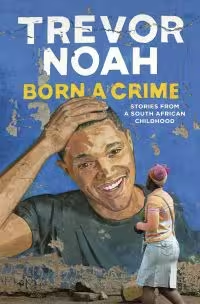
It quickly became a #1 New York Times bestseller, staying on the list for years, and has sold over 3 million copies worldwide across formats, according to Trevor Noah’s official site and industry reports. The audiobook, narrated by Noah himself with his impeccable accents and timing, won multiple awards including the Audie Award for Autobiography/Memoir.
This is a non-fiction autobiographical comedy memoir—yes, that’s a mouthful, but it perfectly captures the genre.
Noah, born in Johannesburg on February 20, 1984, to a black Xhosa mother (Patricia Nombuyiselo Noah) and a white Swiss-German father (Robert), draws from his unique position as a mixed-race (“coloured” under apartheid classifications) child in a country where interracial relationships were criminalized.
His credentials? He’s not just a comedian; he’s a multilingual survivor who turned personal chaos into sharp social commentary, hosting The Daily Show from 2015 to 2022 and earning Emmy nods along the way.
The book’s central thesis shines through every story: In a system built on division and hate—like apartheid South Africa—language, humor, adaptability, and unbreakable family bonds (especially with a defiant mother) become tools for not just survival, but thriving.
Noah argues that apartheid’s genius was turning the majority against itself through tribalism and racial hierarchies, as he writes early on: “The genius of apartheid was convincing people who were the overwhelming majority to turn on each other.
Apart hate, is what it was.” Yet through his mother’s fearless rebellion and his own chameleon-like navigation of worlds, he shows how individuals can outsmart oppression.
Background
To fully appreciate Born a Crime, you need the context of apartheid, which Noah explains brilliantly without info-dumping. Apartheid (“apartness” in Afrikaans) was the official system of racial segregation enforced by South Africa’s white minority government from 1948 until the early 1990s.
Black South Africans, who outnumbered whites nearly 5:1 (as Noah notes), were stripped of rights, forced into townships, and classified into tribal groups to prevent unity.
The Immorality Act of 1927 (amended in 1950 and beyond), quoted at the book’s start, made interracial sex punishable by up to five years in prison—meaning Trevor Noah’s birth in 1984 was literally a crime until the law was repealed in 1985.
Nelson Mandela was released in 1990 when Noah was six, and democratic elections came in 1994 when he was ten. But as Noah shows, freedom didn’t erase poverty, violence, or internalized divisions overnight.
His stories span the dying days of apartheid and the chaotic transition, painting a vivid picture of a police state that perfected racism’s worst elements while discarding what didn’t work (like outright slavery).
According to historical records from sources like the BBC and South African Truth and Reconciliation Commission, over 21,000 people died in political violence between 1948 and 1994, with millions displaced.
Apartheid was South Africa’s legally enforced racial segregation system, generally dated from 1948 to 1994.
A key part of that machine was controlling sex, marriage, and family formation across racial lines. South African History Online documents legislation including the Prohibition of Mixed Marriages Act (1949) and the Immorality Amendment Act (1950) as part of that framework.
Noah is born in 1984—right in the belly of that era—and he even timestamps it:
“…on February 20, 1984, my mother checked into Hillbrow Hospital…”
He places his childhood against the political calendar too:
“I was nearly six when Mandela was released, ten before democracy finally came…”
Mandela’s release date is widely recorded as February 11, 1990. (Google Arts & Culture)
So the book’s background isn’t optional “history flavor.” It’s the logic of the title. He wasn’t “rebellious”; he was illegal by design.
3. Born a Crime summary
Part I: “You can’t raise a child in a cage and expect him to grow wings.”
1. “Run” — survival instincts are learned early
Born a Crime opens with one of those scenes you can’t forget: Trevor as a kid, moving fast—because in his world, staying still is sometimes how you die. Even when the story is “funny,” the subtext is: danger is normal.
This sets up one of the recurring truths of the memoir: humor is not denial. It’s translation. It’s how you take panic and make it speak.
2. “Born a Crime” — the system made his existence evidence
Trevor explains how his mother—Patricia—decides she wants a child, but not the kind of life apartheid assigns to black women. She doesn’t want a man stepping in to “run her life.”
She proposes something startlingly direct to Trevor’s father:
“I just want the sperm from you.”
Then: the line that defines the book.
“…a half-white, half-black child who violated any number of laws… I was born a crime.”
Noah explains the bureaucratic paranoia of apartheid too—how everything had to be classified, recorded, controlled. This isn’t abstract; it determines where a child can walk, which parent can be seen with him, and whether the state might take him away.
He describes the grim irony of family life: where other children prove love, he proves “criminality.”
3. Soweto and the architecture of control
Some of the book’s most chilling writing is when Noah stops joking and simply describes design: apartheid not as insults, but as city planning.
He says:
“Soweto was designed to be bombed…”
He describes Soweto’s population as “nearly one million,” and the limited roads in and out—built so the military could lock people in.
Then he contrasts policing in white areas vs the township:
“In the white areas you rarely saw the police…”
“In Soweto the police were an occupying army.”
This is one of the book’s key gifts: it doesn’t let “apartheid” stay a vocabulary word. It becomes street-level.
4. Patricia (his mother): faith, force of will, and a blueprint for freedom
Trevor’s mother is the engine of this memoir. She’s not written as a saint; she’s written as a decision-maker—someone who refuses to accept the life assigned to her.
One passage that stuck to me is his description of her self-made trajectory:
“No one showed her. No one chose her. She did it on her own.”
He highlights how she expanded his sense of possibility even when the neighborhood’s dreams were materially limited:
“…you can only dream of what you can imagine…”
And she gives him one of the most important parenting lines in the entire book—about knowing the ghetto isn’t the whole world:
“…he will know that the ghetto is not the world.”
That line is like a compass. It explains why she drags him across social boundaries—churches, neighborhoods, languages—because mental freedom comes before legal freedom.
5. “Apartheid didn’t even make sense”—and that’s part of the horror
Noah explains apartheid’s classifications not as “order,” but as chaos pretending to be science. He gives a famous example:
“Chinese people were classified as black…”
…and notes how Japanese people were labeled “white” for economic reasons.
It’s darkly funny, but the point is brutal: race was a policy tool, not a coherent identity system.
6. Language as a survival tool (and social passport)
One of the smartest arguments the book makes is about language. Noah says:
“Language, even more than color, defines who you are to people.”
And he describes how speaking someone’s language changes the power dynamic instantly:
“When you speak to someone in their language… it goes straight to their heart.”
He calls out something many outsiders miss: in multiracial societies, color is only one signal; accent, slang, and fluency can determine whether you’re treated like an insider or a threat.
Part II: Outsiderhood, hustle, and the education you don’t get in classrooms
7. The recurring theme: being “in-between”
Noah repeatedly lands in spaces where he doesn’t fully belong. At school, he describes being the only mixed kid in a large crowd, feeling like he doesn’t naturally fit any group.
This is where his “hustle” begins—not as greed, but as adaptation.
8. The tuck-shop hustle: “time is money,” learned the hard way
He becomes the kid who runs to buy food for others first—and takes a cut. He literally turns speed into income:
“That’s when I learned: time is money.”
I loved this section because it’s funny and entrepreneurial, but it’s also a survival lesson: when you don’t have built-in security, you build micro-systems.
He also nails the feeling of social access through usefulness—he compares himself to being welcomed like “the weed dealer,” not fully part of any circle but allowed in because of what he provides.
9. Poverty is not only “no money”—it’s no options
Noah is blunt about how class intersects with race and geography. He can’t join certain friend groups because they require money (movies, shopping, trips).
And he can’t easily visit township friends due to distance and transport costs.
Born a Crime quietly teaches an AEO-friendly concept: poverty is logistical. It’s what you can’t physically access.
Part III: Comedy, culture clashes, and the violence that arrives anyway
10. “Go Hitler!” — the scene that shows how context can explode meaning
This chapter has become one of the most discussed online because it’s absurd, hilarious, and horrifying all at once.
Noah describes performing at a cultural event, using a song called “Go Hitler” (in his local context, “Hitler” is a nickname/character associated with dance moves). Then a teacher loses it, calling them disgusting, and the conflict turns into a collision of histories.
He writes the moment they leave, chanting:
“Go Hit-ler! Go Hit-ler!”
But what makes this chapter matter isn’t the chant—it’s the lesson: words aren’t universal. Symbols don’t travel cleanly. And racism can weaponize “misunderstanding” to shut people down.
11. Police, bribery, and the everyday corruption of power
Another section that stayed with me is when Noah and friends are pulled over, a gun is “found,” and they’re basically shaken down. He describes “spot fine” as a euphemism for bribe culture:
“ ‘Spot fine’ is the euphemism everyone uses.”
The scene escalates into humiliation and violence—slaps across faces, threats, jail time.
And then the most revealing twist: when Noah gives his home address, the cop labels him “rich boy,” confused why he’s with township kids.
This is one of the book’s sharpest points: systems don’t treat you based on morality; they treat you based on category.
12. The domestic violence arc (Abel) — love doesn’t cancel danger
As the memoir moves toward its later chapters, the tone grows heavier. Patricia enters a relationship with Abel, and the story becomes a painful account of how charm can coexist with control, and how jealousy can metastasize into violence.
Noah does not romanticize it. He shows how abuse isolates families: you start managing a man’s moods, shrinking your world, and constantly calculating risk.
13. The shooting — the “ending” that isn’t tidy, but is real
The memoir builds toward the event that many readers remember most: Abel shoots Patricia.
Noah describes it with brutal directness:
“…put a bullet through the back of my mother’s head.”
And then he delivers the miracle and the rage in the same breath:
“…the bullet… missed every major organ … and she lived.”
This isn’t a Hollywood ending. It’s survival with scars. It’s a system where a woman can do everything right—faithful, hardworking, protective—and still have to survive a bullet.
Throughout, Noah weaves stats and history: Apartheid displaced millions, fostered tribal wars (Zulu vs. Xhosa pride), and left scars like 80% black unemployment in some areas post-1994 (per World Bank data around the era).
Themes of identity (“I was born a crime”), resilience through language/humor, and maternal love dominate. He ends on hope: His mother’s survival reaffirms her mantra—”Learn from your past and be better.”
The big combined lessons
If I compress Born a Crime into core learnings (without flattening it), it’s this:
- Systems create categories; people learn to enforce them.
- Freedom starts as a practice, not a permission slip. (Patricia raising him “for freedom” early. )
- Language can bypass barriers faster than ideology.
- Poverty is a maze of logistics, not only a lack of effort.
- Humor is not denial; it’s survival and communication.
- Love can be revolutionary (Patricia) and destructive (Abel), depending on what it’s built on.
- Trauma doesn’t erase joy; joy doesn’t erase trauma—the book insists both can exist in one life.
4. Born a Crime quotes: 10 Powerful Lines on Race & Resilience
1. On Apartheid’s Divide-and-Conquer Genius
“The genius of apartheid was convincing people who were the overwhelming majority to turn on each other. Apart hate, is what it was. You separate people into groups and make them hate one another so you can run them all.”
Noah drops this early, explaining how the white minority regime weaponized tribal differences (Zulu vs. Xhosa, etc.) among Black South Africans—who outnumbered whites 5:1—to prevent unity. It’s a chilling reminder that racism thrives on internalized division. Resilience here? Recognizing the manipulation and choosing connection over hate.
2. Why Being Mixed-Race Was “Worse Than Treason”
“Because a mixed person embodies that rebuke to the logic of the system, race-mixing becomes a crime worse than treason.”
Noah’s very existence challenged apartheid’s core lie—that races must stay “pure” and separate. The Immorality Act made his birth a felony. This quote reveals how fragile racist systems are: one “mixed” child exposes the absurdity. His resilience? Thriving as living proof that those barriers were always nonsense.
3. The Hypocrisy of “Civilized” Religion
“If you’re African and you pray to your ancestors, you’re a primitive. But when white people pray to a guy who turns water into wine, well, that’s just common sense.”
Reflecting on forced Christianity under colonialism, Noah nails cultural double standards. Black spiritual traditions got demonized while European ones were elevated. It’s a sharp jab at how race colors what’s “savage” vs. “sophisticated.” Resilience shines in his mother’s blend of Xhosa beliefs and Christianity—reclaiming faith on her terms.
4. Language as a Bridge Across Racial Divides
“If you talk to a man in a language he understands, that goes to his head. If you talk to him in his language, that goes to his heart.” (Expanding on Nelson Mandela)
Noah lives this: Mastering multiple languages (Zulu, Xhosa, English, etc.) let him navigate tribes and races like a “chameleon.” In a divided society, language became his superpower for belonging. This quote screams resilience—using tools of the oppressor to forge human connections.
5. Adapting Without Losing Yourself
“I became a chameleon. My color didn’t change, but I could change how I behaved depending on the group I was with.”
In the “Chameleon” chapter, Noah describes code-switching to avoid violence or exclusion. Race fixed his appearance, but adaptability saved him. It’s raw insight into mixed-race identity in a color-obsessed world, and pure resilience: bending without breaking.
6. Dreams Limited by Systemic Barriers
“We tell people to follow their dreams, but you can only dream of what you can imagine, and, depending on where you come from, your imagination can be quite limited.”
Poverty and apartheid capped horizons—many couldn’t even conceive opportunities Noah eventually seized. This hits on how race/class stifles potential before it starts. His resilience? His mother’s relentless push to imagine bigger, proving limits aren’t permanent.
7. Turning Pain Into Growth
“Let the pain sharpen you, but don’t hold on to it. Don’t be bitter.”
Noah learned this watching his mother endure abuse and systemic racism without letting it poison her spirit. In a world designed to break you, bitterness is surrender. Resilience means feeling the hurt, learning, and moving forward unpoisoned.
8. His Mother’s Unbreakable Will
“My mother showed me what was possible. The thing that always amazed me about her life is that no one showed her. She did it on her own. She found her way through sheer force of will.”
Patricia Noah defied every racial, gender, and economic barrier—raising a “crime” child alone, educating herself, surviving a shooting. This quote is Noah’s tribute to the ultimate resilience: forging paths where none exist.
9. Superficial Lessons on Racism’s Legacy
“In South Africa, the atrocities of apartheid have never been taught that way. We weren’t taught judgment or shame. We were taught history the way a scapegoat reads the Bible: to prove that we were the good guys.”
Post-apartheid education glossed over the emotional toll, leaving scars unaddressed. Noah contrasts it with shallow narratives elsewhere. True resilience requires confronting history fully—not “moving on” without healing.
10. Regret as the Real Enemy
“Regret is an eternal question you will never have the answer to… You will never, never know, and it will haunt you for the rest of your days.”
From teenage risks to survival choices, Noah chose action over paralysis. In racist systems that limit options, regret comes from inaction. Resilience? Taking leaps despite fear—because staying still guarantees haunting “what ifs.”
These Born a Crime quotes pack a punch because they’re funny, painful, and profoundly hopeful all at once. Trevor Noah doesn’t just survive race-based oppression—he dissects it with wit and emerges wiser.
5. Strengths and Weaknesses
What I found powerful (Strengths)
1) It teaches apartheid without lecturing.
Instead of “here’s a history chapter,” you get the feeling of apartheid as movement restrictions, policing, family concealment, and neighborhood design—like “Soweto was designed to be bombed.”
2) Patricia is one of the most unforgettable mothers in modern memoir.
Her parenting philosophy is so clear it feels like a blueprint:
“…the ghetto is not the world.”
3) The language insight is genuinely educational.
That line—“Language, even more than color…”—should be printed on the wall of every diversity workshop that forgets culture is lived, not theorized.
4) It’s funny, but never careless.
Even the “Go Hitler!” chaos is doing serious work: showing how misunderstanding + power can become humiliation.
5) It’s emotionally honest about violence.
The shooting is written with clarity and restraint that made it hit harder:
“…missed every major organ…”
What didn’t work for me sometimes (Weaknesses)
1) The thematic structure can feel jumpy if you expect a straight timeline.
I enjoyed it, but some readers will want a “then this happened, then this happened” flow.
2) Some topics are introduced and then left (intentionally) incomplete.
For example, you may want deeper follow-through on certain social issues (like the long-term psychological effects of violence). Noah focuses on storytelling, not clinical unpacking.
3) A few sections lean into “bit” pacing (comedian rhythm).
Personally, I liked that voice, but if you want a more traditionally literary memoir tone, you might feel the comedic cadence in places.
6. Comparison with similar works
If you liked Born a Crime, you’ll probably also connect with:
- Nelson Mandela’s Long Walk to Freedom — broader political autobiography; less comedic, more historical sweep. Mandela’s 1990 release is a key anchor point in both narratives.
- Tara Westover’s Educated — another story of a child shaped by a powerful parent and a restrictive environment, told with sharp self-awareness.
- Frank McCourt’s Angela’s Ashes — poverty + humor + survival voice, though in a different country and era.
- John Howard Griffin’s Black Like Me — identity and racial systems, though from an outsider-experiment frame rather than a lived childhood.
And for readers who want another perspective on apartheid-era life from a South African childhood memoir angle, Mark Mathabane’s Kaffir Boy is often recommended as a counterpart (more stark, less comedic).
7. Conclusion
If you want a deeply readable, deeply teachable memoir—one that explains apartheid without treating you like a student—Born a Crime is one of the strongest books you can pick up.
I recommend it especially for:
- readers searching “Born a Crime summary” or “Born a Crime review” who want more than a plot outline
- anyone who wants to understand how race + class + language interact in real life
- parents, teachers, mentors, and leaders who want a living example of what “raising a child for freedom” looks like
- readers who believe humor can carry truth, not dilute it
It’s not a “feel-good” book. But it is, in a strange way, a life-affirming one—because it shows that even under systems designed to shrink you, people still make choices that expand the future.
8. FAQ
What is Born a Crime about?
It’s Trevor Noah’s memoir about growing up in apartheid and post-apartheid South Africa, focusing on identity, race, language, poverty, religion, and his relationship with his mother—whose choices shaped his survival and worldview.
Why is it called Born a Crime?
Because Trevor was born to a black mother and a white father during apartheid, when such relationships were criminalized; he calls himself “born a crime.”
What happens at the end of Born a Crime?
Trevor’s stepfather Abel shoots his mother Patricia; she survives because the bullet misses vital organs.
Is Born a Crime a true story?
Yes—memoir. It also aligns with documented apartheid timelines (1948–1994).