
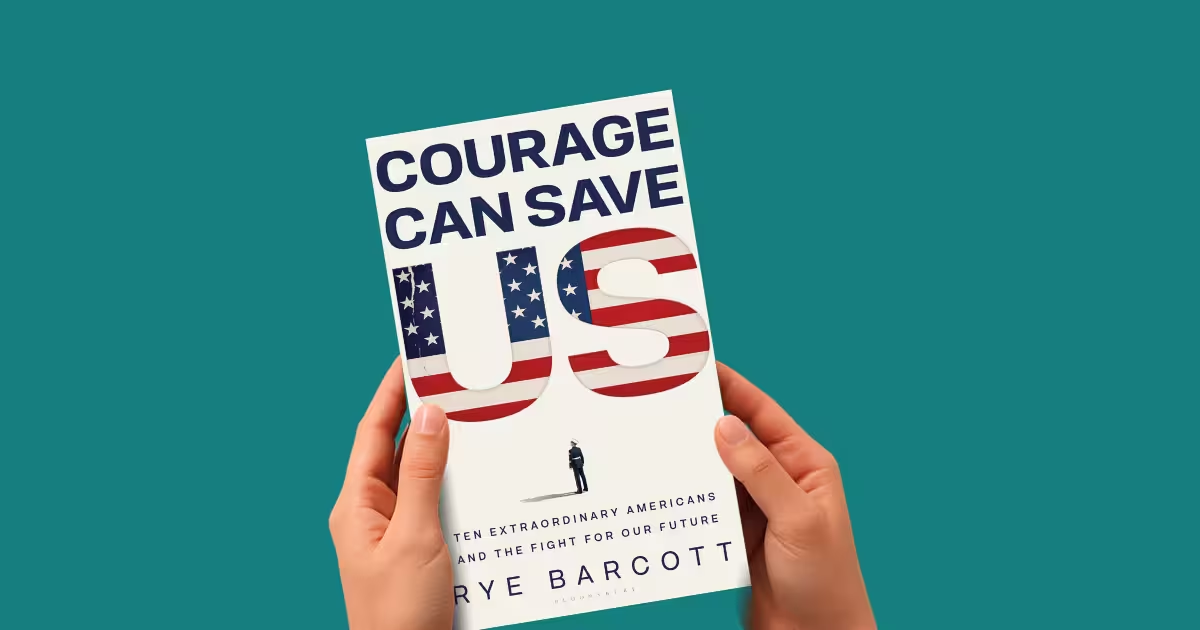
Do you still believe a single act of conscience can change the direction of a nation — or has political life become so corrosive that the very word “courage” sounds naive when applied to Congress? Courage Can Save Us: Ten Extraordinary Americans and the Fight for Our Future by Rye Barcott does not flinch from that question. It plants the answer in ten living, breathing, imperfect human beings and dares you to look away.
Barcott is Marine veteran and With Honor co-founder Rye Barcott profiles ten real American lawmakers (5 Democrats, 5 Republicans — including Mikie Sherrill, Todd Young, Mark Kelly, Wes Moore, Dan Crenshaw, and Jared Golden) to argue that courage — defined as choosing the common good over self-interest, distinct from mere “bravery” — is still possible in U.S. politics, even when it costs careers, primaries, and personal safety.
Each profile traces military service into political risk-taking: bipartisan deals, lonely votes, and reversals of long-held positions when new evidence demanded it.
Courage Can Save Us closes with a deeply personal epilogue about Barcott’s father, a Vietnam veteran who died by suicide, which he frames as a final, complicated act of love rather than a model to emulate.
Courage Can Save Us is best for readers who care about American civic life, veterans, political biography lovers, students of leadership, and anyone frustrated by partisan gridlock who still believes reform is possible.
Not for readers seeking ideological comfort, those who want a polemic against either party, or anyone who considers political nuance a weakness rather than a strength.
Table of Contents
1. Introduction
Courage Can Save Us: Ten Extraordinary Americans and the Fight for Our Future is a work of narrative political nonfiction published in 2025 by Bloomsbury Publishing, written by Rye Barcott — Marine Corps veteran, co-founder of the nonprofit Carolina for Kibera, and founding CEO of the bipartisan veteran political organization With Honor.
The book’s full publication details list Colleen Lawrie as editor, with a bibliography and complete source notes available at withhonor.org.
In terms of genre and subject matter, this sits firmly at the intersection of political biography, leadership studies, and civic memoir — closer in spirit to John F. Kennedy’s Profiles in Courage than to a conventional policy book. Barcott’s credentials are directly relevant. He is himself a combat veteran (Iraq), a Harvard Kennedy School fellow, a UNC-Chapel Hill alumnus, and the architect of a PAC that has since 2018 helped elect over one hundred veterans and national security professionals to office across America.
The book’s central thesis is stated plainly in the prologue, and it is worth sitting with: courage can save us — as individuals and as a republic. Barcott defines courage not as bravery (which he distinguishes carefully, as we shall see) but as “a choice: a decision to advance the common good despite risk.”
Drawing on Stoic philosophy, Greek democracy, Marine Corps fitness reports, and the lives of ten real sitting lawmakers and governors, he builds the case that political courage — specifically the courage to work across party lines in an era that punishes exactly that — is both still possible and urgently necessary.
2. Background
To understand why Courage Can Save Us matters in 2025, you need to know two things: the state of trust in American institutions, and the biography of the man making the argument.
By the time this book was published, more than 80 percent of voters on both sides viewed elected officials from the opposing party as, in Barcott’s words, “a clear and present danger to American democracy.”
Most registered Democrats and Republicans had come to view each other as “downright evil.” The share of veterans in Congress — once over 70 percent, a figure that fell to under 20 percent within David Gergen’s lifetime — had continued to decline. Against that backdrop, Barcott and his co-founder Peter Dixon launched With Honor in 2017 with a character-based pledge: veterans running for Congress would commit to serve with integrity, civility, and courage — especially the courage to work across party lines.
This book is, in a sense, both a report on that experiment and a philosophical defense of why it was worth attempting.
Barcott’s mentor David Gergen — the former presidential adviser who counselled four presidents, three Republicans and a Democrat — passed away while this book was being written. Gergen’s influence runs through every chapter. It was Gergen who first asked Barcott the question that planted the seed: “Do you think your generation will serve again?”
And it was Gergen who pointed to data suggesting that veterans in Congress had historically voted in a more bipartisan manner than their non-veteran peers. That single empirical finding became the intellectual foundation for With Honor, and ultimately for this book.
3. Courage Can Save Us Summary
The Prologue: What Courage Actually Is
Barcott opens with a scar — his father’s, running diagonally across his cheek, a mark left by a bullet in Vietnam that nearly killed him. His father survived only because a smoke grenade strapped to his flak jacket absorbed a round headed for his heart.
The Marine Corps gave his father a Purple Heart and a Bronze Star with a Combat “V” for valor. His father promptly scratched “not true” and “BS” over portions of the official citation he considered exaggerated. That detail — the man who earned a war medal and then edited it for honesty — sets the moral temperature for the entire book.
From there, Barcott develops his core philosophical distinction, one that anchors the whole argument: bravery is not the same as courage. He illustrates this through Oliver Stone’s film Platoon, which his father called “the most powerful depiction of war he’d ever seen.”
Sergeant Barnes, in the film, embodies bravery — fearless, competent, lethal, but ultimately self-serving and cruel. Sergeant Elias embodies courage — compassionate, reflective, willing to risk his standing to protect both soldiers and civilians, even at the cost of his life. Barcott as a teenager admired Barnes. As an adult, he understands the difference.
“Bravery is action in the moment,” he writes. “It can be instinctive or impulsive. It can be selfless or self-serving. Bravery can arise without serious reflection.” Courage, by contrast, “is a choice: a decision to advance the common good despite risk.”
It requires active consideration of what may be lost. This distinction matters enormously throughout the book, because the ten Americans he profiles are not people who simply did dangerous things. They are people who chose principle when the safer, more comfortable path was available.
The prologue also covers the Stoic tradition — the Greek distinction between physical courage and moral courage, Socrates’s death in 399 B.C.E., Marcus Aurelius’s Meditations, and Admiral James Stockdale’s nearly eight years as a prisoner of war in Vietnam’s Hanoi Hilton.
Stockdale, Barcott notes, credited Stoic philosophy for both his survival and his ability to lead. C.S. Lewis is quoted: “Courage is not simply one of the virtues, but the form of every virtue at the testing point.” That sentence functions as this book’s spine.
Barcott also introduces the idea of what he calls “a moral graph” for courage: two axes — the risk faced and the intended benefit to the common good. At the highest point on that graph lies “sacrificial courage, when one knowingly accepts certain death in service to something larger than oneself.”
The ten Americans he profiles do not all reach that apogee, but they each, at pivotal moments, chose the riskier path when a safer one was clearly available.
Governor Mikie Sherrill: “I’ve Done Harder Things Than Take a Vote or Make a Statement”
Sherrill, who became the nation’s first female veteran elected governor (New Jersey, November 2025), opens the book with a story that almost nobody knew at the time of her gubernatorial race.
In June 1991, as a twenty-year-old Naval Academy sophomore on a training cruise, she spent nearly two hours performing CPR on a fellow midshipman who had lost her pulse after being knocked down in heavy seas.
The Navy awarded Sherrill a Navy Achievement Medal — rare for a midshipman. The citation read: “Her persistence and unwavering loyalty to her shipmates inspired all who observed her.”
During her 2025 governor’s race, opponents leaked her military records improperly, targeted her college-age children, and accused her of using her congressional position to secure their admission to the Naval Academy. She called her children to apologize. They took it in stride.
Sherrill’s political biography is compelling precisely because her courage was never theatrical. She flipped a Republican-held congressional seat in New Jersey in 2018 by raising $7.5 million — the most of any woman running for the House that year aside from Nancy Pelosi. She fulfilled a campaign promise not to vote for Pelosi for Speaker on her very first day in office, despite knowing Pelosi would remember.
When the Ukraine whistleblower story broke in September 2019, she co-authored a Washington Post op-ed with six fellow freshman veteran-colleagues titled “These Allegations Are a Threat to All We Have Sworn to Protect,” triggering the first impeachment inquiry into Donald Trump. “I’ve done harder things than take a vote or make a statement,” she told a reporter when asked if she feared political consequences.
In July 2024, she became the seventh Democrat publicly to call for Biden to step aside — a move she told one activist might have “ruined my political career.” She won the New Jersey governorship by 14.5 points.
Senator Todd Young: “Prefer the Hard”
Todd Young’s chapter is in many ways the philosophical heart of the book.
A cum laude Naval Academy graduate and Marine Corps captain who spent years on unglamorous recruiter duty in Chicago and Indiana — which he calls “by far the hardest point in my life,” harder even than running for Congress — Young distilled his ethos into three words: Prefer the Hard.
Young’s most significant legislative achievement is the CHIPS and Science Act of 2022, a $280 billion investment to restore American semiconductor manufacturing competitiveness and fund research in artificial intelligence, quantum computing, and clean energy.
In 1990, the United States produced 37 percent of the world’s semiconductors. By the time Young began championing the legislation, that share had fallen to barely 12 percent. Taiwan produced 90 percent of the world’s most advanced chips — a national security vulnerability that kept Young awake at night.
The unlikely partnership that produced the legislation is one of the book’s most instructive stories. Young, a conservative Indiana Republican, struck up a relationship with Chuck Schumer, the Brooklyn Democratic Senate leader, during early morning gym sessions. “We also discovered a mutual animus toward the Chinese Communist Party,” Young says. “Chuck doesn’t like bullies.
And he thinks China’s a bully.” The bill was denounced as “communistic” by a Republican colleague, branded “corporate welfare” by the Heritage Foundation, and opposed by Indiana’s other Republican senator.
Young pushed through.
The Senate passed it 64–33 in July 2022. Biden signed it into law. As a consequence, Trump’s administration later reduced the CHIPS office staff and eliminated what it called a “semiconductor slush fund,” but Young remained unfazed, noting that his base understood the law’s benefits.
Young also certified Biden’s 2020 election victory, refused to endorse Trump for re-election in 2024 (one of a small group of sitting Republican senators to do so), supported gun safety legislation after Uvalde, and backed the Respect for Marriage Act — for which a county Republican committee formally censured him. “I didn’t come here just to make points,” he said. “I came here to actually solve problems.”
Senator Mark Kelly: “Damn the Torpedoes! Full Speed Ahead!”
Mark Kelly’s chapter opens on January night in 1991, during the first air assault of the Gulf War.
As a Navy lieutenant flying an A-6E Intruder deep into Saddam Hussein’s formidable air-defense lattice — described by Barcott as “a forest of steel spears” — Kelly and his bombardier-navigator Paul Fujimura evaded not one but two Russian-made surface-to-air missiles, delivered six 1,000-pound bombs onto an Iraqi hangar full of enemy aircraft, and then accidentally flew forty or fifty miles into Iranian airspace before realizing they had forgotten to switch their transponder back on after going dark. “FUCK!” Kelly shouted. “We’re at fifteen thousand feet and five hundred knots.”
They flew thirty-seven combat missions in total during that war.
Kelly grew up in West Orange, New Jersey — the “wrong side of the tracks” — with his identical twin brother Scott, both of them described as “borderline juvenile delinquents” before each became an astronaut.
His father Richard was an Irish American cop and an alcoholic who sometimes disappeared for days on a bender, and whose family once found him sitting in the living room with his service weapon in his mouth.
His mother Patricia became one of New Jersey’s first female police officers, training for months to scale a seven-foot-four wall in under nine seconds. Her colleagues called her and her husband “Balls” and “No Balls” respectively.
After his military career, Kelly married Congresswoman Gabby Giffords, who was shot in the head during a constituent event in Tucson in January 2011.
Six people died; thirteen were injured. In the years following, Kelly co-founded Giffords, the gun safety organization, and eventually won a U.S. Senate seat in Arizona in 2020. In the Senate, he worked with Todd Young on the SHIPS Act — a bipartisan effort to revitalize American shipbuilding, described by Barcott as “CHIPS for the seas.”
Congressman Brian Fitzpatrick: “To Build Bridges, Not Burn Them”
Brian Fitzpatrick spent over a decade as an FBI special agent and supervisory agent — including tours in Iraq and Ukraine — before running for the Pennsylvania congressional seat his brother Mike had held.
His law enforcement background shapes everything about his legislative style: methodical, evidence-based, oriented around outcomes rather than optics. He is ranked number one as the most independent member of Congress by multiple measures, including his own social media, which barely mentions his party affiliation.
His most significant moment in the book comes during the vote on Trump’s “Big Beautiful Bill” in 2025. Fitzpatrick opposed it on fiscal grounds — specifically the projected $3.3 to $3.8 trillion addition to the national debt. He cast one of the deciding votes against.
Trump responded at a rally: “I did him a big personal favor. As big as you can get, having to do with death and life. Sure as hell, he voted against us.”
Fitzpatrick took it in stride. “I’m an FBI agent,” he says elsewhere in the book, explaining why he signed a discharge petition on ACA tax credits without waiting for others to go first. “I don’t give a shit about going first.”
Governor Wes Moore: “Have Faith, Not Fear”
Wes Moore’s story is perhaps the most cinematically American in the book. His father died of acute epiglottitis — a misdiagnosed, treatable condition — when Wes was not yet four years old.
His mother moved the family to the Bronx, where Wes drifted toward the streets, spray-painted graffiti tags, was placed on academic probation, and was ultimately sent to Valley Forge Military Academy at twelve against his will, making four escape attempts in four days before a fifteen-year-old cadet named Ty Hill — a Black upperclassman known as “670-1” for his squared-away appearance — took a chance on him.
The sentence that changed Moore’s life came from the commandant of cadets, Colonel Billy Murphy, who was leaving for late-stage cancer treatment: “When it is time for you to leave this school, leave your job, or even leave this earth, make sure it mattered you were ever here.”
Moore went on to Johns Hopkins, Oxford (as a Rhodes Scholar), Afghanistan as a first lieutenant with the 82nd Airborne’s 1st Brigade Combat Team (the “Devil Brigade”), a White House Fellowship under Secretary of State Condoleezza Rice, and the leadership of the Robin Hood Foundation, one of New York’s most prominent anti-poverty organizations — raising more than $650 million.
He was elected Maryland’s governor in 2022, becoming only the third Black person ever elected governor anywhere in the United States. In 2024, when a cargo ship destroyed Baltimore’s Francis Scott Key Bridge, experts estimated eleven months to clear the debris. Moore’s team did it in eleven weeks.
His most controversial moment in the book: vetoing a reparations study bill that passed the Maryland legislature with veto-proof majorities, calling a two-year commission “performative” and insisting that “now is the time to focus on the work itself.”
Maryland’s Black Legislative Caucus called it “a slap in the face.” The legislature overrode his veto. Moore attended a subsequent Democratic gala anyway, to what the New York Times described as “a warm and attentive, if not raucous, reception.”
Congressman Dan Crenshaw: “Are You Here to Do Something, or to Be Something?”
Crenshaw’s chapter is the book’s most intense biographical profile.
His mother Susan died of breast cancer when he was ten years old, after a five-year battle she fought with extraordinary grace — driving him to hospital appointments in a car they nicknamed “Black Beauty,” playing G.I. Joes with him, attending every soccer match. “She was my best friend,” Crenshaw says. Inspired by Richard Marcinko’s Rogue Warrior at thirteen — a book his father gave him deliberately — he committed to becoming a Navy SEAL.
He broke his leg on the third day of Hell Week in his first BUD/S attempt, recovered, returned, and passed.
On June 15, 2012, in Sangin, Afghanistan — a town British soldiers called “Sangingrad” for its resemblance to the World War II siege of Stalingrad — Crenshaw was conducting a battle damage assessment when an IED detonated near his feet. His interpreter Raqman, who ran over to help, lost his arms and legs and died within hours.
Crenshaw lost his right eye and suffered shrapnel wounds throughout his body. Refusing to be carried to the medevac helicopter, he stood up, staggered blindly through the rotor blast, and was hauled aboard. He later served two more deployments and returned as a SEAL officer despite monocular vision.
In Congress, Crenshaw built a large social media following and attempted to use it for substantive governance rather than performative outrage — a genuinely difficult tension in the current media environment.
He lost his 2026 Republican primary. Barcott treats his departure as a warning: the political ecosystem does not always preserve people of substance.
Congressman Seth Moulton: “What Inspires Me Are Those Eighteen-Year-Old Marines”
Moulton served four tours in Iraq as a Marine officer, including Fallujah during its most intense fighting. He was co-founder of the Serve America PAC that helped network many of the 2018 wave of veteran candidates.
His personal profile in the book centers on his willingness to speak about his own post-traumatic stress — doing so in 2019 as a way of modeling the vulnerability that many veterans find hardest to demonstrate. He was also among the first Democrats to publicly call for Biden to step aside in 2024.
Congressman John James: “The Only Things That Last Are What We Give”
John James is an Army Ranger and combat helicopter pilot who flew multiple missions in Iraq.
An African American Republican from Michigan, he lost two Senate races narrowly before winning a House seat. His chapter focuses on the intersection of his faith, his family’s business legacy, and his commitment to a form of conservatism that insists on both personal responsibility and civic service.
His Affirmation Day at West Point — the moment cadets commit to active duty — after September 11 is described as one of the defining moments of his life.
Congressman Don Bacon: “You’ve Got to Have Your Own Compass”
Don Bacon is a retired Air Force brigadier general, one of only 150 such officers among 300,000 airmen.
His chapter is the book’s most explicitly partisan-cost story. Bacon became one of the most bipartisan Republicans in the House — co-founding the For Country Caucus with Democrat Jimmy Panetta, regularly ranking among the ten most bipartisan members in the Lugar Center Index, and casting vote after vote that infuriated the Trumpist base while advancing actual governance.
When House Freedom Caucus members pushed Jim Jordan for Speaker in 2023, Bacon — alphabetically first to vote — cast the first no against Jordan. Sean Hannity read Bacon’s office phone number on air. Tens of thousands of calls flooded in. His wife Angie received a voicemail threatening sexual violence. Omaha law enforcement increased patrols around their home.
Angie slept with a pistol on the nightstand. Bacon held.
He was the first Republican lawmaker to call for Defense Secretary Pete Hegseth’s resignation, after the Atlantic revealed Hegseth had shared sensitive military operational details on an unsecured Signal chat. “He was ‘an amateur person,'” Bacon told reporters.
He was also the first Republican congressman to publicly say Trump’s comment that Russia was not the invader of Ukraine — “that’s just wrong.” Three other Republicans who had been scheduled to appear on the same 60 Minutes segment reportedly backed out. Don Bacon went on.
He retired from Congress in June 2025, citing family — eight grandchildren in Omaha — and the toll on his wife. “I’m a team player,” he said in his farewell. “I want to stand for what’s right. I’ll listen to other views. But in the end, you’ve got to have your own compass.”
Congressman Jared Golden: “I Don’t Fear Losing”
Jared Golden’s chapter is the book’s most morally complicated, and in some ways its most honest.
A Marine infantryman who fought in both Afghanistan and Iraq, Golden was acquitted of a DUI charge after leaving the Marines but still carries the weight of having put himself in a compromised position.
He struggled with PTSD, worked three jobs simultaneously after leaving the military, barely scraped by financially, and found his footing at Bates College on a full scholarship before eventually running for the Maine state legislature — promising himself it would be “one and done.”
In Congress, Golden split his impeachment votes — voting yes on abuse of power and no on obstruction — while every other member voted straight party line. He was the sole House Democrat to vote against Biden’s $2 trillion American Rescue Plan. He voted against an assault weapons ban in 2019 and again in 2022.
Then, in October 2023, a gunman killed eighteen people in Lewiston, Maine — half a mile from Golden’s childhood home. The bowling alley where the shooting began was one where Golden had attended childhood birthday parties.
On the drive back from the airport to Lewiston, without consulting his staff or his wife Izzy, Golden made his decision.
He reversed his lifelong position on assault weapons. “There’s a damn good chance this might be the end of my political career,” he told a staffer. “But I don’t know how else I could go home and be square with it.” His NRA grade dropped from B to F. His Republican opponent hammered him. Golden won his 2024 re-election by six-tenths of a point — in a district Trump carried by 10 points.
He announced his retirement in November 2025. “I don’t fear losing,” he wrote in his farewell. “What has become apparent to me is that I now dread the prospect of winning. Simply put, what I could accomplish in this increasingly unproductive Congress pales in comparison to what I could do in that time as a husband, a father, and a son.”
The Epilogue: Courage Endures
The book’s epilogue returns to Barcott’s father — a Marine Corps veteran, philosopher, scholar, and critical thinker who raised Rye with meticulous intellectual engagement.
His father struggled with post-traumatic stress that was never diagnosed, with lymphoma, and with depression that he kept largely private. In October 2021, his father drove to a cemetery near their family home in Rhode Island — a place where he had once taught young Rye to ride a bicycle — laid an olive-drab tarp on the ground, and shot himself. He left three letters.
The one to Rye began: “Son Rye, I am sorry to leave your mother and anyone who cares about me.” It ended: “Deo Gratias. Dad.”
Barcott writes about his grief with remarkable honesty, and about his struggle to locate his father’s final act within or outside a moral framework. He speaks with a therapist. He talks to his mother. He sits with ambiguity.
The epilogue is not a romanticization of suicide but a meditation on love — on how his father’s final act, by his mother’s own account, was ultimately one of care for her. Barcott makes no general claim about how anyone should understand such a death.
He makes only a personal one: that courage takes many forms, that it can be private, that it can be misunderstood, and that love is still, at the end, what courage is ultimately in service of.
For anyone who is personally navigating grief, depression, or difficult thoughts about their own wellbeing, please know that support is available. If you are in the United States, the 988 Suicide and Crisis Lifeline is available by call or text at 988.
If you are outside the US, the International Association for Suicide Prevention maintains a directory of crisis centers at https://www.iasp.info/resources/Crisis_Centres/. The book itself is not a manual for despair — it is, in every chapter, an argument for staying, serving, and fighting.
The epilogue closes with Barcott’s three distilled takeaways — what he calls the “three roots of courage” found across all ten lives: integrity (doing the right thing when no one is watching), humility (placing the common good above the self), and commitment (the “spirit of determination” that enables one to overcome adversity).
These are not abstract virtues. They are demonstrated, again and again, in ten specific lives across the preceding three hundred pages.
4. Analysis and Personal Commentary
Courage Can Save Us is, without overstating it, one of the most important American political books of the decade — not because it resolves the crisis of democratic legitimacy, but because it refuses to pretend the crisis is someone else’s problem.
As a reader, I found it bracingly honest about the limits of the people it celebrates. Barcott does not write hagiography. He gives you Wes Moore’s contested Bronze Star paperwork, Mikie Sherrill’s impeachment calculations, Dan Crenshaw’s ultimately unsuccessful primary, Jared Golden’s PTSD, Don Bacon’s sleepless wife with a pistol on her nightstand.
What Barcott does extraordinarily well is demonstrate that moral courage in politics is genuinely costly. This is not a feel-good book about heroes. It is a structurally rigorous argument — grounded in philosophy, history, military ethics, and ten contemporaneous biographies — that courage remains possible even in the most toxic political environment in living American memory.
That argument is made more convincing, not less, by the evidence of how many of these ten people lost something for it: Don Bacon and Jared Golden left Congress; Dan Crenshaw lost his primary; Brian Fitzpatrick faces constant primary threats; Todd Young has been censured by county Republican committees; Mark Kelly’s wife was shot in the head.
The book also excels at what few political works attempt: connecting philosophy to practice at the granular level.
The distinction between bravery and courage — developed in the prologue through Platoon and Stoic philosophy — is not decorative. It becomes the evaluative lens through which every subsequent profile is read.
When Barcott tells you that Jared Golden changed his position on assault weapons not for political advantage but because he looked at security footage of the Lewiston shooting and was convinced he had been wrong, the prologue’s framework makes that claim legible. That is courage, not bravery, because it was costly, deliberate, and in service of the common good.
Similarly, the book’s structural choice to include five Democrats and five Republicans is not a lazy gesture toward balance. It is the argument. These ten people disagree sharply on policy. They vote against each other’s priorities.
But they share the three virtues Barcott identifies — integrity, humility, commitment — and they have each, at pivotal moments, chosen principle over political survival. The point is that those three qualities are not partisan. They are, or can be, human.
5. Strengths and Weaknesses
Strengths: The biographical research is meticulous. Barcott traveled to hometowns, spoke with family members, interviewed fellow veterans who served alongside these individuals in combat, and had sufficient trust built with each subject — through the With Honor relationship — to access genuinely candid moments.
The philosophical framework in the prologue is sophisticated without being inaccessible. The epilogue is brave in a way that only personal writing can be. And the book is consistently readable, moving at the pace of good journalism without sacrificing intellectual depth.
The chapter on Jared Golden is, in this reader’s view, the finest piece of political biography in the book. Golden’s story — the DUI, the PTSD, the rock bottom at Bates, the discharge petition filed in 2025, the retirement announcement — reads like a John Updike novel. It is melancholy, honest, and ultimately more moving than triumphant.
That Barcott lets Golden’s retirement stand as a kind of moral tragedy, not a heroic exit, is admirable.
Weaknesses: The book’s biggest vulnerability is the one Barcott acknowledges briefly but does not fully examine: the ten profiled individuals are not a representative cross-section of the U.S. military, which in 2025 was approximately 17 percent Black, 18 percent Latino, and 19 percent women.
The ten in the book skew white and male. Wes Moore and John James add important perspective, but their chapters — measured against, say, the Sherrill or Crenshaw chapters — feel slightly less granular.
There is also a structural tension the book never quite resolves: if courage in politics is this costly — if Jared Golden dreads winning, if Don Bacon’s wife is sleeping with a pistol — then who, rationally, will step forward?
Barcott’s answer is essentially: people who were shaped by something harder than politics before they arrived. That may be true. It is also a somewhat limited vision of civic renewal.
6. Comparison with Similar Works
Readers interested in Courage Can Save Us will find natural companions in several directions. John F. Kennedy’s Profiles in Courage (1956) is the book’s most explicit ancestor — Barcott literally studied it with David Gergen and references it throughout.
Kennedy profiled senators who risked careers for conscience; Barcott does the same for a new generation, with the added dimension of military service. The comparison is fair and the standard is met.
David Gergen’s own Hearts Touched with Fire: How Great Leaders Are Made (2022) is a direct thematic predecessor — and its favorable mention of Mikie Sherrill functions as a kind of endorsement from beyond, since Gergen died as this book was being completed.
For readers interested in the Stoic tradition that runs through the prologue, Ryan Holiday’s Ego Is the Enemy and The Obstacle Is the Way cover adjacent philosophical ground with a broader audience in mind. For readers who want the empirical political science behind the veteran-bipartisanship argument, they would need to supplement Barcott with primary research from the Lugar Center or similar sources.
Finally, for readers who found Barcott’s prologue on courage vs. bravery compelling, Sebastian Junger’s Tribe: On Homecoming and Belonging (2016) is a natural companion — exploring why military service creates bonds of mutual obligation that civilian life rarely replicates, and why veterans often find the transition to political life a form of the same challenge.
7. Conclusion
Should you read Courage Can Save Us: Ten Extraordinary Americans and the Fight for Our Future? If you care about American civic life — yes, emphatically. If you are a student, a veteran, a political science reader, a teacher, a parent trying to explain to a young person why public service still matters — yes, with particular urgency.
This is not a comfortable book. It will not confirm your existing partisan views, because it refuses to be captured by any one of them. What it will do is make you think carefully about what you actually want from the people who govern you — and whether courage, as a virtue, is something you are willing to reward at the ballot box even when it produces decisions you disagree with.
Barcott ends with an echo of the epigraph — “Courage endures” — and he means it not as a bromide but as a bet.
The same bet his father made, his Marine father with a smoke grenade that saved his life, who later scratched “BS” over the parts of his citation he considered false. The truth matters. And sometimes it costs something to tell it.







