
Last updated on July 28th, 2026 at 05:30 pm
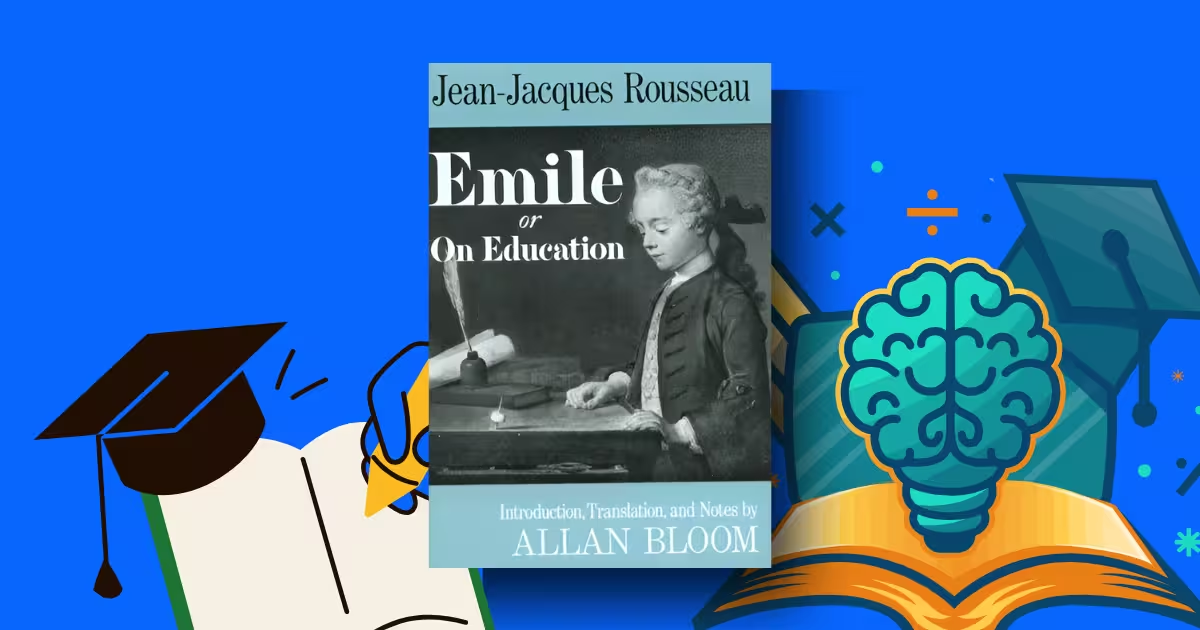
Emile, or On Education is not a parenting guide. It is a philosophical thought experiment—a 500-page novel of ideas—in which Jean-Jacques Rousseau imagines raising a boy from birth to marriage in complete isolation from society’s corrupting influences. The book argues that humans are naturally good and that civilization ruins them.
Rousseau’s solution? A “negative education” that shields the child from books, moral lectures, and adult authority until age twelve, letting nature be the only teacher.
The result is a physically robust, intellectually curious, and morally autonomous young man who can live in society without being enslaved by its opinions.
First published in 1762, Emile was burned in Paris and Geneva for its religious heresy.
Today, it remains the foundational text of child-centered education, inspiring everyone from Piaget to Montessori—while simultaneously provoking outrage over its views on women and its author’s own hypocrisy (Rousseau abandoned his five children to orphanages).
Reader recommendation
Emile is one of the most recommended books for:
- Philosophy students who want to understand the roots of modern educational theory
- Parents and teachers curious about alternative approaches to child-rearing
- Readers interested in the Enlightenment, Romanticism, or the history of ideas
- Anyone questioning whether conventional schooling actually serves human development
Emile is not recommended to:
- Readers seeking practical, step-by-step parenting advice
- Those easily offended by 18th-century sexism (Book V is rough)
- Anyone expecting a systematic, logically consistent argument
- Readers who prefer their philosophers to practice what they preach
Table of Contents
Introduction
Book: Emile, or On Education (Émile, ou De l’éducation)
Author: Jean-Jacques Rousseau (1712–1778)
Publication: 1762 (Amsterdam: Jean Néaulme)
Translator (English edition): Allan Bloom (Basic Books, 1979)
Jean-Jacques Rousseau was a Genevan philosopher, composer, and writer whose ideas helped ignite both the French Revolution and the Romantic movement. Born in 1712, he spent his early years wandering through Switzerland, France, and Italy, working as a tutor, secretary, and music copyist.
His Discourse on the Arts and Sciences (1750) won him fame by arguing that civilization corrupts human goodness—a theme he would develop throughout his life.
By the time he published Emile and The Social Contract in 1762, he was one of the most provocative thinkers in Europe. Both books were condemned by the Catholic Church and burned in Paris and Geneva. Rousseau spent the rest of his life fleeing persecution, writing his Confessions, and descending into paranoia.
He died in 1778.
Context
Emile is the most influential work on education written in the modern world. It combines the form of a novel with a philosophical treatise, following the imaginary pupil Emile from infancy to adulthood under the guidance of a tutor (who is clearly Rousseau himself).
Emile is not about schooling in the conventional sense. Rather, it is about upbringing—how to raise a human being who can be free, good, and whole in a world that systematically crushes those qualities.
Rousseau wrote Emile alongside The Social Contract (also 1762). The two books are companions: the Social Contract imagines how a just political order might be constructed; Emile imagines how a just human being might be formed to live in that order.
Purpose
The book’s central thesis is stated in its famous opening sentence:
“Everything is good as it leaves the hands of the Author of things; everything degenerates in the hands of man.”
Rousseau argues that human beings are born naturally good, free, and whole. But society—with its prejudices, institutions, and artificial needs—corrupts them. The purpose of education, therefore, is not to pour knowledge into a child but to prevent corruption. This is Rousseau’s doctrine of “negative education”: the tutor’s primary job is to remove obstacles, not to impose lessons.
As Rousseau writes in the Preface:
“Childhood is unknown. Starting from the false idea one has of it, the farther one goes, the more one loses one’s way. The wisest men concentrate on what it is important for men to know without considering what children are in a condition to learn. They are always seeking the man in the child without thinking of what he is before being a man.”
Background
The Intellectual Climate of 1762
To understand Emile, one must understand the world Rousseau was reacting against. The mid-18th century was the height of the Enlightenment.
Thinkers like John Locke, Voltaire, and the French philosophes celebrated reason, progress, and the power of education to perfect human beings. Locke’s Some Thoughts Concerning Education (1693) had argued that children are blank slates (tabula rasa) to be written upon by experience and instruction.
Rousseau agreed with Locke that education shapes character but rejected the idea that children are passive recipients. He insisted that children have their own nature, their own developmental stages, and their own ways of seeing the world. To impose adult rationality on a child was, in his view, a form of violence.
Moreover, Rousseau was deeply suspicious of the Enlightenment’s faith in progress. His Discourse on the Arts and Sciences had argued that the arts and sciences, far from improving morals, had made humanity more vain, servile, and miserable.
Emile extends this critique: modern education, he claims, produces “double men” who are neither natural nor fully social, torn between their inclinations and their duties.
The Irony of the Author
No discussion of Emile can ignore the glaring contradiction between Rousseau’s philosophy and his life. Rousseau had five children with his long-term companion, Thérèse Levasseur.
He abandoned all of them to foundling homes shortly after birth. When critics pointed this out, Rousseau defended himself by claiming he was too poor to raise them properly and that the state would do a better job—a defense that rings hollow given the book’s insistence on maternal nursing and paternal involvement.
As one reviewer put it, there is “the irony of Rousseau the child-abandoner writing (in very smug tones!) how the young ought to be raised”.
This hypocrisy has haunted the book’s reception, and it is worth keeping in mind as we read Rousseau’s soaring pronouncements about parental duty.
Emile, or On Education Summary
Emile is divided into five books, each corresponding to a stage of human development. Here is what I learned from reading this dense, brilliant, and maddening work.
Book I: Infancy (Birth to Age 2)
Rousseau begins with the body. Infants are not miniature adults; they are creatures of sensation who need physical freedom above all else. He launches a furious attack on swaddling—the practice of wrapping babies tightly in cloth to keep their limbs straight. This, he argues, is unnatural and cruel:
“The newborn baby needs to stretch and move its limbs in order to arouse them from the torpor in which, drawn up in a little ball, they have for so long remained. They are stretched out, it is true, but they are prevented from moving. Even the head is subjected to caps. It seems that we are afraid lest he appear to be alive.”
Rousseau advocates for loose clothing, free movement, and nursing by the mother herself. He excoriates wealthy women who hire wet nurses and abandon their children:
“When mothers, despising their first duty, have no longer wanted to feed their children, it has been necessary to confide them to mercenary women who, thus finding themselves mothers of alien children on whose behalf nature tells them nothing, have sought only to save themselves effort.”
This is not merely about physical health. For Rousseau, the mother’s milk and care establish the first bonds of love and trust. If these are broken, the child’s moral development is stunted.
The Birth of Amour-Propre
Book I also introduces Rousseau’s most important psychological concept: the distinction between amour de soi (self-love) and amour-propre (vanity or pride). Amour de soi is natural, healthy self-preservation.
Amour-propre is comparative—it cares about what others think. Rousseau locates the origin of amour-propre in the child’s earliest experiences:
“The first tears of children are prayers. If one is not careful, they soon become orders. Children begin by getting themselves assisted; they end by getting themselves served. Thus, from their own weakness, which is in the first place the source of the feeling of their dependence, is subsequently born the idea of empire and domination.”
The tutor’s job is to prevent this transformation. The child must learn that the world is governed by necessity, not by human wills. When a child cries, the caregiver should satisfy genuine needs but never capitulate to whims. Otherwise, the child learns to manipulate others, and amour-propre takes root.
Book II: Childhood (Ages 2 to 12)
This is the longest and most detailed section of the book. Rousseau calls it the “negative education”—a period in which the child learns nothing from books or moral lectures but everything from experience.
The Principle of Negative Education
Rousseau’s maxim is stark:
“The first education ought to be purely negative. It consists not at all in teaching virtue or truth but in securing the heart from vice and the mind from error.”
Until age twelve, Emile should have no formal instruction. He should not learn to read, write, or memorize facts. He should not be given moral precepts. He should not be punished or rewarded. Instead, he should be allowed to explore the physical world, make mistakes, and learn from their consequences.
“Do not give your pupil any kind of verbal lessons; he ought to receive them only from experience. Inflict no kind of punishment on him, for he does not know what it is to be at fault. Never make him beg pardon, for he could not know how to offend you.”
This does not mean Emile runs wild. The tutor carefully arranges his environment so that every experience teaches a lesson. If Emile breaks a window, he sleeps in a cold room. If he refuses to eat, he goes hungry. The tutor never says, “You ought not to do that.” He lets things do the teaching.
The Gardener and Property
One of the most famous episodes in Book II involves Robert the gardener. Emile plants beans in a plot of land, waters them, and watches them grow. He feels a sense of ownership. Then the gardener uproots the beans, explaining that he had planted melons there first. Emile learns that property is based on labor and prior occupation—a lesson in social contract theory delivered through experience rather than lectures.
Why No Books?
Rousseau is scathing about children’s literature, especially La Fontaine’s fables:
“All children are made to learn the fables of La Fontaine; and there is not a single one who understands them. If they were to understand them, that would be still worse, for the moral in them is so mixed and so disproportionate to their age that it would lead them more to vice than to virtue.”
He dissects “The Crow and the Fox” line by line, showing that children identify with the clever fox, not the foolish crow. The moral backfires. Rousseau concludes:
“In thus taking away all duties from children, I take away the instruments of their greatest misery—that is, books. Reading is the plague of childhood.”
Book III: Adolescence (Ages 12 to 15)
This is the “age of strength,” when the child’s physical powers surpass his needs. Rousseau calls it “the most precious time of life”. Now the tutor can introduce useful knowledge—but only knowledge that serves a practical purpose.
Robinson Crusoe
Emile’s only book during this period is Daniel Defoe’s Robinson Crusoe. For Rousseau, this is the perfect educational text:
“This novel, disencumbered of all its rigmarole, beginning with Robinson’s shipwreck near his island and ending with the arrival of the ship which comes to take him from it, will be both Emile’s entertainment and instruction throughout the period which is dealt with here.”
Crusoe is alone, self-sufficient, and forced to rely on his own ingenuity. He embodies the natural man. Emile is to imagine himself as Crusoe, evaluating everything according to its utility on a desert island.
Learning by Doing
Rousseau wants Emile to learn trades—carpentry, farming, blacksmithing—not as a future profession but as a way of understanding the world.
He writes:
“The practice of the natural arts, for which a single man suffices, leads to the investigation of the arts of industry, which need the conjunction of many hands. The former can be exercised by solitaries, by savages; but the others can be born only in society and make it necessary.”
By learning how things are made, Emile gains independence. He can judge the value of goods and labor without being fooled by fashion or prestige.
The Magnet and the Magician
Another famous episode: a magician at a fair makes a wax duck follow a piece of bread. Emile, eager to show off, tries to replicate the trick but fails. The magician then teaches him the secret—a hidden magnet—and delivers a gentle rebuke:
“In reproaching himself for the wrongs of his youth when he is grown up, he will doubtless reproach you for those against which you did not warn him.”
Emile learns humility, the value of patience, and the importance of understanding causes rather than mimicking effects.
Book IV: Adolescence to Adulthood (Ages 15 to 20)
This is the turning point. Emile’s passions awaken. He becomes aware of other people, of love, of morality. The tutor must now guide him into society without destroying his natural goodness.
Compassion
Rousseau argues that compassion is not an innate virtue but a passion that must be cultivated. Emile learns to pity others by seeing that they are weaker or more unfortunate than he is. The tutor carefully selects his experiences so that Emile always sees himself as fortunate in comparison.
The Savoyard Vicar
The most controversial section of Book IV is the “Profession of Faith of the Savoyard Vicar.” A poor priest tells the story of his own spiritual journey, arguing for a natural religion based on conscience rather than revelation.
Rousseau puts these deist views in the mouth of a fictional priest, but everyone recognized them as his own. The Catholic Church condemned the book for this section alone.
The Vicar’s profession is a meditation on God, free will, and the immortality of the soul. It is also, notably, a departure from the book’s earlier empiricism. Emile, who has learned only from the senses, is now introduced to metaphysics.
Love
Rousseau prepares Emile for sexual maturity by sublimating his desires into love. He tells Emile:
“What you desire is sexual intercourse with a woman, but I make you believe that your object contains ideas of virtue and beauty without which she would not be attractive.”
This is the origin of the idea of sublimation—redirecting sexual energy into higher pursuits. Rousseau understands that raw lust is destructive; love, which idealizes the beloved, can be the foundation of morality and family.
Book V: Sophie and Marriage
The final book is devoted to Sophie, Emile’s future wife, and to Rousseau’s views on the education of women.
Sophie’s Education
Rousseau argues that women should be educated differently from men because their natures and roles are different:
“In the union of the sexes, each contributes equally to the common aim, but not in the same way.”
Sophie is to be pious, modest, and domestic. Her education is designed to please men and raise children. She is not to be educated in the sciences or in independent thought.
Controversy
This section has attracted fierce criticism, then and now. Mary Wollstonecraft, in A Vindication of the Rights of Woman (1792), attacked Rousseau’s views on women as a “reverie” that would make them “the most frivolous and the most ignorant” of beings. Modern readers often find Book V unpalatable, if not outright misogynistic.
Nevertheless, Rousseau’s intention is consistent with his overall project: he wants to create a whole human being, and he believes that men and women are complementary halves of a single whole. Whether this is a noble vision or a patriarchal fantasy depends on your perspective.
Emile Analysis
What Makes Emile Revolutionary?
Rousseau’s greatest contribution is the idea that children are not miniature adults. Before Rousseau, education was primarily about imparting knowledge and discipline as early as possible. Rousseau insisted that childhood has its own logic, its own needs, and its own timeline.
This insight—now so obvious that we forget it was ever controversial—underpins virtually every progressive educational movement from Pestalozzi to Piaget to Montessori.
Second, Rousseau’s negative education anticipates modern constructivist theories. Emile learns by doing, by making mistakes, by discovering things for himself. The tutor is a facilitator, not a lecturer.
Third, Rousseau’s emphasis on physical education and sensory development was groundbreaking. He wanted children to run, climb, swim, and work with their hands long before they opened a book. This is the ancestor of outdoor education, Forest Schools, and the whole child movement.
The Problem of the Tutor
Rousseau’s system depends on a tutor who is omniscient, benevolent, and endlessly patient—a figure who controls Emile’s environment so completely that the boy never knows he is being controlled. Critics have pointed out that this is not freedom at all but a more subtle form of manipulation.
As one scholar put it, Rousseau’s “well-regulated freedom” is “outright manipulation in disguise”.
Rousseau himself acknowledged the difficulty. He wrote:
“I show the goal that must be set; I do not say that it can be reached. But I do say that he who comes nearest to it will have succeeded best.”
In other words, Emile is an ideal, not a practical manual.
The Irony of the Author, Revisited
It is impossible to read Emile without thinking of Rousseau’s abandoned children. He tells parents:
“Whoever has vitals and neglects such holy duties will long shed bitter tears for his offense and will never find consolation for it.”
And yet he did precisely that. This hypocrisy does not invalidate his ideas, but it does complicate them. Was Rousseau a visionary who couldn’t live up to his own ideals? Or was his philosophy a form of self-justification, a way of blaming society for his own failings? The question haunts every page.
Strengths and Weaknesses
Strengths
1. Child-Centered Philosophy. Rousseau was the first major thinker to take childhood seriously as a distinct phase of life. His insistence that children learn through experience, not lectures, has influenced every progressive educator since.
2. The Critique of Vanity. Rousseau’s analysis of amour-propre—the desire for recognition and status—remains one of the most penetrating accounts of human psychology ever written. He understood that much of what we call morality is really a form of social performance.
3. Physical Education. Rousseau’s emphasis on the body, on exercise, and on manual labor was ahead of its time. He saw that intellectual development depends on physical health and sensory experience.
4. The Power of Narrative. By framing his philosophy as a novel, Rousseau made abstract ideas accessible and memorable. The episodes—the gardener, the magician, the lost walk—are unforgettable illustrations of his principles.
Weaknesses
1. Impracticality. Rousseau’s system requires a tutor of superhuman patience, wisdom, and control. It also requires complete isolation from society, which is impossible for most families. As Rousseau himself admitted, it is a thought experiment, not a guide.
2. Sexism. Book V is deeply problematic. Rousseau’s views on women are paternalistic and regressive, even by 18th-century standards. Mary Wollstonecraft’s critique remains valid: Rousseau educates women for subservience, not for autonomy.
3. Inconsistency. The book shifts from empiricism to metaphysics, from natural education to religious indoctrination. The Savoyard Vicar’s profession seems to contradict everything that came before. Rousseau’s argument is more rhetorical than logical.
4. Authorial Hypocrisy. Rousseau abandoned his own children. This does not disprove his ideas, but it does raise questions about his credibility and self-awareness.
Comparison with Similar Works
Plato’s Republic
Rousseau explicitly positions Emile as a rival to Plato’s Republic.
Both are thought experiments about the ideal formation of human beings. Both reject conventional education in favor of a carefully controlled environment. But where Plato educates for the sake of the city, Rousseau educates for the sake of the individual.
Book V of Emile directly corresponds to Book V of the Republic, which deals with women and the family.
John Locke’s Some Thoughts Concerning Education
Locke was Rousseau’s immediate predecessor and target. Locke believed in shaping children through reason, rewards, and punishments. Rousseau rejects this as premature and corrupting.
Where Locke is optimistic about human perfectibility through education, Rousseau is pessimistic: education can only prevent corruption, not create virtue.
Mary Wollstonecraft’s A Vindication of the Rights of Woman
Wollstonecraft wrote her Vindication partly in response to Rousseau’s views on women. She argued that women are not naturally inferior to men but are made so by their education.
Rousseau, she claimed, wanted to keep women in a state of “perpetual childhood.” This critique has shaped feminist responses to Rousseau ever since.
Conclusion
Who Should Read Emile?
Emile is not for everyone. If you are looking for practical parenting advice, look elsewhere. If you are offended by 18th-century sexism, you will find Book V difficult. But if you are interested in the history of ideas, in the philosophy of education, or in the question of what it means to be human, Emile is essential reading.
Rousseau himself wrote:
“I care little if men take it to be only a novel, for it ought, he says, to be the history of his species.”
He was right. Emile is a novel about the human condition—about how we lose ourselves in society and whether we can ever find our way back. It is flawed, contradictory, and at times infuriating. But it is also profound, moving, and unforgettable.
Final Thoughts
Reading Emile is like having a conversation with a brilliant but difficult friend. He challenges your assumptions, makes you angry, and occasionally leaves you speechless. He is not always right, but he is never boring.
More than 260 years after its publication, Emile still has the power to shock and inspire. Its central question—how can we raise free, good human beings in a world that crushes freedom and goodness?—is as urgent as ever. Rousseau’s answer may be impossible to implement, but it is impossible to ignore.







