
Last updated on November 6th, 2026 at 11:57 am
Does the name “Sackler” evoke images of grand museum wings and prestigious university halls, or does it trigger a chilling reminder of the worst public health crisis in modern history? Empire of Pain revels what it is. If you’ve ever walked through the Metropolitan Museum of Art or Harvard’s galleries, you’ve seen the name etched in marble.
But behind those letters lies a story so dark and calculated that it makes the fictional “robber barons” of the Gilded Age look like amateurs.
Empire of Pain is best for history buffs, true crime aficionados, and anyone who wants to understand how corporate greed can systematically dismantle a nation’s health. If you loved Dopesick or The Big Short, this is your next obsession.
Not for those readers who are looking for a light “success story” or those who want to believe that the American regulatory system (FDA) is uncorruptible. This book will ruin that illusion forever.
Table of Contents
1. Empire of Pain Summary
1.1 Introduction: A Dynasty Built on “Education” and Opium
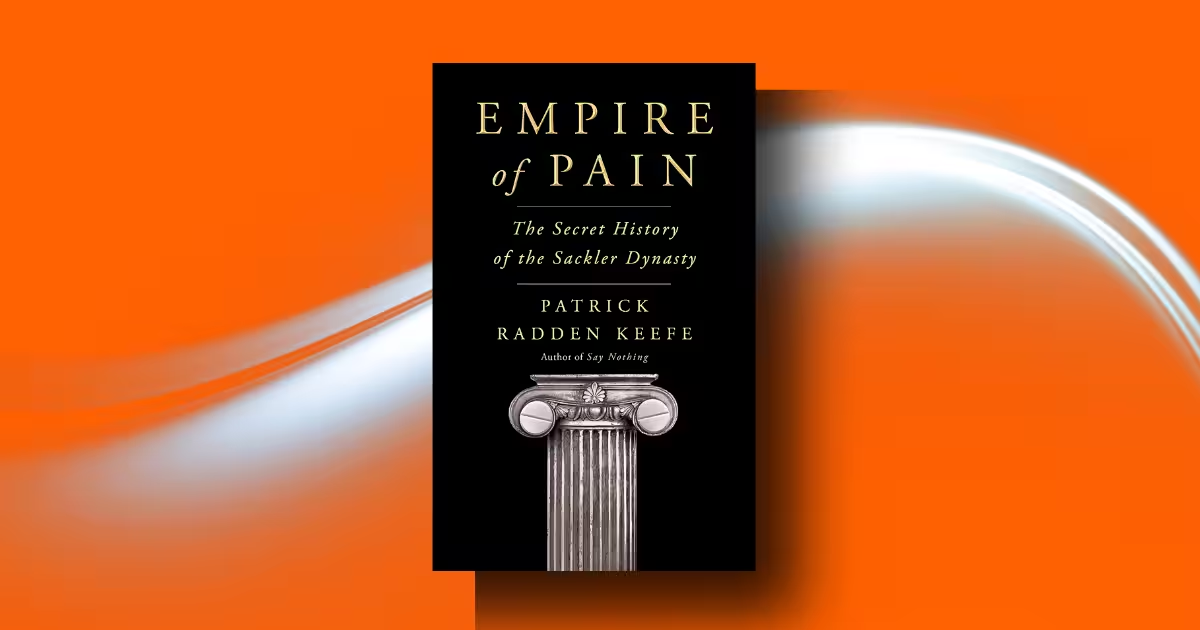
Empire of Pain: The Secret History of the Sackler Dynasty by Patrick Radden Keefe is not just a book; it is a meticulous autopsy of an American tragedy.
Published in 2021 by Doubleday, this 500-plus-page masterpiece is the definitive account of the three generations of the Sackler family—the owners of Purdue Pharma and the architects of the OxyContin marketing machine.
Patrick Radden Keefe, a staff writer for The New Yorker and author of the award-winning Say Nothing, uses his investigative prowess to trace the family’s trajectory from the Great Depression to the bankruptcy courts of the 21st century.
The central thesis is harrowing: the opioid crisis was not a side effect of a “misunderstood” drug, but the intended result of a marketing strategy that prioritized profit over human life, shielded by a family that used philanthropy as a “reputation launderer”.
1.2. The Patriarch: Arthur Sackler and the Invention of the “Hard Sell”
To understand the opioid crisis, you have to understand Arthur Sackler. Before there was OxyContin, there was Librium and Valium.
In 1952, Arthur and his brothers, Mortimer and Raymond, purchased a small, struggling drug company called Purdue Frederick for just $50,000. At the time, the company specialized in unglamorous products like earwax removers and laxatives.
Arthur was a polymath: a psychiatrist who didn’t practice, a collector of Chinese art, and, most importantly, a marketing genius.
He revolutionized pharmaceutical advertising by bypasssing the consumer and targeting the doctor directly. He created the Medical Tribune, a newspaper distributed for free to physicians that was, in reality, a vehicle for drug ads.
Keefe reveals how Arthur marketed Valium not just as a sedative, but as a cure for the “problem of being female”.
Ads targeted “the neurotic singleton” or the “frazled housewife” with slogans that made drugs seem like a lifestyle choice. As Win Gerson, a colleague of Arthur’s, remarked, “One of the great attributes of Valium is that it could be used by almost every specialty”.
This “blizzard of prescriptions” was the blueprint for what was to come.
1.3. The Dynasty: The Birth of OxyContin and “Project Tango”
The book shifts gears in “Book II: Dynasty” to focus on the next generation, specifically Richard Sackler. If Arthur was the architect of the method, Richard was the general who deployed it on a catastrophic scale.
In 1996, Purdue Pharma launched OxyContin, a time-released version of oxycodone.
The genius—and the cruelty—of OxyContin lay in its FDA-approved label. A young FDA official named Curtis Wright allowed a claim that the drug’s delayed absorption was “believed to reduce” its abuse liability.
This was the “H-Bomb” of marketing.
Purdue’s sales force, incentivized by massive bonuses, told doctors the drug was less addictive than other painkillers. They gave away “starter coupons” to patients and flew doctors to lavish seminars in the Caribbean.
By the early 2000s, OxyContin was a blockbuster, generating over $35 billion in revenue.
But as the profits rolled in, so did the bodies. Between 1996 and 2021, more than 450,000 Americans died from opioid-related overdoses.
Perhaps the most chilling revelation in Keefe’s book is “Project Tango.”
As the addiction crisis grew, the Sackler board considered a secret plan to buy a company that treated opioid addiction. A presentation for the board noted, “Pain treatment and addiction are naturally linked,” and described the addiction space as an “exciting entry point” for the company.
They wanted to profit from the “cure” for the very epidemic they had fueled.
1.4. The Legacy: The Fall of the House of Sackler
The final section, “Legacy,” documents the reckoning. For decades, the Sacklers had remained invisible, their name appearing on museum walls but never on Purdue’s pill bottles.
That changed when activists like photographer Nan Goldin, herself a survivor of OxyContin addiction, began “die-ins” at the Guggenheim and the Met.
Goldin’s group, PAIN (Prescription Addiction Intervention Now), targeted the family’s most precious asset: their reputation.
In a dramatic scene at the Louvre, Goldin stood in a fountain shouting, “Take down the Sackler name!”. Within weeks, the Louvre sunset the name, and the “un-naming” movement spread across the globe.
Legal pressure mounted as well.
In 2019, Kathe Sackler was deposed by Paul Hanly, a class-action lawyer. Hanly looked at the billionaires as “arrogant assholes” who had hidden behind a veneer of muted power.
Despite their efforts to seal records, the truth about their personal involvement in marketing decisions became public.
2. Critical Analysis: Why This Book is “The Sense of an Ending” for Corporate Impunity
Empire of Pain is an outstanding and important work of investigative journalism that feels like a high-stakes thriller.
Keefe’s writing is poignant and grounded in human emotion, particularly when he describes the “searing, incandescent pain” of withdrawal through the eyes of people like Nan Goldin.
The author effectively supports his argument by juxtaposing internal company emails with the grim statistics of the crisis.
He shows that the Sacklers weren’t just “passive owners”; they were micromanagers. Richard Sackler was obsessed with sales data, demanding to know why certain regions weren’t prescribing enough pills.
Strengths: * Depth of Research: Keefe utilized hundreds of interviews and thousands of pages of previously sealed legal documents.
Structural Brilliance: Dividing the book into Patriarch, Dynasty, and Legacy allows the reader to see how the “seeds of destruction” were sown decades before the first OxyContin pill was pressed.
Thematic Consistency: The book brilliantly explores the theme of “reputation laundering”—how the family used the name “Sackler” for art and “Purdue” for opioids to keep their hands “clean.”
Weaknesses: * The Length: At over 500 pages, the detailed accounts of corporate litigation in the third act can be dense for casual readers. However, for those seeking the full story, every page is a necessity.
3. Comparison: How it Stands Against Other Works
While Beth Macy’s Dopesick focuses on the victims and the ground-level impact in Appalachia, Empire of Pain focuses on the perpetrators. It is the perfect companion piece to Say Nothing.
If you’ve watched the Netflix series Painkiller, you’ll find that Keefe’s book provides the factual bedrock that the dramatization often skims over.
2026 Update: The Current State of Justice
As of April 2026, the battle for accountability continues. A pivotal moment occurred in June 2024, when the U.S. Supreme Court (SCOTUS) blocked a multi-billion dollar bankruptcy settlement for Purdue Pharma.
The court ruled that the deal was unlawful because it would have granted the Sackler family “third-party releases,” shielding them from future civil lawsuits without the consent of all victims.
This decision reopened the door for individual states and victims to pursue the family’s personal fortune, which remains estimated at over $11 billion.
4. Conclusion
I recommend this book to anyone who values truth over branding. It is essential reading for policymakers, medical professionals, and general audiences alike. Empire of Pain is a reminder that while you can buy a wing in a museum, you cannot buy your way out of history.
Personal Note: Reading this book left me with a profound sense of “ann hedonia”—the inability to feel pleasure in the face of such systemic cruelty.
It is a heartbreaking yet necessary journey into the heart of the American dream gone wrong.
For more in-depth reviews of historical and technical narratives, visit www.sopranu.com or check out the technical tools at modernconvert.com.
Related reading: 1929 Book Review: The Shocking Secrets of the Wall Street Crash Revealed







