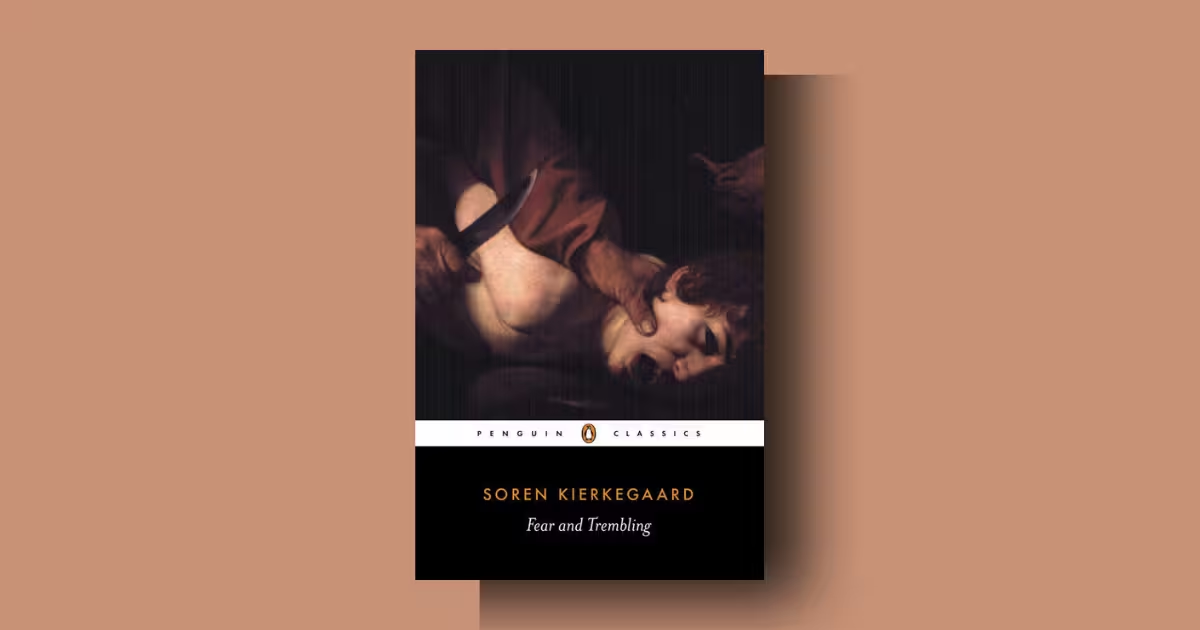
Why does making the most meaningful decision of your life require you to abandon all certainty? That question has haunted me ever since I first picked up Søren Kierkegaard’s Fear and Trembling. It’s not a book that gives you answers; it gives you something far more unsettling: the courage to live without them.
Overview
Fear and Trembling isn’t philosophy as we usually understand it. Written in 1843 by the Danish thinker Søren Kierkegaard under the pseudonym Johannes de Silentio (Latin for “John of Silence”), this slim but dense volume takes the Old Testament story of Abraham and Isaac and turns it into an existential pressure cooker.
Here’s the setup: God commands Abraham to sacrifice his beloved son Isaac on Mount Moriah. Abraham obeys, he takes his son, travels for three and a half days, binds him to an altar, and raises the knife. At the last moment, an angel stops him.
Isaac is spared.
For most of us, that’s a story about obedience and divine intervention. For Kierkegaard, it’s the gateway to something much more disturbing. What if Abraham wasn’t just obeying? What if he genuinely believed he would have to kill his son and simultaneously believed God would somehow give Isaac back?
That’s not obedience, that’s a teleological suspension of the ethical. That’s faith operating on a level where reason simply cannot follow.
The book explores what Kierkegaard calls the “knight of faith”, someone who makes the movement of infinite resignation (accepting the loss of everything they love) and then, by the absurd, gets it all back. Abraham loved Isaac more than anything. He resigned himself to losing him. And yet, he still believed he would keep him. That contradiction is where faith lives.
The title itself comes from Philippians 2:12: “work out your own salvation with fear and trembling”. Kierkegaard isn’t talking about a cozy, comfortable belief system. He’s talking about a faith that terrifies you, that demands everything, that isolates you from everyone around you because nobody else can understand what you’re going through.
Table of Contents
Reader recommendation of Fear and Trembling
Fear and Trembling is recommended to:
- Readers who are tired of philosophy that stays safely in the abstract
- Anyone wrestling with faith, doubt, or the meaning of sacrifice
- Those who appreciate writing that challenges rather than comforts
- People facing a decision where no amount of reasoning provides certainty
- Fans of existentialist thought—this is the foundation stone
Fear and Trembling is not recommended to:
- Readers looking for a straightforward theological defense of Christianity
- Those who prefer clear, linear arguments over paradox and poetic exploration
- Anyone seeking practical self-help or actionable advice
- People who want their books to provide comfortable answers
- Beginners to philosophy—start with something more accessible, or be prepared to read slowly and reread often
Background
To understand Fear and Trembling, you need to understand the man who wrote it—and the personal anguish that fueled it.
Søren Aabye Kierkegaard was born in Copenhagen on May 5, 1813, the youngest of seven children. His father, Michael Pedersen Kierkegaard, was a wealthy merchant who had risen from poverty. But Michael carried a dark secret: as a young boy tending sheep on the Jutland heath, starving and exhausted, he had stood on a hill and cursed God. That curse haunted him for the rest of his life, and he passed that haunting to his son.
By the time Kierkegaard was in his twenties, death had gutted his family. His mother died in 1834. His siblings died one by one. He was left with his older brother Peter Christian and a crushing depression that he would carry to his own grave.
Then came Regine Olsen.
Kierkegaard fell in love with her—deeply, obsessively. He proposed in September 1840 when she was just eighteen. She said yes. But almost immediately, Kierkegaard realized he had made a terrible mistake. Not because he didn’t love her, he loved her desperately, but because he believed his melancholia, his “thorn in the flesh,” made him unfit for marriage.
He broke off the engagement on August 11, 1841. Regine was devastated. Kierkegaard was shattered. He fled to Berlin, where he attended lectures by the philosopher Schelling. And there, in the cold isolation of a foreign city, he began to write.
Fear and Trembling was published on October 16, 1843. It’s impossible to read it without hearing the echo of Kierkegaard’s own broken engagement. Abraham loved Isaac the way Kierkegaard loved Regine. Abraham had to give Isaac up the way Kierkegaard gave Regine up.
And Abraham’s faith- that impossible, absurd faith that God would somehow make everything right- was the only thing Kierkegaard had left to hold onto.
The book is dedicated to “that single individual”, a phrase that would become central to Kierkegaard’s entire authorship. He wasn’t writing for the crowd. He was writing for you, the one person who might actually understand.
Fear and Trembling Summary
Let me be honest: this is not an easy book. I’ve read it three times, and each time I find something new. It’s structured like a series of concentric circles, each one drawing you closer to the terrifying center of what faith actually means.
The Preface: A Warning Shot
Kierkegaard—or rather, Johannes de Silentio—opens with a complaint. In his day, everyone thinks they can go “further than faith.” Philosophers have built vast systems that explain everything, leaving nothing to mystery. Silentio says: “Faith is the highest passion a person can have, but many people may not get that far”.
He’s not being humble. He’s being honest. Most people don’t have faith. They have belief, or habit, or cultural Christianity. But real faith—the kind that Abraham had—is something else entirely.
The Prelude: Four Retellings of the Same Story
This section is brilliant and unsettling. Silentio tells the story of Abraham and Isaac four different ways, each one slightly different from the last. In one version, Abraham’s faith falters. In another, Isaac loses his faith. In a third, Abraham returns alone, broken.
The point is subtle but devastating: we can never really know what Abraham was thinking. We can imagine, we can project, we can interpret, but the silence of Abraham’s three-and-a-half-day journey to Moriah is impenetrable. That silence is the space where faith either lives or dies.
A Panegyric Upon Abraham: The Greatness of Faith
Silentio argues that Abraham was great not because he obeyed, but because of what he believed. “The ethical expression for what Abraham did is that he would murder Isaac,” Silentio writes, “and the religious expression is that he would sacrifice Isaac”.
That distinction is everything. A murderer kills because he wants to. A sacrificer offers because he loves the one who demands the offering. Abraham loved Isaac and loved God. The contradiction is what makes him great—and what makes him incomprehensible.
Preliminary Expectoration: The Leap
This is where Kierkegaard introduces the concept that would make him famous: the leap of faith.
Silentio argues that faith cannot be reached by reason. You can’t think your way to faith the way you think your way to a mathematical proof. Faith requires a leap, a jump into the unknown, based on nothing but the sheer act of choosing to believe.
“Faith begins precisely there where thinking leaves off”. That’s not anti-intellectualism. It’s an honest admission of limits. Reason is powerful, but it can’t give you certainty about the things that matter most. At some point, you have to choose.
Problem I: The Teleological Suspension of the Ethical
This is the most famous, and most controversial, concept in the book.
The ethical, for Kierkegaard (following Hegel), is the universal. It applies to everyone, all the time. But Abraham’s act, willing to kill his own son, violates every ethical norm we have. Murder is wrong. Child sacrifice is wrong. And yet, Abraham is called the “father of faith.”
So Silentio proposes a teleological suspension of the ethical, the idea that, in some cases, the ethical can be suspended for a higher purpose, a telos. Abraham’s duty to God (the absolute) overrides his duty to society (the universal).
That’s terrifying. It means that faith can require you to do things that look, from the outside, like madness or evil. It means you can be called to violate the very moral code that makes society possible. And the only justification you have is your relationship with God—a relationship that nobody else can verify.
Problem II: The Absolute Duty to God
If there’s a teleological suspension of the ethical, then there must be an absolute duty to God. Silentio argues that Abraham’s duty to God was absolute, it trumped every other duty he had.
But here’s the catch: that duty is incommunicable. Abraham can’t explain himself to anyone. If he tells Sarah, “I’m going to kill Isaac because God told me to,” she’ll think he’s insane. If he tells Isaac, the boy will be terrified. If he tells the elders, they’ll stone him.
The knight of faith is alone. Absolutely, terrifyingly alone. And that isolation is part of what makes faith so difficult.
Problem III: Was Abraham Ethically Defensible in Keeping Silent?
Abraham doesn’t tell anyone what he’s doing. He stays silent. Is that ethically defensible?
Silentio says no, not by ethical standards. Abraham’s silence violates the ethical requirement that we make ourselves intelligible to others. But that’s exactly the point. Faith operates outside the ethical. The knight of faith cannot be understood by anyone else. He can only be understood by God.
The Epilogue: The Highest Passion
The book ends with a quiet but powerful statement: faith is the highest passion a person can have. Each generation has to learn it for itself. You can’t inherit faith from your parents. You can’t learn it from a book. You have to discover it in the terrifying solitude of your own existence.
Fear and Trembling Quotes
On Faith and the Paradox of the Single Individual
“Faith begins precisely where thinking leaves off.” This is perhaps the most succinct summary of Kierkegaard’s entire project. It argues that faith is not a lower form of knowledge but a leap into the irrational and absurd, which cannot be reached by logical deduction or philosophical speculation. It’s the ultimate statement on the limits of reason.
“The single individual is higher than the universal.” The central, shocking thesis of the book. Faith is not about conforming to societal norms or universal ethical rules. Instead, the individual’s absolute duty to God places them in a higher, albeit terrifying, position of solitary responsibility, which the rest of society cannot comprehend.
On Infinite Resignation, the Knight of Faith, and Action
“Infinite resignation is the last stage before faith.” This is the critical spiritual movement that precedes faith. You must be willing to give up what you love most in the world (as Abraham was willing to give up Isaac, and Kierkegaard, Regine), fully accepting the loss. Only after making this movement of infinite resignation are you prepared for the “absurd” movement of faith.
“He resigned everything infinitely, and then took everything back on the strength of the absurd.” This is the definition of the “knight of faith.” This figure has made the painful movement of infinite resignation but then, through a leap of faith and by virtue of the absurd (the belief that with God, all things are possible), receives everything back.
“If anyone on the verge of action should judge himself according to the outcome, he would never begin.” This is one of the most practical and frequently quoted lines from the book. It frees the individual from the paralyzing fear of failure by arguing that a person’s greatness is determined by the passion and conviction with which they begin an action, not by its eventual success or failure.
On Love, Despair, and the Human Condition
“If there were no eternal consciousness in a man… what would life be but despair?” This rhetorical question grounds the whole book in existential dread. Without a connection to something eternal and transcendent, life becomes a chaotic, meaningless “wild ferment.” This is the terrifying void that faith must address.
“He who loved God became greater than all.” This quote emphasizes the hierarchy of love in the book’s opening “Panegyric Upon Abraham.” Loving others is great, but the ultimate greatness is found in a passionate, personal love for God, which is the defining trait of the knight of faith.
“For he who loves God without faith reflects on himself, while the person who loves God in faith reflects on God.” This quote provides a crucial distinction between self-centered religiosity, where God is a tool for one’s own reflection, and genuine faith, which is a total, outward-facing focus on the divine.
Understanding the Context: The ‘Teleological Suspension of the Ethical’
To fully grasp the weight of these quotes, it’s helpful to understand the book’s central philosophical problem. Many of the most famous lines, particularly those about the “single individual,” are tied to the concept of the “teleological suspension of the ethical.”
The “ethical,” for Kierkegaard, represents the universal rules and duties of society. Abraham’s decision to obey God’s command to sacrifice Isaac violates the most fundamental ethical rules (do not murder, do not kill your child). The “teleological suspension of the ethical” means that Abraham’s duty to God (the “telos” or higher purpose) supersedes his duty to society, even though this makes his actions incomprehensible to anyone else.
This is why the knight of faith is “a witness”, not a teacher—he can only show his faith through his actions, he cannot explain it.
Fear and Trembling Analysis
Reading Fear and Trembling felt like standing on the edge of a cliff and being told to jump. The book offers no safety net. It doesn’t tell you that everything will be okay. It doesn’t promise that God will send an angel at the last moment. All it offers is the challenge: will you trust?
What struck me most is how deeply personal this book is. Kierkegaard isn’t writing abstract theology. He’s writing about his own agony. The sacrifice of Isaac is the sacrifice of Regine. The silence of Abraham is the silence of a man who couldn’t explain himself to the woman he loved. The isolation of the knight of faith is the isolation Kierkegaard felt every day of his adult life.
This is philosophy as autobiography. And that makes it both more powerful and more problematic.
What works: The book’s willingness to sit with paradox. Kierkegaard doesn’t resolve the tension between ethics and faith, he makes you feel it. He doesn’t explain away Abraham’s terror, he amplifies it. There’s an honesty here that’s rare in philosophy, a refusal to pretend that the hardest questions have easy answers.
What doesn’t work: The book can be frustratingly opaque. Silentio’s style is deliberately indirect, he’s writing under a pseudonym, after all. But sometimes that indirectness feels less like art and more like evasion. The concepts are introduced but not fully developed. The arguments are suggestive rather than conclusive.
Also, there’s an elephant in the room that Kierkegaard never quite addresses: what if Abraham was wrong? What if the voice he heard wasn’t God? The book assumes that Abraham’s faith is justified because God actually did intervene.
But in real life, people hear voices all the time. People commit terrible acts in the name of faith. Kierkegaard’s defense of Abraham can sound, to modern ears, dangerously close to defending religious extremism.
That said, I don’t think that’s what Kierkegaard intended. He wasn’t saying that everyone should go out and sacrifice their children. He was using an extreme example to make a point about the nature of faith. The point is that faith requires risk. It requires acting without certainty. It requires being willing to be misunderstood, even condemned.
Strengths and Weaknesses
Strengths
Profound originality: Kierkegaard effectively invents a new way of doing philosophy. This isn’t system-building; it’s existential exploration.
Beautiful prose: Even in translation, the language is poetic, evocative, and memorable. Passages like “Faith begins precisely there where thinking leaves off” have stayed with me for years.
Honest about struggle: Kierkegaard doesn’t pretend faith is easy. He shows you the fear, the trembling, the sleepless nights. That honesty is rare and precious.
Lasting relevance: In an age of certainty and fundamentalism, Fear and Trembling reminds us that real faith involves doubt. That’s a message we desperately need.
Weaknesses
Dense and difficult: This is not a book you can read quickly. Some sections feel repetitive, and the pseudonymous framing can be confusing.
Limited practical application: If you’re looking for guidance on how to make difficult decisions, this book will frustrate you. It raises questions rather than answering them.
Problematic implications: The defense of religiously motivated action is uncomfortable. Kierkegaard never fully addresses the danger of mistaking one’s own desires for divine commands.
Self-indulgent: The book’s personal nature is also its weakness. At times, it feels less like philosophy and more like an extended therapy session.
Comparison with Similar Works
If you’ve read Albert Camus’ The Myth of Sisyphus, you’ll recognize a similar sensibility. Both Kierkegaard and Camus are wrestling with the absurd—the gap between our desire for meaning and the universe’s apparent indifference. But where Camus concludes with defiance (Sisyphus keeps pushing the rock), Kierkegaard concludes with faith (Abraham keeps trusting God).
Friedrich Nietzsche’s Thus Spoke Zarathustra offers another point of comparison. Both Nietzsche and Kierkegaard are critics of bourgeois Christianity. Both are obsessed with the individual. But Nietzsche’s solution is the Übermensch who creates his own values; Kierkegaard’s solution is the knight of faith who submits to God’s will.
Martin Heidegger’s Being and Time, written nearly a century later, draws heavily on Kierkegaard’s concepts of anxiety and authenticity. But Heidegger strips those concepts of their religious content, turning them into purely existential categories.
Franz Kafka was deeply influenced by Kierkegaard. The absurdity, the isolation, the sense of being trapped in a system you can’t understand—all of that is straight out of Fear and Trembling.
Simone de Beauvoir read Kierkegaard eagerly in her circle. Jean-Paul Sartre, though he denied direct influence, admitted Kierkegaard’s “potency” and “virulence”.
Conclusion
Fear and Trembling is not for everyone. If you want a comfortable faith, stay away. If you want clear answers, look elsewhere. If you want to be told that everything will be okay, this book will disappoint you.
But if you’re willing to sit with discomfort, if you’re willing to ask hard questions about what you believe and why, if you’re facing a decision where no amount of reasoning provides certainty—then this book might change your life.
Kierkegaard wrote for “the single individual”. He wrote for you. Not the crowd, not the committee, not the congregation. You. Alone. Standing on the edge of the unknown, wondering if you have the courage to leap.
That’s the gift of Fear and Trembling. It doesn’t tell you to jump. It just shows you Abraham, knife raised, heart breaking, trusting in the absurd. And then it asks: will you?