
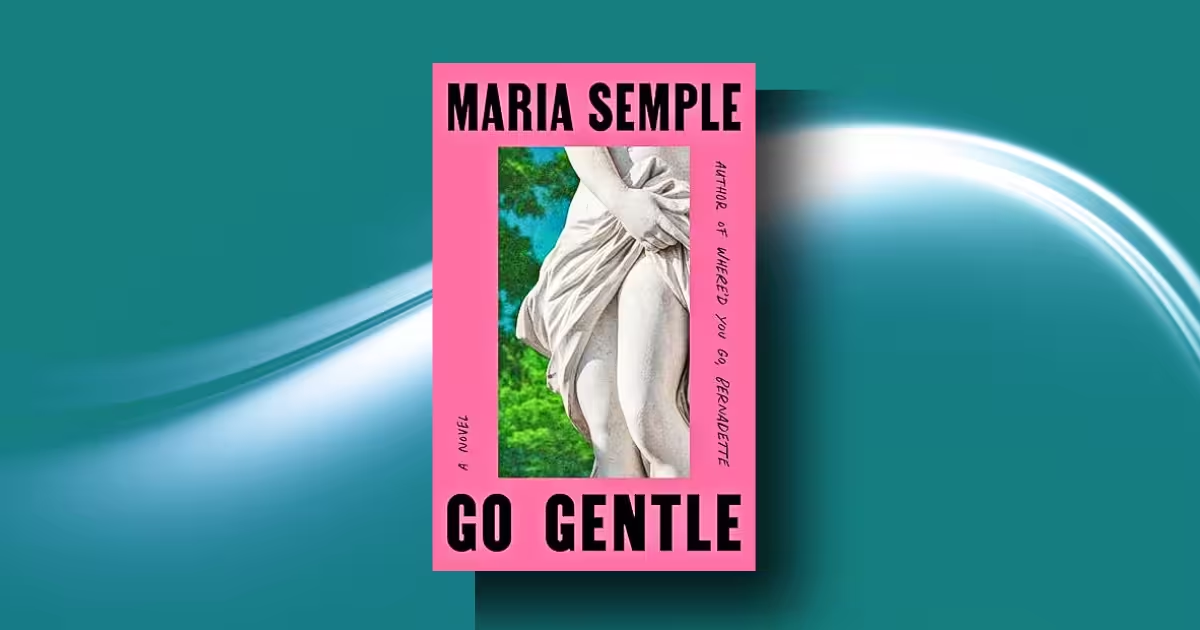
Do you ever find yourself applying ancient philosophy to your grocery list—and then wonder why the world suddenly feels like a collapsing game of Jenga? That’s the precise, brilliant, and utterly chaotic territory Maria Semple maps out in Go Gentle, her first novel in nearly a decade.
It is a story that doesn’t just ask you to turn the page; it demands you rethink how you process joy, desire, and the stubborn, humiliating reality of wanting more.
Go Gentle is a madcap, globe-trotting farce about a Stoic philosopher whose carefully curated, desire-free existence implodes the moment she accepts a stranger’s ballet ticket, proving that even the most disciplined mind is no match for a well-timed smirk, a mysterious burrito bomb, and the arms of the Venus de Milo.
Go Gentle is the perfect read for fans of Maria Semple’s signature zaniness in Where’d You Go, Bernadette, readers who love a hyper-intelligent yet flailing female protagonist, and anyone who has ever secretly wondered if Marcus Aurelius could survive a group text with Manhattan moms.
If you enjoy novels that blend high-stakes international art conspiracy with the very real, very messy concerns of middle age (peri-menopause, surly teens, and the cost of parking in New York), you will adore this.
You might bounce if you require a straightforward, linear narrative. Go Gentle is a “freewheeling plot” that breaks all the conventional rules of pacing and structure.
It’s a book that is proudly chaotic, which some reviewers have found “oddly juvenile” or difficult to keep up with. But for those who trust the ride, the payoff is immense.
Table of Contents
1. Introduction
Maria Semple’s Go Gentle: Oprah’s Book Club (G.P. Putnam’s Sons, April 14, 2026) marks the much-anticipated return of the author who gave us Where’d You Go, Bernadette and Today Will Be Different.
Selected as Oprah Winfrey’s 122nd Book Club pick—a celebration of the club’s 30th anniversary—this novel cements Semple’s place as a master of the comedic novel of ideas.
As Oprah herself put it, it’s “one wild ride of a story that carries equal parts wit and wisdom”. Semple, who previously wrote for iconic shows like Arrested Development and Mad About You, brings all her comedic timing and narrative fearlessness to this exhilarating story of one woman’s midlife transformation.
2. Background: The Stoic and the Semicolon
Understanding Go Gentle requires a brief detour into Stoicism—and Semple’s own life.
The author has maintained a robust Stoic practice for over a decade, and her knowledge of the philosophy is woven so deeply into the novel that the story becomes a kind of literary case study. The book’s title itself is a play on Dylan Thomas’s famous villanelle, “Do not go gentle into that good night,” which serves as the novel’s epigraph.
But where Thomas urged us to “rage, rage against the dying of the light,” Semple’s Adora Hazzard eventually discovers a different, perhaps more radical, path: to “go gentle” not as surrender, but as the ultimate act of trust in love and the universe.
3. Go Gentle Summary
This is a detailed retelling of the plot, including the novel’s full conclusion. If you want to experience the twists for yourself, skip to Section 4.
Part One: The Coven and the Catalyst
We meet Adora Hazzard, a divorced Stoic philosopher in her fifties living in the legendary Ansonia on Manhattan’s Upper West Side with her teenage daughter, Viv, and their dog, Mr. Man.
Adora has built a meticulously ordered life around the principle of desiring only what she has. She’s even assembled a “coven” of like-minded, accomplished single women on the same floor—theater director Minna and lawyer Emily Ann—with the goal of aging in place together.
Their arrangement is a marvel of pragmatic feminism: they share streaming services, parking spots, and even a seamstress who adds pockets to Adora’s uniform of navy-blue cotton dresses.
Her day job is gloriously weird. She holds a fellowship at the Lockwood Library, a Gilded Age museum, where her primary duty is providing “moral training” to the spoiled, sneaker-obsessed tween twin sons of the impossibly wealthy Lionel and Layla Lockwood.
Lionel is a former trust-fund wild child whose life was shattered by a freak climbing accident that left him a partial quadriplegic.
The family’s opulent, glass-walled residence is a marvel of modern design, its stark walls covered in a lush, living garden designed by the enigmatic landscape architect Blanche Falk.
Adora’s carefully cultivated contentment begins to crack when she meets Blanche, who has been hired for a new project, and impulsively asks her to join the coven.
That same night, at the ballet, Adora gives her extra ticket to a handsome, silver-haired stranger named David Ignatius “Digby” Beale. Their chemistry is instant and electric, culminating in a night of passionate, “priority-shifting” sex. But the next day, Digby reveals their meeting was no accident.
He had been watching her. He is on a covert mission to recover a stolen item for a client, and he needs Adora’s help: he asks her to secretly deliver a letter to Layla Lockwood, whose contents are as cryptic as they are alarming: “I know about the arms deal”.
Part Two: Surprise Me — The Unraveling
Adora, against her Stoic instincts, delivers the letter. Soon after, a bomb threat—a suspicious briefcase that turns out to be a burrito intended for Adora—rocks the Lockwood Library.
Simultaneously, a mysterious new statue arrives from France, purchased by Layla from Celine Montfort, an aristocratic art dealer.
The statue, “Boy With Apple,” is a composite of a male torso and arms that seem suspiciously familiar. The family’s elegant curator, Ravi Bhardwaj, is apoplectic, insisting that “boys don’t hold apples” and that the statue’s provenance is a sham.
Digby continues his seduction, both physical and psychological, pulling Adora deeper into his orbit.
He reveals he wrote the NDA she signed thirty years ago, a devastating contract that silenced her after she was sexually assaulted by TJ Steele, a former Laugh Riot actor. This revelation—that the man she’s falling for was the lawyer who helped bury her trauma—is a gut-punch, reframing their entire relationship.
Meanwhile, Adora’s attempts to be a good mother to her phone-addicted, One Direction-loving daughter, Viv, are fraught with hilarious, cringe-inducing tension. Their trip to Connecticut to visit Adora’s narcissistic mother, Phyllis, is a masterclass in intergenerational passive aggression.
Driven by a panicked voicemail from Ravi, who has uncovered something terrifying and then vanished, Adora starts investigating. She enlists her teenage dog walker, Ziggy—who moonlights as a celebrity lip-reader—to interpret surveillance footage. Ziggy’s translation of Ravi’s frantic phone call yields a terrifying list of words: “NAZIS. MONA LISA. REPUTATION. APPLE. ARMS. C4”.
Convinced that Celine Montfort has smuggled plastic explosives into the Lockwood Library under the guise of a statue, Adora does the only logical thing: she calls the FBI.
Part Three & Four: The Evil Genie and the Explosion
The FBI, led by the no-nonsense Agent Faye Lowenstein, raids the Lockwood Library. The “C4” crates are opened, revealing not a bomb, but simply the statue’s limbs (crate four—Caisse Quatre). Adora is publicly humiliated and immediately fired from her fellowship. She is a pariah, and her relationship with Digby seems irreparably broken.
But Adora’s philosophical training, which she had used to suppress her emotions, now kicks into a higher gear. She realizes she was wrong, but she also begins to see the deeper truth that had eluded her.
The “arms deal” was literal: the arms of the statue. She finally connects the dots: Layla Lockwood credits the armless Venus de Milo for curing her husband’s suicidal depression. Celine Montfort, desperate for cash but also fiercely protective of her family’s legacy, orchestrated the entire scheme to keep the Venus de Milo’s arms from ever being reattached, thus preserving the iconic statue’s “mutilated” beauty.
The story culminates in a breathtaking sequence at the Louvre in Paris. Adora, with the help of her unlikely crew (Blanche, who is secretly working for Interpol; her contractor Dorris; and even a Parisian trendspotter named Mathieu), tracks Celine to her family chateau. There, hidden behind a tapestry for decades, they find the real Venus de Milo—intact, with arms, holding an apple.
It was the original, smuggled out of the Louvre by Celine’s father during the Nazi occupation and replaced with a fake.
In a stunning, climactic twist, just as Digby and Adora reunite and kiss in front of the (fake) Venus de Milo in the Louvre, the real terrorist group QUANDO—the ones who bombed the Rosetta Stone—strike. A man in a rainbow poncho throws a net over the statue and detonates an explosion, obliterating the fake.
Celine’s secret is safe, but the world has lost an icon. In the chaos, Adora finally surrenders to her feelings for Digby, choosing to “go gentle” into a love that is messy, uncertain, and profoundly human.
The novel ends with a series of happy resolutions: Ravi, who had been accidentally locked in a soundproof room, is rescued; Adora and Digby are together; Viv gets to enjoy the perks of Digby’s immense carrot fortune; and the “coven” remains a source of strength. Adora has learned that a life of the mind is incomplete without the heart’s chaotic, beautiful interruptions.
4. Go Gentle Analysis
4.1. Go Gentle Characters
Adora Hazzard: Our narrator is a marvel of contradictions. She is a woman whose “life’s work has been chasing the Platonic ideal” of a fried egg sandwich, yet she dresses in a self-imposed uniform of washable blue cotton shifts to avoid wasting mental energy on fashion.
Her voice is the novel’s greatest engine—whip-smart, deeply self-aware, and frequently, unintentionally hilarious. She’s the kind of person who will explain Epictetus while simultaneously loathing her own daughter’s obsession with Taylor Swift.
Her journey is not about becoming a better Stoic, but about realizing that Stoicism alone is not enough.
She has to learn that vulnerability and desire are not failures of character, but essential components of being alive. Her past trauma with TJ Steele is the wound she has tried to heal with philosophy, but it’s only by confronting it—and allowing Digby to see it—that she can truly be “whole”.
David Ignatius “Digby” Beale: He is the perfect foil for Adora: a man who operates in shadows and gray areas, yet is drawn to her moral clarity.
He is, in his own words, a “bad man” trying to do good, the “filthy rich Baby Carrot King” who uses his immense fortune and skills as a former “NDA guy” to act as a sort of benevolent fixer for the elite.
His letter to Adora, where he lays bare his shame for writing her NDA and his subsequent journey to become a better person, is one of the most emotionally raw and effective sections of the entire book. He is the embodiment of Adora’s own aphorism, amor fati—love of fate. He is her fate, in all its messy, complicated glory.
Viv: Adora’s teenage daughter is so much more than a sullen sidekick. She is the novel’s moral compass and its sharpest cultural critic. In one of the book’s most powerful scenes, she eviscerates her mother for mocking her interests, brilliantly connecting the dismissal of a girl’s love for Taylor Swift to a broader societal misogyny: “It’s pure misogyny. You never see anybody telling little boys they’re idiots for playing with dinosaurs.
They will tell it to an eight-year-old girl crying over ‘Love Story’ with friendship bracelets on her arms”. She is a constant, humbling reminder to Adora that wisdom can come from the most unexpected places—and that sometimes, the wisest thing is to just let a teenager enjoy her hot chocolate in peace.
The Lockwoods: Lionel and Layla are a brilliantly observed portrait of obscene wealth and its strange pathologies. Layla, with her outlandish designer outfits (including “underpants” worn to a garden meeting), is a force of nature whose love for her husband is as fierce as it is absurd.
She will stop at nothing to protect him, even if it means unwittingly becoming entangled in an international art conspiracy. Lionel, the handsome, broken scion, is a testament to the power of philosophy and love to heal. His journey from suicidal depression to a life of purpose is a quieter, parallel story to Adora’s own.
4.2. Go Gentle Themes and Symbolism
The Limits of Stoicism vs. The Power of Love: The central, animating conflict of the novel is Adora’s Stoic practice crashing against the rocks of human emotion. She has built a fortress of tranquility, but it is a fortress that keeps out love just as effectively as it keeps out pain.
Digby’s entrance is a battering ram. Semple herself notes that while Stoicism provides an incredible framework for processing emotions, it has a “major hole” when it comes to deep-seated trauma, a gap that the novel explores with unflinching honesty.
The novel’s ultimate argument is that a life of pure reason is a half-life. To be fully human is to risk the mess, the desire, and the potential for heartbreak.
The Venus de Milo: The statue is the book’s central, multi-layered symbol. On one level, she represents the beauty of imperfection, the way something broken can become even more powerful and evocative.
This is the lesson Lionel learns from her limbless form.
But the statue is also a symbol of the secrets we keep, the lies we tell to preserve a cherished reputation.
And finally, in its intact form, hidden away for decades, it represents the complete, true self that we may bury out of shame or fear—the self that, like Adora, is finally unearthed and allowed to stand in the light.
The Coven vs. The Couple: Adora’s plan to grow old with her female friends is a modern, practical, and deeply appealing vision of a support system. It’s a “benevolent dictatorship” based on mutual aid and shared resources.
But the arrival of Digby forces a reevaluation. The novel doesn’t suggest that one is better than the other. Instead, it posits a both/and scenario. The ending finds Adora in love with Digby, but still firmly rooted in her Ansonia community, with the coven thriving. It’s a mature, hopeful vision of how a woman can build a life that contains multitudes.
5. Evaluation
Go Gentle is a breathtakingly original and emotionally intelligent triumph.
1. Strengths / What Worked Beautifully
The book’s greatest strength is its voice. Adora’s narration is a non-stop, high-wire act of wit and insight. Semple’s writing is “limber as ever,” capable of pivoting from a discussion of Seneca’s take on anger to the horror of an unkempt hotel bathroom with breathtaking speed and hilarity.
The plot, for all its intentional chaos, is a perfectly constructed puzzle box. Every bizarre detail—the burrito bomb, Ziggy’s lip-reading, the screaming room—clicks into place in the final act with a deeply satisfying snap.
The integration of Stoic philosophy is never pedantic; it’s woven into the fabric of Adora’s consciousness, making it feel organic and vital.
2. Weaknesses / A Few Stumbles
The “freewheeling” nature of the plot can, at times, feel like it’s spinning its wheels, particularly in the middle section where Adora is flailing between her feelings for Digby and her investigation.
And while the climax at the Louvre is thrilling, the resolution of Celine’s storyline feels a bit rushed.
We understand her motivations, but she becomes more of a plot device than a fully fleshed-out villain in the final act.
3. Impact: How It Resonated
This novel resonated with me on a deeply personal level. Adora’s struggle to balance her intellectual ideals with her very human, very messy desires felt utterly true. Her relationship with Viv is one of the most honest and affecting depictions of a mother-daughter dynamic I’ve read in years.
It’s a book that made me laugh out loud on the subway and then, a few pages later, made me want to call my own mother and apologize for being a brat. It’s a story about learning that the “blight of hope” is not hope itself, but the fear of wanting something more.
4. Comparison with Similar Works
This is pure Maria Semple, but it feels like a more mature, confident version of the voice from Where’d You Go, Bernadette.
It has the same zany, epistolary-adjacent energy, but with a deeper philosophical core. Fans of Lessons in Chemistry by Bonnie Garmus will recognize a similar blend of sharp female intellect and comedic pathos, though Semple’s humor is far loopier and more urban.
It also shares DNA with the work of Meg Wolitzer and Taffy Brodesser-Akner, in its unflinching and witty examination of midlife, ambition, and desire.
6. Personal Insight with Contemporary Educational Relevance
Beyond the delightful farce, Go Gentle offers a profound and timely lesson in what we might call philosophical education. Adora’s job is to tutor two tween boys in the principles of Stoicism, and we get to sit in on her lessons. She doesn’t just lecture; she engages them where they are—using their desire for Louis Vuitton sneakers as a springboard to discuss the nature of “externals” and the fleeting nature of desire.
She uses Plato’s Allegory of the Cave to get them to think about the media they consume, with one of the boys brilliantly connecting the pain of the cave’s sunlight to the feeling of “when you walk outside after a movie during the day”.
This is a powerful model for how we can integrate philosophical thinking into everyday life and, crucially, into modern education.
According to a 2024 study by the Foundation for Critical Thinking, students who are explicitly taught to identify assumptions and evaluate evidence score significantly higher on standardized tests of reading and critical analysis.
While philosophy is often seen as an esoteric, ivory-tower pursuit, Semple demonstrates that its core principles—understanding your emotions, questioning your desires, and acting with virtue—are essential life skills.
The book’s viral moment on TikTok and Instagram, where readers are sharing their own “Stoic Coven” aspirations, speaks to a broader cultural hunger for this kind of practical wisdom. Go Gentle is not just a novel; it’s a user’s manual for navigating midlife with both your mind and your heart intact.
It’s a reminder that true education isn’t about memorizing facts, but about learning how to live a good life.
7. Go Gentle Quotes
On Happiness and Friendship: “When I attempt to define happiness and understand its place in the hierarchy of the human project (divorced philosopher), my mind leaps to those five minutes in the market with Emily Ann. (Sorry, marriage-to-Hal! Sorry, birth-of-Viv!) They were marked by spontaneity, creative problem-solving, lawlessness, laughter and kinship. I existed vividly and exclusively in the present moment.”
On the Nature of Stoicism: “It’s not Keep Calm and Carry On. It’s Change Your Perception So You Never Have to Keep Calm and Carry On.”
On Motherhood: “You’re no skips,” I whispered. “You’re the balm, baby. Nothing beats you.”
On the Absurdity of Wealth: “I was once walking down the Strip in Vegas,” Blanche said. “Outside the Mirage there was a billboard. It read, ‘The Mirage Buffet. Imagine it. Eat it.’ I thought, that’s rich people in a nutshell. Imagine it. Eat it.”
On the Wisdom of Teenage Girls: “It’s pure misogyny. You never see anybody telling little boys they’re idiots for playing with dinosaurs. They will tell it to an eight-year-old girl crying over ‘Love Story’ with friendship bracelets on her arms.”
8. Conclusion
Go Gentle is a spectacular, sprawling, and deeply satisfying novel. It is a comedic thriller, a midlife romance, a philosophical treatise, and a mother-daughter love story all rolled into one glorious, messy package.
I would wholeheartedly recommend it to any reader who loves sharp, character-driven fiction with a brain and a heart. It’s the perfect book club pick—guaranteed to spark conversations about desire, aging, friendship, and whether or not you, too, should form a “coven” in your apartment building.
Ultimately, Go Gentle is significant because it dares to imagine a world where a woman can be both a rigorous thinker and a creature of passion.
It argues that the most courageous thing we can do is not to “rage” against the dying of the light, but to “go gentle” into the unknown, hand in hand with the people we love.







