

Last updated on January 13th, 2026 at 05:16 am
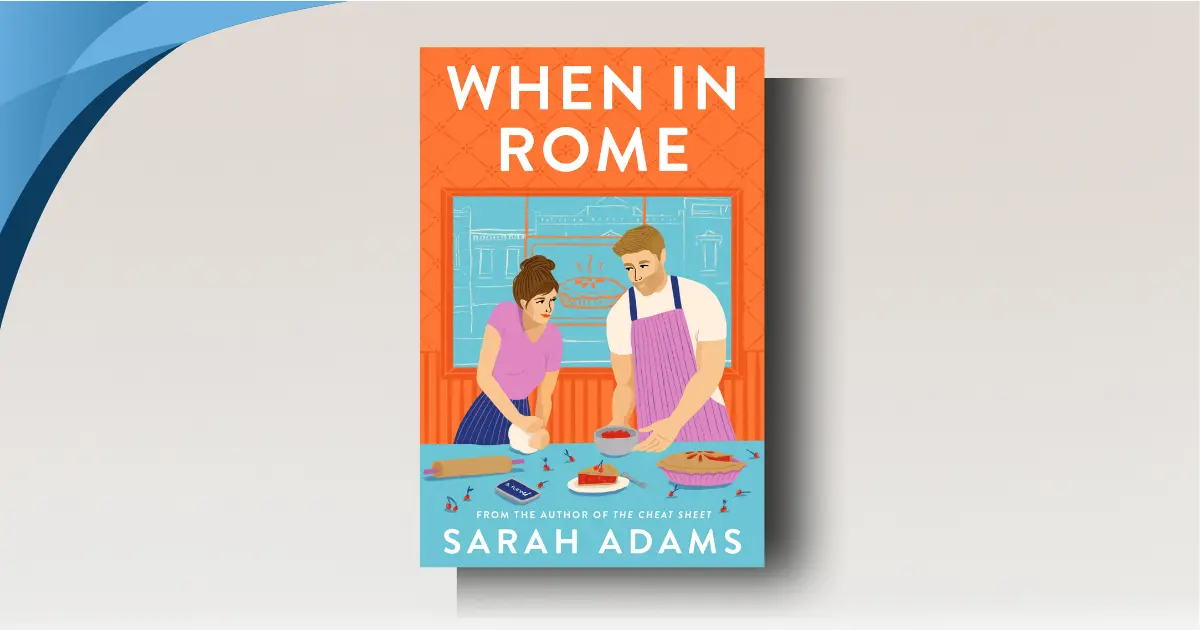
Do you ever feel crushed by the very success and routine you worked so hard to create? When in Rome by Sarah Adams is a heartfelt exploration of that very impulse, showing that sometimes you have to get lost to find what’s truly yours.
A burnt-out pop star, fleeing the pressures of fame, finds unexpected sanctuary, love, and herself in a small Kentucky town after her car breaks down in a pie shop owner’s front yard.
This book is best for readers who love slow-burn, closed-door romances with deep emotional healing, small-town charm, and references to classic films like Roman Holiday. Not for those seeking steamy scenes, high-stakes drama, or a cynical take on fame.
Table of Contents
1. Introduction: A Modern Roman Holiday
When in Rome is a 2022 contemporary romance novel by Sarah Adams, published by Dell (an imprint of Penguin Random House).
This standalone novel quickly became a BookTok sensation for its wholesome yet emotionally resonant take on the “celebrity in hiding” and “small-town romance” tropes, serving as a modern, heartfelt homage to the Audrey Hepburn classic, Roman Holiday.
2. Background: The Allure of Escapism
While not historical, the book taps into a potent modern context: the culture of burnout and the curated, often isolating nature of fame in the social media age.
The protagonist’s journey mirrors a growing societal desire to disconnect from relentless productivity and reconnect with authentic, unplugged living.
Sarah Adams sets her story not in the Italian capital, but in Rome, Kentucky—a deliberate choice that underscores the theme that adventure and transformation can be found in the most ordinary, overlooked places.
3. When in Rome Summary
The novel is told through the alternating first-person perspectives of Amelia Rose and Noah Walker.
Part 1: The Escape & The Grumpy Rescue
Amelia Rose, known globally as pop sensation “Rae Rose,” is having a quiet breakdown. After a grueling rehearsal schedule and a soul-crushing meeting with her manager, Susan, she feels like a hollowed-out “rotting compost pile” (Page 9).
Inspired by her idol Audrey Hepburn in Roman Holiday, she impulsively flees her Nashville mansion in her old Toyota Corolla, heading for the nearest “Rome” on Google Maps: Rome, Kentucky.
Her escape hits a literal roadblock when her car breaks down on a dark, service-less back road—which turns out to be the front yard of Noah Walker.
Noah, a gruff, no-nonsense pie shop owner in his thirties, is initially just an annoyed Good Samaritan. He’s deeply protective of his peaceful, solitary life, a stance rooted in a past heartbreak when his city-girl fiancée, Merritt, left him. He’s convinced Amelia is another fleeting, high-maintenance outsider.
Despite her paranoid refusal to get out of her smoking car, he proves his trustworthiness through his surrogate grandmother, Mabel, and offers her his guest room for the night.
The tension is immediate. Amelia is used to fawning admiration; Noah offers blunt honesty and clear irritation at the disruption. He’s the first person in years who doesn’t treat her like “Rae Rose,” a commodity.
He simply calls her “Smart Mouth” (Page 22). The dynamic is electric because it’s real.
Part 2: The Unlikely Sanctuary
Amelia’s car needs a part that will take two weeks to arrive, stranding her. Though Noah initially plans to shuffle her off to Mabel’s B&B, the meddling town matriarch claims to be fully booked, forcing Noah to extend his hospitality.
He lays down a firm boundary: she can stay, and he’ll even be her reluctant tour guide, but this is not romantic. “This isn’t going to turn into anything romantic between us. It’s just…friendship” (Page 143).
What follows is a beautifully paced, slow-burn connection. Amelia, shedding the “polite, polite, polite” (Page 10) persona of Rae Rose, rediscovers simple joys: eating pancakes without her manager’s approval (Page 59), helping Mabel paint, and playing Scrabble.
Noah, despite his best efforts, finds his defenses crumbling. He sees her vulnerability—like when she accidentally mixes sleeping pills with alcohol and confesses in a vulnerable moment, “I’m drowning and no one sees me” (Page 119).
His quiet, steadfast care for her that night—sitting by her bedside and telling her “I see you” (Page 120)—marks a turning point.
Part 3: Confronting Pasts and Embracing Futures
Their “just friendship” proves impossible. A kiss in the pie shop kitchen (Page 87) and growing emotional intimacy force them to confront their feelings.
Amelia learns about Noah’s tragic past—his outdoorsy parents died in a lightning storm when he was ten (Page 153), and he was raised by his grandmother, whose pie shop he now runs. Noah learns about Amelia’s estranged, exploitative mother and her stifling, joyless career.
The conflict arrives when Amelia’s manager, Susan, and her overbearing world descend on Rome to drag her back for her tour. Faced with the reality of leaving, Amelia and Noah admit their love.
In a climactic scene that inverts the Roman Holiday ending, Amelia doesn’t silently walk away. She chooses Noah and a life that makes her happy.
She postpones her world tour, takes a year off to reclaim her music on her own terms, and commits to building a life with Noah in Rome.
The epilogue shows them happily together, with Amelia writing music inspired by her new life and Noah content in his pie shop, their love story a quiet testament to choosing personal peace over public prestige.
4. Analysis
4.1. Characters
- Amelia (Rae Rose): Her arc is one of profound reclamation. She begins as a “maxed-out credit card that everyone keeps swiping” (Page 48), performing a curated version of herself. Rome and Noah become her sanctuary where she rediscovers Amelia—a woman who loves bad jokes, Scrabble, and simple connections. Her courage isn’t in performing for thousands, but in finally saying “no” to the system that made her famous and “yes” to her own well-being.
- Noah Walker: The quintessential grumpy-with-a-heart-of-gold hero. His gruff exterior masks deep loyalty, trauma from loss, and a fear of abandonment. He isn’t just a stereotype; his “surly pose” (Page 53) is a defense mechanism. His development lies in reopening his heart. He doesn’t change for Amelia; rather, her presence allows the caring, flower-obsessed (Page 135), devoted man he always was to step forward again.
- The Supporting Cast: The town of Rome acts as a character itself. Mabel is the mischievous, wise catalyst. The Walker sisters (Emily, Madison, Annie) provide warmth, humor, and a model of unconditional familial love Amelia craves. They accept her as a person, not a star.
4.2. When in Rome Themes and Symbolism
- The Search for Authentic Self vs. Public Persona: The core theme is the conflict between “Rae Rose,” the product, and “Amelia,” the person. Her journey is about shedding the performance to find authenticity.
- Home as a Feeling, Not a Place: For Amelia, home was a cavernous, empty mansion. For Noah, it was a town he felt tethered to by duty and pain. Together, they create a “home” defined by safety, understanding, and mutual care—symbolized by Noah’s lived-in house and the community pie shop.
- Healing Through Quiet Care: The romance is built not on grand gestures, but on quiet, transformative care: Noah making pancakes, sitting by her sickbed, and giving her the space to be messy. This contrasts sharply with the loud, transactional relationships of Amelia’s fame.
- Symbolism: The pie shop represents legacy, family, and nourishing others. Amelia’s broken-down Corolla symbolizes her former, authentic life before fame, and its breakdown is the necessary catalyst for her journey. Audrey Hepburn films symbolize the idealized escape and grace Amelia seeks, providing the blueprint for her adventure.
5. Evaluation
Strengths:
- Emotional Depth: The handling of burnout and emotional exhaustion is nuanced and relatable, transcending the celebrity trope.
- Character-Driven Romance: The slow-burn is perfectly paced, making the emotional payoff deeply satisfying. The “closed-door” nature of the romance (fade-to-black intimate scenes) focuses the story on emotional intimacy.
- Small-Town Charm: The town of Rome and its residents are delightful without feeling caricatured. They provide a perfect foil to Amelia’s impersonal world.
Weaknesses:
- Predictable Tropes: Readers very familiar with the genre will find few narrative surprises. The conflict (manager arrives, tour looms) is standard.
- Noah’s Past Relationship: The ex-fiancée, Merritt, serves mainly as a backstory device and could have been more fleshed out to deepen Noah’s fears.
Impact:
The book resonates because it’s a fantasy of simplification. In a world that often feels demanding and performative, the idea of finding peace, love, and purpose in a quiet corner with a grounded partner is powerfully comforting. It champions the radical act of choosing a smaller, happier life.
Comparison with Similar Works:
It sits comfortably alongside Emily Henry’s Book Lovers for its witty banter and exploration of life choices, and Abby Jimenez’s romances for their blend of humor and heartfelt emotional issues.
It’s a sweeter, less steamy cousin to Lucy Score’s Things We Never Got Over, sharing the “city woman in small town” trope.
6. Personal Insight: The Quiet Epidemic of Burnout and the Permission to Rest
Reading When in Rome felt less like escapism and more like validation during a time when burnout is a recognized syndrome by the World Health Organization.
Amelia’s feeling of being a “rotting compost pile” is a visceral metaphor many now understand. A 2022 survey by Deloitte found that 77% of professionals have experienced burnout at their current job.
The book’s contemporary relevance lies in Mabel’s fierce proclamation: “When the hell did it become such a crime to be selfish now and again?” (Page 131). In an era of “hustle culture,” Amelia’s journey gives readers permission to contemplate their own “Rome”—a mental or physical space to disconnect and recalibrate. It’s not anti-ambition; it’s pro-balance.
The story argues that sustainable success, whether in career or art, cannot be built on an empty vessel.
Amelia’s choice to pause her tour isn’t a failure; it’s a strategic retreat for long-term survival and creativity, a lesson applicable to any field demanding constant output. It’s a romance, yes, but its most compelling love story might be Amelia’s journey back to loving herself.
7. Quotable Lines
- “I’m drowning and no one sees me.” – Amelia (Page 119)
- “Polite, polite, polite. At all costs, I am always faithfully polite.” – Amelia (Page 10)
- “No one loves anything they’re miserably chained to.” – Mabel (Page 132)
- “I see you.” – Noah (Page 120)
- “This town is too damn polite for its own good.” – Noah (Page 84)
8. Conclusion
When in Rome is a warm, thoughtful hug of a book. Sarah Adams succeeds in crafting a romance that is both delightfully tropey and meaningfully deep. It’s a celebration of small-town life, quiet love, and the courage to redefine success on your own terms.
Final Recommendation: I wholeheartedly recommend this to anyone who needs a comforting read that restores faith in simple pleasures and genuine connection. It’s perfect for fans of character-driven romances where emotional healing is just as important as the happily-ever-after.
Ultimately, When in Rome reminds us that sometimes the greatest adventure isn’t about how far you go, but how deeply you settle into a place—and a person—that feels like home.