
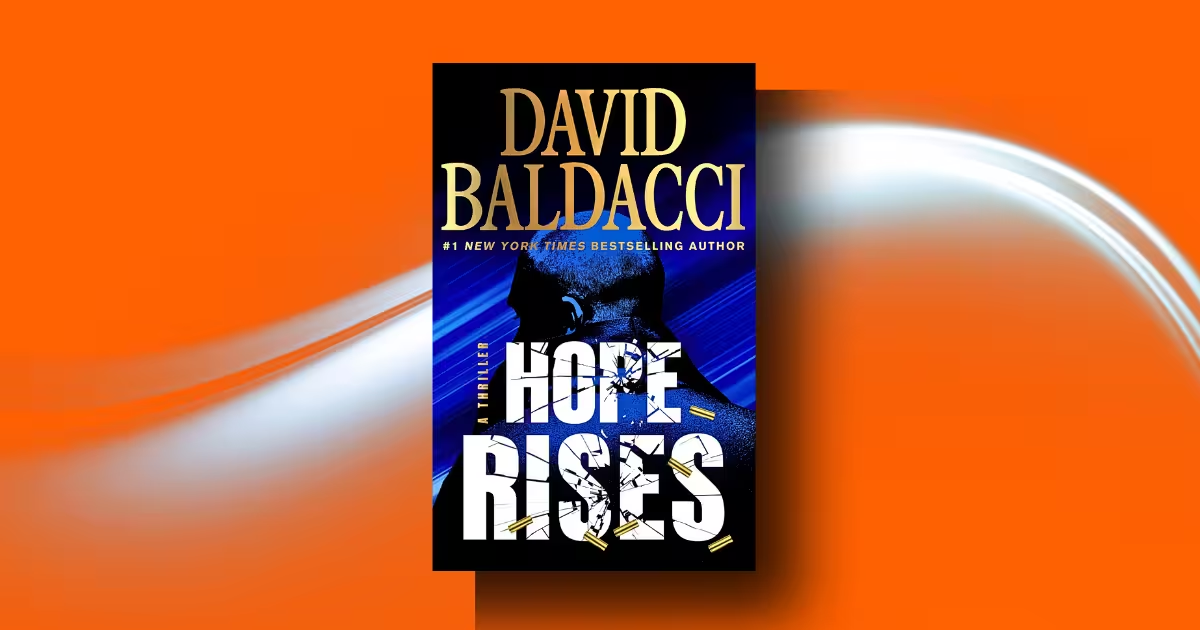
Did you ever wonder if revenge could be more exhausting than forgiveness? David Baldacci’s Hope Rises lays bare a brutal truth: vengeance may satisfy, but it costs the avenger pieces of their own soul that forgiveness might have spared.
Walter Nash, a man whose life was dismantled by a global criminal empire, must physically and psychologically reinvent himself to rescue the mother of his greatest enemy, only to discover that the monster he’s hunting might be a victim of forces far darker than her own choices.
Hope Rises is for readers who love gritty, high-stakes spy thrillers layered with psychological complexity, where the lines between hero and villain are constantly blurred. It’s also for fans of character-driven redemption arcs.
It is not for those seeking a straightforward, cathartic “good guy kills bad guy” narrative, or readers who prefer non-stop action without philosophical introspection on the nature of evil.
Table of Contents
1. Introduction
Hope Rises is the second installment in David Baldacci’s Walter Nash series, published internationally as a number-one bestseller.
The narrative plunges Walter Nash deeper into his undercover life as “Dillon Hope,” a personal security expert embedded within the global drug empire of Victoria Steers. The novel is a breathtaking, high-octane blend of spy craft, family trauma, and brutal physical combat.
It tests the very limits of its protagonist, moving the chess pieces from the glittering skyline of Hong Kong to the treacherous jungles of Myanmar, and ultimately forcing Nash to confront a truth far more jarring than any physical battle: that the line between the woman he has vowed to destroy and the person he might be capable of loving is dangerously thin.
2. Background
Hope Rises picks up after the events of the first book, Nash Falls, where Walter Nash’s idyllic life was shattered. Framed by Victoria Steers for the sexual abuse and murder of his daughter, Maggie, Nash lost his family, his reputation, and his identity.
Recruited by FBI Special Agent Reed Morris, Nash underwent a brutal physical and psychological transformation under the tutelage of Isaiah “Shock” York, a friend of his late father. He became Dillon Hope—a muscled, bald, tattooed bodyguard.
By the end of the first book, his wife, Judith, was saved and placed in protective custody, and Nash had managed to infiltrate Steers’s organization by becoming a bodyguard for Steers’s unwitting associate, Rhett Temple.
3. Hope Rises Summary
The story begins in medias res as Dillon Hope accompanies his boss, Rhett Temple, and the white-haired emissary Lynn Ryder on a private jet to Hong Kong.
They are en route to meet the enigmatic and lethal Victoria Steers, who controls a vast criminal network. Nash is living in an “upside-down world,” a concept he reflects on immediately: a life devoid of business plans and replaced by a deadly game of cat and mouse (Chapter 1).
Nash understands the stakes are absolute. He knows Steers is “into illegal drug distribution on a global scale. And she has people killed” (Chapter 1). The first major shock arrives when Steers demonstrates her absolute control.
To bind Temple and Hope to her service, Steers stages the execution of Lynn Ryder in her penthouse. She shoots Ryder in the head with what Nash believes is his own gun, splattering blood everywhere, and threatens to frame them for the murder in China, a country known for its lethal ruthlessness with criminals (Chapter 2).
The purpose is to blackmail them into a suicide mission: rescuing her mother, Masuyo, from a heavily guarded private prison in a war-torn region of Myanmar.
This mission forms the core of the middle act. Steers’s plan is wildly complex, involving a trip into the Kachin State controlled by the KIA (Kachin Independence Army), a terrain so dangerous that Steers notes, “The junta is not in control of the Kachin State… The KIA and its allies pressed on, and they have largely driven the junta out of the region” (Chapter 8).
Nash and Temple, accompanied by guides Thura, Zeya, and Amrita, must traverse mountains on dirt bikes and horseback.
The journey is arduous and deadly. When a KIA soldier stumbles upon their camp, Nash reacts instinctively, killing the man, which creates a massive liability for the team, turning the local militia into an immediate threat (Chapter 13).
Betrayal is a constant companion. Amrita, the seemingly loyal guide, attempts to kill Nash and Temple to collect a reward for the dead KIA soldier.
Nash was about to be shot when Thura intervened: “I had to kill a friend to protect those I do not know. It is messed up, man,” Thura explains, revealing his own code of honor (Chapter 18). This act cements Thura as Nash’s most reliable ally.
They eventually reach the prison region and, defying Steers’s original plan—which Nash had long suspected was designed to leave them as dead patsies—they execute a brilliant counter-ambush. Nash’s homemade bombs, made from stump remover and sugar (a nod to his resourcefulness, detailed in Chapter 22), decimate the team that was supposed to retrieve Masuyo.
Nash and Thura free Masuyo, convincing the inside guard to drive a body double to the hospital, making the prison believe the escape attempt failed.
Upon delivering Masuyo to Hong Kong, Nash is rewarded not with freedom, but with a terrifying promotion. Steers forces him and Thura to stay as Masuyo’s bodyguards, while Temple is allowed to return to America.
The relationship between Nash and Steers begins an agonizing mutation. Steers, who wears long sleeves to hide horrific burn scars from a plane crash that killed her father, reveals her vulnerability to Nash. “I think your scars are a reminder… of defeat,” Nash deduces, to which she chillingly agrees (Chapter 9). She later invites him to dinner, calling him “Dillon-san,” a sign of profound respect.
He saves her life during an assassination attempt by her own head guard, Hao, solidifying her trust in him (Chapter 39). The bond deepens further when Nash confronts her with the truth Hiroko-san—Steers’s beloved nanny—told him: that Masuyo murdered her other children and convinced Steers that she did it, a psychological manipulation that warped Steers’s soul (Chapter 38).
The final act explodes on American soil. Steers moves her base to a Tuscan-style estate near Temple’s home.
Here, the political and criminal layers converge. Steers reveals to Nash that she has been working for the CIA, selling her empire to a shadowy super-strategist named Connor Lord for one dollar. “The amount I wish for myself is… one American dollar,” she declares in a stunning power play (Chapter 56).
Her plan is a masterful trap; by turning her criminal network over to Lord, she gives the US government everything it needs to dismantle his global network. Lord, a grandmaster chess player with a 215 IQ, was previously untouchable but has now directly acquired Steers’s illegal enterprise (Chapter 57).
Betrayal comes full circle when Masuyo, whose Chinese name is Dai Lu, reveals to Steers that “Dillon Hope” knew her real name, blowing Nash’s cover. Steers takes him, at gunpoint, to the grave of Hiroko-san, who was murdered by Masuyo. Here, Nash finally confesses: “I am… Walter Nash” (Chapter 70). Instead of killing him, Steers lowers her gun.
But their confrontation is interrupted by an attack on the estate. Steers’s mother, working with Lord, has ordered a hit squad to kill everyone. Only Nash and Steers escape, fleeing first to a motel and eventually to her safe house in New Orleans.
The climax is pure vengeance and cunning. Steers and Nash, working with a begrudgingly heroic Rhett Temple, orchestrate a counter-sting in a massive drug warehouse near San Diego.
Temple, playing a triple-agent role, offers to put Lord and Masuyo at the center of a “methamphetamine” revival strategy, pitching the disruptive, zombie-like violence of meth as a better tool than silent fentanyl deaths (Chapter 81).
However, the genius Lord anticipated the trap. He captures Nash and Steers, brings them to the warehouse in shackles, and publicly unmasks Nash.
In a scene of shocking brutality, Temple, in a performance of a lifetime, stabs Nash with a trick knife to prove his loyalty to Lord. “I’m sorry it didn’t work out. I really wanted to be a hero, for once,” Temple whispers, playing his role as Nash “dies” on the floor (Chapter 83).
Then, the ultimate power play: Lord, goaded by Masuyo, is handed a gun to execute Steers. Steers taunts him, pointing to her heart. Lord shoots her, and she collapses beside Nash.
But the gun was a CIA-provided “prop weapon” that triggered a theatrical blood pack, exactly like the trick Steers played on Nash with Ryder years earlier (Chapter 84).
With Lord now undeniably on video committing murder, the FBI and CIA swarm the warehouse. Nash and Steers did not die; their gruesome deaths were a final, flawless piece of theater to ensure Connor Lord would never escape justice.
The Ending Explained: In the aftermath, Masuyo commits suicide in prison with poison provided by Steers—a final, dark act of liberation (Chapter 86). Rhett Temple, having made a deal, goes to prison for his past crimes but with a drastically reduced sentence.
Walter Nash attends his own “funeral” in secret, watching from the shadows as his grieving wife, Judith, and his very-alive daughter, Maggie (who Steers had placed with the US Marshals, not murdered), mourn him. Nash cannot reunite with them, as it would forever put a target on his back and theirs.
The final scene is deeply personal. Nash picks up Steers from a remote prison, where she has served a short sentence and now has a new identity: Jenny Lee. He has set her up in a small apartment with an easel, a bike with a bell, and a garden planter. “I needed you to understand and then believe those words.
You need to understand and believe the truth in those words,” he tells her, acknowledging her capacity for redemption (Chapter 88).
The novel ends on a haunting, ambiguous note of hope—two shattered people, forever changed by unimaginable violence, perhaps finding a future together, not as criminals or spies, but simply as Walter and Jenny.
4. Hope Rises Analysis
4.1 Hope Rises Characters
Walter Nash / Dillon Hope: Nash is a remarkable creation because he is a simulation of a man. His journey is a painful deconstruction of the self.
He is a “mild-mannered, law-abiding business executive… no discernible muscle… nary a tattoo within a mile of him” (Chapter 1), forced to become a “muscled and tatted fighting machine.” His internal conflict is a constant, agonizing thrum. He has every reason to kill Steers, yet finds himself saving her life repeatedly.
His breakdown in the motel room in New Orleans, where he nearly shoots himself after almost consummating his relationship with Steers, lays bare his psychological torture: “What’s wrong?
This whole… this thing is wrong. Wrong!” (Chapter 75). Nash’s arc is about learning that vengeance cannot be a life’s purpose. He confesses to Steers that he’s no longer even sure who he is: “I’m not Walter Nash… not anymore” (Chapter 60). His ending, watching his own funeral in secret and then choosing to be “Dillon” for Steers, is a devastating acceptance that the man he was died years ago.
Victoria Steers (Jenny Lee): Far from a one-dimensional villain, Steers is the novel’s pulsing, tragic heart. She is a product of horrific abuse. Her mother, Masuyo, literally set her on fire, leaving her with scars she refuses to surgically remove as a “reminder” of her failures (Chapter 9).
Hiroko-san’s revelation that Masuyo made Victoria believe she had killed her siblings frames her entire life as a lie: “Masuyo used her mind and her words to convince her daughter that she committed these terrible acts” (Chapter 38).
Steers is not a sociopath; she is a survivor. Her compassion is evident in her relationship with Hiroko and her decision to swap out fentanyl for less lethal drugs, a dangerous moral choice that literally puts her empire at risk.
Her final evolution into “Jenny Lee,” a drug counselor with a buzz cut and an ankle monitor, is a fitting end for a woman who finally steps out of her mother’s suffocating shadow and into the quiet possibility of atonement.
Rhett Temple: Temple is the ultimate foil. He’s a man crushed by his father’s contempt, desperate to be a “hero” but lacking the moral compass to achieve it. His journey from selfish billionaire brat to a man capable of self-sacrifice is messy and believable.
His “Oscar-worthy” performance of killing Nash—”At least you’ll be heading upstairs. Me? I don’t think so. I only see fire in my future” (Chapter 83)—is his redemption song. He’s a coward who finally does one brave thing, and it costs him everything except his soul.
Masuyo (Dai Lu): A monster of pure ideology. A Chinese agent who faked an alliance with Japan, she embodies a cold, calculating evil that makes other villains seem petty. She murdered her own children for not being “pure.” Her attempt to kiss Lord with a gun to kill her own daughter is pure psychopathy refracted through a political lens.
Thura: The novel’s conscience. A simple, honest man from Myanmar, he represents unalloyed loyalty. His simple dreams—”I can work and have a little house and grow old without bullets flying around” (Chapter 22)—ground the narrative in a profound, working-class humanity that contrasts sharply with the Machiavellian wealth of Lord and the Steers family.
4.2 Hope Rises Themes and Symbolism
The Malleability of Identity: The entire novel is a meditation on whether we are who we are born as, or who we are forced to become.
Nash’s tattoos are literal armor, but they also represent the permanent scarring of his soul. Steers’s burn scars are external manifestations of her internal wounds. Hiroko-san’s cryptic parable is the key: “No matter whether a cow looks like a cow, and moos like a cow, and gives milk like a cow, there is no guarantee whatsoever that it is indeed a cow” (Chapter 38).
This speaks to the core of the plot—Nash is not really Hope, Steers is not really evil, and the most dangerous predators (Lord, Masuyo) appear the most civilized.
Redemption as an Active Choice: The book argues fiercely that redemption isn’t a passive state of grace but an active, excruciating process. Steers doesn’t just feel sorry; she dismantles a global empire from the inside, risking assassination by the Chinese, to buy her soul back for “one American dollar.”
Nash chooses to forgive Steers not because she deserves it—she was, after all, responsible for the nightmare that consumed his life—but because he witnesses her fight to be someone else.
The Manipulation of Truth: The entire plot hinges on “sleight of hand and psychological manipulation,” as Steers explains when she reveals Ryder’s staged murder (Chapter 44).
The body double in the prison, the CIA prop gun in the warehouse, the fictional deaths of both protagonists at the end—these are all commentaries on how easily our perception can be hijacked by those with power and motive.
5. Evaluation
Hope Rises is a poignant, muscular thriller that breaks your heart while it races your pulse.
Strengths/Positive Experiences: The novel’s greatest strength is its audacious emotional complexity. Baldacci refuses to let us hate Victoria Steers, which is a masterful piece of manipulation. The prose describing Nash’s grief over finding his daughter’s belongings—”With trembling fingers, Nash slowly opened the box… The tears trickled from Nash’s eyes” (Chapter 36)—is devastatingly effective.
The set-piece in the warehouse is a mind-bending piece of narrative engineering.
Weaknesses/Negative Experiences: The geopolitical chess match involving Lord and the Chinese can feel dense, occasionally bogging down the visceral, personal stakes with exposition about fentanyl logistics and crypto crashes.
While necessary, some of the explanations of the CIA’s sleight-of-hand stretches credulity, even for a spy novel.
Impact: The novel resonates because it offers no easy solutions. Nash doesn’t ride off into the sunset with his wife and daughter. He attends his own funeral, forever separated from the life he was fighting to reclaim.
The quiet, ambiguous ending, with him setting up an easel for a woman he once swore to kill, is a masterstroke of bittersweet resolution. It’s a grown-up ending for a grown-up story about trauma.
Comparison with Similar Works: Fans of the Jason Bourne series by Robert Ludlum will recognize Nash’s physical reinvention and the themes of a spy agency turning on its own.
However, Hope Rises feels more like a peer to John le Carré’s work, particularly The Night Manager, in its focus on moral compromise and the psychological costs of deep-cover work.
6. Personal Insight with Contemporary Educational Relevance
One of the most disturbing yet insightful angles of Hope Rises is its depiction of the “weaponization of despair.” The drug crisis described in the book isn’t just about addiction; it’s framed as a state-level destabilization tool.
The character Connor Lord’s strategy, as laid out by Rhett Temple, to shift from fentanyl (a silent killer) to methamphetamine (a chaos-inducing stimulant), is a chilling clinic in applying market logic to human misery.
“To disrupt, I mean really disrupt, you don’t want people to die quietly and alone… with meth you got people climbing trees, attacking Grandma and their own babies, stealing and trashing stuff… Hospitals full of berserk nutjobs.” (Chapter 81)
This fictional strategy reflects very real contemporary concerns about hybrid warfare and grey-zone conflicts. According to the Centers for Disease Control and Prevention (CDC), psychostimulant overdose deaths (primarily methamphetamine) have risen sharply in recent years, often in combination with synthetic opioids—a devastating polydrug crisis.
The novel’s exploration of how corporate logistics and vast warehouses can be used to “legitimately” smuggle these toxins into communities isn’t a far-fetched spy fantasy; it mirrors investigative reports on the complexities of port security and the global supply chain.
By reading about these mechanics in a thriller, readers gain a visceral, gut-level understanding of how abstract geopolitical policy directly fuels the chaos on American streets. It makes the political personal.
7. Hope Rises Quotes
On transformation: Nash reflects on his new self: “He had gone from reviewing business plans… to playing a deadly game of cat and mouse… I truly am living in the upside-down world.” (Chapter 1)
On motherhood and evil: Masuyo’s dying confession: “You were never a mother to me. You were the opposite of a mother.” – Steers (Chapter 86)
On Hiroko’s wisdom: “The mind thinks too deeply and will play you false when you most need it to be true… But your heart will lead you to where you need to go, Dillon-san. It always does.” (Chapter 38)
On redemption: Steers redefining her purpose: “I am not you. I will never be you. I am Victoria, my father’s daughter.” (Chapter 86)
Final image: “Nash stopped and looked back at the building where on the third floor resided a woman who was easily the most complicated person he had ever known… they both had a chance… And in this world, that was likely as good as it was ever going to get.” (Chapter 88)
8. Conclusion
Hope Rises is essential reading for anyone who believes a thriller can have both a bruiser’s physique and a poet’s soul. It is not merely a sequel; it is an elevation of the entire series, transforming a revenge saga into a profound psychological examination of forgiveness.
David Baldacci has written a novel that provides all the exploding cigar factories and high-octane shootouts a fan could want, while simultaneously breaking down the very concept of “the enemy.”
I recommend it for readers who loved The Bourne Identity but wished it had the emotional depth of A Perfect Spy, and for anyone who understands that sometimes, the only way out is through.







