
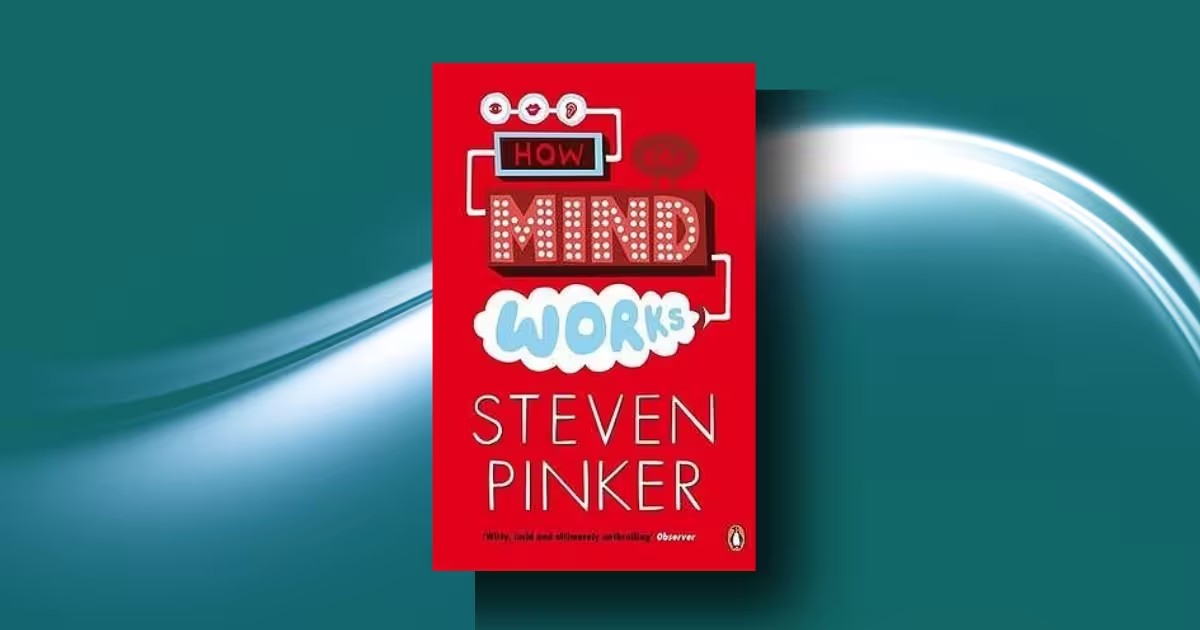
Why do we fall in love, laugh at jokes, see meaning in stories, fear danger before thinking clearly, and still feel like a mystery to ourselves? Steven Pinker’s How the Mind Works helped me see the mind not as a ghost inside the body, but as a brilliant, imperfect survival machine built out of perception, memory, emotion, reasoning, kinship, and imagination.
How the Mind Works is best for curious readers who genuinely want to understand the biological and computational machinery behind everyday thought, emotion, social behaviour, art, and consciousness.
Ideal for students of psychology, philosophy, cognitive science, linguistics, and evolutionary biology. Also perfect for intellectually adventurous lay readers who enjoy rigorous ideas delivered with wit and verve.
Not for readers looking for a quick, breezy self-help read. If you are uncomfortable with evolutionary explanations of human behaviour, or if the idea that the mind is a kind of natural computer unsettles you philosophically, expect challenge and friction — which, honestly, is part of its value.
Table of Contents
1. Introduction
How the Mind Works is a landmark work of popular cognitive science authored by Steven Pinker, first published in the United States by W. W. Norton & Company in 1997, and subsequently published in Great Britain by Allen Lane / The Penguin Press in 1998.
Steven Arthur Pinker is a Canadian cognitive psychologist, psycholinguist, popular science author, and public intellectual.
He is an advocate of evolutionary psychology and the computational theory of mind, and is the Johnstone Family Professor of Psychology at Harvard University.
Before settling at Harvard, he served on the faculties of MIT — where he was Director of the Center for Cognitive Neuroscience — and Stanford. How the Mind Works followed his 1994 bestseller The Language Instinct and earned a nomination for the Pulitzer Prize for General Nonfiction, as well as the Los Angeles Times Book Prize. It was named a New York Times Notable Book of the Year and a Publishers Weekly Best Book of 1997.
In short, this is not the work of a dilettante. Pinker writes from the heart of the scientific conversation.
How the Mind Works belongs to the genre of popular science, but it is no light read. It is simultaneously a work of cognitive science, evolutionary biology, philosophy of mind, and psychology.
Its subject matter is nothing less than the entire human mind — from vision and walking to jealousy, romantic love, art, music, humour, and religious belief.
Pinker draws on neuroscience, artificial intelligence, anthropology, linguistics, and Darwinian theory to weave a cohesive, panoramic account of why we think, feel, and behave the way we do.
Purpose
The book’s central thesis, stated plainly on its pages, is this: “The mind is a system of organs of computation, designed by natural selection to solve the kinds of problems our ancestors faced in their foraging way of life, in particular, understanding and outmaneuvering objects, animals, plants, and other people.”
Pinker calls his method “reverse engineering the psyche” — working backward from what the mind does to figure out what it was designed to accomplish, just as an engineer might disassemble a gadget to understand how it was built and why.
Two big ideas power the entire book: the computational theory of mind (thinking is a form of information processing) and the theory of natural selection of replicators (our mental architecture was shaped by evolution).
Together, these two ideas form what Pinker and others call evolutionary psychology.
2. Background
When How the Mind Works appeared in 1997, cognitive science, artificial intelligence, evolutionary psychology, and neuroscience were all reshaping public conversations about human nature.
The book became a major public statement of a particular scientific worldview: the mind can be studied as information processing, and many of its features make sense only when placed in evolutionary context.
The book was widely noticed. It was a finalist for the 1998 Pulitzer Prize for General Nonfiction, the same year Jared Diamond’s Guns, Germs, and Steel won the category.
It also won the 1997 Los Angeles Times Book Prize for Science and Technology. Wired, writing in 1998, described the book as Pinker’s attempt to “reverse-engineer” the brain by asking what natural selection designed it to do.
The book’s reputation has always been mixed in an interesting way. Many readers admire its ambition, clarity, humor, and scientific range.
Others have criticized Pinker for being too confident about adaptationist explanations. Jerry Fodor criticized the book’s computational optimism, while Daniel Levitin later challenged Pinker’s treatment of music as “auditory cheesecake.”
That controversy is part of why the book still matters. How the Mind Works is not merely a book of answers; it is also a book of arguments.
It forces the reader to ask: How much of human life can be explained by computation? How much by evolution? How much by culture? How much remains mysterious?
3. How the Mind Works Summary
Chapter 1: Standard Equipment — The Robot That Doesn’t Exist
The opening chapter begins with a deceptively simple question: why are there so many humanlike robots in fiction but so few in reality?
Pinker writes directly in the book: “The reason there are no humanlike robots is not that the very idea of a mechanical mind is misguided. It is that the engineering problems that we humans solve as we see and walk and plan and make it through the day are far more challenging than landing on the moon or sequencing the human genome.”
Pinker uses this robot challenge to show that tasks humans perform effortlessly—seeing, walking, grasping, recognizing objects, interpreting people, planning actions—are incredibly difficult engineering problems.
This chapter changed the way I think about “ordinary” intelligence.
We tend to admire chess, poetry, mathematics, and philosophy, but Pinker asks us to admire a child putting a toy on a shelf. Why? Because vision, balance, object recognition, motor control, and intention-reading are not simple. They are achievements.
Pinker’s argument is that the mind is packed with specialised systems — what Pinker calls “organs of computation” — each evolved to handle a specific problem.
Vision is not a camera. The brain has to interpret brightness, depth, surfaces, edges, shadows, objects, movement, and context. Common sense is not a database of facts. It is a flexible system that knows which facts matter in a situation.
Emotion is not random chaos. It is part of a coordinated architecture for action.
A key point in this chapter is that “common sense” is deeply difficult.
Pinker explains the frame problem: an intelligent system must infer the relevant consequences of an action without wasting time on infinite irrelevant consequences. Humans do this constantly, usually without noticing.
This is where the book begins to feel larger than psychology. Pinker is asking us to look at ourselves from the outside.
The things we take for granted—walking across a room, recognizing a friend, knowing a joke is a joke—are not mental dust. They are design.
The chapter introduces the book’s core idea: the mind is not animated by some mystical force or driven by a single all-purpose intelligence.
Chapter 2: Thinking Machines — Computation, Intelligence, and Consciousness
This is the philosophical engine room of the book. Pinker explains the computational theory of mind: the idea that the brain is an information processor and that beliefs, desires, and emotions are forms of information encoded in physical states of the nervous system.
He traces this insight to Alan Turing’s theoretical work and explains how a Turing machine — even one made of toilet rolls and rocks — can, in principle, carry out any rational rule-following task. He writes: “Thinking is computation, I claim, but that does not mean that the computer is a good metaphor for the mind.”
Pinker does not mean that the brain is literally a desktop computer. He means that mental activity can be understood as information processing: the manipulation of representations according to rules, probabilities, associations, and structures.
One of the book’s famous compressed ideas is that “the mind is what the brain does.”
Pinker uses this to move away from mystical accounts of thought while avoiding the crude idea that brain tissue alone explains everything. The important question is not only what the brain is made of, but what information its parts carry and how those patterns transform.
This chapter is also where Pinker distinguishes his view from simplistic “computer metaphor” thinking.
He knows that brains are parallel, noisy, biological, self-assembling systems, not serial beige boxes. But he argues that computation is a level of explanation, just as aerodynamics explains both birds and airplanes without saying birds are airplanes.
The strongest part of this chapter, for me, is its defense of mental representations.
Pinker argues that thoughts need structure. Association alone is not enough. We do not merely link “baby,” “slug,” and “eat.” We understand whether a particular baby ate a particular slug, whether babies generally eat slugs, or whether someone is making a joke about quantification.
This matters because it protects human thought from being flattened into mere stimulus-response behavior.
Our minds handle individuals, roles, relations, propositions, and variables. That is why we can understand stories, laws, jokes, promises, betrayals, family trees, scientific theories, and moral arguments.
Pinker then examines consciousness — the hardest problem of all.
He is admirably honest: he admits we do not know how or why subjective experience arises from physical computation. He distinguishes between access consciousness (information being globally available to the brain’s processing systems, which he can explain) and phenomenal consciousness (the raw “feel” of seeing red or tasting coffee, which remains genuinely mysterious). This humility is one of the book’s intellectual virtues.
The chapter also demolishes behaviourism.
Pinker’s critique of B.F. Skinner is razor-sharp: Skinner’s stimulus-response theory could only work if “stimulus” was defined so broadly (to include “danger,” “beauty,” “praise”) that the definition itself presupposed the very inner mental life it was supposed to eliminate.
Chapter 3: Revenge of the Nerds — The Evolution of Intelligence
Pinker’s evolutionary argument is not that every human behavior is good, moral, or adaptive today.
It is subtler.
He argues that the major faculties of the mind show signs of design, and the only known natural process that produces complex adaptive design is natural selection. He calls natural selection, in the case of the mind, “the Blind Programmer.”
The chapter explains why brains evolved: information has value. Organisms face choices under uncertainty. Information helps them choose better—where to move, what to eat, whom to trust, when to flee, whom to mate with, how to cooperate.
Pinker’s example of lottery tickets shows that information can be worth paying for when it improves expected outcomes.
This is one of the book’s most useful ideas for modern readers. The mind is not built to know truth in some pure philosophical sense. It is built to make useful distinctions in a dangerous world. That explains both its power and its limitations.
Pinker also warns against bad evolutionary storytelling.
A serious adaptationist explanation must first establish the facts and then use an independent engineering analysis. To understand sight, look to optics; to understand movement, robotics; to understand kinship, genetics; to understand cooperation and conflict, game theory and economics.
This is where Pinker is at his best: he is not merely saying “evolution explains everything.” He is saying that if we claim an evolved function, we must specify the problem, the design, and the evidence.
Here Pinker confronts a famous puzzle posed by Alfred Russel Wallace, Darwin’s co-discoverer of natural selection: why do humans have brains apparently far more powerful than they would need for simple foraging? Evolution, after all, tends to produce just enough — not surplus.
Pinker’s answer, drawing on Tooby and Cosmides, is that what looks like surplus general intelligence is actually a dense packing of subject-specific faculties.
The mind is not a general problem-solver; it is an ecological rationalist, equipped with specialised modules for social reasoning, spatial navigation, language, causal inference, and so on.
A hunter-gatherer, after all, needed to be excellent at tracking animals, reading social hierarchies, remembering where food sources were, managing alliances — and these are very different cognitive tasks requiring very different algorithms.
Chapter 4: The Mind’s Eye — How We See
The chapter on vision is one of the book’s finest sections. Pinker shows that seeing is not passive recording.
The brain actively interprets incomplete, ambiguous data. It solves problems of depth, shape, shading, lighting, color constancy, object recognition, and mental imagery.
The most important lesson is that perception depends on assumptions.
The visual system evolved in a world with certain regularities: light usually comes from above, objects tend to be solid, surfaces behave in predictable ways, and two eyes give slightly different views of the same world.
The brain uses such assumptions to solve otherwise impossible problems.
Pinker’s treatment of stereo vision is especially clear. He presents it as a model of how a mental module can be structured, experience-sensitive, and evolved without being simply “learned” in the vague cultural sense.
Stereo vision/stereopsis develops in childhood, but its sensitivity to experience is part of a structured developmental schedule.
He explores stereopsis (how two slightly different retinal images produce the perception of depth), the recognition of shapes and objects, and the remarkable fact — illustrated through neurological case studies — that some patients can see an object’s shape perfectly well but cannot identify what it is, while others can identify what something is from touch but cannot recognise it by sight.
These double dissociations are among the most powerful evidence for modularity in the brain.
This chapter made me feel that seeing is a kind of silent intelligence.
When I look at a chair, I do not see pixels. I see a usable object in a world of depth. That feeling of immediacy is an achievement of hidden machinery.
Chapter 5: Good Ideas — Reasoning, Logic, and Intuition
Does human reasoning follow the rules of logic?
Not quite — but not because humans are irrational. Pinker argues, following Tooby and Cosmides, that human reasoning is ecologically rational: we are exquisitely good at reasoning about the specific problems our ancestors faced (social contracts, cheater detection, causal inference about physical objects), and we are poor at artificial, abstract puzzles that have no ecological parallel.
The famous Wason Selection Task — in which most people fail a simple logical test when it is stated abstractly, but nearly everyone passes it when it is reframed as “catching cheaters” — is one of his key examples.
This is not stupidity; it is specialisation.
The human brain evolved good logic for social life, not for formal symbolic logic.
Pinker also addresses Wallace’s puzzle more fully here, discussing the role of metaphor in extending cognition.
Much of our abstract reasoning, he argues, is built on metaphorical extensions of concrete, embodied experience — a theme later developed at length by George Lakoff and Mark Johnson (whom Pinker credits).
Chapter 6: Hotheads — The Logic of the Emotions
Perhaps the most surprising and satisfying chapter in the book.
Pinker argues that emotions are not irrational interferences with clear thinking — they are adaptations, pieces of machinery that solve specific problems evolution could not afford to leave to deliberate reasoning.
Consider fear.
If you had to consciously deliberate every time a predator appeared — weighing probabilities, consulting your internal logic engine — you would be dead before the computation finished.
Fear evolved as a rapid-response system that bypasses deliberation when deliberation would be too slow.
Similarly, disgust evolved as a protection against pathogens; love evolved as a mechanism for bonding that ensures parental investment in children; guilt evolved as a mechanism for repairing relationships after defection.
Even anger makes sense as a commitment device — a credible threat that you will retaliate against exploitation, even when it is not in your immediate interest to do so.
He quotes from the book itself: “The mind is never so wonderfully concentrated as when it turns to love, and there must be intricate calculations that carry out the peculiar logic of attraction, infatuation, courtship, coyness, surrender, commitment, malaise, philandering, jealousy, desertion, and heartbreak.”
The chapter also explains why emotions feel “hot” and overwhelming — not because they are failures of reason, but because they are designed to override short-term cost-benefit calculations in favour of longer-term adaptive outcomes.
Chapter 7: Family Values — The Social Mind
In “Family Values,” Pinker applies evolutionary psychology to family, romance, friendship, rivalry, and social bonds.
The chapter’s most important idea is that human beings are intensely social, but not in a vague sentimental way. Our social lives are structured by kinship, reciprocity, status, alliance, sexual selection, parental investment, and conflict.
Pinker explains kin altruism not as conscious gene-counting but as psychological machinery.
Humans learn family trees, track relationships, infer kinship from resemblance and shared upbringing, and feel special sympathy and trust toward relatives. He describes kinship as digital, relational, topological, and self-contained—a system of social logic, not just warm feeling.
This chapter can be uncomfortable because it treats family love and romantic love as natural phenomena.
But I did not read it as an insult to love. I read it as a reminder that love is powerful partly because it is embodied. We do not love as floating souls. We love as animals with memory, attachment, fear, desire, dependence, and hope.
Drawing on William Hamilton’s theory of inclusive fitness1 and Robert Trivers’s theories of reciprocal altruism2 and parental investment3, Pinker explains why we care more about our children than our nephews, more about our nephews than strangers, and more about friends who can reciprocate than acquaintances who cannot.
He tackles some of the most politically charged territories in evolutionary psychology — differences in mate preferences between men and women, the logic of jealousy, the psychology of violence within families, the economics of parental investment.
He is careful throughout to distinguish between what evolution designed us to want and what is morally right or socially desirable. As he writes in the book: “Nature does not dictate what we should accept or how we should live our lives.”
One of the chapter’s most arresting observations concerns stepchildren: across cultures, children are far more likely to be abused or killed by a stepparent than a biological parent — a grim confirmation of the evolutionary logic of kin selection.
This is not a justification; it is an explanation, and one that has significant practical implications for child protection policy.
Chapter 8: The Meaning of Life — Art, Music, Humour, Religion, and Philosophy
The final chapter is the most ambitious and the most debatable. Pinker turns to art, music, literature, humor, religion, and philosophy—the things that many readers would consider most human.
His treatment of humor is especially memorable.
Humor, for Pinker, often involves incongruity, resolution, and indignity. It can puncture status and dominance. Laughter becomes a social signal: a way of recognizing that others see the same weakness, absurdity, or pretension.
His treatment of religion and philosophy is more controversial.
Pinker suggests that some of our deepest metaphysical puzzles may arise because the mind’s evolved conceptual equipment is not built to solve every possible problem.
The book’s notes connect religious belief, cognitive psychology of religion, and philosophical bewilderment to researchers such as Dennett, Boyer, Atran, Chomsky, and McGinn.
The ending does not solve the meaning of life. Instead, it reframes the question.
Maybe meaning is not hidden in the universe like a buried object. Maybe it is generated by minds like ours: minds that love, imagine, suffer, explain, joke, worship, create, and ask questions larger than their original design.
He opens with a puzzle: why do humans universally devote so much time and energy to things that, from a strict Darwinian standpoint, seem to confer no survival advantage?
He writes: “Man does not live by bread alone, nor by know-how, safety, children, or sex. People everywhere spend as much time as they can afford on activities that, in the struggle to survive and reproduce, seem pointless.”
On music, Pinker is provocatively sceptical — he famously calls it “auditory cheesecake”: a pleasurable accident, exploiting the auditory system evolved for other purposes (speech, environmental sounds), much as cheesecake exploits taste systems evolved for nutritious foods.
This position drew strong criticism from the neuroscientist Daniel Levitin, who dedicated the final chapter of his book This Is Your Brain on Music (2006) to rebutting Pinker’s arguments.
He closes the book on a note of honest intellectual humility, acknowledging that consciousness, free will, and the meaning of life remain genuine mysteries — not just problems awaiting solution, but perhaps irreducibly beyond the reach of any scientific account we can currently imagine.
Highlighted Lessons / Points at a Glance
1. The Mind is Not a Ghost – It’s a Computer Made of Flesh
“The mind is what the brain does; specifically, the brain processes information, and thinking is a kind of computation.” (Page 21)
Lesson: Thoughts, beliefs, and desires are information, not magical vapors. They are patterns of symbols in the brain’s “mentalese.”
2. Your Brain is a Swiss Army Knife, Not a Single Tool
“The mind is a system of organs of computation, designed by natural selection to solve the kinds of problems our ancestors faced in their foraging way of life, in particular, understanding and outmaneuvering objects, animals, plants, and other people.
The summary can be unpacked into several claims. The mind is what the brain does; specifically, the brain processes information, and thinking is a kind of computation. The mind is organized into mod ules or mental organs, each with a specialized design that makes it an expert in one arena of interaction with the world.” (Pages 27-28)
Lesson: The brain has specialized modules for vision, language, face recognition, cheater-detection, and more. General intelligence alone won’t save you.
3. We See the World Through Built-In Assumptions
“Thethe brain supplies the missing information, information about the world we evolved in and how it reflects light. If the Visual brain “assumes” that it is living in a certain kind of world—an evenly lit world made mostly of rigid parts with smooth, uniformly colored surfaces—it can make good guesses about what is out there.” (Pages 28-29)
Lesson: Vision is inverse optics – an unsolvable problem. The brain guesses based on ancestral rules (e.g., “lighting is even”). That’s why optical illusions fool us.
4. Emotions Are Not Bugs – They Are Strategic Doomsday Machines
“The passions are no vestige of an animal past, no wellspring of creativity no enemy of the intel lect. The intellect is designed to relinquish control to the passions so that they may serve as guarantors of its offers, promises, and threats against suspicions that they are lowballs, double-crosses, and bluffs. The apparent firewall between passion and reason is not an ineluctable part of the archi tecture of the brain; it has been programmed in deliberately, because only if the passions are in control can they be credible guarantors.” (Page 412)
Lesson: Anger, love, and revenge are credible threats/promises. By handcuffing our own choices, we force others to take us seriously.
5. You Have a Built-In Cheater Detector
“People reason unusually well about cheaters.” (Page 337, referencing Cosmides)
Lesson: We effortlessly solve logic problems when they involve breaking a social contract (e.g., underage drinking). Abstract logic is hard; social exchange logic is instinctive.
6. Happiness is a Treadmill – You’ll Never Get Off
“The direct pursuit of happiness is a recipe for an unhappy life.” (Page 393)
Lesson: Winning the lottery and becoming paraplegic both return you to your baseline happiness within a year. We adapt to everything; what matters is social comparison.
7. Parental Love is Not Limitless – It’s a Calculated Investment
“Parents should transfer investment from an older child to a younger one when the benefit to the younger exceeds the cost to the older.” (Page 441)
Lesson: Parent-offspring conflict is real. Children want more than parents want to give. That’s why toddlers tantrum and teenagers rebel – it’s evolution, not bad parenting.
8. Beauty is Not in the Eye of the Beholder – It’s in the Adaptation
“Beauty in a woman comes from a short, delicate, smoothly curved jawbone… signs of youth and health.” (Pages 484-485)
Lesson: Waist-to-hip ratio (~0.70), clear skin, and symmetry are universally attractive because they signal fertility and parasite resistance.
9. Music is “Auditory Cheesecake” – A Pure Pleasure Technology
“Music is auditory cheesecake, an exquisite confection crafted to tickle the sensitive spots of at least six of our mental faculties.” (Page 534)
Lesson: Music has no survival value. It hijacks language, emotion, and motor circuits for pleasure – like a drug we hear.
10. The Ultimate Paradox: We Can’t Fully Understand Our Own Mind
“Maybe philosophical problems are hard not because they are divine… but because the mind of Homo sapiens lacks the cognitive equipment to solve them.” (Page 561)
Lesson: Free will, consciousness, and the self may be cognitive closures – problems our Stone Age brains were never designed to solve.
4. How the Mind Works Analysis
How the Mind Works is, quite simply, one of the most important popular science books published in the twentieth century — and the passage of almost thirty years has not dulled its edges.
Reading it feels less like reading a textbook and more like sitting across from one of the sharpest minds of our time as he thinks out loud, makes jokes, and occasionally stops to demolish a foolish idea with surgical precision.
What strikes me most is Pinker’s intellectual courage.
He published this book at a time when evolutionary psychology was still deeply unfashionable in academic circles — associated in many minds with crude sociobiology and the spectre of genetic determinism.
He did not hedge. He made the case directly and defended it rigorously.
The fact that evolutionary psychology is now a thriving and respected field is due in no small part to the cultural influence of this book.
Pinker rehabilitates unfashionable ideas, such as that the mind is a computer and that human nature was shaped by natural selection, and he challenges fashionable ones, such as that passionate emotions are irrational, that parents socialize their children, that creativity springs from the unconscious, that nature is good and modern society corrupting, and that art and religion are expressions of our higher spirituality.
The New York Times Book Review called it writing that makes you laugh as well as think. Oliver Morton, writing in The New Yorker, observed: “[How the Mind Works] marks out the territory on which the coming century’s debate about human nature will be held.”
Those words have aged extremely well. As someone who came to this book as a reader hungry for answers — not a scientist — I can say: it genuinely changed the way I think about myself, my emotions, my relationships, and my very curiosity about the world.
5. Strengths and Weaknesses
Strengths
Extraordinary breadth and synthesis. Few books manage to move coherently from robot vision to romantic jealousy to the philosophy of art.
Pinker does it with a level of intellectual control that is genuinely rare. He does not cherry-pick convenient evidence; he grapples with objections seriously and often anticipates the reader’s scepticism before the reader has fully formulated it.
Clarity of prose. Science writing often errs on the side of either excessive jargon or excessive dumbing-down.
Pinker splits the difference masterfully. Complex ideas — the computational theory of mind, the frame problem in artificial intelligence, Hamilton’s rule for kin selection — are explained with concrete, often funny, examples that lodge in the memory.
Intellectual honesty. Pinker is forthright about what we do not know, particularly regarding consciousness.
He does not claim to have solved the hard problem; he explains why it is hard and what partial progress looks like. This is far more valuable than a false sense of completion.
Political courage. In an academic climate that was deeply hostile to naturalistic accounts of human behaviour — particularly regarding sex differences, emotion, and violence — Pinker made the case clearly and held his ground.
Pinker tackles this politically sensitive topic with good sense. And it also happens that there is plenty of research to show that stereotypes often have more than a kernel of truth.
Weaknesses and Criticisms
Length and density. At over 660 pages, the book tries the patience of readers who are not already enthusiastic about the subject. Some chapters — particularly the extended treatment of vision in Chapter 4 — could be shorter without losing their essential argument.
The “auditory cheesecake” problem. Pinker’s dismissal of music as a mere by-product of other evolved systems has attracted sustained and legitimate criticism.
Jerry Fodor wrote a book called The Mind Doesn’t Work That Way, arguing: “There is, in short, every reason to suppose that the Computational Theory is part of the truth about cognition. But it hadn’t occurred to me that anyone could suppose that it’s a very large part of the truth.”
The debate between Pinker and Fodor — one of the most important in cognitive science — reveals genuine unresolved tensions in the modularity hypothesis.
Overconfidence in evolutionary “just-so stories.” A persistent criticism of evolutionary psychology — including from distinguished scientists like the late Stephen Jay Gould — is that it is too easy to construct plausible-sounding evolutionary explanations for any trait after the fact.
Pinker addresses this criticism in the book, but critics remain unconvinced that the field’s standards of evidence are always rigorous enough.
Consciousness remains unsolved. Pinker honestly acknowledges this, but it means the book’s most advertised claim — explaining how the mind works — is incomplete by the author’s own admission.
The “hard problem” of phenomenal consciousness is not resolved, only illuminated.
6. Comparison with Similar Works
Daniel Dennett, Consciousness Explained (1991): Dennett tackles the problem of consciousness from a similar computational-evolutionary angle and is more willing to offer a complete (if controversial) account of consciousness. The two books complement each other well, though Dennett is drier and more technical.
Richard Dawkins, The Selfish Gene (1976): The evolutionary foundation on which Pinker builds. Dawkins established the gene-centred view of evolution that underpins much of evolutionary psychology. Pinker credits Dawkins explicitly.
Antonio Damasio, Descartes’ Error (1994): Where Pinker argues for the rationality of emotions as adapted mechanisms, Damasio argues from neurological evidence that emotion is essential to rational decision-making. The two accounts are more complementary than contradictory.
Daniel Kahneman, Thinking, Fast and Slow (2011): A later, widely read account of human cognition that emphasises the many ways in which intuitive thought goes wrong.
Pinker and Kahneman see human cognition differently — Pinker is more sympathetic to the view that our “irrational” intuitions are adaptive — but both are essential reading.
7. Conclusion and Recommendation
Nearly three decades after its publication, How the Mind Works remains one of the essential books for anyone who wants to understand what human beings actually are — not as we like to imagine ourselves, but as evolution built us to be.
It will not tell you how to be happier, or how to succeed, or how to find love.
What it will do is show you the extraordinary, improbable, beautiful machinery that underlies every thought you have ever had, every feeling you have ever felt, and every question you have ever asked about your own existence.
“[How the Mind Works] marks out the territory on which the coming century’s debate about human nature will be held.” — Oliver Morton, The New Yorker
Who should read it? Anyone intellectually curious about psychology, biology, philosophy, cognitive science, or the nature of consciousness. Students in any of these fields. Anyone who has ever wondered why they are the way they are.
Who might struggle? Readers who are philosophically committed to a purely cultural account of human behaviour, those uncomfortable with evolutionary accounts of emotion or sex differences, or anyone who simply does not have the stamina for a 660-page intellectual argument.
For those readers, I would suggest beginning with Chapters 1 and 6 (on standard equipment and emotion) — they are the most immediately gripping and can stand almost alone.
Ultimately, How the Mind Works is a groundbreaking, indispensable work — not because it has answered every question about the mind, but because it has reframed every question worth asking.
Notes
- Inclusive fitness is an evolutionary theory in biology, formulated by W.D. Hamilton in 1964, suggesting an organism’s genetic success is based on both its own reproduction (direct fitness) and the reproduction of relatives who share its genes (indirect fitness). ↩︎
- In evolutionary biology, reciprocal altruism is a behaviour whereby an organism acts in a manner that temporarily reduces its fitness while increasing another organism’s fitness, with the expectation that the other organism will act in a similar manner at a later time. ↩︎
- Developed by Robert Trivers in 1972, Parental Investment Theory suggests that the sex investing more energy, time, and resources into offspring (usually females) becomes more selective in mate choice, while the lesser-investing sex (usually males) competes for mates. ↩︎







