
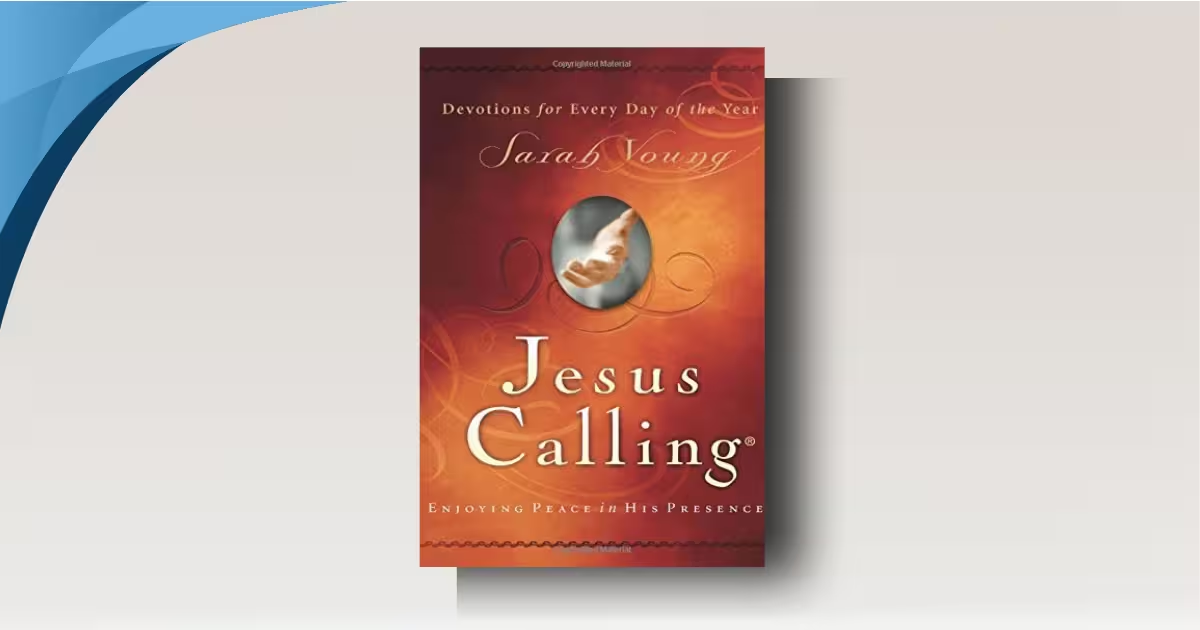
In a world where anxiety disorders affect over 40 million adults in the United States alone, and our screens constantly buzz with bad news, the quest for inner peace isn’t just a spiritual desire—it’s a psychological necessity. I picked up Sarah Young’s Jesus Calling: Enjoying Peace in His Presence during one of those overwhelming seasons, not as a theologian, but as a weary soul desperate for a moment of quiet.
What I found wasn’t just a book; it was a daily practice that reoriented my entire perspective. This review isn’t a scholarly theological treatise. It’s a personal, deep-dive exploration of why this devotional, with over 45 million copies sold worldwide and translated into 30+ languages, has resonated so profoundly with millions, and whether it might do the same for you.
Jesus Calling is best for Christians (particularly those in Protestant/Evangelical traditions) seeking an intimate, conversational devotional practice; individuals feeling spiritually dry or distant; anyone burdened by anxiety, fear, or life’s chaos who yearns for a structured way to “be still.”
But not for** readers uncomfortable with first-person divinity (God/Jesus speaking directly); those seeking deep academic Bible study or theological debate; individuals who prefer purely scripture-based devotionals without supplemental meditation.
Table of Contents
1. Introduction
Jesus Calling: Enjoying Peace in His Presence by Sarah Young (1946-2023). First published in 2004 by Thomas Nelson, it has since spawned an entire series, but this original volume remains the cornerstone.
Jesus Calling sits firmly in the Christian devotional genre, but with a distinct and controversial format: it is written as a collection of 365 daily messages from the perspective of Jesus Christ, speaking directly to the reader in the first person (“I,” “Me,” “Mine”).
Sarah Young held a master’s degree in biblical studies and counseling from Covenant Theological Seminary and was a missionary for many years. Her background is crucial—she wasn’t a novelist but a counselor and missionary who developed this practice out of a personal longing for a deeper sense of God’s presence.
Jesus Calling’s core argument is stated in Young’s introduction: a vibrant, peace-filled Christian life is found not merely in doctrinal belief or moral effort, but in the moment-by-moment, conscious awareness of God’s loving Presence.
The purpose is practical: to provide daily, digestible readings that help readers “shift their focus from their problems to His Presence”. The thesis is that peace (Shalom—wholeness, well-being) is a direct byproduct of this focused intimacy.
2. The Book’s Origin
Before diving into the content, understanding how this book came to be is essential to grasping its tone. In her lengthy introduction, Young shares her personal journey from intellectual faith (she studied philosophy at Wellesley) to a heartfelt encounter with God’s presence in the French Alps.
For years, despite an “exemplary Christian life” of seminary, missionary work, and counseling, she felt a vivid absence of that closeness.
The turning point came in the early 1990s. Inspired by the anonymous devotional God Calling (written by two “listeners” in the 1930s) and her own practice of journaling, she began a new discipline: “I decided to listen to God with pen in hand, writing down whatever I believed He was saying”.
She clarifies that these writings “are not inspired as Scripture is,” but were personal aids that helped her grow closer to God.
She eventually felt led to share them, resulting in Jesus Calling. This background frames the book not as a new revelation, but as a modeled practice of “listening prayer.”
3. Jesus Calling summary
The book’s structure is simple: a short devotional for every day of the year, each followed by 2-4 supporting scripture references. But within this simplicity lies a profound and repetitive deepening of core themes. Here’s a comprehensive breakdown of what the book consistently emphasizes, so you truly know what you’re engaging with.
A. The Central Command: “Be Still, and Know”
The single most frequent instruction woven throughout the year is the call to stillness, quietness, and receptivity. This isn’t passive laziness but active trust. Young’s “Jesus” repeatedly says:
- “Come to Me. Come to Me. Come to Me.” This invitation opens dozens of entries. It’s an antidote to striving. “Come to me, all you who are weary and burdened, and I will give you rest” (Matthew 11:28 is a foundational text, echoed in the July 10 entry: “Relax in My peaceful Presence.”).
- “Stop striving.” The January 3 entry reframes Psalm 46:10: “Alternate readings for ‘Be still’ are ‘Relax,’ ‘Let go,’ and ‘Cease striving'” (page 23). The message argues that our compulsive planning and worrying are forms of idolatry—attempts to control what is God’s domain.
- The Practice of Silence: Entries like March 31 advise: “Tune out other voices, so that you can hear Me more clearly. I designed you to dwell in Peace all day, every day” (page 118).
B. The Core Need: Trust Over Understanding
A second major theme is the primacy of trust (faith) over the need for control, clarity, or answers.
- Trust as a Habit: The January 5 entry introduces a practical tool: “Try saying, ‘I trust You, Jesus’ in response to whatever happens to you… Your continual assertion of trusting Me will strengthen our relationship” (page 29).
- Trust in the “Fog”: The book consistently validates the human experience of confusion. February 25 reads: “I will show you the next step forward, and the one after that, and the one after that. Relax and enjoy the journey in My Presence” (page 83). It champions dependence as a strength, not a weakness.
- Trust Amidst Trouble: Perhaps the most potent messages come when addressing pain. April 27 states: “I can weave miracles into the most mundane day if you keep your focus on Me” (page 42). The February 14 entry is blunt: “In this world you will have trouble. But take heart! I have overcome the world” (John 16:33, page 70). The point is never that trouble vanishes, but that our orientation within it changes.
C. The Path to Peace: Thankfulness and Perspective
The book posits that thankfulness is the “royal road” to God’s presence (January 8, page 32) and the surest guard against anxiety and negativity.
- Thankfulness as Warfare: June 22 delivers a powerful psychological and spiritual insight: “Thank Me for the very things that are troubling you… It is impossible to thank Me and curse Me at the same time” (page 204). This practice is presented as a conscious, disciplined choice that rewires the mind.
- Eternal Perspective: Repeatedly, readers are urged to lift their gaze from immediate, “light and momentary troubles” (2 Corinthians 4:17, cited on page 43) to an eternal perspective. March 9 encourages: “Live above your circumstances… View problems as opportunities to rely more fully on Me” (page 100). This isn’t about denial, but about context.
D. The Relational Goal: Intimate Friendship
The tone of the book is overwhelmingly gentle, tender, and personal. This is its most distinctive and comforting feature.
- “I am with you.” This phrase is the book’s heartbeat. The March 30 entry emphasizes: “These four words are like a safety net, protecting you from falling into despair… Remember that not only am I with you, I am holding you by your right hand” (page 75).
- Divine Affection: The language is intimate. February 13: “Peace be with you!… Wear My Peace with regal dignity. It will keep your heart and mind close to Mine” (page 70). June 14 describes God singing a love song over the reader (page 196).
- Addressing Weakness: There is no pretense of having it all together. April 9 states: “It is easy to touch up your outward appearance… But I see straight through you, into the depths of your being. There is no place for pretense in your relationship with Me” (page 39). This offers profound relief from performative spirituality.
E. Practical Disciplines Embedded in the Text
Beyond theology, the book is a manual of practice:
- Short Prayers: The February 22 entry recommends “simple, short prayers flowing out of the present moment. Use My Name liberally, to remind you of My Presence” (page 79).
- Thought Captivity: March 29 instructs: “Let the goal of this day be to bring every thought captive to Me… In My radiant Light, anxious thoughts shrink and shrivel away” (page 54). This aligns with Cognitive Behavioral Therapy principles from a spiritual foundation.
- Present-Moment Living: A constant refrain against worrying about the future or ruminating on the past. July 15 commands: “Do not worry about tomorrow!… My grace is sufficient for you, but its sufficiency is for only one day at a time” (page 228).
4. Jesus Calling analysis
As a reader, my experience was bifurcated: profound personal comfort alongside an awareness of significant criticism.
Evaluation of Content & Effectiveness:
Young effectively supports her central thesis—that peace comes from practiced awareness of God’s presence—through a relentless, poetic reinforcement of the themes above.
The evidence is experiential and scriptural. Each entry is tied to biblical verses, creating a feedback loop between the devotional thought and its scriptural anchor. The logic is pastoral and psychological: if God is loving, sovereign, and present, then orienting your mind toward that reality will produce peace.
It fulfills its purpose exceptionally well for its target audience: providing an accessible, daily tool for spiritual re-centering.
However, the “evidence” is not academic or argumentative; it’s assumptive of a certain Christian worldview. The book operates within the realm of faith; it doesn’t seek to build a case for it from the ground up.
The Elephant in the Room: First-Person Divinity
This is the most debated aspect. Writing as if Jesus is speaking is a bold literary device. Critics, including some theologians from Reformed and discernment ministries, have labeled it dangerous, potentially blurring the line between Scripture and personal impression. They argue it risks elevating personal revelation to the level of God’s Word.
From my reading, Young’s own introduction desperately tries to ward off this interpretation, clearly subordinating her writings to Scripture. The entries are heavily paraphrased scripture. Yet, the format undeniably creates an intimate, direct encounter that many find more impactful than third-person commentary.
The key question for the reader is: Can you treat this as a devotional aid—a thoughtful, scripture-saturated meditation—rather than a prophetic oracle? If so, it can be enriching. If the format inherently bothers you, it will be a constant barrier.
5. Strengths and Weaknesses
Strengths (The Pleasant Experience):
- Accessible Depth: It makes profound theological concepts (God’s immanence, grace, sovereignty) feel personal and applicable.
- Anxiety Relief: The repetitive focus on trust, presence, and releasing control had a tangible, calming effect on my mental state. It functions as daily cognitive restructuring.
- Gentle Tone: In a religious landscape often marked by guilt and demand, the consistently loving, inviting voice is a balm. The April 17 entry is typical: “I am infinitely tender with you. The weaker you are, the more gently I approach you” (page 33).
- Discipline Catalyst: It provides a fail-proof structure for a daily quiet time, which is the bedrock of any spiritual growth.
Weaknesses (The Unpleasant or Concerning):
- Sameness: The thematic repetition, while psychologically effective, can feel monotonous over a full year. The messages on trust in January are very similar to those in December.
- Lack of Context: The supporting scriptures are often fragments, pulled from across the Bible’s narrative and placed in a new, thematic context. This risks a “proof-texting” approach, divorcing verses from their original story and purpose.
- Theological Simplification: Complex issues of suffering, justice, and divine action are almost always funneled into the channels of “trust Me” and “see from an eternal perspective.” While not incorrect, it can feel inadequate in the face of profound tragedy.
- The Format Itself: As discussed, the first-person voice is a major stumbling block for many, and understandably so.
6. Comparison with Similar Works
- Jesus Calling Vs. God Calling: The direct inspiration. Jesus Calling is more polished, psychologically aware, and accessible to a modern audience. God Calling has a more archaic, mystic tone.
- Jesus Calling Vs. My Utmost for His Highest (Oswald Chambers): Both are giants in the devotional genre. Chambers is more theological, challenging, and exhortative. Young is more comforting, intimate, and focused on emotional peace. Chambers makes you think; Young makes you feel held.
- Jesus Calling Vs. The Book of Common Prayer: The BCP is liturgical, corporate, and scripture-saturated in a formal way. Jesus Calling is personal, conversational, and supplementary. They serve different, potentially complementary, functions.
7. Conclusion & Recommendation
Jesus Calling: Enjoying Peace in His Presence is a cultural and publishing phenomenon for a reason. It meets a deep, widespread hunger for a personal, tangible experience of God’s peace in an age of anxiety. It is less a book to be studied and more a tool to be used—a daily dose of spiritual realignment.
Who should read it? The Christian who feels stuck in their head, burdened by life’s chaos, or distant from God, and who is longing for a gentle, relational path back. The seeker who appreciates a contemplative, grace-oriented spirituality. It’s excellent for beginners establishing a devotional habit or for seasoned believers in a season of weariness.
Who should avoid it? Readers who need deep exegetical study, who are theologically sensitive to the first-person format, or who are facing crises where simple answers of “trust” feel insulting. It is not a substitute for Scripture, therapy, or Christian community.
Ultimately, I found its value not in its literary perfection or theological innovation, but in its functional utility.
For 365 days, it placed before me a choice: to focus on the whirlwind of my circumstances or to whisper, “I trust You,” and recalibrate toward a Presence promised to be my Peace. For that daily nudge, I am, as a reader, grateful.







