
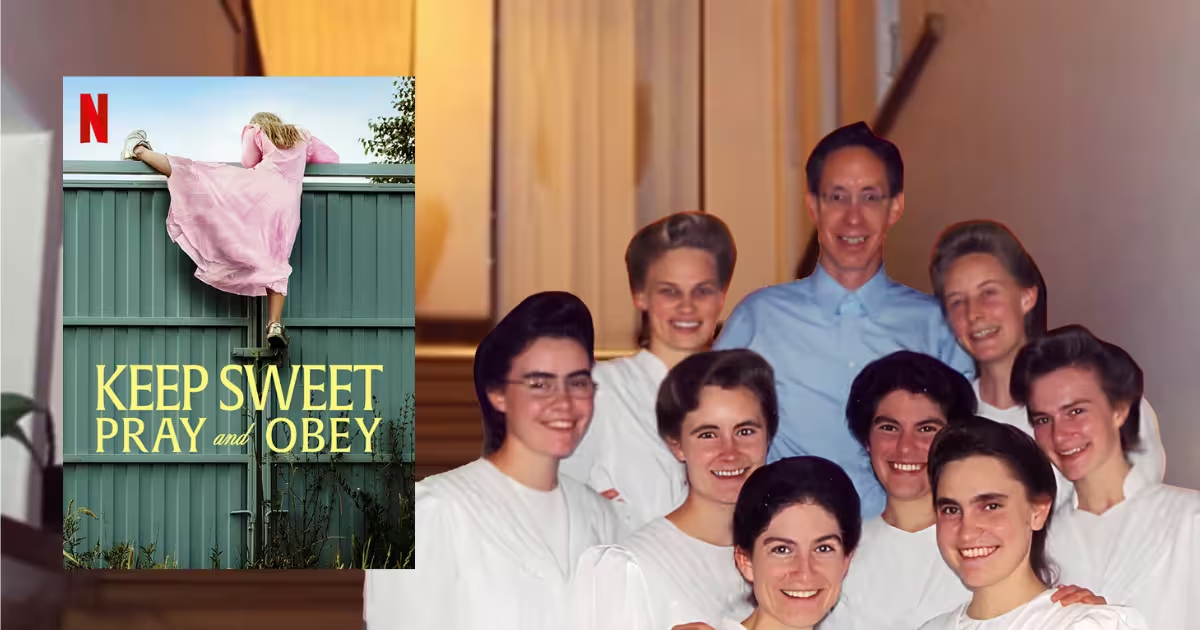

Can a religious leader’s absolute power turn an entire community into a prison where girls as young as 12 become brides and defiance means losing everything?
I remember the first time I pressed play on Keep Sweet: Pray and Obey. I thought I knew what I was getting into – another true crime documentary about a creepy cult leader. What I didn’t expect was to sit through four episodes feeling my stomach turn, my jaw drop, and my heart break for the women who survived one of the most disturbing religious institutions in modern American history.
This isn’t just another Netflix documentary. It’s a brutal, unflinching look at how faith can be weaponized, how absolute power corrupts absolutely, and how a handful of courageous women brought down a man who believed he was God on Earth.
Table of Contents
Overview
Keep Sweet: Pray and Obey is a four-part Netflix documentary series released on June 8, 2022, directed by Rachel Dretzin and Grace McNally. It chronicles the rise of Warren Jeffs within the Fundamentalist Church of Jesus Christ of Latter-Day Saints (FLDS), a polygamous offshoot of mainstream Mormonism.
Through survivor testimonies, the series exposes systematic sexual abuse, forced child marriages, social isolation, and the use of fear as a control mechanism.
Between June 5 and June 19, 2022, the series was watched for 58.78 million hours on Netflix globally. It holds a 91% critic rating on Rotten Tomatoes and a Metascore of 80.
Recommended audience: Anyone interested in true crime, religious extremism, cult psychology, women’s rights, or survivor stories. Due to graphic content involving child sexual abuse, it’s suitable for mature audiences only (TV-MA).
Background: The World of the FLDS
Before diving into the series itself, it’s important to understand what we’re dealing with. The Fundamentalist Church of Jesus Christ of Latter-Day Saints isn’t just some fringe group with quirky beliefs. This is a community that broke away from the mainstream Church of Jesus Christ of Latter-day Saints after the latter officially banned polygamy in 1890. The FLDS continued the practice, believing plural marriage was essential for achieving the highest level of salvation.
The community settled in the twin towns of Hildale, Utah, and Colorado City, Arizona – a remote area on the Utah-Arizona border that became the largest polygamous community in the United States. For decades, they lived in near-total isolation from the outside world, creating their own laws, their own education system (or lack thereof), and their own rigid social hierarchy.
At the top of that hierarchy sat the Prophet – a man believed to speak directly for God. Whatever the Prophet said, no matter how bizarre or cruel, was divine law. Disobedience wasn’t just a sin; it was a ticket to eternal damnation.
Rulon Jeffs held this position for years. He was an aging man with dozens of wives and hundreds of children. But when he suffered a stroke in the early 2000s, his son Warren saw his opportunity. And that’s where the nightmare truly began.
Keep Sweet: Pray and Obey Episode summary
Part One: The Foundation of Fear
The first episode establishes the world of the FLDS under Rulon Jeffs. We meet the survivors – women who escaped and are now willing to talk about what life was really like behind closed doors.
Rebecca Musser, a former wife of Rulon Jeffs, appears throughout all four episodes. She was just 19 when she was forced to marry the 85-year-old Prophet. She recalls lulling him to sleep on nights she had to spend with him so she didn’t have to have sex with him. Think about that for a moment – a teenager, married to a man old enough to be her great-grandfather, using sleep as her only defense against sexual assault.
Elissa Wall, Rebecca’s sister, shares her own harrowing story. She was forced to marry her cousin at 14 years old and was routinely raped. By the time she was 16, she had suffered two miscarriages.
The episode explains the FLDS doctrine and system of privilege and power. Social status was determined by the number of wives a man had. Women existed to serve their husbands and produce children. Their sole purpose was to “keep sweet, pray, and obey.” As Charlene, one of the women interviewed in the series, explains, the mantra “Keep Sweet” meant “to be in control of your emotions and you didn’t display things like anger or resentment or frustration”.
The phrase “Keep Sweet” was even affixed to Rulon Jeffs’ shoes. It meant absolute submissive obedience to your husband as a prerequisite to salvation.
Key Quote from the Episode: “We were well aware that plural marriage is illegal”. Yet Utah Attorney Roger Hoole explains in the documentary that polygamy itself wasn’t the target of law enforcement. As he puts it, “But polygamy is really not the problem anyway. It is the secondary crimes that occur in a closed religious society controlled by men” – sexual abuse, child marriage, neglect.
This distinction is crucial. The government wasn’t interested in breaking apart families for practicing a polygamous lifestyle. They were interested in the crimes that flourished in that closed environment.
The episode also gives background into Warren Jeffs’ personal life. He was born eight weeks premature and was considered to be of higher status because he overcame a near-death experience. When Rulon suffered a stroke, Warren assumed leadership, proclaiming himself the new Prophet. To establish more control, he moved the community from Salt Lake City to Short Creek, Utah.
Part Two: The Tightening of the Noose
The second episode begins immediately after Rulon Jeffs’ death and funeral. On the night of Rulon’s funeral, seven of his wives were married to Warren. This would eventually be the fate for all of Rulon’s wives. A woman named Alicia, who married Rulon when he was 86 and had over 20 wives, was among those reassigned.
This is when things start getting really dark. Individuals began questioning Warren’s actions as the new Prophet, but their concerns were ignored because Warren was believed to be God on Earth.
Fear becomes the dominant theme of this episode. As Erna Black states in her testimony: “I wasn’t scared of death, I was scared of disobeying the Prophet”. This is how cults work – they make the consequences of disobedience so terrifying that death seems preferable to defiance.
Wedding days were a time of terror for the women. The marriage process was shrouded in secrecy. Girls being married were often transported to Nevada without much – or any – notice. Warren would perform the marriages in motel rooms without legal documentation. In multiple instances, the girls were unable to say “I do” due to the distress they were in. Their mothers would have to encourage them.
One survivor describes the moment: “There came this point where I needed to say, ‘I do.’ And I was crying so hard and so distraught, I just could not formulate those words on my mouth”.
We also learn about Lloyd Wall, a convert to the FLDS who was formally educated and created a profitable business for the community. Because of his education and influence, Warren forced him out of the sect. His wives were then remarried to other men. This pattern repeats throughout the series – anyone with independent thought, anyone who might challenge Warren’s authority, was systematically eliminated.
The episode ends with a turning point: a police officer who was also an FLDS member gets charged for his unlawful marriage to an underage bride. Warren, concerned about being criminally charged, begins buying more land.
Key figures introduced in this episode:
- Sam Brower, a private investigator who had investigated the church for several years
- Mike Watkiss, a TV journalist who had done several reports on the church
These outsiders provide crucial external perspectives on what was happening inside the closed community.
Part Three: The Building of Zion
Episode three opens with a pilot flying over a plot of land Warren had purchased in Texas. He had told the community they would be building a hunting lodge. But the pilot became suspicious when he saw the foundation being laid: “As I kept flying, I saw that they were pouring concrete for a foundation, and it is like, ‘This is a big building.’ I mean, a hell of a big building for a hunting lodge. I didn’t know what the hell it was”.
This was the beginning of the Yearning for Zion Ranch, a massive compound in Texas where Warren planned to create his own version of Heaven on Earth.
As pressure from law enforcement increased, Warren disappeared from society. He would make appearances to perform weddings but would then vanish again to hide from authorities.
To consolidate power, “defiant” men and young boys were kicked out of the sect. Their wives were remarried to other men. Isaac, a former member, explains: “People with any influence in town, he’s gotta get rid of them in order to do what he’s trying to do. Because Warren was taking out everybody you know, that had any brains at all”.
The foundation the pilot saw was completed and became known as Zion, Heaven on Earth. But only those considered “righteous enough” were allowed to move there. Everyone else was left behind.
Meanwhile, Elissa Wall began collaborating with authorities to help build a case against Warren for polygamy and child sexual abuse.
Part Four: Justice and Its Limits
The final episode begins with the trial against Warren Jeffs. Elissa is brought in as the key witness and is brutally questioned by the defense: “You described that you had to ‘sugar up’ the situation in order to get things that you wanted from Allen. Based upon your actions, Allen would have thought you were just fine with sexual relations”.
This is classic victim-blaming – the defense trying to shift responsibility from the perpetrator to the victim. But it didn’t work.
Warren was found guilty of two counts of felony child sexual assault and sentenced to life in prison.
But here’s the chilling part: even from prison, Warren maintained control over the church. When women would visit him, they brought notebooks and recorded everything he said. He was still receiving and giving information from inside his cell. He was still running the church from prison.
Police raided the Yearning for Zion Ranch and removed all the children. A massive custody battle began. Then police received information that somewhere in the compound there would be private records documenting the actions of the FLDS. They entered the temple and found the vault.
This was enough evidence to put Warren in prison for even longer. As one official states: “At the punishment phase of the trial, we were able to put in other evidence, and some of the evidence that was put in at that point was that Warren was involved in conducting the marriages of 67 underage girls to FLDS men”.
67 underage girls. That number is staggering. And that’s just what they could prove.
The episode ends on a sobering note. Despite everything, some people still follow Warren Jeffs. He continues to dictate much of what happens in the FLDS from prison. The documentary remarks how Jeffs continues to dictate much of what happens in the FLDS from prison.
Keep Sweet: Pray and Obey Analysis
Director Rachel Dretzin made a conscious choice with this series. She didn’t want to focus on Warren Jeffs’ crimes in a sensationalized way. As she told ReligionUnplugged.com: “I wanted the focus to be on the methodical way in which people were deprived of their autonomy and their freedom of thought”.
She said she did not want to concentrate on the sex itself but to contextualize it in the bigger picture. “This series focuses very consciously on the stories of women who managed not only to escape the FLDS but to stand up against Warren and his despotic rule,” Dretzin said. “That took an immense amount of strength and courage”.
The documentary approaches its talking heads with empathy. These aren’t just victims, they’re survivors who found the strength to fight back against an institution that had controlled every aspect of their lives.
According to Dretzin herself, the focus “[is] not only the experience of being in that cult”, but instead “It’s on the people, particularly the women who managed to defy it and escape it, which, if you know anything about the FLDS, is a pretty miraculous and incredible thing to do”.
However, the documentary isn’t without its critics. Some have pointed out that it presents only the perspectives of those who have left the FLDS, with no testimonies from current members. Because current FLDS members are forbidden to talk to outsiders, this is understandable, but it does create a one-sided narrative.
Roger Ebert’s review notes: “There’s a noble effort here in collecting their stories. But because it traffics so heavily in trauma from start to finish, often involving child sexual abuse, treating this saga mostly as a shocking play-by-play with a5555 reptilian boogeyman at the center feels a little cheap. Something about ‘Keep Sweet: Pray and Obey’ just doesn’t sit quite right”.
The review also points out that “the documentary wields one of its most disturbing audio pieces, involving the abuse of a child, for the end, pushing the production closer to feeling simply shocking. If it were not included, the doc would not have suffered from it”.
CNN’s review notes that the series is “occasionally guilty of veering too far into the weeds of individual stories and engages in some sleazy flourishes – like adding graphics to make Jeffs’ eyes appear snake-like when someone refers to them as such – that don’t belong in a serious documentary”.
Despite these criticisms, the documentary succeeds in its primary goal: giving voice to survivors and exposing the systematic abuse that occurred under Warren Jeffs’ leadership.
Keep Sweet: Pray and Obey Themes and Messages
The Weaponization of Faith
The most disturbing aspect of Keep Sweet: Pray and Obey is how faith, something that should bring comfort and meaning, was weaponized to control and abuse. Warren Jeffs didn’t just claim to be a religious leader; he claimed to be God on Earth. Disobeying him wasn’t just breaking a rule; it was defying God Himself.
This is the ultimate control mechanism. When you believe your leader speaks directly for the divine, you don’t question his commands. You don’t question anything. You obey without thinking.
The Systematic Erosion of Autonomy
Director Rachel Dretzin describes what happened as “the tightening of the noose”. The documentary shows how Warren Jeffs methodically stripped away every bit of autonomy his followers had – restricting education, banning outside communication, controlling marriages, and eliminating anyone with independent thought.
As Dretzin put it: “During that period, what he managed to do in such a methodical way is pretty stunning. I call it the tightening of the noose. It’s quite ingenious, and it was unbelievably effective at robbing people of the little bit of free will that they had left. And it allowed these terrible things to happen”.
The Power of Survivor Testimony
Despite the darkness, the documentary offers a message of hope. The women who spoke out – Rebecca Musser, Elissa Wall, and others – showed incredible courage. They risked everything to tell their stories.
Rebecca Musser walked into the courtroom wearing a bright red dress – the color of defiance. Elissa Wall sat in that same courtroom, reliving the trauma of being forced into marriage as a child. Their testimony helped put Warren Jeffs behind bars for life.
The Limitations of Justice
The documentary also shows that justice has its limits. Warren Jeffs is in prison, but he still runs the church from his cell. The children removed from the Yearning for Zion Ranch faced a difficult custody battle. And the underlying issues – religious extremism, the subjugation of women, the isolation of communities, haven’t disappeared.
Comparison: Two Documentaries, One Subject
It’s worth noting that there’s another documentary with a similar title – Keep Sweet, directed by Don Argott and released on Discovery+ in 2021. That film focuses on the conflicts in Hildale, Utah, and Colorado City, Arizona, following the rift within the FLDS after Warren Jeffs’ imprisonment.
The Don Argott documentary, as described by The New York Times, “charts a rift within the breakaway group”. We hear from former members who say they were disturbed by the way Jeffs controlled and isolated the sect, forbidding books and public education for the children. On the other side are those who have stood by Jeffs even after he was convicted and who refuse to believe the charges against him.
However, the Argott film has been criticized for being “surprisingly vague on which of his dictates the group has retained”. In its second half, the movie tries to show some sympathy for Jeffs’ adherents by turning to a knotty dispute over land ownership. As The New York Times notes, “While the ethical issues of the property situation add complexity, the film’s efforts to balance the arguments on both sides aren’t convincing”.
The Netflix series, by contrast, is more focused on the survivor stories and the systematic abuse that occurred. It’s less concerned with presenting a balanced view of the FLDS and more concerned with exposing the truth of what happened to the women and children trapped inside.
Audience Appeal and Reception
Critical Reception
The series has been well-received by critics. On Rotten Tomatoes, 91% of 11 critics’ reviews are positive. On Metacritic, it holds a score of 80 out of 100, with 86% positive reviews.
Entertainment Weekly gave it a 91, calling it “extremely hard to watch at times” but noting that “the first-hand accounts from survivors are nothing short of awe-inspiring”.
The Chicago Sun-Times gave it an 88, describing it as “a masterful, engrossing and at times chilling series that plays out like a real-life horror movie”.
Decider gave it an 80, saying: “Drestzin has done her job. … If you want insight into a closed society that is only known via blaring headlines, then watch Keep Sweet: Pray And Obey. Just be ready for a narrative that will make you uncomfortable and angry at the same time”.
Viewer Response
Viewers have described the series as “gut-wrenching,” “horrifying,” and “hard to watch”. Some have compared it to a horror movie. One viewer recommended it in a Reddit discussion about “the most horrifying crime documentary ever watched”.
The series was watched for 58.78 million hours globally between June 5 and June 19, 2022. That’s a staggering figure that shows just how deeply it struck a nerve with viewers.
Who Should Watch This?
Keep Sweet: Pray and Obey is suitable for:
- True crime enthusiasts who want to understand one of the most disturbing cults in American history
- Students of sociology, psychology, or religious studies – the series covers a multitude of topics including cults, family dynamics, gender, religion, and the status of women and children
- Anyone interested in survivor stories and the process of breaking free from controlling environments
- Women’s rights advocates – the series offers a stark reminder of what happens when women are stripped of their autonomy
However, due to graphic content involving child sexual abuse, it’s not suitable for sensitive viewers. The series is rated TV-MA for a reason.
Personal Insight: What This Documentary Taught Me About Power and Compliance
Watching Keep Sweet: Pray and Obey forced me to confront some uncomfortable questions. How does an entire community – hundreds of people – allow such systematic abuse to happen? How do parents hand over their daughters to be married to much older men? How do people watch children being sexually abused and do nothing?
The answer, as the documentary shows, is fear. Fear of the Prophet. Fear of damnation. Fear of losing everything – your family, your home, your community. When you’ve been isolated from the outside world your entire life, the threat of exile is terrifying. As Erna Black said: “I wasn’t scared of death, I was scared of disobeying the Prophet”.
But there’s another factor at play: the gradual erosion of autonomy. The documentary shows how Warren Jeffs didn’t take away all freedom at once. He tightened the noose slowly, methodically. One restriction at a time. One rule at a time. By the time people realized what was happening, it was too late.
This is how control works in any abusive system – whether it’s a cult, a relationship, or a workplace. The abuse doesn’t start with the worst thing. It starts small. It builds gradually. And by the time you recognize what’s happening, you’re trapped.
What struck me most, though, was the courage of the survivors. Rebecca Musser, Elissa Wall, and the other women who spoke out didn’t just escape, they fought back. They testified. They helped put Warren Jeffs in prison. They risked everything to tell their stories.
Rebecca Musser’s decision to wear a bright red dress to court, the color of defiance, is a powerful symbol. It says: “I am no longer afraid. I am no longer silent. I am no longer controlled.”
That’s the message I take away from this documentary. No matter how powerful the system, no matter how complete the control, there is always the possibility of resistance. There is always the possibility of freedom.
Key Quotations from the Documentary
- On the “Keep Sweet” mantra:
“To be in control of your emotions and you didn’t display things like anger or resentment or frustration.” – Charlene - On the nature of the problem:
“But polygamy is really not the problem anyway. It’s the secondary crimes that occur in a closed religious society controlled by men.” – Utah Attorney Roger Hoole - On fear and obedience:
“I wasn’t scared of death, I was scared of disobeying the Prophet.” – Erna Black - On the trauma of forced marriage:
“There came this point where I needed to say, ‘I do.’ And I was crying so hard and so distraught, I just could not formulate those words on my mouth.” – Survivor - On Warren’s systematic elimination of independent thought:
“People with any influence in town, he’s gotta get rid of them in order to do what he’s trying to do. Because Warren was taking out everybody you know, that had any brains at all.” – Isaac - On the scope of Warren’s crimes:
“Warren was involved in conducting the marriages of 67 underage girls to FLDS men.” – Prosecution testimony - On the director’s intention:
“I wanted the focus to be on the methodical way in which people were deprived of their autonomy and their freedom of thought.” – Rachel Dretzin
Pros and Cons
Pros
- Powerful survivor testimonies – The women who speak out are incredibly brave and their stories are compelling
- Comprehensive coverage – The series covers the entire history of the FLDS, from Rulon Jeffs to the aftermath of Warren’s imprisonment
- Focus on systemic issues – Rather than just sensationalizing the crimes, the documentary shows how the system enabled them
- High production values – The cinematography, score, and editing are top-notch
- Educational value – The series is useful for courses on sociology, psychology, religious studies, and gender studies
- 91% on Rotten Tomatoes – Critically well-received
Cons
- One-sided perspective – The series presents only the views of those who left the FLDS, with no testimony from current members
- Trauma dumping – Some critics feel the series simply dumps trauma on viewers without providing enough illumination
- Occasional sensationalism – Some flourishes, like making Jeffs’ eyes appear snake-like, feel cheap and unnecessary
- Limited analysis – The series doesn’t always connect the dots or provide deeper analysis of what it all means
- Ending feels abrupt – The final episode packs a lot in and ends suddenly
- Hard to watch – The content is disturbing and may be too much for some viewers
Conclusion
Keep Sweet: Pray and Obey is not an easy watch. It will make you angry. It will make you sad. It will make you question how such things can happen in modern America.
But it’s also an important documentary. It gives voice to survivors who have been silenced for too long. It exposes the systematic abuse that occurred under Warren Jeffs’ leadership. And it shows that even in the darkest circumstances, there is hope – people can break free, they can fight back, and they can win.
The series does have its flaws. It’s one-sided. It occasionally veers into sensationalism. It doesn’t always provide the analysis that the subject matter deserves. But these flaws don’t diminish the power of the survivor testimonies or the importance of the story being told.
Should you watch it? If you’re interested in true crime, cult psychology, or survivor stories, yes, absolutely. But brace yourself. This isn’t entertainment. It’s an education. It’s a reminder of what happens when absolute power meets absolute belief. It’s a testament to the courage of women who refused to keep sweet, who refused to pray and obey, and who fought back against a system designed to break them.
As one critic put it: “Keep Sweet: Pray and Obey ultimately owes its strength to those who didn’t obey and possessed the courage to break free”. That’s the heart of this documentary – not the monster, but the people who defeated him.
Rating: 4/5 stars