
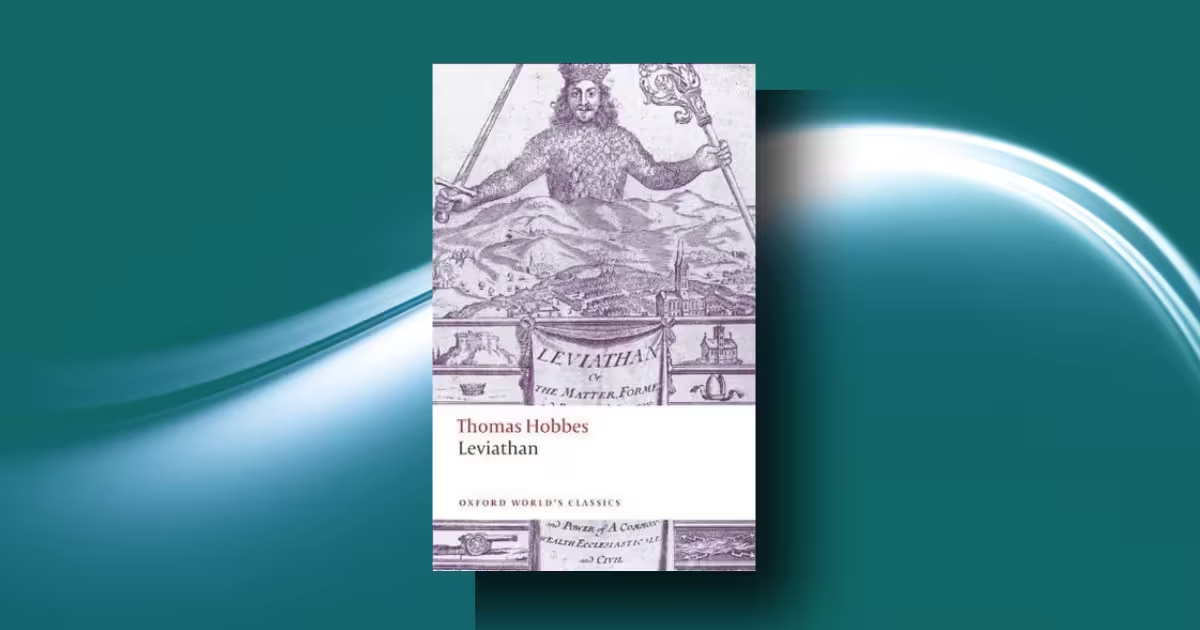
Why do human beings build governments, surrender freedoms, obey laws, and still fear one another? Reading Leviathan by Thomas Hobbes made me feel that this 1651 book is not simply old political philosophy—it is a frighteningly clear mirror of human insecurity, social conflict, and the price we pay for peace.
That question rattled around in my head for weeks after I finished Leviathan. And honestly, it still does. Most of us go through life assuming the political order we inhabit is more or less legitimate — we pay taxes, follow laws, vote occasionally, and call it citizenship.
But Thomas Hobbes, writing in 1651 from the rubble of one of England’s most catastrophic civil wars, tears that comfortable assumption apart. He doesn’t ask whether your government is good.
He asks something far more unsettling: would you rather have any government — no matter how authoritarian — than none at all? And then he argues, with unsettling precision, that the answer is yes. Always yes. Because the alternative is unthinkable.
Leviathan is best for philosophy students, political science readers, history enthusiasts, anyone interested in the origins of modern democracy and the state, readers of Machiavelli or Rousseau, policy scholars, and intellectually curious general readers who want to understand why governments exist at all.
Not for readers looking for a fast, breezy read. Leviathan is dense, long (over 600 pages in its complete form), and written in 17th-century English prose. It is also not for those seeking moral comfort — Hobbes will challenge nearly every optimistic assumption you hold about human nature.
Table of Contents
1. Introduction
Leviathan; or, The Matter, Forme, and Power of a Commonwealth Ecclesiasticall and Civill — that is the full and magnificent title — was written by Thomas Hobbes of Malmesbury (born April 5, 1588; died December 4, 1679) and first published in London in April 1651, printed for Andrew Crooke at the Green Dragon in St. Paul’s Churchyard.
A revised Latin edition followed in 1668. The book you are most likely reading today is based on that first 1651 edition is drawn from the Pelican Classics text, which is itself prepared from the original first edition.
Hobbes was no armchair philosopher. He was a polymath who contributed to history, jurisprudence, geometry, optics, theology, and classical translations.
He spent nearly his entire adult life in service to the aristocratic Cavendish family as tutor, political adviser, and scientific collaborator, which gave him unparalleled access to the most powerful minds and political events of his era.
When the English Civil War broke out in 1642, Hobbes was already in Paris, having fled England, and it was there — in political exile — that he wrote Leviathan, reportedly tutoring the future King Charles II during the same period.
Context
Leviathan belongs to the genre of political philosophy and social theory, but it is far more than a dry academic treatise. It is simultaneously a work of metaphysics, ethics, theology, and constitutional theory.
At its core, it is a systematic attempt to answer one question: what justifies political authority? Hobbes approaches this question not from theology or tradition, but from what he considered a scientific and mathematical study of human nature — an approach that was entirely radical for its time.
As EBSCO Research notes, the book “incorporated a rational, systematic study and justification of natural rights, sovereignty, and state absolutism, and logically deduced an ethical political theory from a scientific and mathematical investigation of human nature.”
The historical context is crucial. Leviathan was written during and immediately after the English Civil War (1642–1651), a brutal conflict between Royalists and Parliamentarians that culminated in the execution of King Charles I on January 30, 1649.
Hobbes had witnessed, from across the Channel, how quickly a functioning society could collapse into violence, betrayal, and mutual destruction. That raw, lived terror saturates every page of Leviathan, and it is what gives the book its urgency even 374 years later.
Purpose
The central thesis of Leviathan is bold and uncomfortable: human beings, in their natural condition, are enemies to one another, driven by competition, fear, and the desire for glory.
Left without a governing authority, they descend into a condition of perpetual war. The only rational escape from this nightmare is the social contract — a mutual agreement by which individuals surrender their natural freedoms to a sovereign power (a person or assembly) in exchange for security and peace.
That sovereign, whom Hobbes calls the Leviathan or the “Mortall God,” must hold absolute, undivided power.
Any limitation of sovereign authority risks sliding back toward civil war, which Hobbes regards as the worst possible human condition. The book’s entire argument flows from this single, terrifying premise.
2. Background: A World on Fire
To understand Leviathan, you must first understand what Thomas Hobbes saw with his own eyes.
By the time the book was published, England had endured nearly a decade of civil war. Cities were besieged. Churches were burned.
The king had been beheaded in public. Religious sects multiplied and fought one another with theological fury. Parliament and Crown clashed over the most fundamental questions about who had the right to rule.
Hobbes had been educated at Magdalen Hall, Oxford, where he developed a deep contempt for scholastic philosophy and Aristotelian tradition. He later traveled Europe as a tutor, meeting leading thinkers including Galileo Galilei and René Descartes.
These encounters shaped his conviction that the world — including human society — could be understood through mechanical, materialist principles.
Matter in motion, he came to believe, explained everything from the movement of planets to the passions of the human heart.
When the political situation in England deteriorated beyond recovery, as EBSCO Research records, “Hobbes abandoned his scientific studies and wrote his most important work on political philosophy.”
He dedicated Leviathan to his friend Francis Godolphin, writing in the dedication that “in a way beset with those that contend on one side for too great Liberty, and on the other side for too much Authority, ’tis hard to passe between the points of both unwounded.”
That single sentence captures the impossible needle Hobbes was trying to thread — and he threaded it, controversially, by coming down hard on the side of authority.
3. Leviathan Content Summary
Leviathan is divided into four major parts: “Of Man,” “Of Common-wealth,” “Of a Christian Common-wealth,” and “Of the Kingdome of Darknesse.”
As SparkNotes accurately observes, “Book I contains the philosophical framework for the entire text, while the remaining books simply extend and elaborate the arguments presented in the initial chapters.”
Let me take you through each part carefully, because this is where the genius — and the scandal — of Hobbes lies.
Part I: Of Man — What Are We, Really?
Hobbes begins not with God, kings, or constitutions — but with sense perception. He is a thoroughgoing materialist. Everything that exists is matter in motion. Human thought, desire, fear — all of it is the product of physical processes. This was shocking in 1651, and it set the philosophical tone for everything that followed.
The Introduction opens with one of the most arresting passages in the entire history of political thought. Hobbes asks us to imagine the Commonwealth as an artificial man, a giant mechanical creature modelled on the human body:
“By Art is created that great LEVIATHAN called a COMMONWEALTH, or STATE, (in latine CIVITAS) which is but an Artificiall Man; though of greater stature and strength than the Naturall, for whose protection and defence it was intended; and in which, the Soveraignty is an Artificiall Soul, as giving life and motion to the whole body.”
This image — the state as a vast artificial organism, sovereign power as its soul, laws as its nerves, wealth as its strength, civil war as its death — is not mere rhetoric. It is Hobbes’s entire theory compressed into a metaphor.
He then asks us to know ourselves. Citing the ancient injunction Nosce Teipsum (“Read Thy Self”), he argues that by examining our own thoughts, passions, and fears, we can understand the inner life of all human beings. Desire, fear, hope — these are the same in everyone, even if their objects differ.
Chapter VI introduces the theory of human passions. All voluntary motion begins with “endeavour” — either appetite (desire, attraction toward something) or aversion (repulsion). What we call “good” is simply whatever we desire; “evil” is whatever we are averse to.
There is no objective moral standard built into the universe. This moral relativism is one of the most radical claims in Leviathan and remains controversial to this day.
Chapter XI delivers one of the book’s most quoted diagnoses of human nature:
“So that in the first place, I put for a generall inclination of all mankind, a perpetuall and restlesse desire of Power after power, that ceaseth onely in Death.”
Read that again. Not some people. Not kings or tyrants. All mankind. Hobbes argues that humans are never satisfied with the power they have, not because they are inherently wicked, but because they cannot feel secure in their present condition without acquiring more.
This is a deeply psychologically honest observation. We do not hoard power out of greed alone — we do it out of fear.
Chapter XIII — “Of the Naturall Condition of Mankind” — is the philosophical heart of the entire book, and perhaps the most famous chapter in all of political philosophy.
Here Hobbes describes the state of nature: the condition of humanity before, or outside of, political society.
In nature, Hobbes argues, all men are approximately equal in body and mind. Even the weakest can kill the strongest, given enough cunning or confederates. From this rough equality comes diffidence (mutual distrust), because if anyone can kill anyone, everyone has reason to fear everyone else. From diffidence comes war. And this war is not merely occasional combat — it is a permanent condition of mutual hostility:
“Whatsoever therefore is consequent to a time of Warre, where every man is Enemy to every man; the same is consequent to the time, wherein men live without other security, than what their own strength, and their own invention shall furnish them withall.
In such condition, there is no place for Industry; because the fruit thereof is uncertain; and consequently no Culture of the Earth; no Navigation, nor use of the commodities that may be imported by Sea; no commodious Building; no Instruments of moving, and removing such things as require much force; no Knowledge of the face of the Earth; no account of Time; no Arts; no Letters; no Society; and which is worst of all, continuall feare, and danger of violent death; And the life of man, solitary, poore, nasty, brutish, and short.”
“Solitary, poore, nasty, brutish, and short.” Those six words have echoed through the centuries. They are among the most cited — and most misunderstood — in the English language.
Hobbes is not saying that humans are evil by nature. He is saying that without political order, the rational pursuit of self-preservation leads inevitably to mutual destruction. The problem is structural, not moral.
He then identifies the three causes of conflict in human nature: competition (for gain), diffidence (for safety), and glory (for reputation). The third is particularly revealing — people will go to war over “a word, a smile, a different opinion, and any other signe of undervalue.” Sound familiar? It should.
Importantly, Hobbes insists that in this state of war, “nothing can be Unjust. The notions of Right and Wrong, Justice and Injustice have there no place. Where there is no common Power, there is no Law: where no Law, no Injustice.”
Justice, in other words, is not a natural fact — it is a political creation. There is no justice without a state to enforce it.
What rescues humanity from this nightmare? Reason and passion working together. The fear of death and the desire for comfortable living incline people toward peace. Reason then supplies the principles — the Laws of Nature — by which that peace can be achieved.
Chapters XIV and XV lay out the natural laws. The First Law of Nature is that every man ought to seek peace as far as he can, and when peace is not obtainable, to seek the advantages of war.
The Second Law follows: that a man should be willing, when others are also willing, to lay down his natural right to all things, and be contented with as much liberty against other men as he would allow them against himself. The Third Law of Nature is justice: that men perform their covenants.
The Right of Nature (Jus Naturale) is defined as “the Liberty each man hath, to use his own power, as he will himselfe, for the preservation of his own Nature; that is to say, of his own Life.” Liberty, meanwhile, is “the absence of externall Impediments.”
These definitions matter enormously — Hobbes is building the philosophical architecture for the social contract from the ground up.
Part II: Of Common-wealth — The Birth of Leviathan
Having established what humans are and what the natural condition looks like, Hobbes turns to the central question: how does a legitimate political order arise? The answer is the social contract.
Chapter XVII is the fulcrum of the entire book. Hobbes argues that small families and informal agreements cannot provide sufficient security — only a sovereign with overwhelming power can. The generation of the Commonwealth happens when individuals covenant with one another, surrendering their natural rights to a central authority:
“I Authorise and give up my Right of Governing my selfe, to this Man, or to this Assembly of men, on this condition, that thou give up thy Right to him, and Authorise all his Actions in like manner.”
This act of collective authorisation creates what Hobbes calls “that great LEVIATHAN, or rather (to speake more reverently) of that Mortall God, to which wee owe under the Immortall God, our peace and defence.”
The sovereign — whether a monarch, an aristocratic council, or a democratic assembly — now speaks with the voice of all, and “by terror thereof, he is inabled to forme the wills of them all, to Peace at home, and mutuall ayd against their enemies abroad.”
Note that word: terror. Hobbes is not squeamish about it. The sovereign rules through the credible threat of overwhelming force. The historian Hugh Trevor-Roper famously summarised Leviathan as: “The axiom, fear; the method, logic; the conclusion, despotism.”
It is a brutal précis, but not an inaccurate one.
The Commonwealth is defined as “One Person, of whose Acts a great Multitude, by mutuall Covenants one with another, have made themselves every one the Author, to the end he may use the strength and means of them all, as he shall think expedient, for their Peace and Common Defence.”
Chapter XVIII lists the twelve rights of the sovereign, including the right to judge what doctrines are fit to be taught, the right of judicature, the right of making war and peace, and the right to reward and punish.
These rights are indivisible — you cannot split sovereignty without destroying it. A divided government, for Hobbes, is a government already at war with itself.
Chapter XIX discusses the three forms of Commonwealth — monarchy, aristocracy, and democracy — but Hobbes makes clear his preference for monarchy: it is more coherent, less prone to faction, and the monarch’s personal interest aligns more naturally with the public good.
What others call tyranny and oligarchy, Hobbes dismisses as mere “different names” for monarchy and aristocracy assigned by those who dislike those governments.
Chapter XXI, “Of the Liberty of Subjects,” is where Hobbes’s political realism becomes most crystalline. He insists that “Fear and Liberty [are] Consistent” — you can be both free and afraid.
Liberty, remember, is the absence of external impediments, not the absence of fear. The subjects retain certain liberties that even the sovereign cannot override: the right to defend one’s own body, the right not to bear false witness against oneself, and the right not to kill oneself on the sovereign’s command.
Beyond these narrow exceptions, obedience is owed absolutely.
Chapters on civil law (Chapter XXVI), crimes and punishments (Chapters XXVII–XXVIII), and the nature of sovereignty in practice round out Part II.
Hobbes’s treatment of law is remarkably modern: a law that has not been made known is no law at all, interpretation of the law belongs to the sovereign’s appointed judges, and no judge is bound indefinitely by his own previous decisions.
Part III: Of a Christian Common-wealth — Religion Under Control
This is the section most readers skip, and that is a mistake, because it was arguably the most explosive and consequential part of the book in 1651.
Hobbes’s core argument here is that the church has no authority independent of the civil sovereign. Religious controversy — specifically, the question of whether the Pope, Bishops, or Parliament had ultimate authority — had torn England apart. Hobbes’s answer is surgically simple: whoever holds civil power holds religious authority too.
Believers do not endanger their salvation by obeying a sovereign’s decrees, because outward obedience is all that is required; inward faith is between a person and God.
As Britannica explains, Hobbes “argues that believers do not endanger their prospects of salvation by obeying a sovereign’s decrees to the letter, and he maintains that churches do not have any authority that is not granted by the civil sovereign.”
This was not just politically controversial — it was branded as atheism by many contemporaries, even though Hobbes insisted he was not an atheist. The Internet Encyclopedia of Philosophy notes that “he was deadly serious in insisting that theological disputes should be kept out of politics.”
This section also contains Hobbes’s extended analysis of scripture, miracles, and prophecy — all filtered through his materialist, sceptical lens.
Miracles that cannot be verified by the sovereign’s authorised representatives are not to be believed. Prophets whose prophecies contradict the law are to be ignored.
Part IV: Of the Kingdome of Darknesse — Against Intellectual Tyranny
The final section of Leviathan is a sustained polemic against what Hobbes calls the “Kingdom of Darkness” — not hell in the theological sense, but the intellectual darkness perpetuated by the Roman Catholic Church, scholastic philosophers, and false prophets who use “insignificant speech” and superstition to maintain power over the minds of subjects.
Hobbes’s contempt for scholasticism is legendary.
As the Internet Encyclopedia of Philosophy records, “Leviathan and other works are littered with references to the ‘frequency of insignificant speech’ in the speculations of the scholastics.”
He attacks the Aristotelian concept of “substantial forms,” the doctrine of transubstantiation, and the political power of the papacy with equal ferocity. His target is any institution or ideology that claims authority over the sovereign — because divided authority, for Hobbes, is the highway to civil war.
4. Leviathan Analysis
Leviathan is, in my honest assessment, one of the most important and most troubling books ever written. Let me be direct about that. It is important because Hobbes saw, with forensic clarity, what happens when political order breaks down, and he constructed a rigorous philosophical response.
It is troubling because his solution — absolute sovereignty — has historically provided ammunition for authoritarians of every stripe.
What I find genuinely remarkable is the internal consistency of the argument. Starting from a set of materialist premises about human nature,
Hobbes builds an entire theory of politics, ethics, law, and religion without ever needing to appeal to God, divine right, or tradition.
The argument is entirely secular and rational — and this was 1651, when virtually all political philosophy was grounded in theology. That alone makes Leviathan a revolutionary document.
The diagnosis of the state of nature is, I believe, one of the most psychologically penetrating things ever written.
Hobbes’s insight that humans fight over “trifles, as a word, a smile, a different opinion” is not cynicism — it is careful observation. We do not need to look at 17th-century England to see it. Social media, geopolitical tensions, tribal politics — Hobbes’s three causes of conflict (competition, diffidence, and glory) map onto modern life with uncomfortable precision.
The British historian quoted by Britannica — “The axiom, fear; the method, logic; the conclusion, despotism” — is right, but it misses Hobbes’s underlying motivation.
He was not advocating despotism for its own sake. He was advocating it as the lesser evil.
What I find most moving, personally, is the passage where Hobbes challenges the reader who doubts the state of nature: “when taking a journey, he armes himselfe, and seeks to go well accompanied; when going to sleep, he locks his dores; when even in his house he locks his chests.”
Does he not, Hobbes asks, by these actions “accuse mankind” just as much as Hobbes does by his words? There is something deeply honest about that. We do not need to accept Hobbes’s politics to recognise the truth of his anthropology.
Does Hobbes make his case?
Largely, yes — within his own framework. The logical chain from materialism to human passions to the state of nature to the social contract to sovereign authority is watertight, if you accept the premises.
The weakest link is the first: the claim that in the state of nature, no justice exists. If justice is purely a creation of political authority, then no moral critique of the sovereign is ever possible, because the sovereign defines right and wrong.
This creates a dangerous circularity: the sovereign is just because the sovereign is sovereign.
As EBSCO Research notes, “Hobbes’s rejection of divine right and moral objectivism leads to a form of moral relativism, suggesting that individual values are shaped by personal experiences and desires.”
That moral relativism is philosophically audacious — but it creates a system with no internal mechanism of accountability.
Hobbes himself acknowledges that subjects retain the right to self-defence, but he never provides a satisfactory account of what happens when sovereigns systematically abuse their subjects.
5. Strengths and Weaknesses
Strengths
Radical Clarity. Leviathan does not hedge. Hobbes says exactly what he means and backs it up with argument.
In an era when political theory was often buried under layers of theological justification and classical allusion, this directness was both unusual and refreshing.
Secular Foundation. By grounding political authority in rational self-interest rather than divine right, Hobbes created the philosophical template for all subsequent social contract theory. John Locke, Jean-Jacques Rousseau, and Immanuel Kant all built on Hobbesian foundations, even when they sharply disagreed with him.
As Britannica observes, Hobbes’s Leviathan “influenced not only his famous successors who adopted the social-contract framework — including John Locke (1632–1704), Jean-Jacques Rousseau (1712–78), and Immanuel Kant (1724–1804).”
Psychological Depth. Hobbes’s account of human passions — desire, fear, glory, aversion — is one of the earliest serious attempts in Western philosophy to ground political theory in a realistic psychology. He is, in many ways, the first political realist.
Linguistic Precision. Hobbes was obsessed with definition. Before making any argument, he defines his terms with a rigour that was almost mathematical. “Liberty,” “law,” “right,” “covenant,” “person” — each receives a precise technical definition that prevents the kind of rhetorical vagueness that plagued his opponents.
Historical Relevance. Leviathan was written in response to a specific political crisis — and it reads that way, urgently and concretely. Unlike many philosophical classics that feel abstract, this book pulses with the lived experience of a man who watched a civilization tear itself apart.
Weaknesses and Criticisms
The Absolutism Problem. The most obvious and damaging weakness of Leviathan is its conclusion: that sovereign power must be absolute and undivided.
History has repeatedly demonstrated that absolute power corrupts absolutely. Hobbes provides almost no mechanism by which subjects can hold a tyrannical sovereign accountable short of outright rebellion — which he considers the greatest possible evil.
The very architecture that prevents civil war also prevents legitimate reform.
The Consent Problem. Hobbes insists that the social contract is based on consent — but his account of consent is strained.
In his theory of “Commonwealth by Acquisition,” those who are conquered and submit to a conqueror to save their lives are considered to have “consented.”
This is a very thin notion of voluntary agreement. John Locke would later argue, far more convincingly, that genuine consent requires the possibility of real alternatives.
The Moral Vacuum. By insisting that justice exists only within a political order, and that the sovereign defines right and wrong, Hobbes creates a philosophical system in which the Holocaust would be “just” if legislated by an absolute sovereign.
He obviously did not intend this, but the logic of his argument leads there. This is the most serious objection to his theory.
Bias Toward Monarchy. Hobbes’s preference for monarchy over democracy is never convincingly argued on purely logical grounds.
It feels like a conclusion he reached before he assembled his premises — partly, perhaps, because he was dependent on aristocratic patrons and had lived through a parliamentary rebellion.
Religious Controversy. As Britannica records, “Leviathan horrified most of his contemporaries; Hobbes was accused of atheism and of ‘maligning the Human Nature.'” While he was probably not an atheist, his materialist metaphysics made a traditional account of God’s existence very difficult to sustain.
6. What I Learned From Leviathan
Reading Leviathan changed the way I think about something as mundane as traffic lights. Every time I stop at a red light at 2 a.m. on an empty road, I am participating, however trivially, in the social contract Hobbes described.
I could run the light — nothing is stopping me.
I stop because I have agreed, implicitly, to defer to the rules that make coordinated social life possible.
Hobbes would say: you stop because somewhere in your psyche you know that the alternative to rule-following is a world in which no one stops at anything, and in that world, you die. Fear is, as Hugh Trevor-Roper said, the axiom.
More profoundly, Hobbes taught me to take seriously the costs of disorder rather than only the costs of authority.
Most political philosophy — and most political discourse — focuses on the dangers of too much government. Hobbes forces us to stare at the other danger: too little. Failed states. Civil wars. Gang-controlled neighbourhoods. Tribal militias. In each case, Hobbes’s diagnosis is recognisable: without a power to keep men in awe, there is a war of every man against every man.
He also changed my understanding of liberty.
We tend to think freedom means freedom from government. Hobbes thought that was naive. True freedom — the freedom to build, to trade, to plan for the future — requires the protection of a sovereign authority. You cannot be free in a burning city.
7. Comparison with Similar Works: Books Like Leviathan
Niccolò Machiavelli — The Prince (1532): Often grouped with Leviathan as a work of political realism, The Prince is darker but narrower.
Where Machiavelli advises rulers on how to hold power, Hobbes explains philosophically why power exists. Both are unsentimental about human nature, but Hobbes is the more rigorous systematiser.
John Locke — Two Treatises of Government (1689): The most direct philosophical response to Hobbes. Locke accepts the social contract framework but argues that sovereignty is conditional: governments that violate natural rights can be legitimately overthrown.
This is, in many ways, the philosophical foundation of liberal democracy, and it makes no sense without Hobbes as its foil.
Jean-Jacques Rousseau — The Social Contract (1762): Rousseau radically inverts Hobbes: the state of nature is peaceful and good, and it is civil society that corrupts. His notion of the “general will” is an attempt to build collective sovereignty without Hobbes’s authoritarianism.
John Rawls — A Theory of Justice (1971): The most important 20th-century contribution to social contract theory. Rawls reinvents the thought experiment of the “original position” to derive principles of justice — deeply Hobbesian in method, but dramatically different in conclusion.
Hannah Arendt — The Origins of Totalitarianism (1951): Where Hobbes warned against statelessness, Arendt analysed the catastrophic consequences of total state power. Reading both together reveals the full range of what political philosophy must confront.
8. Leviathan Quotes
1. The State of Nature and the Human Condition
“The life of man, solitary, poore, nasty, brutish, and short.”
(Chapter XIII · Of the Naturall Condition of Mankind)
This is the most iconic summation of Hobbes’s view of life without government. The full passage reads:
“In such condition, there is no place for Industry; because the fruit thereof is uncertain; and consequently no Culture of the Earth; no Navigation, nor use of the commodities that may be imported by Sea; no commodious Building; no Instruments of moving, and removing such things as require much force; no Knowledge of the face of the Earth; no account of Time; no Arts; no Letters; no Society; and which is worst of all, continuall feare, and danger of violent death; And the life of man, solitary, poore, nasty, brutish, and short.”
“The condition of Man … is a condition of Warre of every one against every one.”
“Hereby it is manifest, that during the time men live without a common Power to keep them all in awe, they are in that condition which is called Warre; and such a warre, as is of every man, against every man.”
To this he adds that in such a war, “nothing can be Unjust” and “Force, and Fraud, are in warre the two Cardinall vertues.”
“Nature hath made men so equall …” (Chapter XIII)
“Nature hath made men so equall, in the faculties of body, and mind; as that though there bee found one man sometimes manifestly stronger in body, or of quicker mind then another; yet when all is reckoned together, the difference between man, and man, is not so considerable, as that one man can thereupon claim to himselfe any benefit, to which another may not pretend, as well as he.”
2. The Social Contract and the Leviathan
The creation of the “Mortall God” (Chapter XVII · The Generation of a Common‑wealth)
“This done, the Multitude so united in one Person, is called a COMMON‑WEALTH, in latine CIVITAS. This is the Generation of that great LEVIATHAN, or rather (to speake more reverently) of that Mortall God, to which wee owe under the Immortall God, our peace and defence.”
The form of the covenant itself is expressed as:
“I Authorise and give up my Right of Governing my selfe, to this Man, or to this Assembly of men, on this condition, that thou give up thy Right to him, and Authorise all his Actions in like manner.”
“Covenants, without the Sword, are but Words.” (Chapter XVII)
“And Covenants, without the Sword, are but Words, and of no strength to secure a man at all.”
3. The Laws of Nature
The First and Fundamental Law of Nature (Chapter XIV)
“To seek Peace, and follow it.”
The Second Law of Nature (Chapter XIV)
“That a man be willing, when others are so too, as farre‑forth, as for Peace, and defence of himselfe he shall think it necessary, to lay down this right to all things; and be contented with so much liberty against other men, as he would allow other men against himselfe.”
And the Gospel summary:
“Whatsoever you require that others should do to you, that do ye to them.”
The Third Law of Nature – Justice (Chapter XV)
“That Men Performe Their Covenants Made.”
A simplified rule for all the Laws of Nature (Chapter XV)
“Do not that to another, which thou wouldest not have done to thy selfe.”
4. On Power, Liberty, and Religion
The restless desire for power (Chapter XI)
“I put for a generall inclination of all mankind, a perpetuall and restlesse desire of Power after power, that ceaseth onely in Death.”
The definition of Liberty (Chapter XXI)
“A FREE‑MAN, is he, that in those things, which by his strength and wit he is able to do, is not hindred to doe what he has a will to.”
Fear as the seed of religion (Chapter XII)
“This perpetuall feare, alwayes accompanying mankind in the ignorance of causes, as it were in the Dark, must needs have for object something. … And this Feare of things invisible, is the naturall Seed of that, which every one in himselfe calleth Religion.”
5. The Mechanical Conception of the Commonwealth
The Commonwealth as an artificial man (The Introduction)
“For by Art is created that great LEVIATHAN called a COMMONWEALTH, or STATE, (in latine CIVITAS) which is but an Artificiall Man; … in which, the Soveraignty is an Artificiall Soul, as giving life and motion to the whole body.”
9. Conclusion
Leviathan is not a book for everyone. It is long, demanding, and written in an archaic English prose that takes patience to absorb.
But if you are willing to do the work, it will repay you in ways that few books can match. It will force you to question every assumption you hold about why governments exist, what justifies their authority, and what you owe them in return.
If you are a student of political science or philosophy, Leviathan is simply non-negotiable.
You cannot understand Locke, Rousseau, Kant, Rawls, or virtually any subsequent Western political thinker without reading it. It is the founding document of secular political philosophy.
If you are a curious general reader who wants to understand why the modern state exists, why authority can feel both oppressive and indispensable, and why human beings have never found it easy to live together in peace, then Leviathan will give you more to think about than almost anything written in the past four centuries.
If you are someone who believes deeply in democracy, human rights, or liberal values, read it as a challenge, not a threat. The best way to defend freedom is to understand the strongest arguments against it.
What Hobbes understood, at the most fundamental level, is that political order is not natural. It is an achievement — fragile, costly, and entirely dependent on the willingness of human beings to subordinate their immediate desires to a common authority.
That insight is as relevant today as it was in April 1651, when a bookseller in St. Paul’s Churchyard placed a remarkable and dangerous book on sale for the first time.
Leviathan does not comfort. It does not flatter. It does not offer easy answers. But it asks the right questions — and in a world that never seems far from Hobbes’s state of nature, that may be the most valuable thing any book can do.
“The life of man, solitary, poore, nasty, brutish, and short.”
— Thomas Hobbes, Leviathan, 1651







