
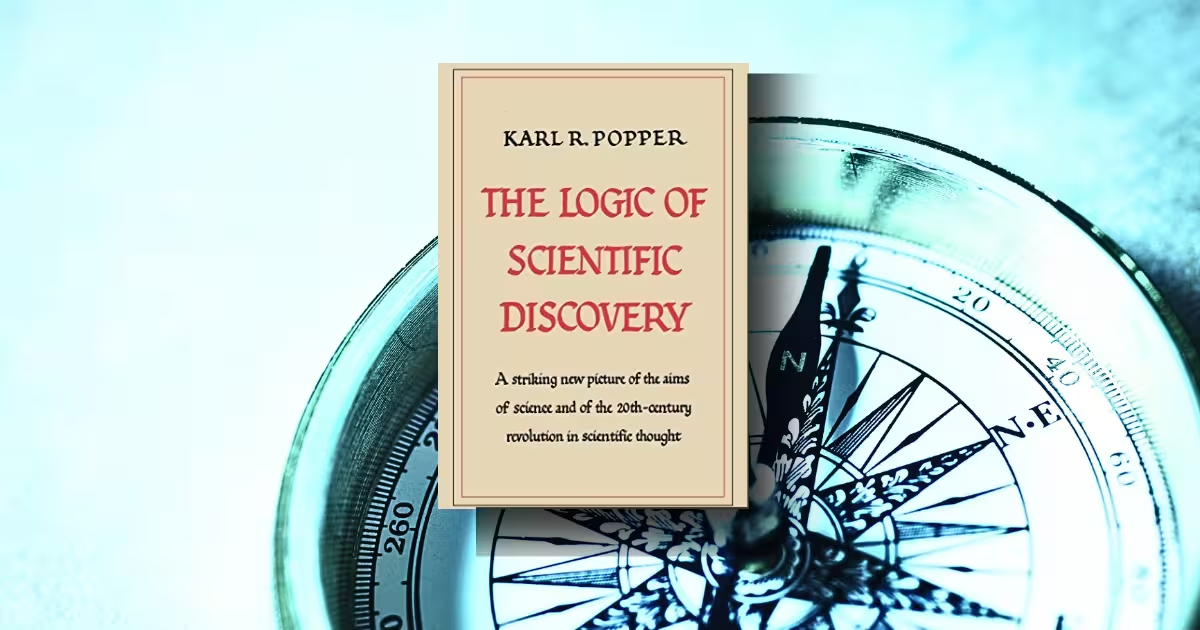
Karl Popper’s The Logic of Scientific Discovery does not simply argue that science should be falsifiable—it systematically dismantles the entire edifice of inductive reasoning and replaces it with a rigorous, deductive framework built on the principle that the true test of a scientific theory is not its ability to survive verification, but its courage to invite refutation.
The book, originally published in German in 1934 as Logik der Forschung and translated into English in 1959, argues that no number of positive experimental results can ever prove a scientific theory correct, but a single reproducible negative result can prove a theory wrong.
It is a work of breathtaking ambition and relentless logic, one that fundamentally changed how we think about knowledge, progress, and the very nature of scientific inquiry.
Reading suggestion
The Logic of Scientific Discovery is highly suggested for philosophy of science students, researchers across all scientific disciplines, critical thinkers who question authority, anyone who has ever wondered why some theories feel “scientific” and others don’t, and readers who appreciate arguments that challenge deeply held assumptions.
But not for casual readers seeking an easy introduction to philosophy, those who prefer narrative-driven non-fiction, readers with low tolerance for dense technical prose, or anyone expecting a practical “how-to” guide for doing science.
As one reviewer put it, “the book is a classic, but a very tough and dry read if you are not fully engaged and aware of fundamentals of logic. It could give you a headache”. Another reader honestly recommends “a strong summary or secondary source over reading this book in full”.
Table of Contents
Introduction
Title: The Logic of Scientific Discovery
Author: Karl R. Popper
Original German Publication: 1934 (Logik der Forschung)
First English Edition: 1959
Publisher: Routledge (current edition)
Pages: 513 (2002 Routledge edition)
Karl Popper was not merely a philosopher—he was a revolutionary. Born in Vienna in 1902, he witnessed the collapse of empires, the rise of totalitarianism, and the breathtaking progress of Einstein’s physics. It was Einstein, in fact, who planted the seed for Popper’s magnum opus. Popper attended Einstein’s lectures and was astounded by the riskiness of Einstein’s work: this great scientist opened himself up to failure, to being wrong in his experimentation.
In contrast, Popper saw the psychoanalysts of his own field—Freud, Adler, and others—whose theories seemed capable of explaining everything and therefore nothing. Data could be manipulated and interpreted to always verify psychological hypotheses.
This comparison between Einstein’s courageous vulnerability and psychoanalysis’s defensive invulnerability led Popper to write a philosophical work that would fundamentally alter the course of 20th-century thought.
Described by the philosopher A.J. Ayer as a work of “great originality and power,” this book revolutionized contemporary thinking on science and knowledge. Ideas such as the now legendary doctrine of “falsificationism” electrified the scientific community, influencing even working scientists, as well as post-war philosophy.
Background
To comprehend why Popper’s book matters, we must first understand the intellectual landscape he was challenging.
The Problem of Induction had haunted philosophy since David Hume. In simple terms: how can we justify the inference from observed instances to universal laws? No matter how many white swans we observe, we cannot logically conclude that all swans are white. The next swan could always be black.
The positivists—the dominant philosophical movement of Popper’s time—had tried to solve this by arguing that scientific statements must be verifiable.
According to this view, a statement only has meaning if we can specify the observations that would verify it. But this created an even bigger problem: if only verifiable statements are meaningful, then scientific laws themselves—which are universal statements that cannot be fully verified—become meaningless.
As Popper himself puts it in the book: “If consistently applied, Wittgenstein’s criterion of meaningfulness rejects as meaningless those natural laws the search for which, as Einstein says, is ‘the supreme task of the physicist’”.
Popper saw this as intellectual suicide. The positivists, in their anxiety to annihilate metaphysics, were annihilating natural science along with it. Something had to change.
The Logic of Scientific Discovery Summary
Popper’s The Logic of Scientific Discovery is not a single argument but a meticulously constructed system. Let me walk you through what I consider the most important elements.
The Central Thesis: Falsifiability as Demarcation
The book’s core argument appears early and with striking clarity. Popper proposes that the criterion of demarcation between science and non-science should be falsifiability, not verifiability.
He writes: “I shall certainly admit a system as empirical or scientific only if it is capable of being tested by experience. These considerations suggest that not the verifiability but the falsifiability of a system is to be taken as a criterion of demarcation”.
In other words, a scientific theory must be capable of being proven wrong. This is the opposite of what most people—and most scientists—had assumed. The goal of science is not to accumulate confirming instances but to subject theories to the most severe tests possible, in the hope of finding their weaknesses.
This is the asymmetry that makes Popper’s system work. Universal statements can never be derived from singular statements, but they can be contradicted by singular statements. One black swan disproves “all swans are white.” A single reproducible negative result can bring down an entire theoretical edifice.
The Problem of Induction: Solved by Elimination
Popper does not try to justify induction. Instead, he eliminates it entirely.
He writes: “According to the view that will be put forward here, the method of critically testing theories, and selecting them according to the results of tests, always proceeds on the following lines.
From a new idea, put up tentatively, and not yet justified in any way—an anticipation, a hypothesis, a theoretical system, or what you will—conclusions are drawn by means of logical deduction”.
The scientist does not start with observations and generalize. The scientist starts with bold conjectures, guesses, hypotheses—and then tests them mercilessly. The initial stage, the act of conceiving or inventing a theory, is not subject to logical analysis; it is a creative act. But once a theory is proposed, it must be subjected to systematic attempts at refutation.
This is the heart of Popper’s deductivism: science progresses not by accumulating evidence but by eliminating error.
The Empirical Basis: No Firm Foundation
One of the most striking—and unsettling—aspects of Popper’s system is his treatment of the empirical basis of science. If theories are tested against observations, what grounds those observations?
Popper’s answer is both honest and radical: there is no solid foundation.
He writes: “The empirical basis of objective science has thus nothing ‘absolute’ about it. Science does not rest upon solid bedrock. The bold structure of its theories rises, as it were, above a swamp. It is like a building erected on piles. The piles are driven down from above into the swamp, but not down to any natural or ‘given’ base; and if we stop driving the piles deeper, it is not because we have reached firm ground. We simply stop when we are satisfied that the piles are firm enough to carry the structure, at least for the time being”.
This is a devastating rejection of foundationalism—the idea that knowledge must rest on certain, indubitable foundations. Popper argues that even our most basic observations are theory-laden and subject to revision.
There are no “protocol sentences” that provide absolute certainty. Every statement can be questioned, tested, and potentially rejected.
Degrees of Testability: Why Some Theories Are Better Than Others
Not all falsifiable theories are equal. Some are more falsifiable than others, and this degree of falsifiability is a measure of a theory’s empirical content.
Popper writes: “The degree of their testability is of significance for the selection of theories”. A theory that forbids more—that rules out more possible observations—says more about the world. It has greater empirical content.
This is why Popper says: “Not for nothing do we call the laws of nature ‘laws’: the more they prohibit the more they say”. A theory that is compatible with every possible observation tells us nothing. A theory that takes risks—that sticks its neck out—is the one worth having.
This leads to a counterintuitive conclusion: the more improbable a theory, the better it is—provided it survives testing. As Popper explains, “the better testable statement, i.e. the one with the higher degree of falsifiability, is the one which is logically less probable”.
Corroboration: Not Confirmation
Popper is careful to distinguish between corroboration and verification. A theory that survives severe tests is corroborated, not confirmed. Corroboration is not a measure of truth or probability.
It is simply a report that the theory has “proved its mettle” by withstanding attempts at refutation.
He writes: “Instead of discussing the ‘probability’ of a hypothesis we should try to assess what tests, what trials, it has withstood; that is, we should try to assess how far it has been able to prove its fitness to survive by standing up to tests. In brief, we should try to assess how far it has been ‘corroborated’”.
This is a crucial point. Corroboration is not probability. A theory can be highly corroborated while remaining highly improbable. In fact, the more improbable a theory is (the more it says, the more it forbids), the more impressive its corroboration becomes if it survives testing.
Probability: A Complex and Controversial Chapter
Popper devotes considerable attention to probability, and this is where The Logic of Scientific Discovery becomes most technical and most controversial. He argues that probability statements in physics are not falsifiable in the same way as other scientific statements. They cannot be conclusively refuted by any finite number of observations.
This creates a serious problem for his criterion of demarcation. If probability statements are not falsifiable, how can they be scientific?
Popper’s solution is elegant: probability statements are used as falsifiable statements through methodological decisions. We decide to regard certain improbable events as ruling out a probability hypothesis. This is not a logical necessity but a practical convention—one that is essential for the application of probability theory in science.
The Metaphysics of Quantum Theory
Popper applies his framework to quantum theory with remarkable audacity. He argues that the uncertainty relations—Heisenberg’s famous principle—should be interpreted statistically rather than as limitations on our knowledge.
He writes: “The statistically interpreted theory, therefore, not only does not rule out the possibility of exact single measurements, but would be untestable, and thus ‘metaphysical’, if these were impossible”.
This is a characteristic Popper move: what appears to be a limitation on knowledge is actually a condition for testability. The metaphysical elements in quantum theory—the idea that the uncertainty principle imposes absolute limits on measurement—are eliminated by recognizing that the theory’s statements are statistical in nature.
The Logic of Scientific Discovery Analysis
Reading The Logic of Scientific Discovery is not an easy experience. The book is dense, technical, and often frustratingly repetitive. One reviewer notes that “the argument is buried under repetition, endless philosophical positioning, and long stretches of abstraction without concrete grounding”.
Another observes that the book “becomes progressively more difficult to read”.
And yet, the book’s importance is undeniable.
What Makes It Revolutionary
First, Popper fundamentally reoriented the philosophy of science. Before Popper, the dominant view was that science proceeds by accumulating evidence in support of theories. Popper showed that this view is logically untenable: no amount of evidence can prove a universal statement. The only thing that can happen is that a theory is refuted.
Second, Popper provided a criterion for distinguishing science from pseudoscience. This is not merely an academic concern. The demarcation problem—how to tell genuine science from impostors—has real-world consequences. As one reviewer puts it, “anyone who has dealt with a flat earther or conspiracy theory understands that a theory must be vulnerable to empirical data and be falsified.
If it isn’t then it is literary or an ideology with epicycles to fortify it but never open to question or investigation and you will learn nothing”.
Third, Popper’s framework captures something essential about scientific practice. Scientists do not simply accumulate confirming instances.
They design experiments to test hypotheses, to try to break them. This is the heart of the scientific method, and Popper articulated it with unprecedented clarity.
What Makes It Problematic
However, Popper’s system has significant limitations.
The most serious problem is that falsification is rarely decisive in practice. When a theory’s predictions fail, scientists often modify auxiliary assumptions rather than abandon the theory. Popper was aware of this and addressed it with his methodological rules.
But the problem remains: in practice, scientists rarely treat a single negative result as decisive.
Another issue is the role of induction. Popper argues that induction is unnecessary, but critics point out that we need some way of generating hypotheses in the first place. As one reviewer notes, “inductive reasoning is necessary to form hypotheses. Without it there would be no hypotheses to test using deduction”.
Popper’s response—that hypotheses are generated by creative intuition rather than logical reasoning—is philosophically defensible but practically unsatisfying. It leaves the most interesting question—how do scientists come up with good ideas?—unanswered.
Strengths and Weaknesses
What I Found Compelling
The clarity of the central idea. Despite the book’s dense prose, the core argument is remarkably simple and powerful. Once you understand falsifiability, you cannot unsee it. It permanently changes how you think about scientific knowledge, certainty, and progress.
The intellectual courage. Popper takes on the entire philosophical establishment—the positivists, the inductivists, the conventionalists—and systematically dismantles their positions. This is not a timid book. It is a declaration of intellectual independence.
The relevance. Published in 1934, The Logic of Scientific Discovery remains astonishingly relevant. The demarcation problem is more pressing than ever, in an age of misinformation, pseudoscience, and conspiracy theories. Popper’s framework provides a powerful tool for thinking about these issues.
The humility. Popper does not claim to have discovered the truth. He argues that we can never know for certain; we can only make conjectures and subject them to criticism. This is a deeply humane philosophy, one that acknowledges our fallibility while celebrating our capacity for learning.
What I Found Frustrating
The density. There is no way around it: this book is hard to read. The prose is dry, the arguments are abstract, and the technical sections (especially on probability) are almost impenetrable.
As one reviewer puts it, “the book is a classic, but a very tough and dry read if you are not fully engaged and aware of fundamentals of logic”.
The repetition. Popper makes the same points over and over again. The book could have been significantly shorter without losing anything essential.
The technical obsolescence. The sections on probability and quantum theory are heavily indebted to the physics of the 1930s. While philosophically interesting, they feel dated and are of limited relevance to contemporary physics.
The lack of practical guidance. Popper tells us what science should be, but he does not tell us how to do it. The book is a work of logic and epistemology, not a manual for scientists.
Comparison with Similar Works
The Logic of Scientific Discovery is often compared to Thomas Kuhn’s The Structure of Scientific Revolutions (1962). The comparison is revealing.
Kuhn argues that science progresses through paradigms—shared frameworks of assumptions, methods, and values. Normal science operates within a paradigm, solving puzzles. Revolutions occur when anomalies accumulate and a new paradigm emerges.
Popper, by contrast, sees science as a continuous process of conjecture and refutation. There are no paradigms, no revolutions, only the relentless testing of theories.
Popper is the optimist: science progresses by eliminating error. Kuhn is the realist: science is shaped by social and historical forces. Both have important insights, and both are worth reading.
Another comparison is with Imre Lakatos, Popper’s student and critic.
Lakatos argued that Popper’s criterion of falsification is too simplistic: in practice, scientists do not abandon theories at the first sign of trouble. Instead, they work within research programs, modifying auxiliary assumptions as needed.
This is a valuable refinement of Popper’s framework.
Conclusion
Who Should Read The Logic of Scientific Discovery?
The Logic of Scientific Discovery is not for everyone. It is demanding, technical, and at times frustrating. But for those willing to engage with it, the rewards are substantial.
You should read The Logic of Scientific Discovery if:
- You are a student of philosophy, science, or epistemology.
- You want to understand one of the most influential philosophical works of the 20th century.
- You are interested in the demarcation problem—how to distinguish science from pseudoscience.
- You appreciate rigorous, systematic arguments that challenge deeply held assumptions.
- You are willing to work through dense, technical prose.
You should not read this book if:
- You are looking for an easy introduction to the philosophy of science.
- You prefer narrative-driven non-fiction.
- You have low tolerance for abstract argumentation.
As Popper himself writes: “Science is not a system of certain, or well-established, statements; nor is it a system which steadily advances towards a state of finality. Our science is not knowledge (epistēmē): it can never claim to have attained truth, or even a substitute for it, such as probability”.
This is a difficult message, but it is also a liberating one. We do not know—we can only guess. And our guesses, our bold conjectures, are our only means of understanding the world. Those of us who are unwilling to expose our ideas to the hazard of refutation do not take part in the scientific game.
That is the enduring lesson of Popper’s great work. It is a lesson worth learning, even if the learning is hard.







