

Last updated on October 17th, 2026 at 11:57 am
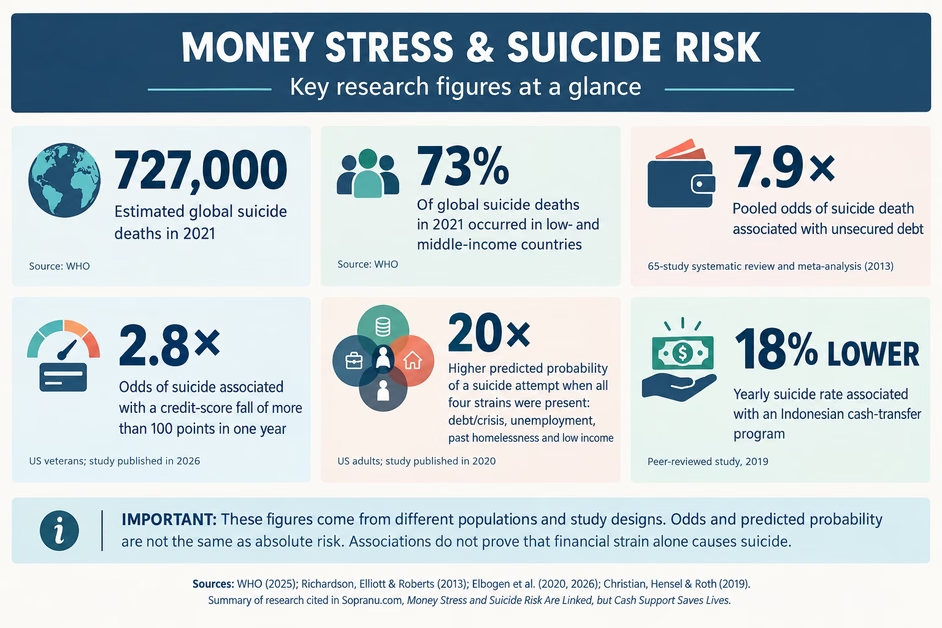
Money stress and suicide risk are linked, and the link is stronger than most people assume. A review of 65 studies found that people with unsecured debt had 7.9 times the odds of dying by suicide (University of Southampton), and a July 2026 study tied a credit score drop of more than 100 points in one year to 2.8 times the odds of suicide (JAMA Network Open, 2026).
Still, there is a hopeful side.
Money problems can be eased in ways a person’s inner pain often cannot, and when governments have put cash into poor households, suicide rates have dropped (Warwick Research Archive).
I first published this piece in August 2019. Rereading it seven years later, I found figures I would not stand behind today. I had used an old estimate of about 800,000 suicides a year, and I leaned on quotations and anecdotes more than on evidence.
So I rebuilt the article from the research up, with Bangladesh at its centre. Every figure below links to where I found it. Where the data is thin, I tell you.
If you are struggling right now: in Bangladesh, Kaan Pete Roi offers free emotional support on 09612119911, from 3 pm to 3 am every day (LifeLine International). In an emergency, call 999. More numbers are listed near the end of this article.
Table of Contents
Money stress and suicide risk at a glance
An estimated 727,000 people died by suicide worldwide in 2021, and 73% of those deaths happened in low- and middle-income countries (WHO).
Debt is one of the most consistent risk markers in the research. In England, people in problem debt are three times as likely to have considered suicide (Money and Mental Health Policy Institute).
The newest evidence (2026) uses real credit records: repossessions, late card payments and falling credit scores were all more common in the year before a suicide (JAMA Network Open).
Financial strain stacks up. Adults facing four kinds of strain at once had a 20 times higher predicted probability of a suicide attempt (Duke Scholars).
In Bangladesh, the WHO estimate (2.8 per 100,000) and police records (about 40 deaths a day) tell very different stories (Prothom Alo).
What helps: income support, doctors asking about debt, kinder debt collection, and removing the law that still treats a suicide attempt as a crime.
One honest caveat: most of this research is observational. Poor mental health can also lead to debt, so the arrow runs both ways.
How strong is the link between money stress and suicide risk?
It is strong enough that researchers now treat debt as a health problem, not only a money problem. The most cited evidence is a meta-analysis by Thomas Richardson, Peter Elliott and Ron Roberts.
Pooling 65 papers (Healio, 2013), they found that people with unsecured debt had 3.24 times the odds of a mental disorder, 2.77 times the odds of depression, and 7.9 times the odds of dying by suicide (University of Southampton).
Other work points the same way. A systematic review on the health effects of indebtedness found that people with unpaid loan payments reported suicidal thoughts and depression more often than people without such problems (PubMed Central).
In the UK, the Money and Mental Health Policy Institute analysed the NHS’s Adult Psychiatric Morbidity Survey and estimated that over 420,000 people in problem debt consider taking their own life in England each year, and more than 100,000 attempt it (Money and Mental Health Policy Institute).
Martin Lewis, who founded that institute, put it bluntly: “Debt and mental health are a marriage made in hell” (The Scotsman). He also noted that people with a mental health problem are four times as likely to be in debt crisis, which shows how the two feed each other.
That last point matters.
Richardson himself admitted “it is hard to say which causes which at this stage” (Healio). Debt can wear a person down, but depression can also make bills harder to manage. I think the fair reading is that money stress is a real and measurable risk factor, rarely the only one, and almost never a full explanation for any single death.
What did the newest research in 2026 find?
The clearest new evidence was published in July 2026. Eric Elbogen and colleagues linked US credit records to death records for 5,000 veterans who died by suicide between 2015 and 2017, and compared them with 12,500 living veterans matched on age, sex and health care use (JAMA Network Open, 2026).
In the 12 months before death, the people who died by suicide were more likely to have had:
- a repossession (1.9 times the odds)
- a credit card payment 30 or more days late (1.7 times the odds)
- a late mortgage payment (1.4 times the odds)
- three or more financial stressors at once (2.4 times the odds)
- a credit score fall of more than 100 points in one year (2.8 times the odds)
Those links held up after the team adjusted for demographics and, among VA patients, for diagnoses of depression, PTSD and substance use (JAMA Network Open, 2026). What makes this study different is the data source. Earlier studies mostly asked people about their finances. This one used TransUnion credit files, which do not depend on memory or honesty.
There is a limit here, and you should know it. Nearly 95% of the sample were men, all were US veterans, and the deaths occurred a decade ago. I cannot confirm with certainty that the same pattern would hold for a rice farmer in Rangpur or a garment worker in Gazipur.
The study builds on Elbogen’s earlier work. In 2020, his team followed 34,653 American adults and found that debt or financial crisis, unemployment, past homelessness and lower income each predicted later suicide attempts (Duke Scholars). As Elbogen said at the time, “financial stressors play a major role in suicides” (Duke Health).
Does losing a job raise suicide risk?
At the population level, yes. A Lancet Psychiatry study led by Carlos Nordt covered 63 countries from 2000 to 2011. It estimated about 233,000 suicides a year in those countries, of which about 45,000 were associated with unemployment (World Economic Forum). In Nordt’s words, “Every year, around one in five suicides is associated with unemployment” (Innovations Report).
Two details surprised me. First, suicide rates rose about six months before unemployment rose, which suggests the fear of losing work can hurt as much as the loss itself (World Economic Forum). Second, the effect was stronger in countries where being out of work is uncommon (The Fiscal Times).
My own reading, and I want to be clear that this is opinion rather than a finding, is that the shame of joblessness weighs more where work is tied to family honour. In Bangladesh, many parents still measure a child’s success by a secure job. I could not find a Bangladeshi study that measures this directly.
Why does money stress feel like a trap?
Money stress feels like a trap because it rarely arrives alone. Elbogen’s 2020 study found that strains add up: people facing all four kinds of financial strain had a 20 times higher predicted probability of attempting suicide than people facing none (Duke Scholars).
Triggers matter too. The Money and Mental Health Policy Institute found that long, threatening letters from lenders, especially from several creditors at once, left many people unable to see a way out (Money and Mental Health Policy Institute). And in Indonesia, economists found evidence that depression was the psychological pathway between income shocks and suicide (Warwick Research Archive).
In my 2019 version, I compared worry to a steady drip of water that never stops. I still think the image fits. A single unpaid bill is a problem.
Months of calls, letters, borrowing from one lender to pay another, and lying to family about it can become something that feels permanent, even when it is not. Notably, “feeling trapped” appears on the US National Institute of Mental Health’s list of suicide warning signs (NIMH).
How many people die by suicide in Bangladesh?
Nobody knows the exact number, and that is part of the problem. The WHO estimated 4,714 suicide deaths in Bangladesh in 2021, a rate of 2.8 per 100,000.
However, the government’s own DGHS Health Bulletin put the 2021 rate at 8.68 per 100,000, and police records average about 14,719 suicides a year, or roughly 40 a day (Prothom Alo). From January to October 2025, police recorded 12,335 cases, about 41 a day (Prothom Alo).
A third estimate, from the Global Burden of Disease study in The Lancet, put Bangladesh at 3.66 per 100,000 in 2021, or about 6,050 deaths (Prothom Alo). So depending on whom you ask, the yearly toll ranges from under 5,000 to nearly 15,000.
Why the gap? Bangladesh has no national suicide surveillance system or central database (BJPsych Open), and many suicides are recorded as accidental deaths to avoid stigma (Netra News). There is some movement, though. A draft Bangladesh National Suicide Prevention Plan was presented for discussion in late 2025 (Prothom Alo).
For context, the global picture is grim but improving. The WHO’s interim mental health chief, Devora Kestel, said suicide accounts for “more than one in every 100 deaths” worldwide, and that each death comes with about 20 attempts (Arab News/AFP).
The age-adjusted global rate fell 35% between 2000 and 2021, yet the world is on track for only a 12% cut by 2030 instead of the one-third reduction it promised (Arab News/AFP).
What is happening to students in Bangladesh?
Student suicides rose again in 2025. Aachol Foundation, which tracks cases through 165 local and national media outlets, counted 403 student suicides in 2025, up from 310 in 2024. School students made up 190 of them, and more of the students who died were female (The Daily Star). Its earlier counts were 532 in 2022 and 513 in 2023 (The Financial Express).
The 2026 numbers so far are not reassuring. Between January and August, Aachol recorded at least 224 student suicides, 117 of them school students. Aachol’s lead psychiatrist, Dr Sayedul Islam Sayed, named financial stress alongside depression, family problems, academic pressure, cyberbullying and loneliness as contributing factors (The Daily Star).
Keep in mind that these are media-based counts, not official mortality data, so the true figure is likely higher.
Is microcredit debt part of the problem in Bangladesh?
Possibly, but the evidence is weaker than the headlines. In 2025, bdnews24 reported a series of family tragedies in which locals and police pointed to NGO loan pressure, rising costs and hardship. It also noted that around 900 registered organisations run small loan operations, according to the Microcredit Regulatory Authority (bdnews24).
The same report carried a counterpoint. One official said that, of the incidents his team had examined in the previous six months, only one involved debt, and that most of the roughly 60 million people under microcredit do well (bdnews24).
Older research summarised by NUS Economics Society suggests about 26% of microcredit borrowers in Bangladesh are over-indebted (NUS Economics Society), and a 2025 review flagged debt traps and high interest rates as unresolved problems (Asian Journal of Economics, Business and Accounting).
What I could not find is a peer-reviewed Bangladeshi study that directly measures whether microcredit debt raises suicide risk.
Those who keep the peace of their inner selves in the midst of the tumult of the modern city are immune from nervous diseases. -Dr. Alexis Carrel
Due to insufficient evidence, I cannot tell you that microcredit causes suicide. I can tell you that over-indebtedness is common, and that the global research above links that kind of strain to suicidal thinking.
What do Bangladeshi studies say about risk factors?
The best local evidence comes from a psychological autopsy study in Dhaka. Researchers interviewed the families of 100 people who died by suicide and compared them with 100 living people matched for age, gender and area. Recent life events carried 17.75 times the odds of suicide, and a psychiatric disorder 15.33 times (BJPsych Open, 2021).
A follow-up analysis estimated that, assuming the links are causal, life events accounted for 85.9% of suicide deaths in the sample, depression for 42.9%, and social isolation for 34.9% (Brain and Behavior, 2021). Financial crises often arrive as exactly these kinds of life events: a failed harvest, a lost job, a loan that cannot be repaid.
Older rural data still matters too. A large household survey in rural Bangladesh estimated a fatal suicide rate of 3.29 per 100,000 person years, and earlier national estimates put deaths at about 10,000 a year (PubMed Central).
In my original article, I cited several older Bangladeshi hospital studies that listed economic hardship and family conflict among the triggers. I could not re-verify their figures online for this update, so I have left those numbers out rather than repeat them.
Why does Section 309 still matter?
Section 309 matters because it punishes people at their lowest point. Under Section 309 of the Penal Code of 1860, attempting suicide in Bangladesh can still bring up to one year in prison, a fine, or both.
At a World Suicide Prevention Day event in Dhaka in 2026, mental health experts called for its repeal (UNB). One speaker, Mahmuda Rahman Khan, said: “No one who attempts suicide truly wants to die” (UNB).
In contrast, England and Wales decriminalised suicide in 1961, and India moved away from the offence through its Mental Healthcare Act of 2017 and its new criminal code (Netra News). Police rarely prosecute attempts in Bangladesh, but the fear of the law can keep survivors from seeking medical care (Netra News). Think about what that means for someone already terrified of a lender at the door. They now have a second reason to stay silent.
What actually lowers suicide risk linked to money?
Here is where the story turns positive. The strongest evidence comes from Indonesia. Its Program Keluarga Harapan, a cash transfer for poor families, cut the yearly suicide rate by 0.36 per 100,000 people, an 18% decrease (Warwick Research Archive).
Oxford researchers estimate it prevented about 1,065 suicides (Oxford Mind and Behaviour Research Group). The program also softened the impact of bad harvests on suicide (Warwick Research Archive), and research on Brazil’s Bolsa Família points in the same direction (Oxford Mind and Behaviour Research Group).
For a country where so many families depend on farming, I find that harvest result striking. It is my inference, not a tested finding, that similar safety nets could help in rural Bangladesh.
Other steps have support too:
- Ask about money in clinics. Richardson urged mental health professionals to ask patients whether they are in debt, and debt advisers to ask about mental health (Healio). The 2026 study authors similarly suggested building financial stressors into clinical checks and safety planning (JAMA Network Open).
- Make debt collection less threatening. The Money and Mental Health Policy Institute has campaigned for clearer letters that point people to help (Money and Mental Health Policy Institute).
- Put counsellors in schools. Aachol has called for trained counsellors in every secondary and higher secondary institution, plus hotlines around exam results (The Daily Star).
If you are the one in debt, the most useful thing you can do this week is tell one person the full truth about the numbers. Secrecy makes debt heavier.
Write down every loan, every lender and every due date, then call the lender before the next missed payment rather than after. None of this fixes everything, but it turns a fog into a list, and a list can be worked through.
What are the warning signs to watch for?
According to the US National Institute of Mental Health, warning signs include talking about wanting to die, feeling great guilt or shame, or being a burden to others; feeling empty, hopeless or trapped; and changes such as withdrawing from friends, giving away important items, extreme mood swings, or using more alcohol or drugs (NIMH).
NIMH advises getting help quickly, especially if the behaviour is new or has increased recently.
With money stress, listen for lines like “everyone would be better off without my debts.” That is the burden theme in plain words, and it deserves a calm, direct question and a real conversation.
Mental Health: Find Strength in What You Can Influence
Life brings uncertainty, disappointment, and challenges that lie beyond our control. We cannot undo every mistake, prevent every loss, or predict everything that tomorrow may bring. Learning to distinguish between what we can change and what we must accept is an important step towards managing stress and maintaining emotional well-being.
A quotation often attributed to U.S. Navy Admiral Ernest J. King expresses this principle: “If a ship has been sunk, I can’t bring it up. If it is going to be sunk, I can’t stop it. I can use my time much better working on tomorrow’s problem than by fretting about yesterday’s.” Although I could not independently verify this quotation from a primary source, its central message is valuable: dwelling endlessly on the past rarely helps us solve the problems of the present.
Focus on What You Can Control
Many of us spend considerable time worrying about things we cannot change. We revisit old mistakes, regret missed opportunities, fear uncertain outcomes, and sometimes allow circumstances beyond our influence to dominate our thoughts. Such concerns can consume the energy we need to make constructive decisions.
A more productive approach is to acknowledge difficult circumstances, learn from experience, and direct our attention towards practical steps we can take now. Gratitude, realistic optimism, hope, problem-solving, and supportive relationships can help us cope with life’s challenges. However, a positive outlook is not a guarantee against psychological distress.
According to the World Health Organization (WHO), depression can affect anyone and arises through a complex interaction of biological, psychological, and social factors.
Therefore, struggling emotionally should not be treated as a personal failure or a simple lack of positive thinking. Persistent distress deserves understanding, support, and, when necessary, professional care.
Do What Lies Clearly Before You
The philosopher Thomas Carlyle is credited with a maxim that physician William Osler later cited when discussing how to approach life’s responsibilities:
“Our main business is not to see what lies dimly at a distance, but to do what lies clearly at hand.”
The principle encourages us to concentrate on the responsibilities and opportunities immediately before us rather than becoming paralysed by distant uncertainties.
Consider the life of Robin Williams, the celebrated American actor and comedian who died by suicide in August 2014 at the age of 63. An autopsy revealed advanced Lewy body dementia, a progressive neurological disease that had not been correctly identified during his lifetime.
The Lewy Body Dementia Association documents the symptoms he experienced and the diagnostic challenges surrounding his illness.
His story reminds us that public success and the ability to make others laugh cannot tell us everything about a person’s private struggles. We should never assume that someone who appears successful or cheerful is free from suffering. Nor should we reduce a person’s death to a simplistic explanation about attitude, motivation, or willpower.
The experience of Marilyn Monroe, another internationally celebrated Hollywood star, also deserves careful consideration. She died in August 1962 from acute barbiturate poisoning, and authorities classified her death as a probable suicide.
Questions about whether the overdose was intentional or accidental have persisted, although a later investigation found no evidence of murder. The Los Angeles Times’ account of the case explains the uncertainty surrounding the circumstances of her death.
These cases should not be used to speculate about the private thoughts of people who are no longer alive. Instead, they remind us of the limits of what appearances can reveal and the importance of treating mental health struggles with compassion.
Live Today Without Neglecting Tomorrow
In How to Stop Worrying and Start Living, Dale Carnegie popularized the principle of living in “day-tight compartments,” drawing on advice associated with physician William Osler. The idea is to avoid carrying the full emotional burden of yesterday’s disappointments and tomorrow’s uncertainties into the present day.
This does not mean that planning for the future is unnecessary. Responsible planning is useful; endless rumination is not. We can learn from the past, prepare thoughtfully for the future, and still give our attention to the work, relationships, and decisions that matter today.
The Roman poet Horace expressed a related idea in Odes, Book 1, Ode 11, with the words carpe diem, quam minimum credula postero—commonly translated as “seize the day, trusting as little as possible in tomorrow.” The original poem reflects on the uncertainty of the future and the importance of making good use of the present.
Ultimately, mental well-being is not about maintaining an unrealistically cheerful attitude or believing that everything is within our control. It is about responding to difficulties as wisely as we can, recognising our limitations, seeking support when needed, and taking the next constructive step.
We cannot guarantee a life without anxiety, disappointment, or hardship. But we can learn to respond to challenges with greater perspective, care, and purpose. Sometimes, the most meaningful progress begins not with changing our entire situation, but with deciding what we can reasonably do today.
Happy the man, and happy he alone,
He, who can call to-day his own:
He who, secure within, can say:”
“To-morrow, do thy worst, for I have liv’d to-day”.– Horace
Where can you get help?
- Bangladesh: Kaan Pete Roi, 09612119911, 3 pm to 3 am daily (LifeLine International). Emergency: 999. Child Helpline: 1098 (TherapyRoute).
- United States: call or text 988 (NIMH).
- United Kingdom: Samaritans, 116 123 (The Scotsman).
Frequently asked questions
Can debt cause suicide? Debt is strongly associated with suicide, but the research cannot prove it is the sole cause. Most studies are observational, and mental illness can also lead to debt (Healio).
What is the suicide rate in Bangladesh? The WHO puts it at 2.8 per 100,000 for 2021, while the DGHS Health Bulletin reported 8.68 per 100,000 for the same year (Prothom Alo).
Is attempted suicide still a crime in Bangladesh? Yes. Section 309 of the Penal Code remains in force, although experts are calling for its repeal (UNB).
A last word
When I wrote the first version of this article, I ended with Horace, in John Dryden’s translation: “Happy the man, and happy he alone, / He who can call to-day his own.” I still love those lines. Yet I see them differently now. It is hard to own today when a lender owns tomorrow.
That is why I no longer think the answer lies only in personal calm or positive thinking. It lies in money reaching people before despair does, in laws that treat a survivor as a patient, and in someone close enough to ask the right question.
If any part of this article touched something in your own life, please reach out to Kaan Pete Roi or someone you trust today.