
Last updated on November 6th, 2026 at 11:41 am
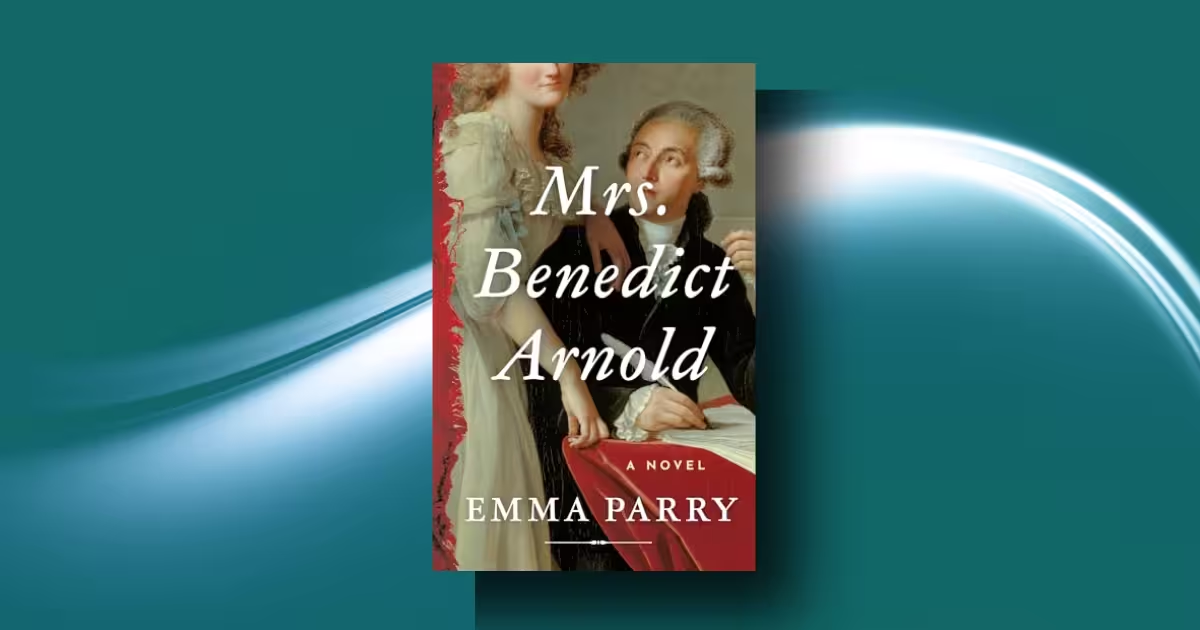
Did you ever wonder why you feel a strange pull toward the villains of history, or why the women standing in the shadows of “great men” are often the ones holding the real match? Mrs. Benedict Arnold by Emma Parry is that rare, searing piece of historical fiction that doesn’t just tell a story; it reconstructs a soul.
This novel is a brilliant, high-stakes reimagining of Peggy Shippen—the teenage socialite of Revolutionary Philadelphia—as the strategic mastermind whose pursuit of security and peace ultimately fueled the most infamous act of treason in American history.
Readers who devoured Hamilton or Turn: Washington’s Spies and are looking for a complex, female-driven narrative that explores the blurred lines between loyalty, love, and survival.
Mrs. Benedict Arnold is not for t hose seeking a dry, traditional history textbook or a simple “good vs. evil” morality tale where the protagonist remains a passive observer of her own life.
Table of Contents
1. Introduction
Today, the name Benedict Arnold is a shorthand for betrayal, but Emma Parry’s debut novel, Mrs. Benedict Arnold, published by Zando on April 28, 2026, shifts the lens.
Spanning 320 pages of meticulously researched prose, Parry invites us into the drawing rooms and war rooms of 18th-century America to meet the real Peggy Shippen. It is a story of a woman who, in a world of men at war, decides that the only side worth choosing is her own family’s survival.
2. Background
The setting is 1777 Pennsylvania—a time of “cold salt spray” and “dread churning”. The Shippen family, led by Peggy’s cautious father, tries to navigate the “lethal political currents” of Philadelphia by remaining neutral.
However, neutrality is a luxury the war won’t allow. As the city shifts from British occupation to Patriot control, Peggy finds herself at the center of a social and political whirlwind, moving from the “Loyalist balls” of Captain John André to the “Patriot salons” of General Benedict Arnold.
3. Mrs. Benedict Arnold Summary
Part 1
The story begins with a young, restless Peggy Shippen in Philadelphia, feeling the “veneer of civilization” thinning as the Revolutionary War encroaches on her doorstep. While her father insists that the duty of every moderate man is to “remain silent and inactive,” Peggy’s spirit is far more “bolshily” inclined.
She is a girl who finds solace in the woods of Shippensburg, running “like an ostrich” to escape the stifling expectations of her gender and class.
When the British occupy Philadelphia, Peggy is swept into a world of “glamorous” officers, most notably the charming and artistic Captain John André. Their connection is depicted not just as a teenage crush but as a meeting of minds. André sees the “bright mind behind the beautiful face,” and they share a bond forged in coded messages and shared ambitions.
However, when the British retreat to New York, Peggy is left devastated and “devastated—both by his absence and the horrors of ongoing conflict”.
Enter Benedict Arnold. He arrives in Philadelphia as a war hero, a man who has “run forty men through with my sword” and carries the scars of the Battle of Saratoga on his leg. To Peggy, Arnold is a “dashing, older military hero” who represents a new kind of power.
Their courtship is a dance of mutual need: Arnold is “defensive—sensitive to slights” and feels unappreciated by the Continental Congress, while Peggy seeks a protector in an increasingly unstable world.
After their marriage, the two settle at Mount Pleasant, a grand estate that Peggy finds beautiful but which quickly becomes a symbol of their mounting debts and Arnold’s growing resentment.
Arnold is haunted by “past war actions” and his failed requests for “financial compensation”. He feels “submerged in a collective effort” that has only brought him “scurrilous slights in print”.
It is here that the novel takes its most provocative turn. Rather than Peggy being a mere “spoilt teenager” dragged along by her husband’s bitterness, she becomes the architect of their future.
Encouraged by her secret correspondence with André (now a British spy chief), Peggy “conceives of an audacious scheme”. She realizes that if Arnold can deliver West Point—the “key to the continent”—to the British, they can end the war, secure a fortune, and ensure their own safety.
Part 2
As Benedict Arnold takes command of West Point, the “key to the continent,” the novel’s tension shifts from the social drawing rooms of Philadelphia to the high-stakes world of military espionage.
Peggy, now a mother to her first child, Eddie, finds that her maternal instincts have radically sharpened her political resolve. She tells Benedict, “One way or another, life as we’ve known it is over”.
To Peggy, the Continental Congress is a “collective effort” that has only rewarded her husband with “scurrilous slights,” and she sees the British as the only path to a stable, wealthy future for her son.
The betrayal is meticulously planned. Peggy acts as the “invisible hand,” using her old friendship with John André to facilitate the secret correspondence.
When the plot finally collapses after André is captured with the West Point plans in his boot, the novel reaches its emotional peak. Benedict is forced to flee, leaving Peggy behind to face the wrath of George Washington and his men.
In a scene that Parry writes with gut-wrenching intensity, Peggy performs a “hysterical act of madness,” appearing before Washington in her nightdress, disheveled and raving, to convince him of her innocence. She uses the era’s prejudices against women’s intellectual capacity as a shield, weaponizing the idea that she is merely a “spoilt teenager” too fragile for politics.
The ending follows the Arnolds into their bittersweet exile in London.
Though they have their lives, they have lost their reputation. They discover St. Mary’s Battersea, a church on the Thames that feels like a “pretty waterfront” refuge, yet the shadow of treason follows them.
Benedict dies a man whose name is “synonymous with betrayal,” while Peggy remains the quiet, steel-spined survivor who ensured her children reached safety.
The story concludes not with a roar of victory, but with the “low slanting rays of the morning light” hitting her father’s law journals—a reminder of the order and civilization she sacrificed everything to preserve.
4. Mrs. Benedict Arnold Analysis
4.1. Mrs. Benedict Arnold Characters
Peggy Shippen-Arnold: She is far from a passive historical figure. Parry paints her as a woman who manages a “secret index to monitor her dread levels,” showing a modern, internal struggle with anxiety. Her motivation isn’t malice, but a fierce, almost primal, loyalty to her own blood over any flag.
Benedict Arnold: He is portrayed as a man “submerged in a collective effort” who feels “defensive—sensitive to slights”.
His complexity lies in his transition from a hero who “felt invincible” to a man who realizes “murder is more grave” than loyalty to a failing cause.
John André: More than just a British officer, he represents the “glamorous” life Peggy lost. Their relationship is a “printed question mark” that Parry fills with intellectual chemistry and coded longing.
4.2. Mrs. Benedict Arnold Themes and Symbolism
The Myth of Neutrality: The book explores the impossibility of staying neutral in a divided nation. Peggy’s father claims the duty of a moderate is to “remain silent,” but Peggy realizes that silence is just a slower way to lose everything.
The “Secret Index”: This serves as a powerful symbol of the internal toll of war on those who do not fight on the battlefield but are trapped in the “restless swell” of its consequences.
5. Evaluation
Mrs. Benedict Arnold is a marvelous, groundbreaking re-examination of American history’s most hated couple. It feels like a poignant companion to The Sense of an Ending, reminding us that history is often just the memories of the survivors.
Strengths: Parry’s ability to weave domestic intimacy with international intrigue is breathtaking. The “madness” scene is a masterclass in tension, and the portrayal of the Shippen family’s “veneer of civilization” thinning under pressure is hauntingly vivid.
Weaknesses: Some readers may find the pacing in the final London chapters a bit “choppy” compared to the high-octane energy of the West Point betrayal.
Impact: The book left me questioning the very nature of “treason.” If your country fails to protect your family, where does your loyalty truly lie? It’s an intellectually stimulating read that resonates long after the final page.
Comparison and Adaptation
While Allison Pataki’s The Traitor’s Wife offers a broader look at the Arnold household, Parry’s work is more of a psychological “deep dive” into Peggy’s specific psyche.
Currently, while there is no direct film adaptation of Parry’s novel, the book’s cinematic quality—comparable to the visual storytelling in Turn: Washington’s Spies—makes it a prime candidate for a prestige limited series.
6. Personal Insight: The Cost of Polarization
Reading this book in 2026, it’s impossible not to see the contemporary relevance. We live in an era where “committees of safety” have been replaced by digital watchdogs, yet the “fear rising like water” remains the same.
Peggy’s struggle reflects a universal truth: in times of extreme political polarization, the individual often feels “pinned in place while puppets bicker”.
Statistically, historical fiction remains a powerhouse in the literary market, with women making up approximately 80% of its readership.
This is because these stories, like Parry’s, provide a necessary “reframing” of the female experience in eras that tried to silence them. You can find more on the impact of historical “reframing” at sopranu.com.
7. Mrs. Benedict Arnold Quotes
- “The duty, Peggy, of every moderate-thinking man is to remain silent and inactive in these times.”
- “I had an uneasy image of us as seasonal produce.”
- “I was no saint or martyr, but it didn’t feel unfair a person working to stop war should face a fate soldiers met each day.”
- “I began a secret index to monitor my dread levels, marking my anxiety like notes on a score.”
8. Conclusion
Emma Parry has delivered a debut that is both a thrilling spy novel and a sensitive character study.
It is a must-read for fans of Hamilton and anyone who enjoys seeing the “heaviest printed question marks” of history finally answered.
I highly recommend this to readers who value historical accuracy seasoned with a healthy dose of human emotion.







