
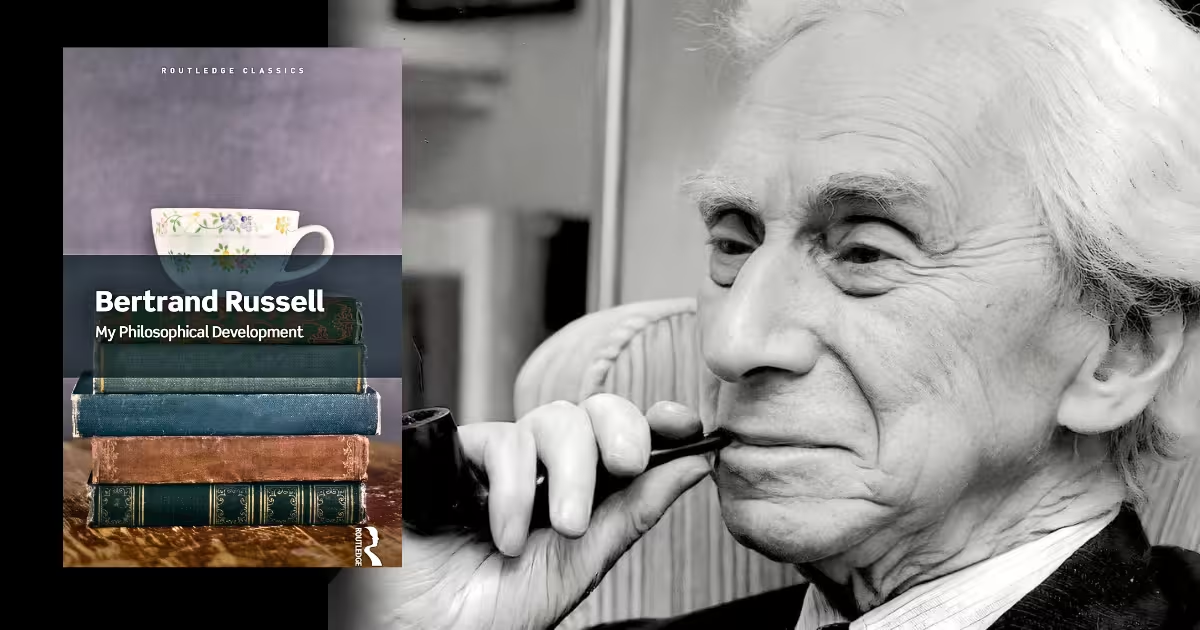
What happens when a teenage boy, tormented by religious doubt and desperate for certainty, dedicates his entire life to the pursuit of truth—only to discover that certainty itself might be an intellectual vice?
Overview
My Philosophical Development (1959) is Bertrand Russell’s intellectual autobiography, chronicling his philosophical journey from his adolescent reflections in 1888 to his mature views in Human Knowledge: Its Scope and Limits (1948).
Russell guides readers through his revolt against Hegelian idealism, his collaboration with Alfred North Whitehead on Principia Mathematica, his adoption of logical atomism, his engagement with Wittgenstein’s ideas, and his later work on language, perception, and non-demonstrative inference.
This is not a dry textbook but a candid, self-critical narrative by one of the twentieth century’s greatest philosophers, written with his characteristic clarity, wit, and occasional sarcasm.
Table of Contents
Reader suggestion
My Philosophical Development is suggested for:
- Philosophy students and academics seeking a firsthand account of Russell’s intellectual evolution
- Readers who enjoyed Russell’s Autobiography and want a focused philosophical companion
- Anyone interested in the history of analytic philosophy, logic, and the foundations of mathematics
- General readers curious about how a great mind grapples with fundamental questions over a lifetime
My Philosophical Development is not suggested for:
- Readers looking for a comprehensive survey of Russell’s ethical or political views (these are largely absent)
- Those who prefer systematic philosophical treatises over intellectual memoir
- Beginners with no prior exposure to basic philosophical concepts
Background
Bertrand Arthur William Russell (1872–1970) was not merely a philosopher—he was a mathematician, logician, social reformer, and Nobel laureate in Literature (1950). Alongside G.E. Moore, he is generally recognized as one of the founders of modern analytic philosophy.
His contributions to logic, epistemology, and the philosophy of mathematics established him as one of the foremost philosophers of the twentieth century.
To the general public, he was equally famous for his outspoken atheism and his advocacy for pacifism and nuclear disarmament.
By the time Russell wrote My Philosophical Development, he was in his late eighties. The book was published in 1959 by George Allen & Unwin, and a new Routledge Classics edition appeared in 2023 with a foreword by Nicholas Griffin.
As one reviewer put it, the book is “an excellent—perhaps the best—introduction to his philosophy and a very enjoyable read”.
My Philosophical Development Summary
Russell organizes his intellectual autobiography into eighteen chapters, tracing his development from his earliest philosophical stirrings to his final views. My Philosophical Development is, in his own words, “an attempt to discover how much we can be said to know and with what degree of certainty or doubtfulness”.
Chapter 1–2: Introductory Outline and Present View
Russell opens by dividing his philosophical development into stages, noting that the revolution of 1899–1900—when he adopted logical atomism and Peano’s mathematical logic—was so profound that “my previous work, except such as was purely mathematical, irrelevant to everything that I did later”.
He then presents his current worldview: a synthesis of physics, physiology, psychology, and mathematical logic. He rejects the Kantian habit of starting with how we know and proceeding to what we know, calling it a mistake that “gives to knowing a cosmic importance which it by no means deserves”.
He accepts without qualification the astronomical view that “there is no evidence of anything mental except in a tiny fragment of space-time”.
Chapter 3–4: First Efforts and Excursion into Idealism
Russell reveals that he began thinking about philosophical questions at age fifteen. He includes extracts from a secret journal he kept in 1888, written in Greek letters and phonetic spelling to conceal his heretical thoughts from his family. At sixteen, he had already rejected free will, then immortality, and finally God.
He wrote: “I do wish I believed in the life eternal, for it makes me quite miserable to think man is merely a kind of machine endowed, unhappily for himself, with consciousness”.
At Cambridge, he was indoctrinated with Kant and Hegel. He describes his Hegelian phase as producing work that now seems to him “complete nonsense”. In one note from 1898, he wrote: “Every science works with a certain limited number of fundamental ideas” and “what we have to do, therefore, in a logic of the sciences, is to construct, with the appropriate set of ideas, a world containing no contradictions”.
Chapter 5–6: Revolt into Pluralism and Logical Technique
The turning point came in 1898 when Russell and G.E. Moore rebelled against Kant and Hegel. Russell called this the rejection of “the doctrine of internal relations” and the adoption of “the doctrine of external relations”. He explains: “The doctrine of internal relations held that every relation between two terms expresses, primarily, intrinsic properties of the two terms”. Russell found this view made mathematics inexplicable, particularly because of asymmetrical relations like “earlier than”.
He describes this intellectual revolt as “a great liberation, as if I had escaped from a hot-house on to a wind-swept headland”. He became a “naïve realist” and “rejoiced in the thought that grass is really green, in spite of the adverse opinion of all philosophers from Locke onwards”.
In 1900, at the International Congress of Philosophy in Paris, Russell encountered Peano’s work. He recalls: “Every day I found myself understanding something that I had not understood on the previous day. I thought all difficulties were solved and all problems were at an end. But the honeymoon could not last”.
Chapter 7–8: Principia Mathematica
The years 1900–1910 were consumed by Principia Mathematica, co-authored with Whitehead. Russell explains the primary aim: “to show that all pure mathematics follows from purely logical premisses and uses only concepts definable in logical terms”.
Then came the devastating discovery of the paradoxes. Russell recounts: “I was led to this contradiction by considering Cantor’s proof that there is no greatest cardinal number”. He describes the class of classes that are not members of themselves—the famous Russell’s Paradox—and how each alternative leads to its opposite. He wrote to Frege, who replied “that arithmetic was tottering”.
The solution, Russell concluded, lay in the theory of types. He explains: “When I assert all values of a function fx, the values that x can take must be definite if what I am asserting is to be definite”.
The liar paradox—“everything that I assert is false”—illustrates the problem: it refers to the totality of his assertions and “it is only by including it in that totality that a paradox results”.
Chapter 9: The External World
Russell discusses his Lowell Lectures of 1914 and the problem of perception. He describes how Whitehead’s method of constructing points from events led him to a new view: “I came to the conclusion that space has six dimensions and not only three”. He explains that what counts as a point in physics is “really a three-dimensional complex”.
He introduces the concept of “perspectives” and “sensibilia”—appearances that things present in places where there are no minds to perceive them. He concludes: “All the puzzles about the differences between different people’s perceptions of one thing…are cleared away by this theory”.
Chapter 10: The Impact of Wittgenstein
Russell acknowledges his profound debt to Wittgenstein while also noting their disagreements. He describes Wittgenstein’s Tractatus doctrine that “a proposition is a picture of the facts which it asserts”. He accepted the idea that “the gramophone record, the musical thought, the score, the waves of sound, all stand to one another in that pictorial internal relation, which holds between language and the world”.
However, Russell never accepted Wittgenstein’s mysticism. He notes: “I suggested that, although in any given language there are things which that language cannot express, it is yet always possible to construct a language of higher order in which these things can be said”.
Chapter 11–13: Theory of Knowledge, Consciousness, and Language
Russell describes his shift from Brentano’s view of sensation as a three-element relation (act, content, object) to William James’s view that sensations are not essentially relational. He writes: “I became convinced that William James had been right in denying the relational character of sensations”.
He explains the consequences: “So long as the ‘subject’ was retained there was a ‘mental’ entity to which there was nothing analogous in the material world, but, if sensations are occurrences which are not essentially relational, there is not the same need to regard mental and physical occurrences as fundamentally different”.
On language, Russell emphasizes that a word is a universal: “a word is a universal of which the instances are the occasions on which an instance of the word is spoken or heard or written or read”.
He defines meaning in terms of causal laws: “The relation of a word to its meaning is of the nature of a causal law governing our use of the word and our actions when we hear it used”.
Chapter 14–15: Universals, Particulars, and Truth
Russell tackles the ancient problem of universals and particulars. He recounts a fable about philosophers arguing whether a tough piece of meat is “beef” or “horse”—the point being that “the question of ‘universals’ is not merely one of words, but one which arises through the attempt to state facts”.
He explains his theory of descriptions, which he considered his most important contribution to logic. The theory shows that “a phrase may contribute to the meaning of a sentence without having any meaning at all in isolation”.
On truth, Russell defends a correspondence theory against both the monistic coherence theory and pragmatism. He quotes James’s definition of truth as “the expedient in the way of our thinking” and responds: “I have never been able to understand what other meaning his words can have”.
Chapter 16–17: Non-Demonstrative Inference and the Retreat from Pythagoras
Russell addresses the problem of induction and non-demonstrative inference. He notes: “inductive arguments, unless they are confined within the limits of common sense, will lead to false conclusions much more often than to true ones”. He proposes five postulates to validate scientific inference, including the postulate of quasi-permanence, separable causal lines, and analogy.
In the final substantive chapter, Russell reflects: “My philosophical development, since the early years of the present century, may be broadly described as a gradual retreat from Pythagoras”.
He describes how mathematics once gave him “something profoundly satisfying” and “a refuge in a timeless world”.
But the First World War shattered this ascetic mood: “I used to watch young men embarking in troop trains to be slaughtered on the Somme because generals were stupid. I felt an aching compassion for these young men, and found myself united to the actual world in a strange marriage of pain”.
Chapter 18: Some Replies to Criticism
My Philosophical Development concludes with Russell’s responses to critics, including J.O. Urmson, P.F. Strawson, and Gilbert Ryle. He is characteristically blunt: “I find myself totally unable to see any cogency whatever in the arguments that Mr Urmson advances”.
He defends analysis as the proper method of philosophy and dismisses the idea that philosophy should concern itself only with language: “It seems to concern itself, not with the world and our relation to it, but only with the different ways in which silly people can say silly things”.
My Philosophical Development Analysis
Reading My Philosophical Development feels like sitting across from a brilliant, elderly scholar who has spent a lifetime wrestling with the hardest questions and is now willing to tell you—with remarkable candor—where he succeeded and where he failed.
Russell’s self-criticism is one of the book’s most striking features. He describes his early Hegelian work as “complete nonsense” and admits that his youthful optimism about mathematics was “largely nonsense”. He writes: “I cannot any longer find any mystical satisfaction in the contemplation of mathematical truth”. This is not false modesty; it is the honest assessment of a man who valued truth above ego.
My Philosophical Development also reveals Russell’s deep emotional struggle. He began philosophy seeking certainty—first in religion, then in mathematics, then in science. Each quest ended in disappointment.
He writes: “I have always ardently desired to find some justification for the emotions inspired by certain things that seemed to stand outside human life”. But he concludes: “Impersonal non-human truth appears to be a delusion”.
This tension between intellectual conviction and emotional longing runs through the entire narrative.
For contemporary readers, Russell’s insistence on the importance of analysis remains relevant. He writes: “I have always been deeply persuaded that, from a cosmic point of view, life and experience are causally of little importance”. This cosmic perspective—rare in philosophy today—gives his work a distinctive grandeur.
One of the book’s most valuable contributions is its account of Russell’s relationship with Wittgenstein. Russell acknowledges his debt while also noting their disagreements.
He criticizes Wittgenstein’s later philosophy as “an abnegation of his own best talent” and describes the later Wittgenstein as someone who “seems to have grown tired of serious thinking and to have invented a doctrine which would make such an activity unnecessary”. This is harsh but revealing.
Strengths and Weaknesses
Strengths:
Unmatched firsthand account: No one else could tell this story. Russell’s personal involvement in every major development of analytic philosophy makes this an indispensable primary source.
Remarkable candor: Russell’s willingness to admit error and change his mind is both intellectually honest and pedagogically useful.
Clarity of exposition: Even when discussing technical topics like the theory of types or non-demonstrative inference, Russell writes with his characteristic lucidity. As one reviewer noted, the book is written in “a beautifully clear manner”.
Historical value: My Philosophical Development includes previously unpublished notes from Russell’s Hegelian period and his adolescent journal, offering rare glimpses into his intellectual development.
Engaging style: Russell’s wit and occasional sarcasm make the book enjoyable even when the subject matter is dense.
Weaknesses:
Limited scope: As Russell’s editor Nicholas Griffin notes, the book “has no mention of the development of his ethical or social views”. Readers interested in Russell’s political activism or his famous atheism will need to look elsewhere.
Selective coverage: The book focuses heavily on the period up to 1918, with later philosophy treated more briefly. Griffin observes that “by the late 1950s, Russell’s philosophy before 1918, though often misunderstood, was quite widely known” whereas “his post-1918 philosophy…was generally taken to lie quite outside all the historical narratives”.
Scrapbook quality: My Philosophical Development relies heavily on long quotations from earlier works, giving it “at times like a philosophical scrapbook”. This can make it feel less like a new synthesis and more like a compilation.
Factual errors: Griffin identifies several errors, including an incorrect claim about proving mathematical induction without the axiom of reducibility in the second edition of Principia Mathematica.
Polemical tone: Russell’s attacks on his critics, particularly in the final chapter, can feel ungenerous. His dismissal of Wittgenstein’s later philosophy as trivial is unlikely to persuade those who find value in it.
Comparison with Similar Works
Russell’s My Philosophical Development invites comparison with other intellectual autobiographies by philosophers:
Wittgenstein’s Philosophical Investigations (1953) also represents a later philosopher looking back at his earlier work, but Wittgenstein’s style is aphoristic and opaque where Russell’s is clear and direct.
Karl Popper’s Unended Quest (1976) similarly traces a philosopher’s intellectual development, but Popper focuses more on his engagement with specific problems (induction, demarcation) than on the full arc of his thought.
A.J. Ayer’s Part of My Life (1977) covers similar ground from a logical positivist perspective, but Ayer was a follower rather than a founder, and his account lacks Russell’s historical authority.
G.E. Moore’s Autobiography (1942) in The Philosophy of G.E. Moore is more modest in scope and less self-critical.
Russell’s book stands out for its combination of historical significance, philosophical depth, and personal candor. No other philosopher of Russell’s stature has provided such a detailed and honest account of their own intellectual development.
Conclusion
My Philosophical Development is not Russell’s greatest philosophical work—he himself would probably not claim it as such. But it is arguably the best introduction to his philosophy and an essential companion to his Autobiography.
What makes My Philosophical Development valuable is not just its content but its spirit. Russell shows us what it means to pursue truth with intellectual integrity, even when the pursuit leads to uncomfortable conclusions. He began with a desperate hope for certainty and ended with the recognition that “the demand for certainty is one which is natural to man, but is nevertheless an intellectual vice”.
Yet he never gave up the search.
For anyone interested in philosophy, logic, or the history of ideas, My Philosophical Development is essential reading. It is a testament to one of the greatest minds of the twentieth century—and a reminder that the most important philosophical questions are often the ones we never fully answer.







