
Last updated on November 6th, 2026 at 11:43 am
Why do we feel weirdly haunted by “lost treasure” stories—like the ocean is keeping a secret that’s also keeping us? Neptune’s Fortune shows you that the real treasure isn’t gold…it’s what obsession, empire, and memory do to people when the sea refuses to give anything back.
Neptune’s Fortune is best for you if you love narrative nonfiction that reads like a thriller but keeps its historical receipts; shipwreck history, underwater archaeology, and high-stakes maritime law; and books that expose the Spanish Empire’s afterlife—how colonial extraction still shapes modern politics.
Neptune’s Fortune is not for you if you* want a neat “and then they recovered the treasure” payoff. This is a saga of delays, secrecy, institutions, and moral rot; prefer history without ethical tension. This book repeatedly forces the question: is recovery preservation…or plunder? and need a tight cast. The story grows into a web: treasure hunters, presidents, academics, investors, lawyers, militaries.
Table of Contents
1. Introduction
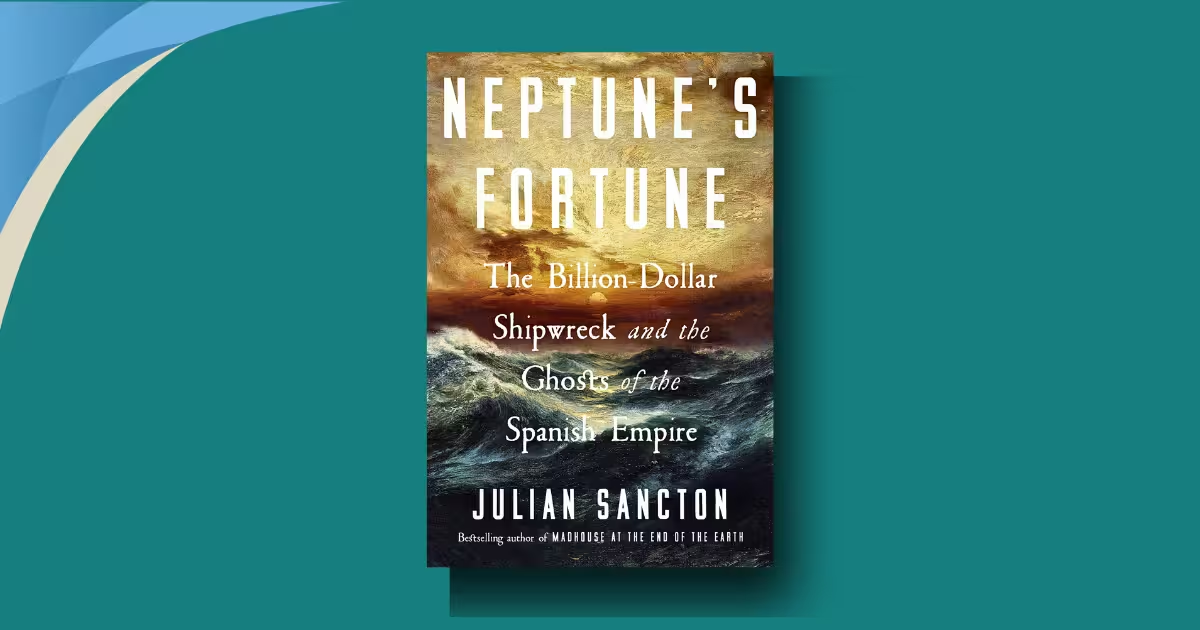
Neptune’s Fortune: The Billion-Dollar Shipwreck and the Ghosts of the Spanish Empire is written by Julian Sancton and published on January 27, 2026 by Crown (Penguin Random House).
This is narrative history with teeth: part maritime war story, part modern investigative reporting, part moral argument about ownership, cultural heritage, and what “discovery” means when the “treasure” was created by centuries of forced labor.
Sancton frames the book through a modern figure—Roger Dooley—who arrives in the story already coated in rumors. Sancton says his first sources described Dooley as “a crackpot,” “a charlatan and a fake,” a “bullshitter.” That opening move is important: the book is not just about a shipwreck—it’s about credibility, and how reputations are weaponized when billions (and national pride) are involved.
Here’s what I think Sancton is ultimately doing:
He uses the “billion-dollar shipwreck” as bait, then turns the story into an anatomy of empire’s long shadow—how colonial extraction (silver, gold, bodies) becomes modern conflict (lawsuits, diplomacy, secrecy, “heritage” branding). The San José isn’t merely lost; it’s politically radioactive.
And Sancton names the scale of the fight early, quoting how officials in Colombia called it “the biggest treasure in the history of humanity,” and noting it triggered a “custody battle” involving Spain, Colombia, finance elites, and Indigenous peoples whose lands were mined for the cargo.
That’s the thesis pressure point: the shipwreck is a vault of money, yes—but also a vault of ghosts.
2. Background
Before Sancton even gets us near modern salvage tech, he drags the spotlight backward—into the moral machinery that produced “treasure” in the first place.
He reminds us that gold and silver weren’t originally “currency” in many Indigenous contexts; they had ceremonial meaning. But European empires—Spain first and fiercest—were built on converting sacred metal into global power. Sancton quotes a line attributed to Ferdinand that still makes me flinch because it’s both blunt and endlessly reproducible: “Get gold…at all costs.”
Then comes Potosí—the mountain that powered the Spanish Empire and poisoned its soul. Sancton describes Cerro Rico and the Imperial City of Potosí becoming a boomtown with a population larger than London’s by the late sixteenth century. And he includes a harrowing account of mine labor—workers crawling “like worms,” dying in darkness.
This background matters because it changes what “shipwreck treasure” means. Once you sit with these chapters, the San José stops being a fantasy chest and starts looking like a floating balance sheet of suffering.
3. Neptune’s Fortune summary
Highlighted “At-a-glance” timeline
1698: San José launched (historical baseline).
8 June 1708: The San José is destroyed/sinks during Wager’s Action off Barú, near Cartagena.
Late 1970s–1980s: Modern treasure hunting becomes pop-cultural and commercial; diving media explodes (film, novels, hype).
1980s–2000s: Sea Search Armada vs Colombia: shifting “percentages,” corruption allegations, legal ambiguity, long delays.
2001: UNESCO drafts Convention on Underwater Cultural Heritage; est. 3 million undiscovered shipwrecks; the sale of artifacts from >100-year-old wrecks is forbidden under its principles.
2015: Colombia announces discovery of the San José; the discovery involved deepwater technology and outside expertise (often associated publicly with WHOI).
May 7–8, 2022: Colombian Navy expedition performs a ceremony over the wreck; tech issues, “holy water,” and the first sighting of an eight-escudo coin; Sancton notes the story’s obsession with the number 8, including June 8, 1708 as the battle date.
January 2024: Dooley’s life in limbo; boxes labeled “Cartagena”; he sells his Rolex for $10,000 and prepares to move.
Part I — The last days of the San José: a warship carrying an empire’s bloodstream
Sancton opens the historical portion with the San José not as myth but as a living machine: sailors, guns, bureaucracy, cargo, fear. The galleon is a node in Spain’s imperial logistics—the Tierra Firme fleet system that carried extracted wealth back across the Atlantic.
The War of the Spanish Succession hangs over everything. Treasure isn’t luxury here; it’s war funding. If you’ve ever wondered how empires “pay” for conflict, this is the brutal answer: they liquefy colonies into coin.
The book’s narrative reconstruction of 1708 doesn’t feel like an encyclopedia entry—it’s bodily. You can sense the claustrophobia, the discipline, the volatile powder, and the way a single naval engagement can turn 600 lives into a mass grave.
Externally, common estimates say roughly 600 people died with only 11 survivors. That number is easy to skim until you picture it: a ship erupting, a night sea swallowing bodies, and a wreck becoming both cemetery and commodity.
This part also makes clear: even before the ship sinks, the “ghosts” are already aboard—because the cargo’s history is soaked in coercion. Sancton’s background on extraction and Potosí means the “treasure” is never neutral.
Part II — Rapture of the Deep: Roger Dooley’s origin story and the psychology of obsession
Then, Sancton pivots hard into the modern character engine: Roger Dooley.
He introduces Dooley through hostility—people telling Sancton Dooley is a criminal, a pirate, a con man. And then Sancton does what good reporting should do: he chases the man anyway.
We get Dooley’s odd biographical braid: born in the U.S. in 1944, raised largely in Brooklyn, then emigrated to Cuba as a teen. That detail matters because Dooley becomes a human bridge between U.S. systems and Cuban systems—between freedom mythology and surveillance reality.
There’s a section that hit me harder than I expected: Dooley’s life in Miami, under threat from militant exile groups, looking over his shoulder, changing cars constantly. It’s a reminder that political violence doesn’t stay “over there.” It follows diaspora.
Then the book shows Dooley caught in a strange immigrant reversal. After escaping Cuba’s control, he ends up in a humiliating American limbo—testing an infomercial laundry product in a storage unit. Sancton captures the absurdity: Dooley “wondering how he had gone from discovering a lost treasure galleon to testing towels that retailed for $4.95.”
That is not just comic relief. It’s the core emotional fuel of his obsession:
- A man who believes he’s meant for history
- Trapped in menial repetition
- Trying to claw his way back toward significance
This is where the book becomes a study of why people need the sea to validate them—why a shipwreck can become a religion.
Part III — A brief history of treasure hunting: from romantic adventurism to regulated shame
Sancton’s “treasure hunting history” section is where the book starts sounding like a cultural autopsy.
He traces how treasure hunters were once seen as daring entrepreneurs but later became associated with grave robbing and heritage destruction. He quotes maritime lawyer James Goold comparing it to elephant hunting: once “cool and adventurous,” now “not so anymore.”
Then comes a key pivot: UNESCO 2001. Sancton explains that the Convention sought to protect an estimated three million undiscovered shipwrecks, forbade selling artifacts older than 100 years, urged leaving wrecks in situ, and reinforced “sovereign immunity” for sunken warships.
This is where the San José becomes legally and ethically explosive:
- If it’s a warship, does Spain own it forever?
- If it lies in Colombia’s waters, does Colombia’s patrimony override?
- If the cargo came from Indigenous lands via forced labor, what does “ownership” even mean?
Sancton doesn’t pretend there’s a clean answer. Instead he shows how every answer is a weapon.
Part IV — The Search: coordinates, secrecy, politics, and the ocean as a courtroom
This final arc is essentially a modern thriller made of memos, expeditions, contracts, and the slow-motion violence of bureaucracy.
The Sea Search Armada saga: how “finders” become litigants
We see investors, deals, renegotiated shares, hints of payoffs, and the way governments change the rules when the prize becomes too large to share.
At one point, the Colombian government drafts a contract granting SSA 35%—but never countersigns. Then Colombia reduces private share to a 5% finder’s fee, taxable at 45%, and retroactive. That kind of move tells you what this really is: not a treasure hunt, but a sovereignty fight.
And Sancton includes the human collapse: an early figure dies of terminal cancer; his wife says he thought maybe the money would have cost them their soul—maybe they “weren’t meant to have it.” That line is basically the moral chorus of the whole book.
The 2015 discovery and the politics of “heritage”
Publicly, the San José is often described as worth up to $17 billion and lying around 600 meters deep. Recent reporting notes Colombia has retrieved a few artifacts (a cannon, coins, a porcelain cup) as part of scientific work, while legal disputes still rage.
Sancton’s inside reporting shows how secrecy becomes policy. Santos declares: “this is the Colombian people’s cultural heritage.” The rhetoric is powerful—and politically effective—but it also raises a fear among academics: will “heritage” be used to justify commercialization?
Sancton recounts an open letter signed by 118 experts warning against massive commercialization and secrecy. This part, to me, is where the book stops being just exciting and starts being genuinely tense—because you can feel how easily history can be “saved” in the most destructive way.
Dooley’s discovery moment: devotion, tears, and the ship as a living god
In one of the book’s most cinematic scenes, Dooley reads out coordinates; people react in real time; his wife Adriana weeps; and Dooley says, “Twenty-three years I’ve been waiting for this.” (Sancton even notes Dooley miscalculated in the thrill—showing how memory edits itself when obsession peaks.)
A captain raises a toast to the dead—“six hundred lives.” The book keeps insisting: this is a war grave, not a jewelry box.
2022 expedition: ritual, technology, and superstition
One of the eeriest passages describes the Colombian Navy mission: they throw flowers, ask permission from the souls, sprinkle holy water on malfunctioning equipment, and then—after midnight—see an eight-escudo coin.
I’m not even religious, but I understood why they did it. When you’re hovering above a mass death site that could bankrupt or enrich nations, rationality doesn’t feel like enough. Humans reach for ritual.
Epilogue: the wreck that won’t end—and the man who can’t stop waiting
By January 2024, Sancton visits Dooley in Miami: his “books, maps, and endless files” are packed into boxes labeled Cartagena. Dooley sells a Rolex for $10,000, not as a flex but as survival. Sancton admits he’s heartbroken for him—and I believed that emotion, because the reporting has made Dooley human, not myth.
And the wreck? Sancton closes with an image I can’t shake: the ship sitting for centuries, “a site of mass death but also of teeming life,” slowly “digesting the traces of humanity.”
That’s the book’s final spell: the ocean doesn’t just hide history. It metabolizes it.
4. Neptune’s Fortune analysis
Does Sancton support his story with evidence and logic?
Yes—mainly because he refuses to rely on one mode of proof.
- He uses archival history (empire logistics, letters, mines).
- He uses interviews (Dooley, officials, rivals).
- He uses institutional context (UNESCO, maritime law, academic criticism).
- He includes self-awareness about uncertainty and rumor.
The strongest move is his refusal to make Dooley either hero or villain. Sancton begins with insults—“crackpot,” “charlatan,” “bullshitter”—but then reports patiently until those labels become questions rather than answers.
That structure mirrors the real world: in high-stakes discovery stories, truth is rarely “found.” It’s litigated.
Does the book fulfill its purpose and contribute meaningfully?
For me, absolutely—because it does two things at once:
- It delivers the adventure (the shipwreck, the tech, the hunt).
- It interrogates the adventure (heritage ethics, colonial extraction, the politics of ownership).
A weaker book would stop at the dopamine of “billion-dollar wreck.” Sancton keeps returning to the moral debt behind the cargo—especially through Potosí and the Indigenous labor story.
My biggest takeaway
This book changed the way I hear the phrase “sunken treasure.” Now I hear: unpaid labor, stolen lives, war graves, and modern bureaucrats trying to turn grief into a museum or a payout.
That’s not cynicism; it’s clarity.
5. Strengths and Weaknesses
Strengths (what I found compelling)
1) The hook is moral, not just sensational.
Even the “treasure” is framed as contested human history: a custody battle involving states, finance, and Indigenous claims.
2) The history sections make the modern fight feel inevitable.
Once you absorb “Get gold…at all costs,” modern greed stops looking like an anomaly and starts looking like the empire simply changing clothes.
3) The book captures obsession as lived time.
Dooley saying “Twenty-three years” (even if miscounted) expresses what obsession really is: a calendar you can’t escape.
4) The underwater cultural heritage debate is explained without being boring.
UNESCO, sovereign immunity, in situ preservation—Sancton makes it readable and urgent, not textbook.
Weaknesses (what didn’t fully work for me)
1) If you crave strict resolution, the ending may frustrate you.
Even recent journalism shows the story is still unfolding—artifacts retrieved, disputes ongoing.
The book reflects that unresolved reality.
2) The scale can be dizzying.
Sometimes the cast of institutions (ministries, courts, agencies, investors) can blur unless you slow down. The flip side is: that blur is realistic—because bureaucracy is one of the book’s villains.
6. Comparison with similar works
If you liked:
David Grann’s investigative pacing (obsession + mystery), you’ll recognize the “reporter pulled into a vortex” energy here.
Madhouse at the End of the Earth (also Sancton) for survival/history narrative craft—Kirkus notes Sancton’s emphasis on Dooley and the 1708 battle setup.
Shipwreck/treasure legal sagas (like those covered in longform podcasts and business-history journalism), you’ll appreciate how this book treats law as plot.
But Neptune’s Fortune is more ethically explicit than many treasure narratives: it refuses to let wonder erase origin.
7. Conclusion
If you want one sentence: Read this if you’re tired of treasure stories that pretend wealth has no bloodline.
You should read Neptune’s Fortune if you are:
- A general reader who loves page-turning nonfiction but also wants historical seriousness.
- Interested in Spanish Empire history, Latin American politics, and colonial extraction.
- Curious about underwater archaeology, salvage tech, and why “finding” something can start wars.
You might skip it if you are:
- Looking for a clean recovery narrative with a satisfying “the treasure is raised and everyone agrees.”
- Uninterested in moral complexity.
For me, the value is that Sancton makes the San José feel like a living argument: a war grave, an imperial archive, a national symbol, a legal grenade, and an obsession engine—all at once.
And honestly? After finishing it, I stopped asking “where is the treasure?” and started asking “who gets to call this history—and who gets erased again?”
8. FAQ
What is Neptune’s Fortune about?
A true story of the Spanish galleon San José (sunk 1708) and the modern obsession/legal fight to locate and control it, framed through treasure hunter/researcher Roger Dooley.
When did the San José sink?
June 8, 1708, during Wager’s Action near Barú, off Cartagena.
How valuable is the San José treasure?
Estimates often run into the billions; some public estimates cite up to ~$17 billion.
Is Colombia recovering items from the wreck?
Yes—recent reporting describes recovery of a cannon, coins, and a porcelain cup as part of scientific investigation, with disputes continuing.







