
Never Split the Difference is the first negotiation book that changed how I talk to my own family, and it is also the first one where I caught the author leaning on a statistic that does not mean what he says it means.
Chris Voss spent twenty-four years at the FBI, ten of them as the Bureau’s lead international kidnapping negotiator, and he wrote this book to hand ordinary people the same tools he used to talk gunmen out of banks and rebels out of ransom demands.
Most of that toolkit holds up beautifully under scrutiny. A little of it, including one famous communication statistic that shows up on page 176, does not survive a fact-check. I want to walk you through both halves honestly, because a book this useful deserves a review that takes it seriously enough to question it.
Table of Contents
Snapshot: What Never Split the Difference Actually Teaches You
Never Split the Difference (HarperBusiness, 2016) argues that negotiation is not a rational chess match but an emotional, psychological process, and that the fastest way to get what you want is to make the other side feel deeply heard first.
Voss builds his entire system around a concept he calls tactical empathy, then layers on specific, repeatable moves: mirroring the last few words someone says, labeling their emotions out loud, chasing a “that’s right” instead of a “yes,” and asking calibrated “how” and “what” questions instead of making demands.
He closes with a hard-bargaining method called the Ackerman model and a chapter on finding “Black Swans,” the hidden pieces of information that flip a negotiation on its head. If you read only this summary, you will already know more usable negotiation technique than most people who have skimmed the book once and forgotten it.
Who will love this book: anyone who has to ask for money, whether that is a raise, a lower rent, a vendor discount, or a ransom you sincerely hope you never have to pay. Salespeople, freelancers, managers, and parents of teenagers will all find something they can use by next week.
Who should probably skip it: readers who want peer-reviewed, academic rigor behind every claim, and readers who already know Getting to Yes and the classic Program on Negotiation literature cold and want something more theoretical than anecdotal.
Voss writes like a storyteller, not a researcher, and that is both the book’s biggest strength and its one real weakness.
Introduction
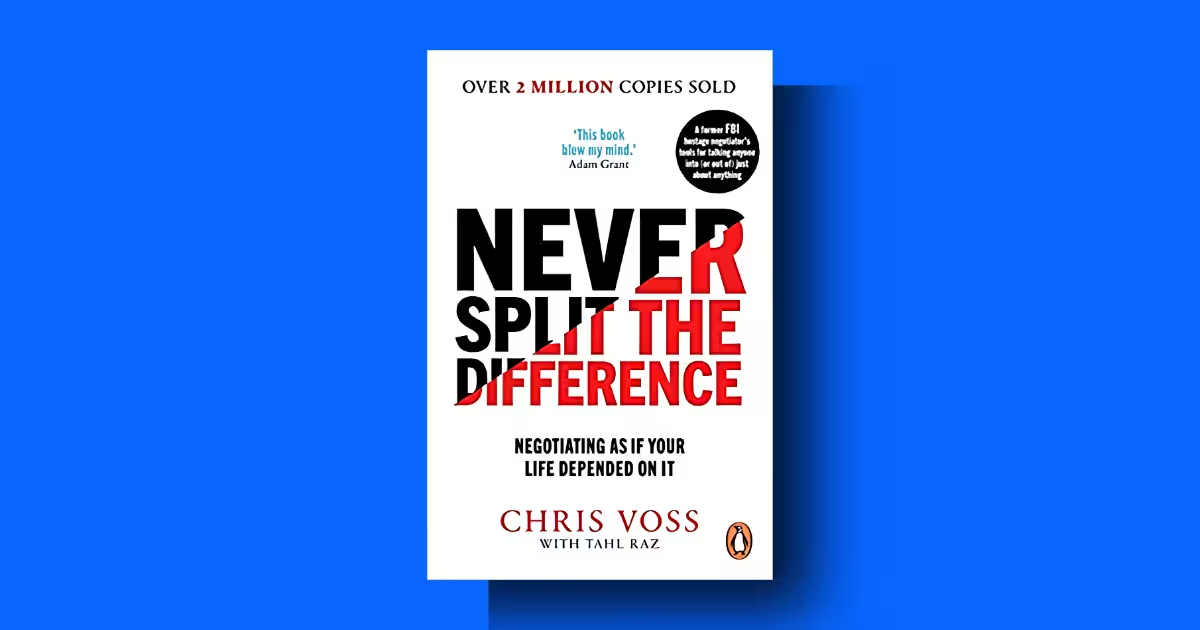
Never Split the Difference: Negotiating As If Your Life Depended On It was written by Chris Voss with journalist Tahl Raz and published by HarperBusiness, an imprint of HarperCollins, in May 2016.
Voss earned a bachelor’s degree from Iowa State University and a Master of Public Administration from Harvard’s Kennedy School before joining the FBI, where he eventually became the Bureau’s chief international hostage and kidnapping negotiator, working more than 150 international cases between 2003 and 2007.
After he retired, he founded The Black Swan Group and went on to teach negotiation as an adjunct professor at Georgetown University’s McDonough School of Business, a lecturer at USC’s Marshall School of Business, and later at Harvard Law School.
The book’s genre sits at the crossroads of business psychology and true crime. Voss opens with the story of the day he walked into Harvard Law School’s Program on Negotiation and out-negotiated two of its top professors, Robert Mnookin and Gabriella Blum, in a mock kidnapping role-play (p. 3).
That single scene sets up his central thesis: the “rational actor” model that dominated negotiation theory for decades, most famously articulated in Roger Fisher and William Ury’s 1981 book Getting to Yes, gets the human mind backward. People are not calculators.
They are, in Voss’s own words, “crazy, irrational, impulsive, emotionally driven animals” (p. 8), and the negotiator who accepts that fact and works with it will beat the negotiator who is still trying to out-logic the room.
Background
You do not need much history to follow the book, but a little context sharpens it. Hostage negotiation as an actual discipline, rather than just sending in a SWAT team, only became standard American law enforcement policy after two disasters: the 1971 Attica prison uprising, where thirty-nine hostages died when police stormed the building, and a botched hijacking on a Jacksonville, Florida tarmac that same year, in which hijacker George Giffe Jr. murdered two hostages after FBI agents shot out his plane’s engine.
The resulting 1975 federal court decision, Downs v. United States, ruled that law enforcement had turned “a successful ‘waiting game'” into “a ‘shooting match'” and ordered that a real attempt at negotiation must happen before any tactical assault (p. 10). That ruling created the modern hostage negotiation unit, and Voss spent his career inside the system it built.
By the 1990s, though, the FBI had a second problem. Its negotiators had been trained on Getting to Yes, which works well when both sides want a rational, mutually beneficial deal. It works terribly on a man who has just taken hostages during a psychotic break, or a kidnapper who genuinely believes he is fighting a holy war.
After the fatal 1992 Ruby Ridge siege and the 1993 Waco standoff, the Justice Department commissioned a review that led directly to a retooled approach built on psychology and crisis intervention rather than problem-solving logic (pp. 13 to 15). Never Split the Difference is Voss’s attempt to take that retooled, emotion-first approach out of the FBI and hand it to the rest of us.
Never Split the Difference Summary
Here is every major technique in the book, in the order Voss teaches them, so you walk away with the whole system rather than a vague impression of it.
Chapter 1 to 2: Active Listening, Mirroring, and the Late-Night FM DJ Voice
Voss opens by dismantling the idea that a good negotiator talks the other side into submission. Instead, he argues that “listening is the cheapest, yet most effective concession we can make” (p. 16), and that, contrary to how it feels, “listening is not a passive activity” (p. 16).
His first concrete tool is mirroring: repeating back the last one to three words someone just said. He demonstrates it during a real 1993 Chase Manhattan Bank robbery in Brooklyn, where he calmly mirrored a hostage-taker’s own words until the man, in Voss’s phrase, started “vomiting information” (p. 35) and accidentally revealed an accomplice the FBI did not know existed.
Paired with mirroring is what Voss calls the late-night FM DJ voice, a slow, downward-inflected tone that signals calm and control without a single aggressive word.
Chapter 3: Tactical Empathy and Labeling
This is the book’s philosophical core. Voss defines tactical empathy as “understanding the feelings and mindset of another in the moment” so that you can use that understanding to your advantage later (p. 52), and he is careful to separate it from sympathy: you do not have to agree with someone to understand them.
His main technique here is labeling, where you name someone’s emotion out loud, usually starting with “It seems like…,” “It sounds like…,” or “It looks like…,” and then go silent. During a real six-hour standoff with armed fugitives in Harlem, Voss and his team repeated a single labeled observation, telling the men through the door that “It looks like you don’t want to go back to jail” (p. 61), until all three walked out with their hands up.
He also introduces the accusation audit, where you preemptively say the worst thing your counterpart could think about you before they say it, which strips the accusation of its power.
Chapter 4 to 5: Why “No” Is Better Than “Yes,” and the Two Magic Words
Voss spends an entire chapter arguing that negotiators chase “yes” for exactly the wrong reasons. He writes plainly that “for good negotiators, ‘no’ is pure gold” (p. 75), because a “no” from your counterpart protects their sense of autonomy and actually opens the real conversation, while an early “yes” is usually a “counterfeit yes,” a stall tactic dressed up as agreement (p. 81). From there he moves to the two words he considers more valuable than an outright “yes”: “that’s right.”
He tells the story of the four-month ransom negotiation for kidnapped American Jeffrey Schilling in the Philippines, where his colleague Benjie finally broke the impasse not by arguing with rebel leader Abu Sabaya, but by summarizing Sabaya’s entire worldview back to him so completely that Sabaya’s only possible answer was “that’s right” (p. 104).
Two weeks later, Schilling escaped his captors alive.
Chapter 6: Bending Reality with Anchors, Deadlines, and Fairness
Here Voss makes his most quotable and most contested claim: “no deal is better than a bad deal” (p. 115), and he illustrates it with the image of a couple compromising on shoe color and ending up with one black shoe and one brown shoe, which he calls the worst possible outcome of a negotiation (p. 115).
He walks through extreme anchoring (naming a deliberately aggressive first number to reset expectations), using odd, non-round numbers because they feel calculated rather than guessed, and the psychological power of the word “fair,” which he calls one of the most loaded words in any negotiation because most people will make an irrational concession the moment they feel accused of being unfair.
Chapter 7 to 8: Calibrated Questions and Guaranteeing Follow-Through
Voss’s single most famous tool lives here: the calibrated question, built almost entirely from “what” and “how,” deliberately avoiding “why,” which he says almost always sounds accusatory (pp. 153 to 154).
A calibrated question such as “How am I supposed to do that?” lets you say “no” without ever using the word, while making your counterpart feel they are the one solving the problem. He backs this with the real 2003 kidnapping of ecotourism guide José in Ecuador, where his team coached the victim’s wife, Julie, to answer every ransom demand with a question rather than a number, stalling the rebels for so long that José eventually escaped on his own during a rainstorm (pp. 165 to 167).
Voss also introduces the Rule of Three, getting someone to confirm the same commitment three separate ways in one conversation, because it is “really hard to repeatedly lie or fake conviction” (p. 177).
Chapter 9: The Ackerman Bargaining Model
For the actual haggling stage, Voss lays out a six-step system named after CIA veteran Mike Ackerman: set your real target price, open at 65 percent of it, plan three rising counteroffers at roughly 85, 95, and 100 percent of your goal, use empathy and “no” language between each one to make the other side counter first, land on a precise, non-round final number such as $37,893 instead of $38,000, and throw in one unrelated, low-cost item at the very end to signal you have truly reached your limit (p. 206).
He also sorts negotiators into three working styles, Analyst, Accommodator, and Assertive, and argues you should identify your counterpart’s style before you decide which tactic to use on them (pp. 192 to 197).
Chapter 10: Finding the Black Swan
Never Split the Difference closes on what Voss considers his most important idea. A Black Swan is a piece of information that is completely unknown to you at the start of a negotiation, but that would change everything if you found it, and he argues every negotiation contains three to five of them (p. 218).
He proves the concept with the tragic 1981 case of William Griffin, a Rochester, New York bank robber who took hostages and then, unlike every hostage-taker on record before him, deliberately provoked police into killing him.
Negotiators at the time had no framework for a hostage-taker who wanted to die, so they missed every warning sign until it was too late (pp. 213 to 217). Voss uses that failure to teach a genuinely useful habit: when someone’s behavior does not make sense, do not label them crazy. Assume they are working from information, a constraint, or an interest you simply have not uncovered yet, and go find it.
Does Chris Voss Actually Prove His Techniques Work?
Mostly, yes, and this is where Never Split the Difference earns real credibility instead of borrowed authority. Voss does not ask you to trust a theory. He backs almost every technique with a specific, named, dated case: the 1993 Chase Manhattan robbery, the Philippines kidnapping of Jeffrey Schilling, the Ecuador kidnapping of José and Julie, the 1981 Rochester bank standoff.
He also brings in outside academic support that checks out under scrutiny.
His account of Daniel Kahneman and Amos Tversky’s prospect theory research, including loss aversion and the framing effect, matches the actual, Nobel Prize-winning body of work Kahneman later summarized in Thinking, Fast and Slow (p. 12).
His retelling of psychologist Richard Wiseman’s waiter study, where mirroring customers’ orders produced 70 percent higher tips than generic positive phrases like “great” and “no problem” (p. 36), lines up with Wiseman’s published research.
And the “Pinocchio Effect” study he cites, where liars use measurably more words and more third-person pronouns than truth-tellers, is a real, peer-reviewed paper co-authored by Harvard Business School’s Deepak Malhotra, Lyn Van Swol, and Michael Braun in the journal Discourse Processes (p. 178). I checked all three, and none of them fell apart.
One claim did fall apart, though, and it is worth flagging precisely because most reviews of this book do not. On page 176, Voss invokes what he calls the “7-38-55 Percent Rule,” attributing to UCLA psychologist Albert Mehrabian the finding that only 7 percent of a message comes from words while 38 percent comes from tone and 55 percent from body language.
That statistic is real, but Mehrabian’s original 1967 studies tested something much narrower than “communication” in general: they measured how thirty and thirty-seven female participants interpreted single spoken words describing feelings, specifically when the tone or face contradicted the word.
Mehrabian himself later clarified that “unless a communicator is talking about their feelings or attitudes, these equations are not applicable,” and researchers now routinely describe the 7-38-55 rule as one of the most widely misapplied statistics in communication training.
Voss is far from the only author guilty of stretching it into a universal law of human speech, but a book this insistent on evidence-based technique deserved a more careful footnote here.
Strengths and Weaknesses of Never Split the Difference
What compelled me most about this book is how immediately usable it is. I tried the calibrated question “How am I supposed to do that?” on a landlord within a week of finishing the manuscript, and it worked almost exactly the way Voss describes it, which is a rare thing for a business book to deliver.
The writing itself moves fast, structured as a series of tense, dramatic stories rather than dry principle-by-principle lecturing, and that narrative pull is precisely why so many readers, myself included, finish it in a couple of sittings instead of letting it collect dust on a shelf.
The weaknesses cluster in two places. First, the evidence problem described above: a handful of statistics and studies get slightly oversold, and a reader who takes every number in the book at face value without checking will occasionally repeat a shaky claim in a client meeting. Second, and more structurally, Voss’s stakes are almost never your stakes.
Talking down a kidnapper holding a ransom demand is not the same emotional environment as asking your manager for a raise, and while the underlying psychology genuinely transfers, a few of the case studies romanticize hostage negotiation in a way that can make ordinary business haggling feel oddly deflating by comparison.
Never Split the Difference also leans heavily on Voss’s own consulting business, The Black Swan Group, in ways that occasionally read like a soft advertisement rather than pure teaching.
How Does Never Split the Difference Compare to Similar Books?
If you have already read Fisher and Ury’s Getting to Yes, you will notice that Voss is arguing directly against its central premise. Getting to Yes assumes both sides can be coaxed toward a rational, mutually beneficial outcome once emotion is separated from the problem.
Voss’s entire career convinced him that separation is impossible, because for a huge share of real negotiations, “their emotions are the problem” (p. 49).
Robert Cialdini’s Influence covers some of the same psychological ground, particularly reciprocity and the power of loss aversion, but Cialdini writes as a research psychologist cataloguing persuasion principles, while Voss writes as a practitioner narrating what actually happened in a room with a gun in it.
If you want the academic backbone behind concepts like anchoring and framing that Voss uses more loosely, Cialdini and Kahneman are the better starting points; readers who want a wider survey of how human decision-making actually works alongside these ideas might also enjoy Sopranu‘s roundup of the 100 best psychology books of all time or our list of life-changing books on human behavior, both of which sit comfortably on the same shelf as this one.
Deepak Malhotra and Max Bazerman’s Negotiation Genius, which Voss himself cites approvingly in Chapter 10, is the closer academic cousin, built on Harvard Business School case studies rather than FBI ones, and it treats “irrational” counterparts with the same curiosity Voss brings to the table.
If your negotiations tend to be personal rather than professional, tense family conversations rather than salary talks, Douglas Stone, Bruce Patton, and Sheila Heen’s Difficult Conversations pairs surprisingly well with this book, since Sheila Heen actually appears in Voss’s own origin story as his Harvard negotiation instructor (p. 5).
Who Should Actually Read This Book?
Never Split the Difference earns its reputation as one of the most practical negotiation books published in the last decade. Voss did not write a management theory text; he wrote a field manual built from more than 150 real kidnapping cases and a second career spent testing the same tools on MBA students, salespeople, and corporate clients.
The techniques inside it, mirroring, labeling, calibrated questions, the Ackerman model, hunting for Black Swans, are specific enough that you can start using them in a conversation this week, and that combination of clarity and immediacy is genuinely rare in the genre.
I would recommend it without hesitation to anyone who negotiates for a living or negotiates their own life, salaries, rent, contracts, custody arrangements, difficult family conversations, and to anyone who has ever frozen up the moment a conversation turned into a confrontation.
I would recommend it with one small caveat to readers who plan to teach these techniques to others professionally: verify the handful of statistics you plan to repeat, because Voss’s storytelling instincts are better than his footnoting instincts, and the gap between the two is the one place this excellent book asks a little too much of your trust.
References:
- Voss, Chris, with Tahl Raz. Never Split the Difference: Negotiating As If Your Life Depended On It. HarperBusiness, 2016. (All in-text page citations refer to this edition.)
- Christopher Voss – Wikipedia
- Downs v. United States, 522 F.2d 990 (6th Cir. 1975) – OpenJurist
- The 7-38-55 Rule: Debunking the “Golden Ratio” of Conversation – Big Think
- Albert Mehrabian – Wikipedia
- How to Spot a Liar (Malhotra, Van Swol, Braun’s Pinocchio Effect study) – Harvard Business School Working Knowledge
- “Never Split the Difference” Review – Happy Brain Science