
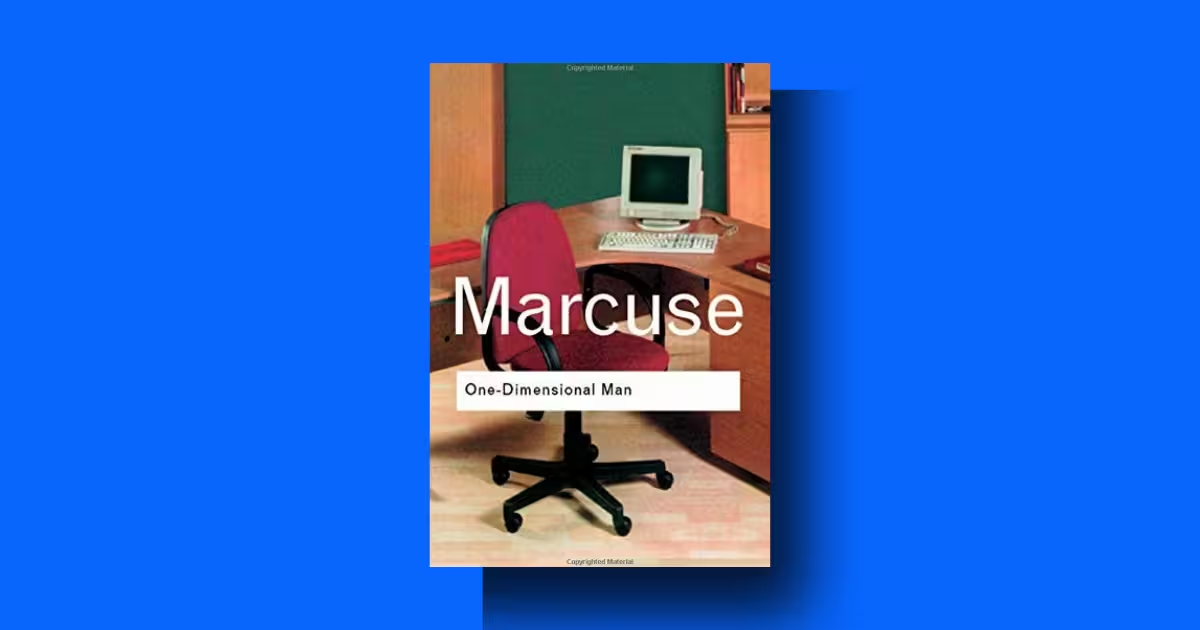

Do you ever feel like your thoughts aren’t really your own—like the options you have, the things you want, even the way you see the world have all been pre-packaged and handed to you? Herbert Marcuse’s One-Dimensional Man argues that this feeling isn’t paranoia, it’s the defining condition of modern life.
Overview
One-Dimensional Man: Studies in the Ideology of Advanced Industrial Society (1964) is philosopher Herbert Marcuse’s searing critique of how modern capitalism and technology have created a society where genuine opposition, critical thinking, and the very possibility of imagining a different way of life have been systematically eliminated.
Marcuse, a key figure in the Frankfurt School of Critical Theory, argues that advanced industrial societies, both capitalist and communist, have developed sophisticated mechanisms of control that go far beyond overt repression.
Through mass media, advertising, the manipulation of needs, and the transformation of rationality itself into a tool of domination, these societies produce citizens who are comfortable, compliant, and incapable of recognizing their own unfreedom.
The book became an ideological bible for the New Left in the 1960s, and its insights remain disturbingly relevant today. Marcuse doesn’t offer easy solutions, but he provides something perhaps more valuable: a language for understanding why genuine change feels so impossible, and why the “happy consciousness” of consumer society might be its most dangerous feature.
Reader recommendation
I recommend One-Dimensional Man to readers who are frustrated with the emptiness of consumer culture, suspicious of the way mass media shapes public opinion, or looking for a rigorous philosophical framework to understand modern alienation. If you’ve ever felt that something fundamental is wrong with society but couldn’t quite put your finger on it, Marcuse gives you the concepts and the language.
I don’t recommend One-Dimensional Man to anyone looking for a quick, uplifting read or practical solutions to social problems.
Marcuse’s prose is dense, academic, and deeply pessimistic. His conclusion, that the forces of liberation are weak and the system overwhelmingly powerful, can be genuinely depressing. If you’re not willing to sit with discomfort and complexity, this book will frustrate you.
Table of Contents
Background
Herbert Marcuse (1898–1979) was a German-American philosopher and critical theorist, born in Berlin and educated at the universities of Berlin and Freiburg. He was a central figure in the Frankfurt School, a group of thinkers who developed Critical Theory, an approach that combined Marxian social analysis with insights from Freud, Hegel, and Weber to critique modern capitalist society.
Marcuse studied with Martin Heidegger in the 1920s and early 1930s, and this early engagement with phenomenology and existentialism left lasting marks on his thinking.
However, he broke with Heidegger after the rise of National Socialism and Heidegger’s affiliation with the Nazi party. Marcuse fled Germany, eventually joining the Frankfurt Institute for Social Research in exile; first in Geneva, then in New York, where the Institute affiliated with Columbia University.
During World War II, Marcuse worked for the U.S. Office of Strategic Services (the precursor to the CIA) and later the State Department, analyzing fascism and contributing to the war effort against Nazi Germany. After the war, he returned to academia, teaching at Columbia, Harvard, Brandeis, and finally the University of California, San Diego.
By the 1960s, Marcuse had become an unlikely celebrity, dubbed “the foremost philosopher of the New Left” by The New York Times and hailed as a “guru” by student radicals around the world. “One-Dimensional Man,” published in 1964, was his most influential work.
One-Dimensional Man Summary
Reading One-Dimensional Man is like having someone hand you a pair of glasses that lets you see the invisible architecture of modern life. Marcuse systematically dismantles the myths of freedom and progress that we take for granted, showing how the very things that seem to make us free are actually the instruments of our containment.
The Central Thesis: We Live in a Closed Universe
Marcuse’s core argument is that advanced industrial society has created a “one-dimensional” universe of thought and behavior. What does this mean? It means that all ideas, aspirations, and objectives that transcend the established system, that imagine a fundamentally different way of organizing society, are either repelled or reduced to terms that fit within the existing framework.
“Thus emerges a pattern of one-dimensional thought and behavior in which ideas, aspirations, and objectives that, by their content, transcend the established universe of discourse and action are either repelled or reduced to terms of this universe.”
This isn’t the result of overt censorship or terror. It’s much more insidious. The system works through technological rationality, the way that technology and scientific thinking become the dominant mode of understanding everything, including human beings.
The New Forms of Control: How We’re Managed Without Realizing It
Marcuse opens the book with a striking claim: “A comfortable, smooth, reasonable, democratic unfreedom prevails in advanced industrial civilization, a token of technical progress”. This is the paradox at the heart of his analysis. The very things we celebrate, rising living standards, technological convenience, political stability, are also the instruments of our servitude.
The key mechanism is the production of false needs. Marcuse distinguishes between true needs, the vital ones like nourishment, clothing; and shelter, and false needs, which are “superimposed upon the individual by particular social interests in his repression”. These false needs include the urge to relax in prescribed ways, to consume according to advertisements, to love and hate what others love and hate.
“Most of the prevailing needs to relax, to have fun, to behave and consume in accordance with the advertisements, to love and hate what others love and hate, belong to this category of false needs.”
The genius of this system is that people genuinely identify with these needs. They find themselves in their commodities:
“The people recognize themselves in their commodities; they find their soul in their automobile, hi-fi set, split-level home, kitchen equipment.”
Marcuse argues that this identification isn’t an illusion, it’s real. But it constitutes a more advanced stage of alienation:
“This identification is not illusion but reality. However, the reality constitutes a more progressive stage of alienation. The latter has become entirely objective; the subject which is alienated is swallowed up by its alienated existence.”
The Closing of the Political Universe: Where Did All the Opposition Go?
One of the most striking aspects of Marcuse’s analysis is his claim that the working class, which Marx had identified as the revolutionary force that would overthrow capitalism, had been integrated into the system.
“The former conflicts within society are modified and arbitrated under the double (and interrelated) impact of technical progress and international communism. Class struggles are attenuated.”
In the United States, Marcuse observed the collusion between business and organized labor. In Western Europe, social democratic and communist parties had abandoned revolutionary politics in favor of working within the parliamentary system. The result was a political universe where meaningful opposition had all but disappeared.
Marcuse doesn’t deny that living standards had improved. But he argues that this improvement came at the cost of genuine freedom:
“The slaves of developed industrial civilization are sublimated slaves, but they are slaves, for slavery is determined not by obedience, nor by the hardness of labor, but by the status of instrument and the reduction of man to the state of a thing.”
The Conquest of the Unhappy Consciousness: Repressive Desublimation
This is one of Marcuse’s most original and disturbing concepts. Drawing on Freud, he argues that advanced industrial society has found a way to absorb and neutralize the very forces that once threatened it, including sexuality and artistic expression.
In earlier eras, art and literature contained a negative or oppositional power. They presented images of another way of life, of freedom and fulfillment that contradicted the reality of domination. But in the one-dimensional society, these images are incorporated into the system:
“The higher culture of the West—whose moral, aesthetic, and intellectual values industrial society still professes—was a pre-technological culture… Its validity was derived from the experience of a world which no longer exists and which cannot be recaptured because it is in a strict sense invalidated by technological society.”
Marcuse uses the example of sexuality to illustrate repressive desublimation. In classical literature, sexuality was presented in a highly sublimated form that was uncompromising and unconditional, it refused and exploded the established reality. In contemporary culture, by contrast, sexuality is “liberated” in a way that makes it harmless:
“What happens is surely wild and obscene, virile and tasty, quite immoral—and, precisely because of that, perfectly harmless.”
The result is a Happy Consciousness, a state in which people believe that the real is rational and that the system delivers the goods. This happy consciousness is the ultimate form of control because it makes people complicit in their own domination.
The Closing of the Universe of Discourse: How Language Itself Is Controlled
Marcuse argues that language itself has been co-opted. The prevailing modes of speech eliminate the tension between appearance and reality, between fact and possibility. Words are reduced to their function in the existing system.
He points to the way that political language has become a form of hypnotic formula:
“Such nouns as ‘freedom,’ ‘equality,’ ‘democracy,’ and ‘peace’ imply, analytically, a specific set of attributes which occur invariably when the noun is spoken or written.”
In the West, “freedom” means free enterprise, elections, and individual rights. In the East, it means building communism and the abolition of hostile classes. On either side, any transgression beyond this closed structure is dismissed as propaganda.
“The result is the familiar Orwellian language (‘peace is war’ and ‘war is peace,’ etc.), which is by no means that of terrorist totalitarianism only.”
One-Dimensional Thought: The Triumph of Positive Thinking
Part II of the book is Marcuse’s most philosophical section, where he traces the historical development of negative thinking (dialectical thought that sees the existing world as deficient and in need of transformation) and its replacement by positive thinking (thought that accepts the existing world as the only possible one).
Marcuse locates the origins of negative thinking in ancient Greek philosophy, where Reason was understood as the cognitive faculty to distinguish truth from falsehood—and truth was understood as a condition of Being, of Reality. The philosopher Socrates, by questioning the established order, was engaged in a subversive act.
But over time, formal logic developed as a way of thinking that was indifferent toward its objects:
“In this formal logic, thought is indifferent toward its objects. Whether they are mental or physical, whether they pertain to society or to nature, they become subject to the same general laws of organization, calculation, and conclusion.”
This formal logic, Marcuse argues, is the intellectual counterpart of technological rationality—the mode of thinking that reduces everything to calculable, controllable units. It’s the logic of domination.
The Chance of the Alternatives: Is There Any Hope?
The final section of the book is the most sobering. Marcuse asks whether there are any forces left that could challenge the one-dimensional society. His answer is not encouraging.
The traditional revolutionary subject, the working class, has been integrated into the system. The only remaining force of opposition might be the outsiders and outcasts:
“However, underneath the conservative popular base is the substratum of the outcasts and outsiders, the exploited and persecuted of other races and other colors, the unemployed and the unemployable. They exist outside the democratic process; their life is the most immediate and the most real need for ending intolerable conditions and institutions.”
But even this is only a chance. Marcuse concludes with a quote from Walter Benjamin:
“It is only for the sake of those without hope that hope is given to us.”
One-Dimensional Man Analysis
One-Dimensional Man is one of those rare books that fundamentally changes how you see the world. Reading it for the first time, I felt like I had been walking through a fog and suddenly the fog lifted.
Marcuse gives you a vocabulary for understanding things you’ve always felt but couldn’t articulate—the emptiness of consumer culture, the way that “freedom” feels like a trap, the sense that genuine alternatives have somehow disappeared.
What Makes It Powerful
The book’s greatest strength is its scope. Marcuse doesn’t just critique one aspect of society, he connects everything. The economy, politics, culture, language, psychology, and philosophy all form part of a single system of domination. Reading him, you understand why piecemeal reforms never seem to change anything fundamental.
His concept of false needs is perhaps his most enduring contribution. In an age of targeted advertising, social media algorithms, and influencer culture, Marcuse’s insight that our desires are manufactured for us seems almost prophetic. The question “What do I actually want?” becomes increasingly difficult to answer when everything you want has been presented to you as desirable.
His analysis of technological rationality also feels more relevant than ever. We live in a world where everything is being optimized, measured, and quantified, including our own behavior. The idea that this rationality is not neutral but serves specific political ends is a crucial insight.
Where It Falls Short
That said, the book has significant weaknesses. Marcuse’s prose is dense and often impenetrable. He writes in the tradition of German idealism, and his sentences can be long, abstract, and burdened with jargon. This makes the book inaccessible to many readers, which is ironic given its subject matter.
More seriously, the book is deeply pessimistic. Marcuse argues that the system is so powerful, so all-encompassing, that genuine change is almost impossible. This can be paralyzing. If you accept his analysis, what’s left to do?
The book’s conclusion, that only the outcasts and outsiders might spark change, feels like a thin reed to hang hope on.
Some critics have argued that Marcuse’s pessimism was self-defeating. By emphasizing the power of the system, he may have inadvertently discouraged the very opposition he wanted to encourage. Others have pointed out that his analysis of the working class was premature—the 1960s saw massive social upheaval, much of it led by students and workers.
There’s also the question of elitism. Marcuse seems to suggest that the masses are too indoctrinated to recognize their own unfreedom, and that only an enlightened few (intellectuals, artists, outsiders) can see clearly. This sits uneasily with the democratic impulses of much critical theory.
Strengths and Weaknesses
Strengths
Prophetic accuracy: Many of Marcuse’s predictions about the integration of opposition, the role of mass media, and the transformation of needs have proven remarkably accurate.
Comprehensive analysis: Few books attempt to connect so many different domains of life into a single coherent critique.
Conceptual innovation: Terms like “false needs,” “repressive desublimation,” and “technological rationality” have become essential tools for understanding modern society.
Intellectual honesty: Marcuse doesn’t pretend to have easy answers. He confronts the difficulty of the situation head-on.
Weaknesses
Dense prose: The book is notoriously difficult to read, which limits its audience.
Pessimism: The overwhelming bleakness can be demoralizing.
Elitism: The implication that only intellectuals can see the truth is uncomfortable.
Lack of solutions: Marcuse diagnoses the problem brilliantly but offers little guidance on what to do about it.
Dated examples: Some of the specific references (to Cold War politics, 1950s consumer culture, etc.) feel dated.
Comparison With Similar Works
One-Dimensional Man shares DNA with several other important works of 20th-century social criticism:
Theodore Adorno and Max Horkheimer’s Dialectic of Enlightenment (1944): This earlier Frankfurt School text explores how Enlightenment rationality, intended to liberate humanity, became a new form of domination. Marcuse builds on their insights but applies them more directly to the postwar consumer society.
C. Wright Mills’ The Power Elite (1956): Mills’ analysis of the interlocking power structures of corporate, military, and political elites anticipates Marcuse’s argument about the integration of opposition.
Daniel Bell’s The End of Ideology (1960): Bell argued that ideological politics had become obsolete in the West. Marcuse essentially agrees that ideology has ended, but he sees this as a tragedy rather than a triumph, the end of ideology means the end of critical thought.
George Orwell’s Nineteen Eighty-Four (1949): Marcuse explicitly references Orwell’s language of control (“peace is war,” etc.), but he argues that the reality of one-dimensional society is more insidious than Orwell’s dystopia. In Marcuse’s world, we don’t need to be forced to comply, we happily comply on our own.
Conclusion
One-Dimensional Man is not an easy book, and it’s not a hopeful one. But it is an essential one. Marcuse gives us the tools to understand why genuine change feels so difficult, why our desires seem to align so perfectly with the needs of the system, and why the very concept of a radically different way of life has become almost unimaginable.
The book’s central insight, that the most effective form of control is the one that makes you believe you’re free, s more relevant today than ever. In an age of social media algorithms, targeted advertising, and personalized content, we are constantly being shaped by forces we barely perceive. Marcuse’s call for “negative thinking”—for refusing to accept the world as it is, for insisting on the possibility of something different—is a vital intellectual and moral imperative.
If you’re willing to struggle with difficult ideas and sit with uncomfortable truths, One-Dimensional Man will reward you with a deeper understanding of the world you live in; and perhaps, just perhaps, a sense of why it’s worth fighting for something better.
“It is only for the sake of those without hope that hope is given to us.”
FAQs
Q: What is One-Dimensional Man about?
A: One-Dimensional Man is Herbert Marcuse’s 1964 critique of advanced industrial society, arguing that modern capitalism and technology have created a system where genuine opposition and critical thinking are systematically eliminated. The book examines how mass media, advertising, and the manipulation of needs produce citizens who are comfortable, compliant, and incapable of imagining a different way of life.
Q: Why did One-Dimensional Man become so influential?
A: The book resonated deeply with the emerging New Left in the 1960s because it provided a comprehensive critique of both capitalist and communist societies, articulating the frustrations of a generation concerned about conformity, consumer culture, and the lack of genuine political alternatives.
Q: Is One-Dimensional Man still relevant today?
A: Yes. Marcuse’s analysis of technological rationality, false needs, and the integration of opposition has become even more relevant in the age of social media, targeted advertising, and algorithmic control. His insights into how technology shapes consciousness and limits the imagination of alternatives remain crucial for understanding contemporary society.
Q: Is One-Dimensional Man difficult to read?
A: Yes. Marcuse writes in the tradition of German idealism, with dense, abstract prose and specialized jargon. The book is challenging but rewarding for readers willing to engage with complex philosophical ideas.
Q: What is “technological rationality” in Marcuse’s work?
A: Technological rationality is Marcuse’s term for the mode of thinking that reduces everything to calculable, controllable units. It’s the logic of science and technology applied to human beings and society, and Marcuse argues it serves the interests of domination rather than liberation.