
Last updated on October 29th, 2026 at 08:58 pm
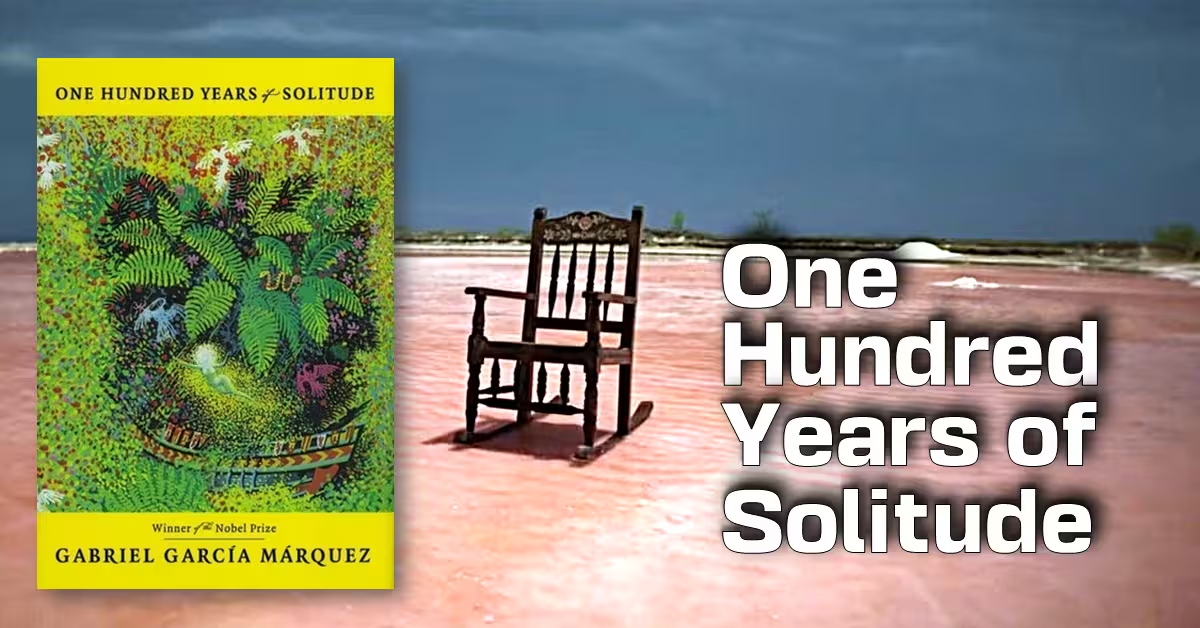
One Hundred Years of Solitude is Gabriel García Márquez’s 1967 novel about seven generations of the Buendía family, and it ends with the town of Macondo wiped off the earth at the exact moment the last Buendía finishes reading the family’s fate. It is also famously easy to get lost in, because the same handful of names return in every generation and time keeps looping back on itself.
Still, the book has sold more than 50 million copies in 46 languages, so the confusion clearly pays off.
Below you get the full plot with the ending explained, a family tree that sorts out the names, the real massacre behind the book’s darkest scene, and a plain answer on whether Netflix’s Spanish-language series, which wrapped up in August 2026, can stand in for the novel.
One Hundred Years of Solitude at a Glance
- What it is: a 1967 magical realist novel by Colombian author Gabriel García Márquez, first published in Buenos Aires and translated into English by Gregory Rabassa in 1970.
- The story: José Arcadio Buendía and his wife and cousin Úrsula Iguarán found Macondo. Their descendants repeat the same names, loves and mistakes through civil wars, a banana boom, a massacre and a flood of rain.
- The ending: Aureliano Babilonia, the last Buendía, decodes a manuscript that predicts his family’s whole history. Macondo vanishes in a hurricane while he reads.
- The big idea: solitude as both private pride and a political condition, and the price of forgetting.
- The real history: the strike massacre is based on the Ciénaga killings of December 1928.
- On screen: Netflix’s series runs 16 episodes, with season 1 on 11 December 2024 and season 2 on 5 August 2026.
- My rating: 4.5 out of 5. Read it for the images and the ending. Skip it if you need a fast, tidy plot.
Who wrote One Hundred Years of Solitude, and when was it published?
Colombian author Gabriel García Márquez wrote One Hundred Years of Solitude (original title Cien años de soledad), and Editorial Sudamericana first published it in Buenos Aires in May 1967. Harper & Row brought out Gregory Rabassa’s English translation in the United States in 1970, with Jonathan Cape publishing it in the UK, and García Márquez said he preferred the English text to his own Spanish.
The usual genre label is magical realism, though I would call it a family saga that happens to contain miracles.
García Márquez (1927 to 2014) went on to win the 1982 Nobel Prize in Literature, the first Colombian and only the fourth Latin American writer to do so. The citation praised novels and stories in which the fantastic and the realistic merge into a richly composed world that reflects a whole continent’s life and conflicts.
Is One Hundred Years of Solitude worth reading?
Quick verdict
Yes, as long as you can live with a maze of repeating names. It is funny, brutal and heartbreaking in turns, and it earns its reputation. I recommend it to anyone who enjoys literary fiction where the weather, the dead and the politics all have opinions.
Should you read it?
| Reasons to read | Reasons to hesitate |
|---|---|
| Unforgettable images, from a rain of yellow flowers to a girl rising into the sky | Heavy name repetition: Aureliano appears 22 times in the family tree |
| A whole country’s history told through one family | The middle generations slow down |
| Comedy and tragedy often share a single sentence | Fate is announced early, so there is little classic suspense |
| An ending that rewrites everything before it | Women often serve the men’s stories, which is my reading and not a settled view |
Rating
4.5 out of 5
What is One Hundred Years of Solitude about?
It follows the Buendía family through seven generations in Macondo, a made-up Colombian town founded in the jungle, from its dreamlike beginnings through civil wars, a banana boom and a massacre to its final erasure. On the surface it is a family saga.
Underneath, it is an argument about memory, repetition and the isolation that pride and history impose. Everything that happens was written down long ago by a wandering gypsy, and the family spends a century failing to read it.
What real history sits behind Macondo?
Macondo is invented, but its history is Colombia’s. García Márquez drew on his childhood in Aracataca, where his grandfather, a veteran of the Thousand Days’ War, supplied the rebellion stories, and his grandmother’s superstitions shaped the book’s tone.
The idea for the book came in 1965, when he was driving to Acapulco on holiday, turned the car around, drove back to Mexico City and spent about a year and a half writing it while his wife, Mercedes Barcha, managed the family’s money.
Three real episodes feed the plot. The Thousand Days’ War between Liberals and Conservatives ran from 1899 to 1902, and an estimated 130,000 people died. Later, a foreign fruit company arrived, and the novel’s American banana company stands in for the United Fruit Company.
Then, in December 1928, the army killed striking workers in Ciénaga. Britannica dates the killings to 6 December and calls them unprovoked, carried out by troops under General Carlos Cortés Vargas. The novel puts the dead at about three thousand, while published estimates range from 47 to roughly 2,000, and the true number is still unknown.
The book also belongs to the Latin American Boom of the 1960s and 1970s, the wave that put García Márquez beside Mario Vargas Llosa, Julio Cortázar and Carlos Fuentes.
One Hundred Years of Solitude plot summary
The founding of Macondo
One Hundred Years of Solitude begins inside its own ending. Colonel Aureliano Buendía, standing before a firing squad, remembers the afternoon his father took him to see ice for the first time. Then the book rewinds to the start.
José Arcadio Buendía and Úrsula Iguarán are cousins, and both families fear that a child of theirs will be born with a pig’s tail. They marry anyway. In their home town of Riohacha, José Arcadio kills a man named Prudencio Aguilar with a spear after a cockfight insult, and the dead man’s ghost keeps turning up until the couple leave. After a long trek they camp beside a river, José Arcadio dreams of a city of mirrors called Macondo, and he founds it on the spot.
For years the village is cut off from the world. Once a year gypsies led by Melquíades arrive with wonders: magnets, a telescope, a magnifying glass and ice. José Arcadio is swallowed by science and alchemy and drifts away from his family. Úrsula, practical and tireless, runs the house and a candy business, and she lives past a hundred.
Three children are born: José Arcadio, Aureliano and Amaranta. The family also adopts Rebeca, an orphan who arrives carrying a sack of her parents’ bones and eats dirt and whitewash. Rebeca unknowingly brings an insomnia plague that wipes out memory. People start labelling every object with its name and use, until Melquíades, who had been reported dead in Singapore, returns with a cure. He later dies for good and leaves behind parchments nobody can read.
The eldest son, José Arcadio, gets the fortune-teller Pilar Ternera pregnant and runs off with the gypsies. He comes back years later enormous and covered in tattoos, marries Rebeca, and is banished from the house with her. He soon dies of a mysterious gunshot, and a thread of blood runs across town to Úrsula’s kitchen.
Amaranta, who had battled Rebeca over the Italian music teacher Pietro Crespi, rejects him when he finally turns to her, and he kills himself.
She burns her hand and wears a black bandage over it for the rest of her life. Old José Arcadio Buendía goes mad at last, speaks only Latin and is tied to a chestnut tree. When he dies, a rain of yellow flowers falls on Macondo.
The wars
Macondo’s isolation ends when the government arrives. Don Apolinar Moscote comes as the town’s first magistrate, a rigged election between Conservatives and Liberals follows, and quiet Aureliano, who has married Moscote’s very young daughter Remedios, joins the Liberal rebellion. Remedios dies soon afterwards, during her pregnancy.
As Colonel Aureliano Buendía he fights thirty-two uprisings and loses every one, survives several attempts on his life, and fathers seventeen sons by seventeen women, all named Aureliano. Each carries an ash cross on the forehead that never fades. Years later nearly all of them are hunted down and murdered, and the last survivor is killed on his father’s doorstep.
Back in town, Arcadio, the son of José Arcadio and Pilar Ternera who never learns who his parents are, appoints himself ruler, turns schoolchildren into soldiers and terrorises Macondo until Conservative troops take it and shoot him. His partner, Santa Sofía de la Piedad, stays with the Buendías and bears three children: Remedios the Beauty and the twins José Arcadio Segundo and Aureliano Segundo.
Another of the Colonel’s sons, Aureliano José, is obsessed with his aunt Amaranta. She refuses his proposal, and he is shot dead in the war.
The Colonel himself is sentenced to death, which is the scene the book opened with, and his brother José Arcadio rescues him at the last minute. The war ends with a peace treaty at Neerlandia. Worn out, the Colonel fires a bullet into his own chest and survives.
He retreats to his workshop and spends his remaining years making tiny gold fishes, melting each batch down to start again. He dies beside the chestnut tree in the courtyard. Amaranta never marries, and she dies at peace with her own solitude.
The banana years and the rain
After the wars the railroad arrives, and with it the foreigners. A visitor named Mr. Herbert tastes the local bananas at the Buendía table, and soon a banana company sets up a plantation and its own fenced village across the river. Macondo booms.
The twins go separate ways. Aureliano Segundo loves parties and his mistress Petra Cotes, and he grows rich because their animals multiply wildly whenever the two make love. José Arcadio Segundo becomes a labour organiser on the plantations. Aureliano Segundo also marries Fernanda del Carpio, a rigid beauty from a ruined aristocratic family, who was brought to town to compete against Remedios the Beauty for carnival queen.
The carnival ends in bloodshed. Fernanda takes the household away from an ageing, blind Úrsula and runs it with an iron fist. Remedios the Beauty, so lovely that several men die over her, rises into the sky one afternoon while folding sheets.
Fernanda has three children: José Arcadio, who is sent to a seminary in Rome to become Pope; Meme, a musician with her father’s appetite for life; and Amaranta Úrsula. Meme falls in love with Mauricio Babilonia, a mechanic who is always trailed by yellow butterflies. Fernanda has him shot as a chicken thief, and he spends the rest of his long life paralysed. Meme is sent to a convent and never speaks again. She gives birth there to a boy, Aureliano, who is delivered to the house in a basket and raised as an orphan to hide the shame.
Then comes the strike. Plantation workers demand better conditions, and the army opens fire on the crowd in the square by the station. José Arcadio Segundo wakes up among the dead and walks home. The novel puts the toll at about three thousand.
By morning every official denies it: the company’s lawyers argue that it never had any workers, and the court rules that the workers never existed. Only José Arcadio Segundo remembers, and he shuts himself in Melquíades’s old room to study the parchments.
Rain follows for more than four years and rots everything. Aureliano Segundo’s herds die, his fortune goes, and he spends his last years digging for buried gold. When the rain finally stops, Úrsula dies, far older than anyone can say. The twins die in the same hour years later, and in the confusion each is buried in the other’s grave.
The last Buendías and the wind
Fernanda finally dies, and the house is half in ruins. José Arcadio comes back from Rome without ever becoming a priest, finds the gold Úrsula buried under her bed, wastes it on parties and a swimming pool, and is drowned by the teenage boys he lured into the house, who steal what is left.
Aureliano Babilonia stays on in the house, working at Melquíades’s parchments with some help from José Arcadio Segundo before the old man dies. His few friends scatter, and one of them, Gabriel, who shares a first name with the author, leaves for Paris.
Amaranta Úrsula, Fernanda’s youngest, returns from Europe with her much older Belgian husband, Gastón, whom she leads around on a silk leash. When Gastón’s airmail plan collapses because his plane is shipped to Africa by mistake, he goes to look for it, and Amaranta Úrsula writes to tell him she loves Aureliano Babilonia. Neither of them knows they are aunt and nephew, because Fernanda hid the boy’s parentage.
Their affair is total. While ants and rot eat the house around them, the pair lose themselves in each other, and Amaranta Úrsula is sure the child they are expecting will start the family over.
The baby is born with a pig’s tail, exactly what Úrsula feared a century earlier. Amaranta Úrsula bleeds to death in childbirth. In his grief Aureliano neglects the infant, and ants carry it away.
Pilar Ternera, the last living link to the town’s beginnings, dies after passing her 145th year. Aureliano goes back to the house, and at last he can read Melquíades’s parchments. They are the history of the Buendías, written in advance, and the epigraph says the first of the line is tied to a tree and the last is being eaten by ants. A wind begins to rise.
He skips ahead, desperate to reach the last page before it arrives, and realises that he is reading the very moment he is living.
Macondo, the city of mirrors from José Arcadio’s dream, was a mirage all along, and it will be erased from human memory the instant he finishes. The book’s closing line says that races condemned to one hundred years of solitude do not get “a second opportunity on earth.”
How does One Hundred Years of Solitude end?
In short, Aureliano Babilonia finishes deciphering Melquíades’s parchments, learns that they describe his own family’s rise and fall, and a hurricane erases Macondo while he reads the last lines. Here is how I read that ending.
First, the prophecy was never hidden. Melquíades recorded the family’s entire history in advance, and the Buendías lived inside it for a century without opening it. Second, the pig’s tail finally arrives, but the real curse is ignorance, not biology.
The parents never knew the omen, and they never knew that the fear had come true before, so the family keeps walking into its own history. Third, love does appear at the very end, and it comes too late.
Critic Gene Bell-Villada reads the arrival of love as the old Buendía egoism giving way, yet the child still dies. Finally, the parchments are the novel itself, a mirror inside a mirror, which is why the last page feels like the book swallowing its reader.
Who are the main characters in One Hundred Years of Solitude?
The cast is huge, but about ten people carry the book. The tree below shows the main line of descent, and the notes after it say what each key character does. The names repeat on purpose: the José Arcadios tend to be impulsive and enormous, while the Aurelianos tend to be withdrawn and lucid.
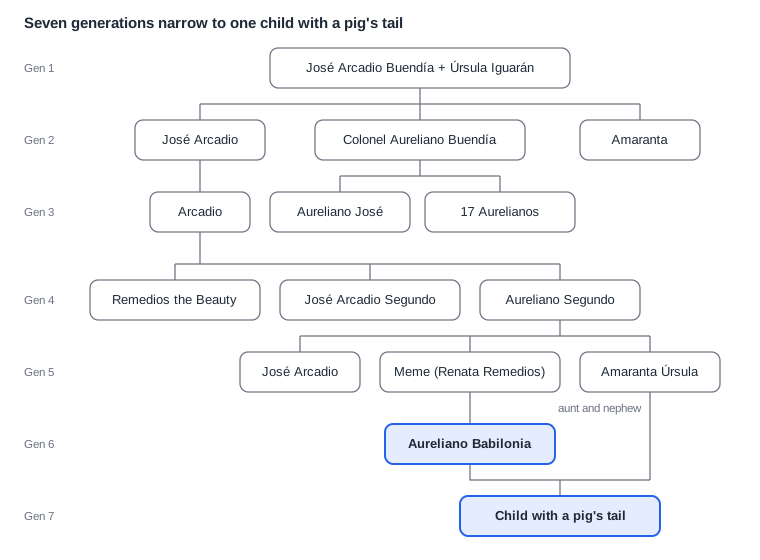
Highlighted boxes mark the last two generations. Amaranta has no children, and the Colonel’s sons, Aureliano José among them, die before the end, so the line that reaches the ending runs through Arcadio.
José Arcadio Buendía is the founder, a man of enormous energy who becomes the family’s first recluse. His curiosity builds Macondo and then swallows him, and he ends tied to a tree.
Úrsula Iguarán is the practical heart of the book. She lives well past a hundred, oversees six of the seven generations and often succeeds where the men fail.
Colonel Aureliano Buendía is the revolutionary who loses thirty-two wars and ends up making gold fishes. He is the book’s sharpest portrait of idealism hardening into a private war.
Amaranta is the most bitter solitude in the novel. She does everything she can to stop Rebeca’s wedding, even attempting to murder her, rejects every suitor and finally accepts what she has become.
Remedios the Beauty is so lovely and so detached from ordinary life that she literally floats out of it. Her ascent is the book’s best-known miracle.
Fernanda del Carpio is the outsider nobody accepts, a rigid aristocrat whose paranoia and letters to invisible doctors make her partly comic and partly cruel.
José Arcadio Segundo is the witness, the only survivor of the banana massacre and the one person who keeps the memory alive.
Aureliano Babilonia and Amaranta Úrsula are the last lovers, the first pair in the book to find real love, and they are punished for it.
Melquíades is the keeper of the archive. The gypsy who writes the family’s fate also carries a name that echoes Melchizedek, a mysterious priest in the Old Testament.
Pilar Ternera is the thread between generations, a fortune-teller who survives into the last days of Macondo, past 145 years old.
My assessment: most Buendías are built around one dominant obsession, such as science, war, gold or pride, and that is deliberate. They behave more like weather patterns than people. The exceptions, Úrsula and Amaranta above all, are the ones who actually change, and that is why I remember them best.
What are the major themes and symbols in One Hundred Years of Solitude?
Solitude as a private habit and a political fate
Almost every Buendía ends up alone, through pride, war, obsession or failed love. The town’s isolation makes the family more selfish over time, and critics read that selfishness as the habit of a land-owning elite. García Márquez widened the idea in his Nobel lecture, arguing that Latin America’s reality is so extreme that the region struggles to make its own life believable to outsiders. He called that the crux of our solitude.
Time that repeats
Names, traits and mistakes come back in every generation, so history feels like a circle. Over six generations, the José Arcadios keep their strength and the Aurelianos their quietness, and each generation repeats the last one’s errors. Yet the book is not purely circular. It also zigzags through flashbacks and leaps ahead, and its famous first sentence already looks back from the future toward the past.
Memory and forgetting
This is the theme that feels most alive today. The insomnia plague strips people of the names of things, and the banana massacre is scrubbed from the official record.
Against that, the parchments work as an archive, with Melquíades as its keeper. In Michael Wood’s reading, the novel is a place where beliefs and metaphors become forms of fact, and ordinary facts become uncertain.
Love against egoism
Love keeps trying to break the Buendía habit of loving only themselves. Aureliano Segundo and Petra Cotes discover solidarity during Macondo’s slump, and the pattern repeats with Aureliano Babilonia and Amaranta Úrsula. That last love produces the child with a pig’s tail, which is the cruelest joke in the book.
Incest and the pig’s tail
The fear of a monstrous child starts early and returns on the final pages. One reading treats the tail as a symbol of an elite family that loves itself literally and refuses to learn from its past, which is why even the names repeat. I read it more simply: the tail is what a family becomes when it stops looking outside itself.
Symbols worth tracking
Yellow and gold: gold stands for the hunt for wealth, and yellow for death, change and destruction. Think of the butterflies that follow Mauricio Babilonia and the yellow flowers that fall when José Arcadio Buendía dies.
Mirrors and mirages: the city of mirrors in José Arcadio’s dream turns into a city of mirages by the last page.
Ice: the book’s first marvel opens the novel, and one scholarly reading sees ice and the glass city as images of a continent whose history was already outlined for it.
Ants: they eat the house, the baby and, in the epigraph, the last Buendía.
The flat tone: the term magical realism was coined by the art critic Franz Roh in 1925, and scholars describe the novel’s calm voice as unastonished, which is what lets impossible events feel ordinary.
My verdict on One Hundred Years of Solitude
One Hundred Years of Solitude is a dizzying, merciless and oddly tender novel that squeezes a century into one long afternoon and then shuts the door. Reading it felt like being handed a family album by a relative who loves you and will not stop talking.
What works
The images are the reward: a rain of yellow flowers, a girl folding sheets as she rises into the sky, a man tied to a chestnut tree speaking Latin.
The comedy matters as much as the grief. Even the insomnia plague has its jokes, since people start labelling cows and chairs so they will not forget what they are.
And the book keeps an entire country in view without ever losing the family at its centre. Harold Bloom described rereading it as a kind of “aesthetic battle fatigue”, because every page holds more life than a single reader can absorb.
What doesn’t
The names are the obvious snag. I needed the family tree open for much of my reading, and even then I lost the thread. The middle generations also slow down, and the war chapters and the long rain can blur together. And while Úrsula is magnificent, many other women, Remedios the Beauty above all, seem to exist as objects of desire or as punishments for the men. That is a fair complaint, not a settled verdict.
Impact and controversy
The book changed what other writers believed fiction could do. Pablo Neruda called it the greatest revelation in the Spanish language since Don Quixote, and a survey of international writers for the journal Wasafiri ranked it first among the books that had most shaped world literature over the previous 25 years. Its afterlife keeps surprising people.
In 2024, a Japanese paperback edition sold 290,000 copies in eight weeks, close to what three hardcover printings had sold in the previous 52 years, after a first Japanese print run of only 4,000 copies in 1972.
The controversy is about the massacre. In November 2017 Colombian lawmaker María Fernanda Cabal called the 1928 banana massacre a historical myth and said García Márquez invented the three thousand dead, arguing that it was an armed confrontation.
Colombia Reports noted that the event itself has never been seriously disputed, and that only the death toll is debated. I come back to that in the lessons below.
Comparison with similar works
Pedro Páramo by Juan Rulfo is a shorter, ghostlier Latin American classic, grouped with One Hundred Years of Solitude among five key Hispanic American novels by the scholar Antonio Sacoto.
William Faulkner’s Yoknapatawpha novels matter here too. David Haberly has argued that García Márquez borrowed ideas from Faulkner’s fictional county, and Absalom, Absalom! makes a good companion read.
Toni Morrison’s Beloved pairs well with it, because scholar Daniel Erickson treats the ghosts in both books as symbols of the past’s hold on the present.
Salman Rushdie’s Midnight’s Children is my own pick: another novel that tells a nation’s story through one family and a generous dose of magic.
Is the Netflix series faithful to the book?
Largely yes, and it is the version the author’s family approved. García Márquez refused to sell the screen rights because he wanted any adaptation in Spanish and believed two hours could never hold the plot. His sons, Rodrigo García and Gonzalo García Barcha, later became executive producers, and Netflix announced the series on 6 March 2019.
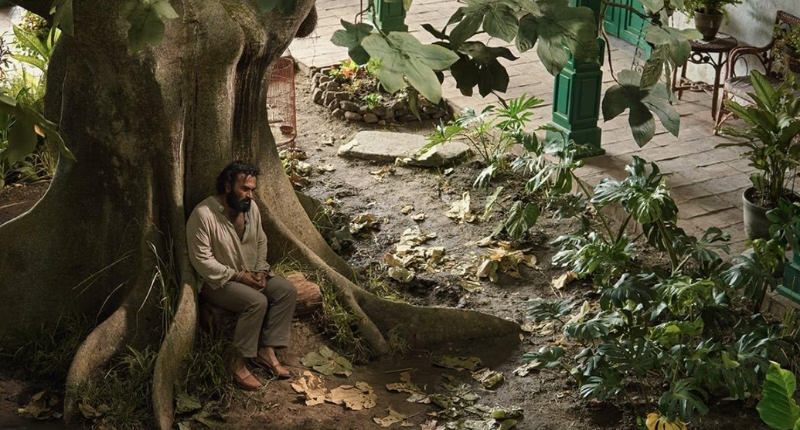
What was made. The series was filmed entirely in Colombia, in Spanish, with three versions of Macondo built for it, and it is Netflix’s most expensive Latin American production. Alex García López and Laura Mora directed the first season, and Laura Mora and Carlos Moreno directed the second. Season 1 arrived on 11 December 2024 with eight episodes.
Season 2 followed on 5 August 2026, with a feature-length Grand Finale on 26 August, which brings the run to 16 episodes in total. Mora has said that a nearly two-hour finale was the only way to match the novel’s scale.
How it compares with the book. The show follows the novel’s order, even starting where the story ends and then going back to the founding of Macondo. Time’s Judy Berman found it remarkable how close the series gets to the spirit of the book and ranked it among the best of a year of adaptations of supposedly unfilmable novels. Metacritic gave season 1 a score of 80 from 16 critics.
Not everyone agreed. Roger Ebert’s site noted pacing problems, with the middle of season 1 dragging, and one season 1 reviewer on Metacritic concluded that García Márquez was right and the book cannot be adapted.
For season 2, Inverse described the final stretch as the wrap-up of an underseen masterpiece.
Here is my own view. A screen has to show what the novel merely reports, so ghosts and miracles lose the narrator’s calm, which scholars call unastonished. That tone is the book’s real magic trick, and it is the one thing a camera struggles to copy.
What the series does better than the page is give you faces for all those repeating names, which makes the family far easier to follow.
Box office. There is none, since the series is a streaming original, and I could not verify any official viewership figures.
What does One Hundred Years of Solitude teach us about memory today?
The scene that stays with me is not the girl who floats away. It is the morning after the massacre, when José Arcadio Segundo walks home and every official voice tells him nothing happened. That scene has outlived its fiction. In November 2017 a Colombian lawmaker called the 1928 massacre a myth and blamed García Márquez for inventing the death toll.
Yet Britannica describes the killings as unprovoked, and published estimates of the dead run from 47 to roughly 2,000. The argument is really about a number, and the book saw that coming.
The novel keeps finding readers, too. A Japanese paperback sold 290,000 copies in eight weeks in 2024, so the old warning still sells.
Five lessons I take from it:
- A disputed number is not a missing event. Argue about the count, never about whether it happened.
- Write things down while witnesses live. José Arcadio Segundo’s account survives only because he told it to a young Aureliano.
- Watch for repeated names in your own life. Families, offices and nations recycle the same quarrels.
- Solitude is built from small refusals. Pride, not exile, did most of the Buendías’ damage.
- Open the manuscript. The family owned its warning for a century and never read it.
Quotations
Opening line — “Many years later, as he faced the firing squad, Colonel Aureliano Buendia was to remember that distant afternoon when his father took him to discover ice.”
The most famous opening in Latin American fiction; establishes time, memory, war, and ice.
Úrsula’s suspicion about time. As the years pass she keeps feeling that time is turning in a circle, which is the book’s central structure stated by its most sensible character.
The world before names — “The world was so recent that many things lacked names, and in order to indicate them it was necessary to point.”
Frequently cited for its creation-myth quality.
Melquíades on objects — “Things have a life of their own… It’s simply a matter of waking up their souls.” (p. 9)
A signature magical-realist statement.
The earth is round — “The earth is round, like an orange.”
José Arcadio Buendía’s revelation; often quoted as a comic-sublime moment.
Death and belonging — “A person does not belong to a place until there is someone dead under the ground.” (p. 18)
Widely cited line about Macondo’s founding and the family’s rootedness.
Úrsula’s resolve — “If I have to die for the rest of you to stay here, I will die.”
Often cited as the novel’s clearest statement of Úrsula’s matriarchal will.
Melquíades’ return — “He really had been through death, but he had returned because he could not bear the solitude.”
A defining line for the novel’s treatment of solitude and resurrection.
The discovery of ice — “It’s the largest diamond in the world.” / “No… It’s ice.”
One of the most iconic scenes and exchanges in the novel.
Macondo’s dream-name — “a noisy city with houses having mirror walls rose up… a name that he had never heard… Macondo.
Central to the novel’s founding myth and mirror imagery.
Colonel Aureliano Buendía’s legend — “He had seventeen male children by seventeen different women and they were exterminated one after the other on a single night before the oldest one had reached the age of thirty-five.”
Frequently cited summary of the Colonel’s mythical, tragic proliferation.
Why fight? — “Tell me something, old friend: why are you fighting?” … “I’ve come to realize only just now that I’m fighting because of pride.”
A key passage on the emptiness and pride of war.
“It’s raining in Macondo” — “Aureliano,” he said sadly on the key, “it’s raining in Macondo.” … “Don’t be a jackass, Gerineldo… It’s natural for it to be raining in August.” (p. 134)
Often quoted for its telegraphic loneliness and dark humor.
“Cease, cows” — “Cease, cows, life is short.”
Aureliano Segundo’s famous carpe-diem refrain; also used on his wreath.
Old age and solitude — “the secret of a good old age is simply an honorable pact with solitude.”
One of the novel’s most cited aphorisms.
Liberals and Conservatives — “The only difference today between Liberals and Conservatives is that the Liberals go to mass at five o’clock and the Conservatives at eight.”
A frequently quoted satire of political difference.
Death’s timing — “Tell him… that a person doesn’t die when he should but when he can.”
Often cited as the Colonel’s fatalistic wisdom.
Remedios the Beauty’s ascension — “she watched Remedios the Beauty waving good-bye in the midst of the flapping sheets that rose up with her… lost forever with her in the upper atmosphere…”
The novel’s most famous magical-realist ascension scene.
The great rain — “It rained for four years, eleven months, and two days.”
One of the novel’s most recognizable sentences and temporal gestures.
The banana massacre and denial — “There must have been three thousand of them.” … “There haven’t been any dead here… nothing has happened in Macondo.”
The court that abolishes the dead. After the massacre, a legal ruling declares that the workers never existed. This scene falls in chapter 15, and it is the cruelest bureaucratic joke I know in fiction.
Central cited passage on historical erasure and official denial.
The ending / ant epigraph — “The first of the line is tied to a tree and the last is being eaten by the ants.” … “races condemned to one hundred years of solitude did not have a second opportunity on earth.”
The novel’s terminal prophecy and one of its most quoted closing lines.
Common questions about One Hundred Years of Solitude
Is One Hundred Years of Solitude hard to read?
It is hard to keep straight and easy to read sentence by sentence. The prose is plain, and the difficulty is structural: repeated names and constant time jumps. Keep the family tree beside you and do not worry about who is who for the first fifty pages.
How many generations does the book cover?
Seven, from José Arcadio Buendía and Úrsula to the child with the pig’s tail.
Is One Hundred Years of Solitude based on a true story?
Not literally. Macondo is fictional, though García Márquez’s childhood home in Aracataca inspired the setting, and the strike massacre is based on the real 1928 killings in Ciénaga.
Is the Netflix series finished?
Yes. Season 1 came out on 11 December 2024, and season 2 followed on 5 August 2026, with the feature-length Grand Finale on 26 August 2026.
Why is it called One Hundred Years of Solitude?
The phrase comes from the closing line, which says that families condemned to a century of solitude get no second chance. García Márquez tied the idea to Latin America in his Nobel lecture, The Solitude of Latin America.
Which English translation should I read?
Gregory Rabassa’s 1970 version is the original English translation, and García Márquez said he preferred it to his own Spanish text.
Final thoughts on One Hundred Years of Solitude
Read it if you like novels that trust you to keep up, and if you want to feel a whole century pass in a handful of evenings. It suits fans of literary fiction, magical realism, family sagas and Latin American history, and anyone who finished Beloved or Midnight’s Children wanting more of that scale.
It may frustrate you if you want a tight plot, clear heroes or a pace that never dips. If that sounds like you, watch the series first and come back to the book later.
What stays with me is the manuscript nobody read. The novel shows its warning from the very first page, then shows how easily a family, or a country, can look away from it.
That is why the book still feels current to me, and why I rate it 4.5 out of 5.
One Hundred Years of Solitude

One Hundred Years of Solitude is Gabriel García Márquez's 1967 novel about seven generations of the Buendía family, and it ends with the town of Macondo wiped off the earth at the exact moment the last Buendía finishes reading the family's fate. It is also famously easy to get lost in, because the same handful of names return in every generation and time keeps looping back on itself.
URL: https://www.sopranu.com/one-hundred-years-of-solitude-magical-realism/
Author: Gabriel García Márquez
4.5
Pros
- Unforgettable images; a whole country's history through one family; comedy and tragedy in the same sentence; an ending that rewrites everything before it
Cons
- Repeating names are hard to track; the middle generations slow down; fate is announced early, so suspense is low; women characters often serve the men's stories, in my reading







0 thoughts on “One Hundred Years of Solitude Is Confusing, Cruel, and Unforgettable”