
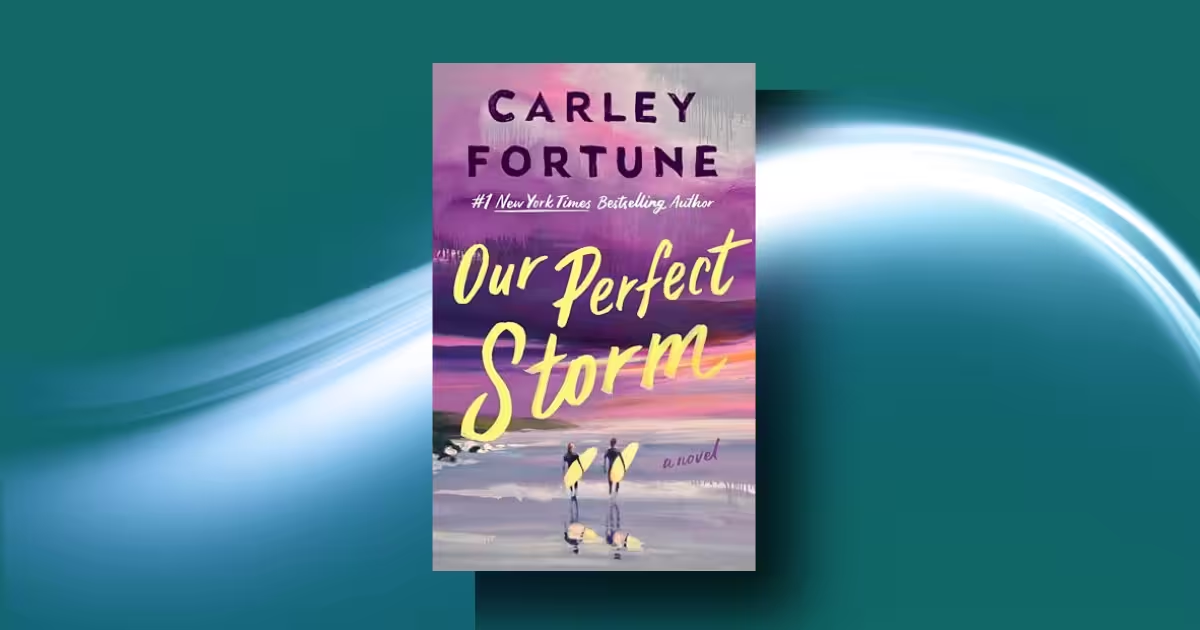
Do you ever find yourself pushing away the person who knows you best, terrified that letting them in might destroy everything you’ve built together? That’s the question at the heart of Carley Fortune’s latest novel, Our Perfect Storm—and the answer might just change how you see every friendship you’ve ever had.
Our Perfect Storm is a sweeping, time-hopping romance about Frankie Gardiner and George Saint James, childhood best friends who spend twenty-two years circling each other, hiding their true feelings behind promises and letters, until a canceled wedding and a week in Tofino finally forces them to confront what everyone else has seen all along.
Our Perfect Storm is best for readers who devoured Every Summer After and Meet Me at the Lake and want more of Fortune’s signature emotional depth, anyone who believes in childhood friendships turning into something more, fans of Jo and Laurie from Little Women who wished they’d ended up together, and people who love cookbooks, coastal settings, and letters hidden in wooden chests.
Not for those who prefer fast-paced thrillers over slow-burn emotional journeys, readers bothered by extensive flashback structures, or anyone who thinks friends should never cross that line.
Table of Contents
Introduction
Our Perfect Storm is Carley Fortune’s fifth novel, published in 2026 by Berkley (Penguin Random House).
Fortune, the #1 New York Times bestselling author of Every Summer After (2022), Meet Me at the Lake (2023), This Summer Will Be Different (2024), and One Golden Summer (2025), has established herself as a dominant voice in contemporary romance. S
he’s also an award-winning Canadian journalist who worked as an editor for Refinery29, The Globe and Mail, Chatelaine, and Toronto Life. She lives in Toronto with her husband and two sons.
Background
Fortune has built her brand on emotionally complex romances set against stunning Canadian landscapes.
Her debut, Every Summer After, drew comparisons to Love and Other Words by Christina Lauren, while Meet Me at the Lake leaned into her signature blend of past-and-present timelines. Our Perfect Storm continues this tradition but pushes further into what might be called “the friendship dilemma”—the question of whether a platonic soulmate can become something more without burning everything down.
The novel also carries significant ecological weight. Fortune weaves in the real-world plight of the North Atlantic right whale, a critically endangered species with fewer than 370 individuals remaining and fewer than 70 breeding females.
This isn’t window dressing; it’s central to the protagonist’s fractured relationship with her mother and her own sense of identity.
Our Perfect Storm Summary
Prologue and Part One: The Manor
The novel opens at Darlington Manor, a historic country estate an hour east of Toronto, where Frankie Gardiner is two days away from marrying Nate Bacon, a forty-six-year-old mathematics professor sixteen years her senior.
The wedding is extravagant—six courses, a string quartet playing “Orchard House” from the 1994 Little Women film, a guest list of 120 people, and a dress that cost as much as a small car.
But Frankie can’t breathe. Her best friend, George Saint James, hasn’t checked into the hotel. She’s left him messages. She’s texted. Nothing.
When he finally arrives—rumpled, bespectacled, with his signature “chestnut hair a whirling mess”—Frankie charges across the room and throws her arms around him. The relief is immediate. “For the first time tonight,” she tells us, “I can breathe.”
Here’s what we learn immediately: Frankie and George have been best friends since they were eight years old, when she found him peering through the cedar hedge that separated their properties. She thought his grandmother was a witch. He thought Frankie was the most incredible person he’d ever met. They’ve been inseparable ever since—even getting matching tattoos of each other’s names on their rib cages when they turned eighteen.
Frankie has his name tattooed on her right side. George has hers on his left.
They dance at the welcome dinner, George leading her around the room with the ballroom skills Mimi taught them as kids. Frankie closes her eyes, the way Mimi instructed, and lets him lead. “It’s the only time I hand over control to someone else,” she admits, “and the feeling is one of complete liberation.”
But the happiness is short-lived.
Eight hours later, Frankie wakes to find a note on blue Darlington Manor stationery:
I love you, but I can’t marry you.
Nate is gone. His phone goes to voicemail. The wedding is over before it began.
George carries Frankie to her parents’ car. He whispers into her hair: “I’ve got you. It’s going to be okay. I promise. I promise.”
Part Two: The Woods
Frankie moves back to her childhood home on Old Stone Road in the Kawartha Lakes region, two hours northeast of Toronto. She sleeps in her old bedroom, surrounded by Katniss Everdeen posters and a bulletin board covered in letters from George, track and field ribbons, and recipes clipped from magazines.
She spends her days on Aurora’s couch (her friend from the tattoo parlor) before her parents come to collect her.
She’s a wreck. She tallies all her deficiencies on a piece of paper: bad temper, inability to be a “good girlfriend,” the one time she lost her cool with Nate a few days before the wedding. She blames herself. She doesn’t know that George is the reason Nate left.
The birdhouse mailbox—the one George installed when they were kids, modeled after the one Laurie gives the March sisters in Little Women—still stands in the gap of the cedar hedge. Frankie leaves him a letter. She doesn’t know when he’ll get it, but she writes anyway.
Then, one day by Mimi’s pool, George appears. He’s been traveling through Peru, Ecuador, Colombia, and Cuba for a series about mangrove restoration. He looks different—new glasses (tortoiseshell horn-rims), new haircut, new cologne. He’s been working out. He has abs.
And he has a plan.
“We’re running away,” he tells her. “To Tofino.”
Frankie’s canceled honeymoon. The villa Nate booked. The non-refundable deposit. George wants to take her there instead.
She agrees. Just like that.
Part Three: The Coast
The drive to Tofino on Vancouver Island’s Pacific Rim Highway is terrifying—sharp twists and turns around cliffs, drizzle turning to rain, trees so massive they block out the sky. George has an actual itinerary. Seven days. Seven themes.
Day One: Wallow. Feel your feelings. Respect the shittiness. Honor the shittiness. (Frankie’s response: “So there’s really no sex cult?”)
Day Two: Indulge. George takes her to a floating sauna accessible only by boat, operated by Derek, a retired fire chief he met while covering the wildfires that burned across Canada in 2023.
They toggle between the sauna’s dry heat and the sharp bite of the Pacific. Frankie wears a red bikini. George wears 1960s Bond-style swim trunks. She notices things she’s spent years ignoring: his mouth, his eyes, the way he’s built now. He stares at her chest in the sauna. She catches him.
“I think I’m overheating,” she says.
“We should cool off.”
They don’t cool off. Not really.
At Pluvio restaurant in Ucluelet, Frankie eats the best meal she’s had in months—roasted lingcod with spot prawns, sprout farm quail, a chocolate tart called the Enchanted Forest with meringue rocks and edible soil. “I feel kind of inspired,” she admits. “Don’t tell Brie.”
But that night, something shifts. Frankie wakes from a sex dream about George to find him spooning her, hard and breathing her name: “Sweetheart.”
Morning brings awkwardness. Then surfing lessons. Then a kiss in the rainforest.
The Kiss
It happens on Day Four, during a hike through the old-growth forest of the Pacific Rim National Park Reserve. The rain falls. The trees are so tall they can’t see the tops. George catches a droplet of rain on his tongue, and Frankie can’t look away.
“I’m having one of those moments,” he says. “The best kind. The kind that makes me grateful to be alive, right here, right now, on this spectacular planet.”
“But most of all,” he says, “I feel lucky to be here with you.”
Frankie takes a step closer. She reaches for the collar of his jacket.
“I’m sorry,” she tells him. “I once made you a promise, but I can’t keep it. I promised I wouldn’t kiss you.”
“You did,” he says, his voice rough. “But I never promised you the same thing.”
He kisses her first. It’s not hesitant. It’s demanding, needy. She moans. He growls. The rain falls harder. It’s “volcanic,” Frankie will later say.
They agree it was a mistake. They agree to forget it happened.
They don’t forget.
Day Five: Want
The hot springs at Hot Springs Cove. Geothermal pools created by fissures in the earth’s crust. Frankie watches George’s back, the water running down his spine, and realizes she can’t shove her feelings back down anymore.
“I know what I want,” she tells him on the point overlooking the ocean. “I want you to have dinner with me tonight as a date. And while we’re on our date, I want you to consider whether you want to go on another one with me, and maybe a third and a fourth.”
“What about a fifth date?” George asks.
“I think I probably want that, too.”
They have dinner on the beach, string lights in the branches, a vegetarian meal the chef prepared just for them. Frankie pays. George protests. They walk to the shore.
“Can I kiss you?” she asks.
He answers with his mouth.
The Revelation
They have sex. A lot of sex. In the bed, on the desk, in the glass shower while a storm rages outside. George is good at this—attentive, dirty-mouthed, devastating. Frankie realizes she’s been ignoring her attraction to him for years. “I heard you once when you brought someone home,” she admits. “The sound you made when you came. It was just… so sexy.”
But then Nate calls.
Actually, first, Kevin—the resort’s head of guest experiences—confesses he knew Frankie and George weren’t really married. He’d spoken to Nate before they arrived. Nate wanted him to take care of her, to give her anything she wanted. And Kevin, who’s seen enough couples to know what love looks like, decided to play matchmaker anyway.
Then Frankie calls Nate to thank him for the gifts he sent: a hand-forged Japanese chef’s knife and a recipe journal.
“George didn’t tell you?” Nate asks.
“Tell me what?”
Nate’s voice is clipped. “This is exactly what he wanted, so he can do the explaining. Talk to George.”
Frankie turns to find George’s face ashen.
She demands the truth.
George confesses everything: The night before the wedding, he got drunk with Nate and Frankie’s brothers. He told stories about Frankie—the time she called their French teacher a misogynistic asshole, how she quit her restaurant job after slapping a raw steak on a customer’s plate, the fire in her belly that Nate had never seen. Nate asked point-blank if George was in love with Frankie.
“I told him the truth,” George says. “I told him I loved you in a way he’d never understand.”
George didn’t know Nate would call off the wedding. But he also didn’t stop it. And he never told Frankie.
“I’m in love with you, Frankie,” he says. “I’ve been in love with you for a very long time.”
He reminds her of the phone call during the wildfires, when he thought he might die. “I told you then. I couldn’t stand the idea of you not knowing how I really felt.”
But Frankie heard “I love you,” not “I’m in love with you.” There’s a difference. She knows there’s a difference.
She walks away.
Part Four: The Woods (Return)
Back at her parents’ house, Frankie spirals. Her brother Darwin talks her down. He tells her he’s known about George’s feelings for years. Moby, too. They gave George shit for it constantly.
“He thought he’d have more time,” Darwin says.
Frankie’s mother finally tells her the truth about her own departure: hyperemesis gravidarum so severe she couldn’t keep food down, the way she missed her family, the slow suffocation of giving up her dream to study right whales. “I think I might have withered up if I’d stayed.”
And then she delivers the blow: Francesca, the right whale Frankie was named after, died two years ago from a vessel strike. Her calf died, too.
Frankie grieves. She whispers the bedtime story her mother used to tell her into the dark.
The Letters
George doesn’t text. He doesn’t call. But letters begin appearing in the birdhouse mailbox.
Age 12: “You’re the coolest girl I’ve ever met… and the prettiest one, too. I’m pretty sure you’d hate it if I told you that, so I’m not going to give this letter to you.”
Age 13: “I like you. There. That feels… weird, but also good.”
Age 15: “I thought going out with other girls would help me not like you anymore. But I don’t think it’s working.”
Age 16: “I can’t believe you asked me to have sex with you! Do you know how badly I wanted to say yes?”
Age 18: “I knew in that moment that I was in love with you… I love you, Frankie. I love you. I love you. I love you.”
Frankie reads them all. She collects them like treasures. She writes back: “I’d like the rest of my letters.”
George meets her at the hedge. He’s holding the mahogany chest he kept under his bed for years—the one with the lilies carved into the lid, the one she always assumed held pornography. It holds their entire friendship instead. Letters. Postcards. A blue jay feather. A sketch of a labyrinth. The menu from her final culinary school presentation.
“It was my mom’s,” George says.
They squeeze into the cupboard behind the library bookshelf—the same cupboard where they plotted adventures as children, where they exchanged vows at ten years old. They barely fit now. They’re too big.
George backs Frankie against the wall, hooks her leg around his hip, and fits himself inside her.
“It’s not the past that unfolds before me,” Frankie tells us. “It’s our future.”
Epilogue: We Are Thirty-One
One year later, Frankie and George are married. They exchanged vows beneath the apple tree, family gathered around, a confetti of apple blossom petals at their feet. Frankie carried violets from Mimi’s garden. George combed his hair.
They’ve been traveling up the coast, following the right whale migration for a series George is writing. Frankie is documenting their journey through food for her own cookbook. Her mother is coming to join them in a few days.
On the Bay of Fundy, a right whale breaches—seventy tons of weightless grace.
“I miss my mom,” Frankie says.
“She’ll be here in a few days,” George replies, kissing her cheek. “But let’s call her when we get back.”
“I’m proud of you,” he adds. “For bringing your mom home.”
Home, he means, to her whales.
Frankie turns to George, hugging him close, returning to her kingdom.
The final line: “I turn to George, hugging him close, returning to mine.”
Our Perfect Storm Analysis
Characters
Frankie Gardiner: Frankie is a thirty-year-old former sous chef who burned out of the restaurant industry after slapping a raw steak on a customer’s plate.
She’s stubborn, hotheaded, independent, and deeply afraid of being consumed by love—because she watched her mother give up her dream of studying whales to raise a family, and she watched her mother leave when she couldn’t take it anymore. Frankie’s arc is about learning that being loved doesn’t mean losing yourself.
Her name is significant: she was named after a real North Atlantic right whale (Catalog Number 1950) her mother saw while pregnant. When that whale dies, Frankie finally grieves not just the whale but the version of her mother she lost.
George Saint James: George is an environmental journalist who’s spent years running away—from his feelings for Frankie, from his father’s abandonment, from the trauma of covering the 2023 wildfires.
He’s bilingual (French and English), collects sand from beaches around the world, eats two hundred grams of protein a day, and has been in love with Frankie since he was twelve years old. The wooden chest under his bed isn’t filled with pornography; it’s filled with letters he never sent. His arc is about learning to stay.
Nate Bacon: Nate is the ex-fiancé, and Fortune refuses to make him a cartoon villain. He’s kind, steady, easy to be around—and completely wrong for Frankie.
He broke up with her in a letter because he couldn’t face her, but he also paid for her Tofino honeymoon and asked Kevin to take care of her. His final conversation with Frankie is painful and honest: “I’m sorry I didn’t have the guts to tell you to your face. I knew I’d never be able to follow through if I was looking into your eyes.” He’s not the bad guy. He’s just not George.
Rebecca Gardiner (Frankie’s mom): Rebecca is the novel’s most complex secondary character. She left her family for eighteen months when Frankie was eight to work with right whales in New Brunswick.
She came back changed—quieter, more domesticated—and never talked about whales again. T
he revelation that she suffered from hyperemesis gravidarum (extreme morning sickness) during her pregnancy with Darwin reframes her departure: she didn’t leave because she didn’t love her family. She left because she was suffocating. Her line—“We’re all entangled in our own way”—is the novel’s thematic thesis.
Mimi Saint James: George’s grandmother, a former principal dancer with Les Grands Ballets Canadiens in Montreal, who married a lumber baron and moved to the country. She’s sharp, witty, and smokes skinny cigarettes. She taught George and Frankie to dance.
She knew about George’s feelings the whole time. Her line—“You can never go back, ma chère. You can only go forward”—is the novel’s engine.
Aurora: Frankie’s tattoo-artist best friend, who’s been telling her for years that George is the one. Aurora has espresso eyes, braids that morph from black to purple to pink, and an ancient cat named Atomic Yellow.
She’s the reader’s proxy, the one who screams “YOU GUYS ARE IN LOVE!” when Frankie sends her photos from Tofino.
Darwin and Moby: Frankie’s older brothers. Darwin is twelve years older, works with their father in the cabinetry business, and has a daughter named Birdie. Moby is ten years older, works as a cybersecurity engineer in Ottawa, and still acts like a teenager. They’ve known about George’s feelings for years.
They’ve been giving him shit about it for just as long.
Our Perfect Storm Themes and Symbolism
Fear of Abandonment vs. Fear of Being Consumed: Frankie and George are mirror images of the same wound. Frankie watched her mother leave; she’s terrified of being abandoned, so she pushes people away before they can push her.
George was abandoned by his father after his mother died; he’s terrified of being left, so he runs first. The novel argues that these fears are two sides of the same coin—and that only by facing them together can they be healed.
The Birdhouse Mailbox: Modeled after the one Laurie gives the March sisters in Little Women, the mailbox becomes the central symbol of George and Frankie’s communication.
They write letters when they can’t speak. They leave treasures.
It’s where George confesses his love for the first time (in a letter he never sends). It’s where Frankie finally says “I’d like the rest of my letters.” The mailbox is the threshold between friendship and something more.
The Labyrinth: As children, George and Frankie built a labyrinth in Mimi’s yard.
They argued about what should go in the center (George: a secret garden; Frankie: a fountain). The labyrinth becomes a metaphor for their friendship: winding, confusing, with something precious at its heart.
At the end of the novel, when they have sex in the library cupboard for the first time as lovers, Frankie realizes: “This, I think, is what’s at the center of the labyrinth. George and me, kissing each other for as long as possible.”
*Little Women: * The novel is threaded with references to Louisa May Alcott’s classic.
Frankie has always related to Jo March—stubborn, hotheaded, independent, uninterested in marriage until suddenly she isn’t. But the novel subverts Alcott’s ending: Jo married Professor Bhaer (a man sixteen years older, like Nate), but Frankie ends up with Laurie (the boy next door, the best friend).
George explicitly argues that Jo and Laurie would have been great together. “They have hot tempers and strong wills and are too fond of freedom,” he writes. “But I think that’s what would have made them great together. I think they would have had a big, loud, epic life together. I think we would, too.”
Right Whales: The North Atlantic right whale is critically endangered—fewer than 370 remain, fewer than 70 breeding females.
The species’ inability to reproduce quickly enough to offset human-caused deaths mirrors Frankie’s fear of attachment. She’s been “entangled” in her own way, trapped by her mother’s choices, unable to see a future where love doesn’t mean loss.
When her namesake whale dies from a vessel strike, Frankie finally grieves—and finally lets herself be loved.
Dancing: Mimi taught Frankie and George to dance as children. She made Frankie close her eyes so she had no choice but to follow George’s lead. Dancing becomes the only time Frankie willingly surrenders control—and it’s no coincidence that the novel’s most romantic scenes happen on dance floors.
When they dance at Darwin’s wedding, when they dance at the welcome dinner, when George leads her around the room with his hand on her back, Frankie is finally, briefly, at peace.
The Wooden Chest: George’s mahogany chest, carved with lilies, originally belonged to his mother. Frankie spent years assuming it held pornography or secrets she wasn’t allowed to see. In fact, it held every letter, postcard, and memento from their friendship. The chest is George’s heart—locked, hidden, but full of love. When he finally gives it to Frankie, he’s giving her himself.
Evaluation
Overall Impression: Our Perfect Storm is an emotionally devastating and ultimately triumphant addition to Fortune’s bibliography.
It’s her most ambitious novel yet, juggling multiple timelines (ages 8, 10, 14, 15, 16, 18, 20, 21, 27, 30, 31), two major settings (rural Ontario and coastal British Columbia), and a secondary plot about right whale conservation that carries genuine ecological weight.
The prose is lush without being overwrought, and the payoff—George’s letters, the chest, the final scene in the cupboard—is earned.
Strengths:
The letters. George’s letters from ages 12, 13, 15, 16, and 18 are the heart of the novel. They’re funny, painful, and achingly real. The letter from age 15—“I just compare them to you, and they’re never as good, and I feel like a jerk”—is the kind of writing that makes you shut the book and stare at the wall.
The Tofino setting. Fortune has visited Tofino four times, and it shows. The descriptions of the rainforest, the hot springs, the surfing, and the food are transportive. You can smell the salt and spruce.
The secondary characters. Mimi, Rebecca, Aurora, Darwin, and even Nate are fully realized. Nobody is a villain. Everyone is trying their best.
The sex scenes. Fortune has grown as a writer of intimacy. The scenes in Tofino—the morning after the dream, the first time in the library cupboard—are hot without being gratuitous, emotional without being saccharine.
The right whale subplot. It’s not window dressing. Frankie’s mother’s departure, her return, and the death of Francesca the whale are thematically integral. The novel argues that conservation isn’t separate from human relationships—it’s the same struggle to care for something fragile and endangered.
Weaknesses:
The pacing in the middle. The week in Tofino is structured around seven daily themes (Wallow, Indulge, Move, Reflect, Want, Expand, Memorialize). While clever, it occasionally feels like a checklist. Some days (Expand, Memorialize) are thinner than others.
The Nate revelation timing. George’s confession about the wedding night comes very late—the end of Day Six—and the fallout is rushed. Frankie goes from “I can’t do this” to reading his letters to having sex in the cupboard in the space of a few chapters. A little more breathing room would have helped.
The epilogue. The final scene on the Bay of Fundy is lovely, but the “one year later” jump skips over the difficult work of rebuilding trust. How did Frankie forgive George? How did they navigate his confession? The novel gestures at these questions but doesn’t fully answer them.
Impact: This book will destroy anyone who’s ever been in love with their best friend and said nothing. It will also resonate with readers who’ve struggled with parental abandonment, career burnout, or the fear of being “too much.” The final line—“I turn to George, hugging him close, returning to mine”—is a gut punch.
Comparison with Similar Works
Every Summer After by Carley Fortune (same author, similar childhood-friends-to-lovers structure but with a darker secret at its center)
People We Meet on Vacation by Emily Henry (best friends who take annual trips together, one pining in secret)
Love and Other Words by Christina Lauren (dual timeline, childhood sweethearts reunited as adults)
Book Lovers by Emily Henry (sisters, small towns, and the fear of being “too much”)
The Friend Zone by Abby Jimenez (chronic illness, emotional walls, and a man who refuses to give up)
Normal People by Sally Rooney (the push-pull of a connection that neither can fully articulate)
Personal Insight with Contemporary Educational Relevance
The most urgent lesson from Our Perfect Storm is also the most scientifically validated: emotional suppression—especially in women—harms both relationships and mental health. Frankie spends years tranquilizing herself, hiding her temper, and apologizing for being “too much.” George calls her out: “You’re not a house pet. Your fire is one of the things I admire most about you.”
Research backs this intuition. Studies have found that when women suppress negative emotions, they report lower relationship satisfaction and higher depressive symptoms (Dubé et al., 2019). One study specifically linked rigid suppression in women to poorer romantic relationship quality and increased loneliness (Dworkin, M. J., et al., 2019; Koppel, S. D., 2015).
More recent work confirms that suppression of negative emotions puts female emerging adults at significantly greater risk of poor romantic relationship satisfaction and consequent loneliness (2025 study). The concept of “self‑silencing” —hiding one’s true thoughts and feelings to avoid conflict—has also been tied to poorer marital adjustment and worse mental health outcomes among married women (Ahmed & Iqbal, 2019).
Notably, these patterns are not exclusive to women: men’s habitual use of suppression predicts lower marital quality over time as well (Velotti et al., 2016).
In short, the coping strategy that Frankie uses to keep peace in her relationship is the very thing that would have destroyed her. Contemporary therapy approaches (e.g., cognitive‑behavioral therapy, emotion‑focused couple therapy) now prioritize helping clients, particularly women, express rather than suppress negative emotions—because authentic expression, not silence, builds intimacy and resilience.
Five lessons from Our Perfect Storm, backed by the science of suppression:
- The right person won’t ask you to be smaller. If you have to suppress your true self to maintain a relationship, the relationship is already broken.
- Secrets don’t protect love; they poison it. Hiding your feelings to avoid conflict only creates a divided self—and depression often follows.
- Running away is a form of staying. George traveled the world but never stopped loving Frankie. Distance doesn’t cure suppression; honest communication does.
- Mothers are more complicated than we allow. Frankie’s mother wasn’t a villain; she was a woman who silenced herself for years until she couldn’t. Understanding her story is the first step to breaking the cycle.
- Love isn’t about finding someone perfect; it’s about finding someone who sees your mess and stays. Frankie learns to stop performing “good girlfriend” and lets George love the real her—fire, temper, and all.
If you or someone you know recognizes these patterns, consider speaking with a therapist about emotion regulation strategies that prioritize expression over suppression. As Mimi tells Frankie: “You can never go back. You can only go forward.”
Our Perfect Storm Quotes
- “I’m not afraid of storms, for I’m learning how to sail my ship.” — Louisa May Alcott, Little Women (epigraph)
- “I’m utterly desperate for an adventure.” (Frankie, age 8, to George—the line that starts everything)
- “Forward, side, together. Francesca, you have the grace of a rhinoceros.” (Mimi, during dance lessons)
- “You’re never too much—I always want more.” (George to Frankie, in the library cupboard)
- “I don’t think we’re burning it down. Our friendship is the fire. I think we’re giving it oxygen.” (George, after their first night together)
- “We’re all entangled in our own way.” (Rebecca, Frankie’s mother)
- “I love you, Frankie. My love for you is fundamental to who I am. It’s deep in my bones. A sonnet written in the marrow.” (George, in the library)
- “This, I think, is what’s at the center of the labyrinth. George and me, kissing each other for as long as possible.” (Frankie, at the climax)
- “Promise for a promise?” — “A promise for a promise.” (Their recurring refrain, from childhood to adulthood)
- “I turn to George, hugging him close, returning to mine.” (Final line)
Conclusion
Our Perfect Storm is a masterful, heart-wrenching, ultimately hopeful novel about the fear of being loved and the courage it takes to let someone in. Carley Fortune has written her most mature work to date, balancing romance with ecological grief, childhood nostalgia with adult accountability, and the messiness of family with the clarity of chosen love.
Recommendation: Read this book if you loved Every Summer After, if you’ve ever been in love with a friend and said nothing, if you’re fascinated by right whale conservation, or if you simply want to spend a week in Tofino without leaving your couch. Skip it if you prefer plot-driven thrillers over character-driven emotional journeys.
Why this book matters: In an era when we’re all terrified of being “too much,” Our Perfect Storm argues that the right person won’t ask you to shrink. They’ll build a bigger container.







