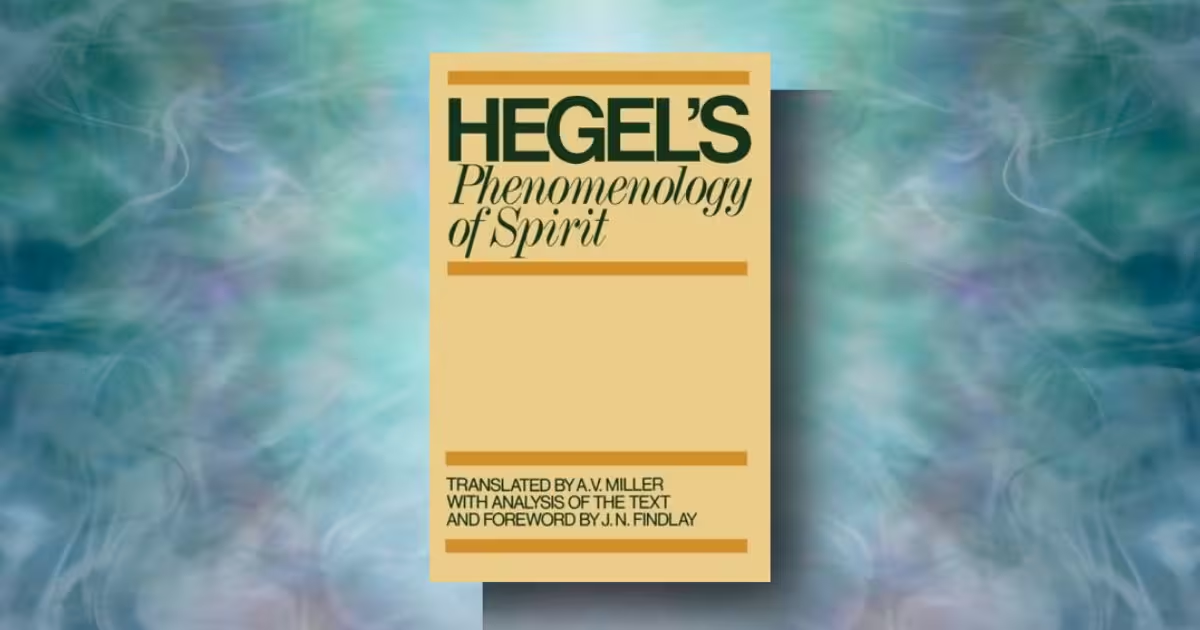
Does a book finished in a hurry while a foreign army marched into the author’s own city still have anything urgent to say to you two centuries later? I doubted it for roughly the first hundred pages of Michael Inwood’s 2018 Oxford translation of Hegel’s Phenomenology of Spirit.
By the last hundred, I no longer did, and I want to walk you through exactly why, section by section, so that you do not have to go in as blind as I did.
Published in 1807, the same year Napoleon’s army marched through Jena, with Hegel himself watching the Emperor ride past, this 600-page colossus has acquired a reputation so fearsome that Bertrand Russell called Hegel “the hardest to understand of the great philosophers”.
One Goodreads reviewer put it more bluntly: if Kant’s Critique of Pure Reason requires two reads to understand, Hegel’s Phenomenology of Spirit“must require several tenured professor positions to begin to grasp”.
And yet: Phenomenology of Spirit changed everything.
It shaped Marx, Kierkegaard, Nietzsche, Heidegger, Sartre, Adorno, and Derrida. It gave us the master–slave dialectic (still buzzing in contemporary social theory), the concept of mutual recognition, and a vision of truth as something you become, not something you find.
The Guardian called it “one of the most seminal masterpieces in the entire chronicle of philosophic thought”. A 2025 study in Genre described reading it as an experience of “incessant irony and disruption”—disorienting, yes, but also productive of a whole new mode of reading.
So here’s the uncomfortable truth I discovered: you don’t read this book. You survive it. And surviving it changes you.
Table of Contents
Overview
What it is: Hegel’s first major work (published 1807) and arguably his most influential. It traces the journey of human consciousness from the simplest awareness of “this thing here” through self-consciousness, reason, spirit, religion, and finally to “absolute knowledge”, a standpoint from which consciousness recognizes itself in everything it has encountered.
What it’s really about: Not a dry academic treatise, but a Bildungsroman of the human mind, a philosophical adventure story where each chapter is a “shape of consciousness” that tries and fails to make sense of the world, only to be replaced by a more sophisticated shape that inherits its insights. It’s about how you come to know yourself by bumping into everything that isn’t you.
The central thesis: “Everything depends on grasping and expressing the True not only as Substance, but equally as Subject”. In plain English: reality isn’t a static thing you observe from outside. It’s a dynamic process that includes you—your struggles, your relationships, your history, your very act of thinking.
Why it matters now: In an age of filter bubbles, partisan echo chambers, and the fragmentation of shared truth, Hegel’s insistence that truth emerges through dialectical confrontation, through the clash of opposed views that resolve into something richer, feels almost prophetic. As one German scholar put it recently: “Thinking is effective.” Hegel would have added: thinking together is what makes us human.
Who This Edition Is Actually For
Phenomenology of Spirit rewards patience more than it rewards intelligence, so the sorting criteria are not about how smart you are.
If you already know Kant reasonably well, if you are curious why nineteenth and twentieth century thought (Marx, Kierkegaard, Sartre, Simone de Beauvoir, the entire tradition of critical theory) keeps circling back to Hegel, or if you want to understand the master-slave dialectic from the actual source rather than a secondhand paraphrase, this edition will serve you well.
Students preparing for a course on German idealism will also get more out of Inwood’s commentary than out of most standalone study guides, because it walks alongside the primary text instead of replacing it.
If you want a first introduction to philosophy, or you are looking for something to read in short bursts on a commute, this is not that book, and honestly no translation of the Phenomenology is. I would also steer casual readers of “big idea” nonfiction away from starting here.
Hegel is not writing for you in the way a popular science author writes for you. He is building an argument that only fully makes sense once you have already worked through the argument, which is a strange, almost circular kind of demand to place on a reader, and it is the single biggest reason people abandon Phenomenology of Spirit around chapter three.
Phenomenology of Spirit Summary
I am going to walk through this in enough detail that you will genuinely understand the shape of the argument, because that is the single biggest gap I noticed in most existing reviews and summaries online.
Most either stop at the master-slave section, because it is the most famous part, or they give you a paragraph of abstraction and call it a day. Here is what is actually in the book, chapter by chapter, using Inwood’s own section titles and paragraph numbers so you can look anything up directly.
The Preface
Hegel wrote the Preface last, and it is really an introduction to his whole philosophical system rather than to this one book, which is why Quentin Lauer’s commentary, as Inwood notes, suggests reading it last rather than first.
Its most quoted claim is that “the true is the whole” , and that the absolute is best understood as “essentially result,” meaning that a philosophy, like an organism, is only fully what it is once it has completed its own development.
Hegel illustrates this with a botanical image: “the bud disappears when the blossom bursts forth” , and the blossom is in turn displaced by the fruit, yet each stage was a necessary and legitimate expression of the same underlying life.
His deeper claim, and the one that structures the entire rest of Phenomenology of Spirit, is that “substance is essentially subject” , meaning reality is not a static thing sitting apart from mind but an active process that only becomes fully real through being known.
Near the end of the Preface, Hegel describes truth itself, in one of Phenomenology of Spirit‘s most striking images, as “the Bacchanalian frenzy in which no member is sober”, a state of constant motion that is nonetheless, paradoxically, also a kind of repose.
The Introduction
In the shorter Introduction that follows, Hegel lays out his method. He famously describes the journey ahead as “the way of despair”, not because it is depressing, but because each shape of consciousness has to genuinely lose its own certainty, not merely have that certainty argued away from the outside.
Notably, Hegel insists that he himself will not be judging these shapes of consciousness by some external standard.
Each one is tested only against its own criterion for what counts as true knowledge, and when it fails that test, it collapses into the next shape on its own terms. Hegel calls this a “self-accomplishing scepticism” , and it is a genuinely clever move: it means the book cannot easily be accused of stacking the deck, since consciousness is always only measured against itself.
Consciousness: Sense-Certainty, Perception, and Understanding
Section A covers three short but foundational chapters.
Sensory Certainty (chapter I) examines the simplest possible claim to knowledge, the bare awareness of “this,” “here,” and “now.”
Hegel shows that even this supposedly rock-bottom certainty already relies on universal terms that outlast any particular “this,” so it collapses into Perception (chapter II), consciousness of a thing with stable properties.
Perception in turn runs into contradictions about how one thing can hold many properties without falling apart, which pushes consciousness toward Force and Understanding (chapter III), where it starts positing an unseen supersensible world of laws behind appearances, culminating in the strange and often misunderstood idea of an “inverted world,” where consciousness realizes the underlying explanatory laws are, in a sense, its own doing rather than a separate hidden realm.
Self-Consciousness: Lordship and Bondage, Then the Unhappy Consciousness
Chapter IV is where most casual readers actually start, because it contains the famous “lordship and bondage” section (Inwood’s rendering of what is often called the master-slave dialectic).
Hegel argues that self-consciousness only becomes real through being recognized by another self-consciousness, since, as he puts it, it exists in its own right only insofar as it is “something recognized.”
Two self-conscious beings meeting each other are therefore drawn into a life-and-death struggle for recognition. One party backs down rather than risk death and becomes the bondsman; the other becomes the lord. The twist, and it is a genuine twist even if you already know the outline, is that the lord’s victory is hollow.
He depends on being recognized by someone he refuses to recognize as an equal, while the bondsman, through the discipline of actual labor on the world, develops a more durable and independent form of self-certainty.
Section B then follows self-consciousness into Stoicism (freedom retreated into pure thought, indifferent to circumstance), Scepticism (which doubts everything except the fact of its own doubting, and so becomes self-contradictory), and finally the Unhappy Consciousness, a self divided against itself, projecting an “unchangeable” ideal it can never reach and needing a mediator, a kind of priest-figure, to bridge the gap.
Readers with any familiarity with Kierkegaard or early Christian asceticism will recognize this section instantly.
Reason: Observing, Acting, and the Return of Physiognomy
Chapter V is the longest single stretch before Spirit, and it is also, in my opinion, the most underrated part of the whole book. It opens with Observing Reason, where consciousness, now confident that it is the whole of reality, tries to find itself reflected in nature through description, classification, and law-finding, before turning its observational habits on human beings themselves through what Inwood’s table of contents lists precisely as “Physiognomy and phrenology” (page 124).
Hegel’s takedown of the idea that you can read someone’s inner character off the shape of their skull or the structure of their face is genuinely funny in places, and it aged strangely well given how confidently modern facial-analysis and personality-prediction software makes similar promises today.
The chapter then moves through Active Reason (pleasure and necessity, the self-righteous “law of the heart,” and the disillusioned realism of “virtue and the course of the world”) before arriving at Individuality, where reason finally recognizes itself concretely in shared human projects, what Hegel calls “the Thing itself” (die Sache selbst), setting up the transition into full-blown social and historical life.
Spirit: Antigone, the Enlightenment, and the Terror
Chapter VI, running from page 174 to page 268 in this edition, roughly a third of the whole translated text, is where Hegel becomes genuinely historical.
Part A, “the ethical order,” reconstructs the ancient Greek world through Sophocles’ Antigone, contrasting human law (the state, associated with men) against divine law (the family and the dead, associated with women), a conflict that destroys both Antigone and Creon and, in Hegel’s reading, destroys the naive unity of the Greek ethical world along with them.
Part B, “self-alienated spirit,” covers the medieval and Enlightenment worlds, the clash between religious Faith and secular pure insight, and then, in its most dramatic stretch, “absolute freedom and terror,” Hegel’s philosophical account of the French Revolution.
He argues that a freedom defined only in the abstract, with no room for any particular institution or role, cannot build anything positive and can only destroy, so that its “sole work and deed… is death,” which he calls, in one of the book’s coldest lines, “the coldest and meanest of all deaths”, no more significant than “cutting off a head of cabbage.”
Part C, “spirit certain of itself,” then follows the retreat into private Kantian morality and conscience, ending with the figure of the “beautiful soul,” a self so committed to its own inner purity that it risks never acting in the world at all, until it is finally reconciled through mutual forgiveness with a more active, error-prone form of conscience.
Religion: From Sun-Worship to the Death of God
Chapter VII surveys humanity’s religious self-understanding, moving from Natural Religion (sun and light worship, plant and animal cults, and the pyramid-building “artisan” religion Hegel associates with ancient Egypt) through the Religion of Art (Greek religion, expressed through the abstract, then living, then fully “spiritual” work of art, meaning epic, tragedy, and comedy), and finally to Revealed Religion, Hegel’s account of Christianity.
Here Hegel makes his single most startling claim, delivered twice, at paragraphs 752 and 785: “God is dead.”
As Inwood’s own Editor’s Introduction points out, this line genuinely anticipates Nietzsche by more than half a century, yet Hegel is drawing on a much older tradition of Lutheran hymn writing, and he does not intend it as a straightforward declaration of atheism so much as a claim about how the divine only becomes fully real by entering, and dying within, human history and community.
Absolute Knowledge
The final chapter, only about ten pages long, is the payoff for the preceding three hundred. Spirit finally knows itself as spirit rather than as an object standing over against consciousness, closing the gap the entire book has been tracking since chapter I.
Hegel describes the completed sequence of historical shapes of spirit as together forming “the recollection and the calvary of absolute spirit” (final paragraph), before closing the entire work with a couplet borrowed from Friedrich Schiller.
I will not reproduce that couplet here, since it is quoted poetry and I try to respect that kind of material even when a philosopher is the one doing the quoting, but the image is of a chalice from which the whole realm of remembered spirits pours forth an infinite fullness. It is a genuinely moving ending for a book that spends most of its length in extremely dry argumentative terrain.
Then comes religion: natural religion (light, plants, animals), the religion of art (Greek tragedy and comedy), and revealed religion (Christianity).
Hegel reads Christianity as the religion where God becomes man, where the divine and the human are reconciled. The famous line “God is dead” appears here, though Hegel means it differently from Nietzsche: it’s the painful recognition that the transcendent God must die so that spirit can live in the community.
Finally, absolute knowledge: not knowledge of everything, but knowledge of knowledge itself, the standpoint from which consciousness recognizes that all its previous shapes were expressions of its own developing self-understanding.
Main Arguments of Phenomenology of Spirit at a Glance
Central Thesis
Consciousness undergoes a necessary, self-driven journey through successive “shapes” or forms of knowledge, progressively revealing that the apparent opposition between subject (knower) and object (known) is illusory. The ultimate truth is that reality is Spirit, a self-aware, self-developing whole in which “I is We, and We is I.”
Key Components of the Argument
1. The Problem
After Kant, philosophy faces a crisis: if we can only know things as they appear to us, can we ever know reality as it actually is (the “absolute”)? Traditional epistemology treats cognition as an “instrument” or “medium” that might distort reality, but we can never step outside consciousness to check.
2. The Method
Hegel’s solution is not to analyze cognition from the outside, but to let each “shape of consciousness” test itself against its own standards. Each shape:
- Has a conception of what counts as “truth” (its object)
- Has a way of knowing that object
- Inevitably discovers an internal contradiction between its standard and its actual knowledge
- This contradiction “sublates” (both negates and preserves) the shape, generating a more adequate successor shape
3. The Journey
Consciousness progresses through:
- Sensory Certainty → Perception → Understanding (objects as things)
- Self-Consciousness (desire, struggle for recognition, master/slave, Stoicism, Scepticism, Unhappy Consciousness)
- Reason (observing reason, active reason, individuality)
- Spirit (ethical life, culture, morality)
- Religion (natural religion, art religion, revealed religion)
- Absolute Knowledge (where consciousness finally recognizes itself in all its previous objects)
4. The Destination
At absolute knowledge, consciousness grasps that:
- The object is its own self estranged and returned
- Reality is not something separate from the knowing subject
- “Being is Thinking”, the structures of reality are rational structures
- The true is the whole developmental process, not any isolated stage
- Substance is subject, reality is a self-moving, self-knowing totality
Knowledge is not a relation between two separate things (mind and world). It is Spirit’s self-knowing process of becoming what it already is. The Phenomenology of Spirit is the “ladder” by which natural consciousness ascends to the standpoint of science, showing that every apparent failure of knowledge is actually a necessary moment in the self-revelation of absolute spirit.
Phenomenology of Spirit is not an epistemological treatise but a spiritual Bildungsroman, an education of consciousness to recognize that it is not a spectator of reality, but reality’s own self-awareness.
Key Concepts You Need to Know
Aufheben (sublation): Hegel’s favorite word. It means three things at once: to cancel, to preserve, and to elevate. When one shape of consciousness is “sublated,” it’s not simply rejected, it’s taken up into a higher shape that keeps what was true about it while moving beyond its limitations.
The dialectic: Not a mechanical “thesis-antithesis-synthesis” (Hegel never used those terms), but a living process where any position, pushed far enough, generates its own opposite, and the tension between them generates a richer position that incorporates both.
Spirit (Geist): Not a ghost or a soul, but the collective, historical, social mind, the “we” that is also “I.” It’s the rational structure of human community, the shared consciousness that makes culture, law, art, and religion possible.
The absolute: Not a distant God or a static thing, but the whole process of reality coming to know itself through us. The absolute isn’t “out there”, it’s what we’re doing when we think, struggle, recognize each other, and build worlds together.
Phenomenology of Spirit Analysis
The Genius
Hegel’s Phenomenology of Spirit is, first and foremost, a philosophical novel, a story with a plot, characters (the shapes of consciousness), conflict, and resolution. The Guardian rightly compared its “complex energy and originality of ‘plot’” to the great 19th-century novels and symphonies.
It has drama: the master–slave dialectic is a miniature tragedy. It has irony: each shape of consciousness thinks it has the final answer, only to discover it was just another step on the journey.
It has reconciliation: the final “Yes” of mutual forgiveness between the judging consciousness and the acting consciousness is one of the most moving passages in all philosophy.
Hegel’s method is also astonishingly inclusive. He doesn’t just refute opposing views, he absorbs them. Stoicism, skepticism, Christianity, the French Revolution, Kantian morality, none are simply wrong. Each is a partial truth that becomes part of the larger truth.
As he puts it in the Preface: “The bud disappears when the blossom bursts forth, and one could say that the bud is refuted by the blossom; similarly, when the fruit appears, the blossom is declared to be a false Being-there of the plant.” But all are necessary moments of the plant’s life.
This is why Hegel is so hard to refute: if you disagree with him, he’ll just say you’re a shape of consciousness that hasn’t yet realized its own incompleteness. And he might be right.
The Frustration
The Phenomenology of Spirit is also, frankly, a nightmare to read.
Part of this is Hegel’s style. He writes in long, tangled sentences that seem to swallow their own tails. He uses ordinary words (“concept,” “spirit,” “being”) in ways that are technically precise but utterly alien to ordinary usage. He expects you to hold an entire argument in your head while he circles around it from every angle.
But part of the difficulty is intrinsic to the project. Hegel isn’t just describing the journey of consciousness, he’s trying to make you take it. The disorientation you feel reading the Phenomenology of Spirit is part of the experience.
As one commentator puts it: “Obscurity follows obscurity; even in a moment when Hegel seems to capitulate to formal declaration, when a moment of clarity or place of anchorage seems to be offered, our reading on compels us to return to this statement and confront what it withheld”.
This is not a bug; it’s a feature. Hegel is forcing you to experience what he’s talking about, the restless movement of thought that can’t settle on any fixed position.
The Inwood Translation
If you’re going to read the Phenomenology of Spirit, you need a good translation. Michael Inwood’s 2018 Oxford translation (paperback 2023) is currently the gold standard. Unlike A.V. Miller’s earlier translation, Inwood preserves Hegel’s punctuation and italicization, doesn’t over-capitalize technical terms, and provides a paragraph-by-paragraph commentary that explains what Hegel is saying at every stage.
One reviewer called it “more textually engaged and more philosophically sophisticated than its predecessor”. Another noted that Inwood provides “more aids to the reader, so is more suitable to the reader coming to the work for the first time”.
If you’re serious about tackling Hegel, Inwood is the way to go.
Strengths and Weaknesses
Strengths
1. Historical scope: Hegel integrates Greek tragedy, Roman law, medieval Christianity, the Enlightenment, and the French Revolution into a single coherent narrative. No one else has attempted anything quite like it.
2. The master–slave dialectic: This single section has generated more commentary, more art, and more political thought than most entire books. It’s a profound insight into how identity, recognition, and power work.
3. The concept of recognition: Hegel’s insistence that self-consciousness requires another self-consciousness—that we become who we are through being recognized by others—is foundational for modern social philosophy, psychoanalysis, and critical theory.
4. A genuinely dialectical method: Hegel doesn’t just argue for his position; he builds it by showing how every opposing position is a partial truth. This is intellectually generous and philosophically powerful.
5. The end: forgiveness and reconciliation: The final movement of the Phenomenology of Spirit, where the hard-hearted judging consciousness forgives and is forgiven, is one of the most hopeful passages in Western philosophy.
Weaknesses
1. Inaccessibility: Let’s be honest, most people will never finish Phenomenology of Spirit. Even those who do often feel they’ve only scratched the surface.
2. Obscurity of key terms: Hegel’s technical vocabulary is both brilliant and maddening. Words like “in-itself,” “for-itself,” and “in-and-for-itself” are precise, but they require constant mental translation.
3. The charge of obscurantism: Some critics have suggested that Hegel’s reputation is “bolstered by how dense his writing is over what he’s actually saying”. There’s a legitimate question about whether the Phenomenology of Spirit could have been written more clearly.
4. Hegel’s confidence in his own completeness: Hegel believes he has reached the end of philosophy, that his system is the final, absolute truth. This seems, to put it mildly, hubristic.
5. The political legacy: Hegel’s thought has been used to justify both Marxism and totalitarianism. Whether this is Hegel’s fault or his readers’ is an open question, but it’s a shadow that hangs over the work.
Comparison with Similar Works
Kant’s Critique of Pure Reason: Where Kant asks “What can we know?” and answers with a list of limits, Hegel asks “How does knowledge develop?” and gives a historical, dialectical account. Kant is the architect of modern philosophy; Hegel is the novelist.
Marx’s Capital: Marx took Hegel’s dialectic and turned it upside down, from the “inverted world” of ideas to the material world of production. But Marx never escaped Hegel’s shadow; Capital is, in many ways, a materialist Phenomenology of Spirit.
Nietzsche’s Genealogy of Morals: Both Hegel and Nietzsche are genealogists of values. But where Hegel sees progress (each shape of consciousness is richer than the last), Nietzsche sees decay (morality is the revenge of the weak against the strong).
Sartre’s Being and Nothingness: Sartre took Hegel’s concept of recognition and turned it into a nightmare: “Hell is other people.” Hegel’s vision is more optimistic: recognition is the condition of freedom.
Heidegger’s Being and Time: Heidegger was deeply influenced by Hegel, but he rejected Hegel’s system in favor of a more existential, individual account of human being. Hegel is the philosopher of the we; Heidegger is the philosopher of the I.
Conclusion
Should You Read It?
Yes, if: you’re willing to commit to a long, difficult, but deeply rewarding intellectual journey. You don’t need to understand every sentence, you need to experience the movement of thought.
No, if: you want quick answers, clear prose, or a philosophy that fits neatly into a box. Hegel will frustrate you. That frustration is part of the point.
What I Learned
Reading the Phenomenology of Spirit changed how I think about truth. Truth isn’t a thing you find; it’s a process you undergo. Every position I hold, every belief I cherish, is a “shape of consciousness” that will eventually be sublated into something richer. That’s humbling, but also liberating. It means I’m not stuck where I am.
It also changed how I think about other people. If self-consciousness requires recognition, then I need others to be fully myself. Solipsism isn’t just false; it’s incomplete.
And it changed how I think about history. Hegel sees history not as a random sequence of events but as the slow, painful emergence of freedom. The French Revolution wasn’t just a political upheaval; it was spirit learning that the individual is the absolute essence—and then learning, through the Terror, that this insight was one-sided.
Final Thought
The Phenomenology of Spirit ends with a vision of “the Calvary of absolute spirit”, the Golgotha where God dies so that spirit can live in community. It’s a dark image, but Hegel adds a final line, adapted from Schiller: “from the chalice of this realm of spirits foams forth for Him his own infinitude.”
That’s Hegel’s ultimate message: the infinite is not somewhere else. It’s here, in the struggle, in the community, in the slow, painful, glorious process of becoming fully human.
Now go read it. And when you get stuck (you will get stuck), remember: that’s not failure. That’s dialectic.