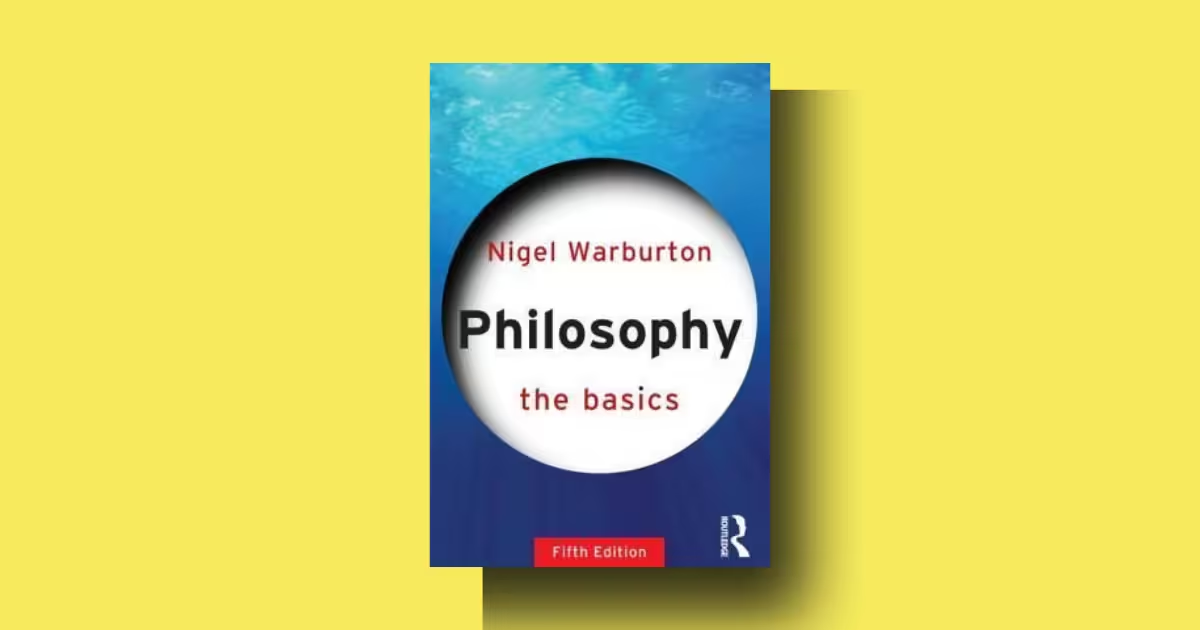
Do you ever catch yourself lying awake at night, wondering if the world is really as it appears, or if your mind is something more than just a brain? These aren’t idle thoughts; they’re the very questions that have driven human curiosity for thousands of years. Yet most of us never learn how to properly think through them. Nigel Warburton’s Philosophy: The Basics doesn’t just give you answers, it teaches you how to ask better questions.
Overview
Philosophy: The Basics is exactly what its title promises: a clear, accessible, and engaging tour through the foundational questions of Western philosophy. In just 184 pages, Nigel Warburton covers the existence of God, right and wrong, animal ethics, politics, perception, science, the mind, and art. The fifth edition, published in 2012 by Routledge, adds a timely new chapter on animals and updates the further reading sections.
The book doesn’t preach a particular worldview. Instead, it presents the major arguments on each topic and then offers criticisms of those arguments, encouraging readers to make up their own minds. As Warburton himself puts it, “Argument is central to the kind of philosophy that I’m interested in, making a case for a position without being dogmatic about what that position is”.
What makes this book special: It’s written by someone who genuinely understands how intimidating philosophy can feel to beginners. Warburton created the book he wished he’d found as a teenager—one that doesn’t assume prior knowledge and communicates with remarkable clarity.
The verdict: If you’ve ever felt curious about philosophy but didn’t know where to start, this is your gateway. It won’t make you an expert, but it will give you the tools to think like one.
Reader recommendation
*Philosophy: The Basics is perfect for:
- Absolute beginners with zero philosophy background
- Students about to start a philosophy course who need a head start
- Curious readers who want to understand what philosophy is actually about
- People who want to develop their critical thinking skills
*Philosophy: The Basics is probably not for:
- Experienced philosophy students looking for deep, original scholarship
- Readers who prefer deep dives over broad overviews
- Those seeking a single, definitive philosophical system or answer
- Anyone who dislikes being presented with arguments and counter-arguments
- Readers who want a historical, chronological approach rather than a topic-based one
As one reviewer noted, “This book is far too short to really investigate the topics it covers in any great detail. You will only get an overview”. That’s precisely the point—it’s an introduction, not a comprehensive treatise.
Table of Contents
Background
Before we dive into the book itself, it’s worth understanding who’s guiding you through these philosophical waters.
Nigel Warburton (born 1962) is a British philosopher who has dedicated his career to making philosophy accessible to the general public. He earned a BA from the University of Bristol and a PhD from Darwin College, Cambridge, and was a lecturer at the University of Nottingham before joining the Open University’s Department of Philosophy in 1994.
He served as Senior Lecturer at the Open University until 2013.
Julian Baggini, a prominent philosopher in his own right, has called Warburton “one of the most-read popular philosophers of our time”.
Beyond his books, Warburton co-created the wildly successful Philosophy Bites podcast with David Edmonds. The podcast, which features short interviews with philosophers on bite-size topics, has been downloaded over 40 million times. He also regularly teaches courses on aesthetics at Tate Modern in London.
What makes Warburton’s approach distinctive is his commitment to clarity without condescension. In his own words, describing Philosophy: The Basics: “It’s a book that doesn’t presume any prior knowledge of philosophy, but I’ve also tried to write it as clearly as possible”.
Philosophy: The Basics Summary
Let me walk you through what this book actually contains. I’ve read it cover to cover, and here’s what stood out to me.
The Introduction: What Philosophy Actually Is
Warburton opens by tackling the question that stops many people before they even start: what is philosophy?
He defines it not as a collection of dusty facts, but as an activity—”a way of thinking about certain sorts of question”. Its most distinctive feature is its use of logical argument. Philosophers invent arguments, criticize other people’s arguments, or do both.
This matters because most of us go through life without examining our fundamental beliefs. We assume killing is wrong, but why? Is it wrong in every circumstance? What about self-defence? What about animals? These are philosophical questions.
Warburton also addresses a common objection: that philosophy is pointless because philosophers never agree on anything. His response is that philosophy isn’t about reaching final answers—it’s about learning to think more clearly. As he puts it, the methods of philosophical thought are “useful transferable skills” that can be applied to law, computer programming, management, journalism, and countless other fields.
He quotes Socrates’ famous claim that “an unexamined life is not worth living”. To carry on a routine existence without examining its principles, he suggests, is like driving a car that’s never been serviced.
Chapter 1: God
The book’s first substantive chapter tackles the biggest question of all: Does God exist?
Warburton begins by defining Theism, the view that one God exists, who is omnipotent (all-powerful), omniscient (all-knowing), and supremely benevolent (all-good).
He then presents four major arguments for God’s existence, along with their criticisms:
The Design Argument (Teleological Argument): This argument, associated with William Paley, claims that the complexity of natural objects like the human eye proves they must have been designed by a Divine Watchmaker. Just as a watch implies a watchmaker, the eye implies a Creator.
Warburton presents several criticisms:
- The analogy between a watch and an eye is weak
- Darwin’s theory of evolution by natural selection provides an alternative explanation
- The argument doesn’t prove monotheism—it could be a team of gods
- The existence of evil in the world contradicts the idea of an all-good designer
The Fine Tuning Argument: This recent variant claims that the universe’s physical conditions were so precisely “fine-tuned” for human life that it must be the work of a divine architect.
The criticism: the “lottery objection.” Winning the lottery is statistically unlikely, but if you win, it doesn’t prove divine intervention. Our existence in a life-friendly universe isn’t surprising; we couldn’t exist anywhere else.
The First Cause Argument (Cosmological Argument): Everything has a cause, so the universe must have a first cause, which is God.
Criticisms:
- It contradicts itself by saying everything has a cause but God doesn’t
- It doesn’t prove that the first cause is all-knowing or all-good
- Why can’t the universe itself be the uncaused cause?
The Ontological Argument: This a priori argument, formulated by St Anselm and used by Descartes, claims that God’s existence follows from the definition of God as “that being than which nothing greater can be conceived”.
Criticisms:
- It would allow us to define anything into existence (like a perfect island)
- Kant’s objection: existence is not a property
The Problem of Evil: This is the most serious challenge to belief in God. If God is all-knowing, all-powerful, and all-good, why does evil exist?. Warburton discusses the Holocaust, Pol Pot’s massacres, torture, and natural disasters as examples.
He presents three attempted solutions (theodicies):
- Saintliness: Evil allows saints and heroes to emerge
- Artistic analogy: Evil contributes to the world’s overall harmony like discords in music
- The Free Will Defence: God gave humans free will, and evil is a necessary consequence
Each of these, however, faces serious objections. The Free Will Defence, for instance, only explains moral evil, not natural disasters like earthquakes.
Miracles and Pascal’s Wager: Warburton also discusses Hume’s arguments against believing in miracles and Pascal’s famous “wager”—the idea that it’s rational to believe in God because the potential payoff (eternal life) is infinite.
Chapter 2: Right and Wrong
This chapter introduces three major ethical frameworks:
Duty-based theories (Deontology): Actions are right or wrong regardless of consequences.
Christian ethics: Morality is based on God’s commands. The Euthyphro dilemma asks: does God command what is good because it’s good, or does God’s command make it good? Either answer creates problems.
Kantian ethics: Kant’s Categorical Imperative says we should “act only on maxims which you can at the same time will to be universal laws”. We should treat people as ends in themselves, never merely as means. Criticisms include its emptiness, conflicts of duty, and the dismissal of emotions like compassion.
Consequentialism: Actions are judged by their consequences.
Utilitarianism (Bentham and Mill): The right action produces the greatest happiness for the greatest number. Criticisms include difficulties in measuring happiness, the problem of justifying sacrificing an innocent person for the greater good, and Robert Nozick’s Experience Machine thought experiment.
Negative utilitarianism: Focus on minimizing suffering rather than maximizing happiness. Criticism: it would justify painlessly destroying all life.
Rule utilitarianism: Follow general rules that tend to produce happiness.
Virtue theory: Based on Aristotle, this focuses on character rather than actions. The central question is “How should I live?”—and the answer is to cultivate virtues like courage, generosity, and honesty.
The chapter also covers applied ethics through the lens of euthanasia, showing how different ethical theories would approach the same practical problem.
Meta-ethics: The chapter concludes with questions about the meaning of ethical language, covering naturalism, moral relativism, and emotivism.
Chapter 3: Animals (New to the Fifth Edition)
This new chapter addresses a topic that has become increasingly urgent in philosophical discourse.
Warburton begins with the observation that animals clearly suffer, they squeal, take avoidance action, and show signs of distress. The most plausible explanation is that they feel pain much as we do.
He discusses Descartes’ troubling view that animals are mere machines without souls, which he used to justify vivisection. Fortunately, Darwin’s theory of evolution has made such views less tenable.
The central concept in this chapter is speciesism, a term coined by Richard Ryder and popularized by Peter Singer. Speciesism is a prejudice against other species, akin to racism. It involves treating animals’ interests as less important simply because they’re not human.
Arguments for speciesism include:
- God gave humans dominion over animals
- Animals don’t show respect for each other
- The analogy with favouring our own children
Anti-speciesism argues that animals have interests—particularly an interest in not suffering—and these deserve equal consideration.
Warburton also explores whether animals have rights. Some philosophers argue that rights imply duties, and animals can’t have duties. But others point out that many humans (infants, the severely brain-damaged) also can’t have duties yet still have rights.
He concludes with Kant’s indirect duty view, the idea that cruelty to animals is wrong because it damages the perpetrator’s character, not because of the animal’s suffering.
Chapter 4: Politics
This chapter examines equality, democracy, freedom, punishment, and civil disobedience.
Equality: Egalitarians argue for some form of equality, but “equality” is always equality in certain respects, not every respect. The chapter discusses equal distribution of money, equal opportunity in employment, and reverse discrimination.
Democracy: Two models exist, direct democracy (everyone votes on everything) and representative democracy (we elect representatives). Criticisms include:
- Marx’s view that democracy is an illusion reflecting economic power
- Plato’s concern that voters aren’t experts
- The paradox of democracy: what happens when you vote against your conscience and lose?
Freedom: Isaiah Berlin’s distinction between negative freedom (absence of coercion) and positive freedom (exercising control over your life). Negative freedom is what Mill defended in On Liberty—individuals should be free to conduct their “experiments of living” as long as they don’t harm others.
Punishment: Four justifications:
- Retribution (they deserve it)
- Deterrence (discourages others)
- Protection of society (removes the threat)
- Reform (changes the criminal)
Civil disobedience: Non-violent, public law-breaking designed to draw attention to unjust laws. Examples include the suffragettes, Gandhi, and Martin Luther King Jr.
Chapter 5: Appearance and Reality
This chapter addresses epistemology—the theory of knowledge.
Common-sense realism: The view that there’s a world of physical objects that exist independently of us and are more or less as they appear.
Sceptical challenges:
- The Illusion Argument: Our senses sometimes mislead us, so how can we ever be certain?
- Could I be dreaming? How can I know I’m awake right now?
- Hallucination: Perhaps I’m just a brain in a jar being stimulated by an evil scientist
Descartes’ Cogito: “I think, therefore I am”—even if I’m being deceived, the fact that I’m being deceived proves I exist.
Representative realism (Locke): We don’t perceive objects directly, but through mental representations. This introduces the distinction between primary qualities (shape, size, movement—actually in objects) and secondary qualities (colour, smell, taste—powers to produce sensations in us).
Idealism (Berkeley): “To exist is to be perceived.” Objects only exist while being perceived.
Phenomenalism: Objects are patterns of actual and possible sense experiences.
Causal realism: The most satisfactory theory, which holds that physical objects cause our sense experiences, and perception is a matter of acquiring information about our environment.
Chapter 6: Science
This chapter challenges the simple view that science begins with unbiased observation and moves to theory.
The Problem of Induction: Inductive arguments (generalizing from past observations) can’t be logically justified. Hume pointed out that we can’t prove the future will resemble the past without using induction itself, which is circular.
Bertrand Russell’s chicken example illustrates this perfectly: the chicken was fed every day and expected it to continue, until one day its neck was wrung.
Nelson Goodman’s “grue” example shows an even deeper problem: the same evidence can support multiple contradictory generalizations.
Falsificationism (Popper): Scientific theories can’t be proven true, only falsified. Science progresses through conjecture and refutation. A single falsifying instance is more powerful than any number of confirming instances.
Falsificationism also provides a criterion for distinguishing science from pseudo-science: a theory is scientific only if it can, in principle, be falsified. Psychoanalysis, for example, has been criticized as unfalsifiable because any evidence can be interpreted to support it.
Criticisms of falsificationism include that it ignores the role of confirmation, doesn’t account for human error, and is historically inaccurate—scientists often cling to theories despite apparent falsifications.
Scientism: The view that science can explain everything. The criticism is that it impoverishes our understanding—love, music, and personal relationships can’t be reduced to scientific explanations.
Chapter 7: Mind
This chapter tackles the Mind/Body Problem.
Dualism (Descartes): Mind and body are separate substances. The mind is non-physical. Criticisms: it can’t be scientifically investigated, evolution is hard to explain, and interaction between mind and body is mysterious.
Physicalism: Mental events are physical events in the brain.
Type-identity theory: Mental states are identical to specific brain states. Criticisms include the problem of qualia (what it actually feels like to be in a mental state), and individual differences in brain structure.
Token-identity theory: Each mental event is a physical event, but the same type of thought can involve different brain states.
Behaviourism: Mental states are just dispositions to behave in certain ways. Criticisms: it can’t distinguish genuine pain from pretending, ignores qualia, and can’t explain how we learn about our own beliefs.
Functionalism: Mental states are defined by their functional roles—their relations to inputs, outputs, and other mental states. The Chinese Room thought experiment (Searle) argues that a computer could manipulate symbols without genuine understanding.
Other Minds: How do I know other people are conscious? The Argument from Analogy says they resemble me physically and behaviourally, so they probably have minds like mine. But this isn’t a proof—I only have one instance (myself) of the connection between body and mind.
Chapter 8: Art
The final chapter asks: what is art?
Can art be defined? Some argue no—works of art share only a “family resemblance” (Wittgenstein).
Significant form theory (Bell): Works of art share “significant form” that produces an “aesthetic emotion” in sensitive critics. Criticism: this is circular—each concept is defined in terms of the other.
Idealist theory (Collingwood): The actual work of art is an idea in the artist’s mind, not a physical object. Criticisms: it’s strange to think of artworks as non-physical, and it’s too narrow.
Institutional theory (Dickie): Works of art are artefacts that have been given the status of art by members of the “art world”. Criticisms: it’s circular and doesn’t distinguish good from bad art.
Art and evolution: Some philosophers, like Denis Dutton, argue that art arises from instincts—the “art instinct”. Landscape preferences may reflect environments hospitable to our ancestors, and artistic creation may be like a peacock’s tail—a costly signal of fitness.
Art criticism: The chapter also discusses whether an artist’s intentions are relevant to interpretation. Anti-intentionalists argue we should only consider evidence internal to the work. Critics argue this is too narrow and ignores irony.
Authenticity and forgeries: Can a perfect forgery be as artistically valuable as the original? The answer involves questions about creativity, originality, and the intent to deceive.
Philosophy: The Basics Analysis
Let me be direct: Philosophy: The Basics is the best introduction to philosophy I’ve ever encountered. That’s not hyperbole—it’s a sentiment shared by Stephen Law, author of The Philosophy Gym, who calls it “the most recommended introduction to philosophy on the market”.
What makes it so effective?
First, the structure is brilliant. Each chapter presents a philosophical problem, lays out the major arguments, and then—crucially—offers criticisms of those arguments. This isn’t just a dry summary. It’s an invitation to participate in the conversation. As Warburton explains, “There’s an engagement with the ideas, not just simply a summary of them, it’s meant to encourage the reader to decide how good they think the criticisms are”.
Second, the writing is remarkably clear. Philosophy is often written in impenetrable jargon, but Warburton avoids this. He defines unfamiliar terms as he goes along, and he never assumes prior knowledge. The book is structured so you can skim to get the big picture, then dive deeper into areas that interest you.
Third, the scope is ambitious but manageable. Eight chapters cover God, ethics, animals, politics, perception, science, mind, and art. That’s a lot of ground, but each chapter is just long enough to give you a solid foundation without overwhelming you.
Fourth, the book is genuinely useful. I walked away from this book with a practical toolkit, not just facts, but ways of thinking. I can now identify logical fallacies, evaluate arguments, and understand the structure of philosophical debate. As Warburton notes, these are “transferable skills” applicable to law, journalism, management, and countless other fields.
But there are limitations. As one reviewer noted, the book is “far too short to really investigate the topics it covers in any great detail”. You’ll only get an overview, not deep expertise. This isn’t a criticism of the book’s purpose; it’s an introduction, after all, but it’s worth noting.
Additionally, some readers might find the topic-based approach frustrating if they prefer historical chronology. Warburton acknowledges this in the introduction, explaining that his goal is to give readers “the tools to think about philosophical issues yourselves rather than simply to explain what certain great figures have thought about them”.
Strengths and Weaknesses
Strengths
Exceptional clarity. Warburton’s writing is patient, accurate, and clear. He avoids unnecessary jargon and explains unfamiliar terms as he goes.
Balanced presentation. Each argument is presented alongside its criticisms. You’re never told what to believe—you’re equipped to decide for yourself.
Topic-based approach. This is more engaging than a dry historical survey. Each chapter tackles a question you’ve probably asked yourself.
Comprehensive coverage. Eight chapters cover the major areas of philosophy. The new chapter on animals (fifth edition) is particularly timely.
Practical value. The book develops skills in critical thinking and argument evaluation that transfer to many areas of life.
Weaknesses
Breadth over depth. At just 184 pages covering eight major topics, nothing is explored in great detail.
Western focus. The book focuses almost exclusively on the Western philosophical tradition, despite acknowledging Eastern philosophy in the introduction.
Limited historical context. Because it’s topic-based, readers don’t get a strong sense of how philosophical ideas developed over time.
Some topics feel rushed. The chapter on the mind, in particular, covers complex material very quickly.
Designed for beginners only. Experienced philosophy students won’t find anything new here.
The “criticisms” format can feel repetitive. Each section follows the same pattern (argument → criticisms), which is effective but can become predictable.
Comparison with Similar Works
Philosophy: The Basics is often compared to other introductory philosophy books. Here’s how it stacks up:
Philosophy: The Basics vs. Think by Simon Blackburn: Blackburn’s book is considerably more difficult in places. It’s written for a more sophisticated audience and assumes greater intellectual stamina. Warburton is gentler and more accessible.
Philosophy: The Basics vs. What Does It All Mean? by Thomas Nagel: Nagel’s book is also a brief introduction, but it’s more idiosyncratic—it reflects Nagel’s own philosophical interests and positions. Warburton is more neutral and comprehensive.
Philosophy: The Basics vs. The Philosophy Gym by Stephen Law: Law’s book is more playful, using dialogues and stories to illustrate philosophical ideas. Warburton is more straightforward and systematic. Interestingly, Law himself praises Philosophy: The Basics as the best introduction available.
Philosophy: The Basics vs. A Little History of Philosophy by Nigel Warburton: This is Warburton’s other popular introduction, but it takes a historical rather than topic-based approach. If you want chronology, choose A Little History; if you want topics, choose Philosophy: The Basics.
Philosophy: The Basics vs. Sophie’s World by Jostein Gaarder: Gaarder’s book is a novel that teaches philosophy through its plot. It’s charming and effective, but it’s also much longer and less direct. Warburton is more efficient and focused.
Conclusion
Philosophy: The Basics is the book I wish I’d read at sixteen. It’s the book that would have shown me that philosophy isn’t a collection of dusty, irrelevant arguments—it’s a living conversation about the questions that matter most.
Who should read this book? Anyone who’s ever wondered about the meaning of life, the existence of God, the nature of right and wrong, or the limits of human knowledge. It’s perfect for absolute beginners, students about to start a philosophy course, and curious readers who want to understand what philosophy is actually about.
Who shouldn’t? Experienced philosophy students won’t find anything new here. And if you’re looking for deep expertise on any particular topic, this isn’t the book for you—it’s a gateway, not a destination.
The bottom line: Stephen Law called it “the most recommended introduction to philosophy on the market”. That’s not marketing hype—it’s the truth. There is no better short introduction to philosophy available today.
My advice: Buy it, read it, and then follow the further reading suggestions at the end of each chapter to explore the topics that grabbed you. Let this book be the beginning of your philosophical journey, not the end.