
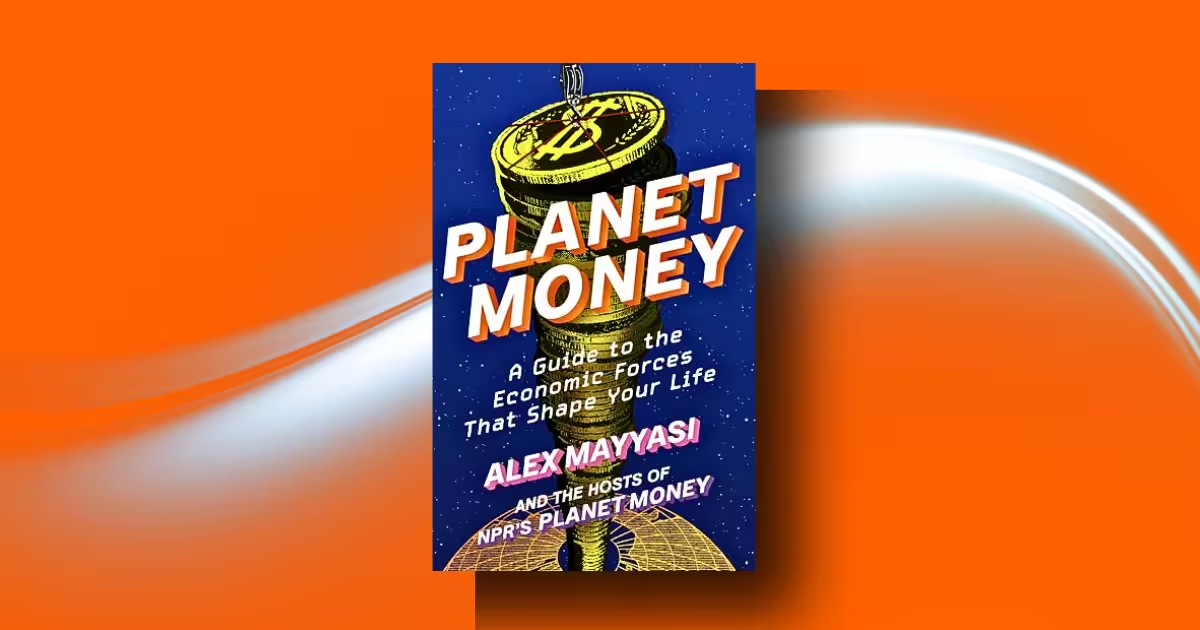

Why does the price of eggs suddenly double? Why do corporations seem immortal while small businesses struggle? And why does the economy sometimes feel like an invisible force shaping every decision in our lives? When I picked up Planet Money: A Guide to the Economic Forces That Shape Your Life, I realized something remarkable: economics is not merely charts, GDP figures, or policy debates.
It is the quiet logic behind our groceries, our careers, our relationships, and even the way our weekends feel.
Written by Alex Mayyasi with the hosts of NPR’s iconic podcast Planet Money, this book transforms complex economic ideas into stories that feel almost personal.
Table of Contents
1. Introduction
Planet Money: A Guide to the Economic Forces That Shape Your Life (2026) by Alex Mayyasi and the Hosts of NPR’s Planet Money, published by W. W. Norton & Company, is the first major book inspired by the globally popular economics podcast launched in 2008 during the global financial crisis.
Its mission echoes the podcast’s famous tagline: “The economy explained.”
But unlike traditional economics textbooks, the book uses vivid stories—from a raisin cartel in California to corporate law in Delaware—to explain the economic forces shaping everyday life.
This book belongs to the genre of:
- Popular economics
- Narrative nonfiction
- Financial literacy
Similar to works like:
- Freakonomics by Steven Levitt and Stephen J. Dubner
- The Undercover Economist by Tim Harford
The difference is tone: Planet Money feels less like a lecture and more like a conversation.
Author Alex Mayyasi is a journalist and longtime contributor to the podcast. He previously edited the acclaimed project Gastro Obscura and has written for outlets like The Washington Post and Smithsonian.
The book also draws on more than a decade of reporting by the Planet Money team, one of the most influential economics podcasts in the world.
Purpose and Central Thesis
Planet Money’s central argument is simple yet powerful:
Economic forces shape nearly every aspect of our lives—even when we do not notice them.
As the introduction states:
“The economy is the grandest collaborative project in human history… Everyone contributes to it. Everyone is shaped by it.”
The authors aim to equip readers with an “economic lens”—a way of thinking that helps us understand:
- prices
- markets
- careers
- corporations
- inequality
- investing
- technology
2. Background
To understand the significance of this book, one must understand the phenomenon of Planet Money.
Launched by NPR in 2008, during the global financial crisis, the podcast aimed to explain complicated financial events—like bank failures or bailouts—to ordinary people.
Over time it became a global educational phenomenon, winning Peabody and Murrow Awards for its storytelling approach to economics.
The team even conducted unusual experiments to understand the economy:
- buying crude oil from a well
- starting a record label to test streaming royalties
- investigating shell companies by creating one
As Planet Money explains:
“To investigate shell companies, we set one up ourselves… To understand the oil industry, we bought crude oil ourselves.”
This investigative spirit defines the book.
3. Planet Money Summary
Planet Money is divided into five thematic sections, each exploring how economics shapes different areas of life.
PART I: Meet the Economy
The Pickle Problem: The Power of Prices
This is the killer opener. We meet Susannah Morgan, a food bank director in Alaska who keeps getting shipped truckloads of pickles she doesn’t need.
Planet Money explains how, with the help of economists like Canice Prendergast, Feeding America abandoned Soviet-style central planning for an auction market. “Prices are like tiny newspapers,” the authors write, summarizing a huge amount of distributed information into a single number.
The result? Food banks got 100 million more pounds of food efficiently. This chapter proves that markets aren’t evil; they are just tools—and even a socialist food banker can use them to feed the hungry.
One of the most memorable stories in the book begins with a food bank in Alaska.
In 2004, Susannah Morgan, director of the Food Bank of Alaska, received a donation offer from the nonprofit Feeding America. The donation? Five-gallon buckets of pickles.
The problem:
- The food bank didn’t need pickles.
- They needed fruits and vegetables.
But the centralized distribution system meant food banks had little choice.
Eventually, economists proposed a solution: create a market system with auctions.
Food banks would receive fake money and bid for donated food.
The result?
- Better distribution
- Less waste
- More efficient allocation
The book explains the insight beautifully:
“Prices are like tiny newspapers. They summarize a huge amount of distributed information into a single number.”
This story illustrates one of the core principles of economics:
Prices transmit information.
The Invisible Hand in Action
Planet Money frequently references the famous economic idea of the “invisible hand” from Adam Smith.
Markets coordinate millions of decisions without central planning.
A vivid example comes from a Cold War anecdote.
In 1989, Soviet leader Boris Yeltsin visited an American supermarket and was stunned by the enormous selection of goods.
According to the story:
“Not even Soviet leaders had this many choices,” he said while wandering the aisles.
Within two years, Yeltsin helped dissolve the Soviet Union.
The lesson?
Decentralized markets create abundance.
PART II: Work and Career
This section explores how economic forces shape employment, workplace culture, and technological change.
The ATM and the Bank Teller
One chapter examines automation through a surprising example: bank tellers.
When ATMs became widespread in the 1980s, economists predicted tellers would disappear.
Instead, something unexpected happened.
The number of bank tellers actually increased for several decades.
Why?
Because ATMs lowered operating costs, allowing banks to open more branches.
The lesson:
Technology often changes jobs rather than eliminating them.
The Gig Economy
Another chapter tells the story of two gig workers navigating modern freelance labor.
Planet Money carefully explores:
- flexibility vs instability
- independence vs lack of benefits
The authors neither praise nor condemn the gig economy—they simply explain its incentives.
PART III: Love and Family
This section of Planet Money: A Guide to the Economic Forces That Shape Your Life is pure gold for anyone navigating relationships, family planning, housing, or the daily juggle of work and kids.
It applies economic thinking to the most personal parts of life, showing how markets, incentives, and big data shape who we love, where we live, and how we raise the next generation.
As a reader who’s seen friends delay marriage or kids because of skyrocketing costs (and local housing squeezes that echo the book’s stories), I found it eye-opening and oddly reassuring.
Economics isn’t just for Wall Street—it explains why dating apps feel rigged, why the American Dream feels uneven, why rents crush dreams, and why childcare feels like a conspiracy against parents.
Here’s the full breakdown, chapter by chapter and point by point, with key stories, data, quotes, and takeaways straight from the pages so you get the complete picture without needing the book itself.
Chapter 10: The Labor of Finding Love – Every Market Has a Designer
The chapter opens with a 2019 Stanford dorm scene: students refreshing emails at midnight for their “Marriage Pact” match (page 156).
Alden O’Rafferty got “KT” (Kyra Dorado Teigen); they were 99th percentile compatible and ended up platonic “friend-married” with a pact to wed at 30–40 if still single. It’s a hedge against ending up alone, unlike swipe-happy dating apps.
Core idea: Dating is a matching market (no prices, just compatibility). Market design (a branch of economics) fixes broken ones, like the “stable-marriage problem” (page 160).
The Gale-Shapley algorithm (1960s) has one side propose; the other accepts or rejects. Outcome is always stable, but proposer-optimal.
Real-world proof: New York City schools used a tweaked version—top-choice matches jumped from ~50,000 to 70,000 students (page 161).
The Marriage Pact story: Undergrads Liam McGregor and Sophia Sterling turned a class project into a survey-based algorithm (value questions like “Would you keep a gun in the house?” to make it strategy-proof—no lying for better matches).
It exploded: 4,000+ sign-ups in a week at Stanford. They fulfilled Alvin Roth’s three principles of good markets: thick (enough participants), safe (reveal true preferences), uncongested (not overwhelmed) (page 163).
The twist: It worked for platonic pacts too, but scaling into a dating app clashed with profit motives. McGregor pivoted to Matchbox (mini-pact events for mentors, Bible study buddies, etc.) (page 166).
Dating-app paradox: Better matching = fewer users = less revenue.
Apps keep you swiping (collaborative filtering predicts “likes you back,” but we suck at knowing what we want—speed-dating studies show stated preferences don’t predict actual dates) (page 165).
Chapter 11: The Opportunity Atlas – The American Dream Exists, It’s Just Not Evenly Distributed
This one hits hard with the Moving to Opportunity (MTO) experiment (page 172). In the 1990s, HUD ran a lottery for 4,608 public-housing families in five cities.
Control group stayed put; some got regular vouchers; the experimental group got vouchers only for low-poverty neighborhoods (<10% poverty).
Lydia Grayson-Cross’s story: East Harlem mom with addiction struggles won the lottery and moved her family to Jacksonville, NC (page 171). Safety improved, mental health bettered, but jobs/schools didn’t transform immediately—her older kids struggled; her youngest (age 2 at move) thrived, earning degrees later.
Initial MTO results (2011 HUD report): Big wins in safety/health, but no big income/employment jumps for parents or kids at first (page 176).
The breakthrough: Economists Raj Chetty and Nathan Hendren re-analyzed with IRS tax data (page 176). Kids who moved young saw huge gains—lifetime income boost of ~$302,000 for a child moving at age 4 vs. 8. It’s generational: “You’d actually see higher outcomes on average for the four-year-old” (page 177).
Opportunity Atlas: Chetty/Hendren mapped mobility using 70M+ IRS records (page 178). American Dream alive in places like San Jose, Salt Lake City, rural Iowa/North Dakota—but dead in Charlotte (poor stay poor despite growth).
Key factor? Social capital—cross-class friendships (rich-poor connections) predict mobility best (page 179). Facebook data (21B friendships) confirmed: more “bowling alleys” (Putnam-style mixing) = higher mobility.
Policy wins: MTO 2.0 vouchers with counseling got 50%+ into high-mobility areas; Seattle rebuilt Yesler Terrace as mixed-income (page 178).
Not just place: Immigrants and motivated families build social capital anywhere. Grayson-Cross: “You have to be your own cheerleader… It’s up to you to get to the finish line” (page 180).
Quote: “Social capital… is one of the strongest predictors of differences in economic mobility” (Chetty, page 179). Takeaway: Neighborhoods matter enormously for kids, but individual drive and cross-class ties can bridge gaps.
Sidebar: Relationship Advice from Economists (page 197)
A fun, illustrated “Dear Love Economists” column with real queries and economist replies. Examples: How to split chores (use comparative advantage), whether to date a manager (power dynamics as market failure), and why “settling” can be rational (stable matching). Light-hearted but insightful—shows economists see love as a market with trade-offs and incentives.
Chapter 12: The Rent Is Too Damn High – The Squamish Nation’s Impossibly Simple Solution to the Housing Crisis
Vancouver’s insane rents (3rd most expensive city globally) meet Indigenous land reclamation (page 185).
The Squamish Nation reclaimed Sen̓ áḵw (10.5 acres by False Creek) after a decades-long lawsuit proving 1913 forced sale was illegal (“honor of the Crown” violated—page 188).
The project: 11 towers, 6,000 rental units (250–300 for Squamish families). Freed from city zoning, it’s building density where Vancouver banned it (single-family zoning, NIMBY approvals) (page 186).
History: 1913 eviction/burning of village; 1970s lawsuit used 10,000+ documents. Settlement: $92.5M + land return (page 191).
Economic insight: Rent-seeking by homeowners blocks supply (page 189). High prices signal shortage, but zoning + neighbor vetoes = luxury-only builds. Sen̓ áḵw proves: free land from zoning = massive supply (projected $10B revenue over decades for Nation) (page 194).
Trickle-down housing: New market-rate units free up cheaper ones elsewhere (45–70 people per 100 new residents). Aging luxury becomes tomorrow’s affordable via “filtering” (page 195).
Vancouver shift: 2023 end to single-family zoning province-wide (page 196).
Quote: “The high price of housing is a clear signal that these cities don’t have enough homes” (page 186). Lesson: Upzoning + removing NIMBY vetoes works. Empathy for future residents > protecting current property values.
Chapter 13: The Global Conspiracy to Make Childcare More Expensive – Why Goods Get Cheaper and Services Don’t
Wesley & Giovonni Wade’s nightmare: PhD student + attorney couldn’t find affordable childcare in Durham, NC—every center wait-listed. Wesley quit his job (page 201). Why? Baumol’s cost disease (page 206).
Goods vs. services: Corn chips get cheaper via productivity (tech, scale). But violin quartets, haircuts, or childcare need the same human hours forever (page 206). “You can’t innovate your way to a three-person quartet” (page 206).
The mechanism: Productivity in manufacturing → higher wages there → teachers/childcare workers demand raises too → prices rise (no efficiency gain). Result: goods cheapen; services (childcare ~$11k/child/year average US) inflate (page 207).
Stats: Raising a 2015-born child to 17 costs $233k (2017 est.) → >$300k today. US offers little subsidy vs. peers → fewer kids, later births (page 209).
Cure: Subsidize (taxes fund it). Wealth from productive sectors can cover it. “The price of a successful economy is your taxes going up, forever” (page 210).
Tooth Fairy “inflation” chart shows kids getting more money while goods cheapen—parents spoil via cheaper toys (page 208 sidebar). Quote: “The global economy has many faults, but it’s also a giant conspiracy to provide us with better goods at a lower cost” (page 205).
Part IV: Saving & Investing
Bobby Bonilla Day:
The Mets owe a retired baseball player $1.19 million every July 1 until 2035. Sounds stupid, right? Wrong.
Planet Money explains Compound Interest. The Mets took $5.9 million, invested it at 8% (theoretically), and turned it into $30 million.
This isn’t a blooper; it’s a blueprint for retirement planning. If you start saving in your 20s, your money grows like a snowball downhill. The book warns, however, that the Mets lost it all by investing with Bernie Madoff, proving that even “genius” finance can be a confidence trick.
Weighing a Cow and Picking Stocks:
Can you beat the market? Unlikely.
Planet Money recreates Francis Galton’s 1906 experiment where the average guess of a crowd guessed the weight of an ox perfectly.
Similarly, the stock market’s “wisdom of crowds” makes it nearly impossible to outperform. “The only free lunch in investing is diversification,” they argue, leading to the inevitable champion: the Index Fund.
The Global Conspiracy to Make Childcare More Expensive:
Why are goods cheap but services (like babysitters) expensive? Baumol’s Cost Disease. The book explains that a violinist playing a Schubert quartet takes just as long today as in 1900.
As manufacturing gets more efficient (paying higher wages), service providers must raise wages to compete, passing the cost to you. This is why your rent and tuition go up even when TV prices fall.
PART V: Leisure
The final section explores how economics influences things we rarely think about: leisure, networks, and even credit card rewards.
Network Effects
Planet Money compares weekends to subway systems and ride-sharing platforms.
Why?
Because both rely on network effects.
A subway system becomes more valuable as more people use it.
Similarly:
- social media platforms
- ride-sharing apps
- digital payment systems
grow stronger with more participants.
Credit Card Points
Another chapter dismantles the illusion of “free rewards.”
Credit card points exist because banks collect fees from merchants.
So the perks are not free—they are redistributed costs.
As economists like to say:
There is no such thing as a free lunch.
Key Economic Concepts Explained in the Book
Planet Money covers dozens of economic ideas, including:
- Supply and demand
- Price signals
- Market design
- Public goods
- Externalities
- Automation
- Inflation
- Index investing
- Network effects
These are not explained through formulas but through stories.
4. Critical Analysis
My Overall Impression
After finishing Planet Money: A Guide to the Economic Forces That Shape Your Life, I felt the same sense of intellectual excitement I experienced when reading books like Freakonomics or The Undercover Economist.
Yet this book carries a distinctive voice: it feels like a journalistic expedition into the hidden machinery of everyday life.
In my opinion, Planet Money is one of the most accessible and engaging introductions to economics published in the 2020s.
The authors succeed in transforming an intimidating subject into a series of fascinating stories about people, choices, incentives, and unintended consequences.
Reading it almost feels like listening to the podcast itself—curious, playful, and occasionally mischievous.
Evaluation of the Book’s Argument
The book’s central claim is that economic thinking can illuminate almost every decision we make, from grocery shopping to choosing a career.
In many ways, the book proves this argument convincingly.
Consider the famous “pickle problem” story from the beginning of the book. A nonprofit food distribution network was failing to allocate donations efficiently until economists introduced a simple market mechanism—auctions using artificial currency.
The result was dramatic:
- more efficient allocation of food
- reduced waste
- better outcomes for food banks
As the book explains:
“Prices are like tiny newspapers. They summarize a huge amount of distributed information into a single number.”
This metaphor perfectly captures one of the most powerful insights in economics: prices transmit information across an entire society.
Instead of a central authority deciding what people should consume or produce, markets allow millions of individuals to coordinate their choices through price signals.
The authors repeatedly demonstrate this principle through vivid examples.
Storytelling as Economic Explanation
One of the book’s greatest strengths is its storytelling approach.
Traditional economics books often rely on equations or graphs.
This book relies on narratives.
For example:
- a Soviet leader visiting an American supermarket
- a California farmer accused of illegally selling raisins
- a corporate lawyer shaping the rules of global capitalism
Each story functions as a case study in economic behavior.
Take the supermarket anecdote involving Boris Yeltsin.
When the Soviet leader visited a Houston grocery store in 1989, he was stunned by the abundance of products available.
According to the account:
Yeltsin “roam[ed] the aisles… nodding his head in amazement.”
For someone raised in a centrally planned economy, the supermarket represented something extraordinary: the spontaneous order of markets.
The authors use this story to illustrate how decentralized economic systems often outperform centralized planning.
A Broader View of Economics
Another impressive feature of the book is its scope.
Instead of focusing only on finance or markets, the authors explore how economics intersects with:
- careers
- relationships
- technological change
- environmental policy
- public goods
For instance, the chapter on corporations reveals how corporate law in Delaware shapes global capitalism.
It explains that most major American corporations—from technology firms to manufacturing giants—are legally incorporated in Delaware because of its specialized corporate court system.
The state earns approximately $2 billion annually from incorporation fees, representing roughly 30% of its state budget.
This fascinating detail demonstrates how a tiny state became the legal operating system of global business.
Economic Concepts Explained Clearly
The book introduces many core economic ideas without jargon.
Some of the most important include:
1. Supply and Demand
The foundational idea that prices adjust based on the balance between buyers and sellers.
2. Market Incentives
Economic systems influence behavior by rewarding certain choices.
3. Externalities
Costs or benefits imposed on people who are not directly involved in a transaction.
For example:
- pollution from factories
- environmental damage from fossil fuels
4. Public Goods
Certain services—like clean air or national defense—cannot be efficiently provided by markets alone.
5. Network Effects
Products become more valuable when more people use them.
Examples include:
- social media platforms
- ride-sharing services
- payment networks
By explaining these ideas through stories, the authors make complex theories feel intuitive.
5. Strengths and Weaknesses
Strengths
1. Exceptional Storytelling
The book reads more like narrative journalism than academic economics.
Each chapter feels like a mini documentary.
The stories are memorable and engaging.
For example:
- the “raisin cartel” that controlled California’s raisin market
- the auction system used by food banks
- the surprising survival of bank tellers in the age of ATMs
These stories make economic concepts tangible.
2. Accessibility
Many people feel intimidated by economics.
This book removes that barrier.
The authors deliberately avoid technical jargon.
Instead, they rely on relatable scenarios from everyday life.
3. Practical Lessons
Unlike purely theoretical economics books, Planet Money offers practical insights.
Readers learn about:
- investing strategies
- career choices
- automation and technology
- inflation and purchasing power
For example, the chapter on index funds explains why many professional investors fail to outperform the market.
This lesson alone could potentially save readers thousands of dollars in investment fees over a lifetime.
4. Balance and Intellectual Honesty
The authors avoid ideological extremes.
They acknowledge both:
- the power of markets
- the limitations of markets
For instance, markets can allocate resources efficiently—but they may also produce inequality or environmental harm.
This balanced perspective makes the book credible.
Weaknesses
No book is perfect, and Planet Money has a few minor shortcomings.
1. Fragmented Structure
Because the book is based on stories, the structure can feel somewhat episodic.
Some readers may prefer a more systematic explanation of economic theory.
2. Limited Global Perspective
Although the book occasionally references international examples, much of its analysis focuses on the United States.
Given the global nature of modern economics, a broader international perspective might have enriched the discussion.
3. Simplification of Complex Issues
In order to remain accessible, the book sometimes simplifies complicated economic debates.
For example:
- the causes of inequality
- the complexities of globalization
These topics could easily fill entire books on their own.
6. Comparison with Similar Works
Several popular economics books explore similar themes.
Here is how Planet Money compares.
Freakonomics
by Steven D. Levitt and Stephen J. Dubner
This famous book also uses unusual stories to illustrate economic ideas.
However:
- Freakonomics focuses more on behavioral economics
- Planet Money focuses more on systems and institutions
The Undercover Economist
by Tim Harford
Harford’s book explains economic principles through everyday experiences like coffee prices and supermarkets.
Both books share a similar mission.
However, Planet Money is more narrative-driven and journalistic.
Capital in the Twenty-First Century
by Thomas Piketty
Piketty’s work examines inequality through historical data.
While immensely influential, it is much more technical.
Planet Money serves as a much more approachable introduction to economic thinking.
7. Personal Reflection
While reading Planet Money, I felt something I rarely feel when reading about economics: curiosity instead of intimidation.
The book does not talk down to the reader.
Instead, it invites us to see everyday life through an economic lens.
A simple grocery store becomes a lesson in global trade.
A baseball contract becomes a lesson in finance.
A bucket of pickles becomes a lesson in market design.
Economics suddenly feels alive.
Reading this book changed the way I see ordinary life.
Now, when I walk into a grocery store, I do not simply see shelves of products.
I see:
- supply chains
- price signals
- global trade networks
When I read about technological change, I think about incentives and labor markets.
When I hear about inflation, I think about the complex interplay of monetary policy, supply shocks, and consumer behavior.
In other words, the book does exactly what it promises:
It teaches readers how to see the world through the lens of economics.
8. Conclusion
Planet Money: A Guide to the Economic Forces That Shape Your Life is one of the most engaging popular-economics books of recent years.
Through vivid storytelling and clear explanations, the authors demonstrate that economics is not an abstract academic discipline.
It is the hidden architecture of everyday life.
The book reveals why:
- prices rise and fall
- corporations behave the way they do
- technology reshapes the labor market
- financial decisions compound over time
Most importantly, it shows that understanding economics helps us make better decisions—as consumers, workers, investors, and citizens.
For readers who want to understand the modern world without wading through dense textbooks, this book is an excellent starting point.