
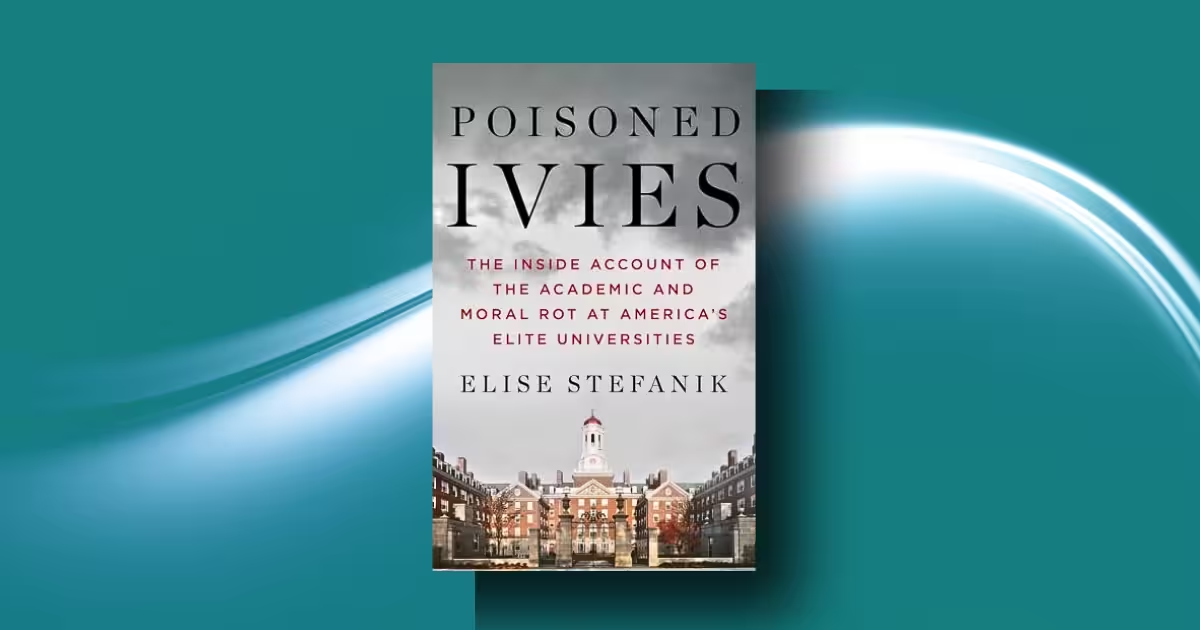

Why do so many ordinary people suddenly distrust elite universities like Harvard University or Yale University? If you’ve ever wondered whether America’s most prestigious colleges still pursue truth—or whether they have drifted into ideological activism—Poisoned Ivies by Elise Stefanik might be the most revealing book you will read this year.
From my perspective as a reader deeply interested in culture, politics, and education, this book felt less like a typical political memoir and more like an investigative narrative exposing the crisis unfolding within America’s most influential academic institutions.
Table of Contents
1. Introduction
Poisoned Ivies: The Inside Account of the Academic and Moral Rot at America’s Elite Universities is a political and cultural critique written by Elise Stefanik, a U.S. congresswoman from New York who gained international attention after questioning university presidents during a historic congressional hearing in December 2023.
Poisoned Ivies examines the ideological transformation of elite universities—especially the Ivy League institutions such as:
- Harvard University
- Yale University
- Princeton University
- Columbia University
- University of Pennsylvania
- Dartmouth College
- Brown University
- Cornell University
Published by Simon & Schuster, the book blends political memoir, investigative journalism, and cultural criticism.
What Poisoned Ivies Is About
The book falls into the genres of:
- political non-fiction
- higher-education critique
- cultural commentary
- investigative political narrative
Stefanik argues that elite universities—once pillars of intellectual inquiry—have drifted toward ideological conformity, administrative bureaucracy, and moral confusion.
Her central claim is blunt:
American higher education, particularly elite institutions, has undergone decades of ideological and institutional decay.
One of Poisoned Ivies’s most striking opening statistics illustrates the erosion of public trust in universities.
According to the author:
“A September 2025 Gallup poll revealed… only about 35 percent of Americans think a college education is ‘very important.’ That’s a rapid drop from 53 percent in 2019 and 75 percent in 2010.”
In other words, public confidence in higher education has collapsed within a generation.
Poisoned Ivies ’s Central Ideas
The core argument of Poisoned Ivies is that elite universities have abandoned their historic mission of truth-seeking and replaced it with ideological activism.
According to Stefanik:
“Universities once dedicated to the pursuit of truth and academic excellence have become centers of radical political indoctrination.”
She argues that several trends have contributed to this transformation:
- ideological dominance among faculty
- diversity-equity-inclusion (DEI) bureaucracies
- suppression of dissenting viewpoints
- rising antisemitism on campuses
- skyrocketing tuition with declining educational value
Poisoned Ivies ultimately asks a disturbing question:
Can American higher education be reformed—or must it be rebuilt from scratch?
2. Background: The Crisis in Higher Education
To understand the urgency of Stefanik’s argument, the book begins by describing the broader crisis facing American universities.
Collapse of Trust
Surveys show Americans increasingly skeptical about the value of higher education.
Stefanik cites multiple indicators:
- Public confidence in universities falling dramatically.
- Students graduating with average debts of about $40,000.
- Only 30% of 2025 graduates finding jobs in their chosen field.
Even more troubling is the disconnect between academic success and real knowledge.
She notes that:
- many students require remedial classes
- grade inflation is widespread
- more than 60% of students admit to cheating.
These statistics suggest that universities may be producing credentials rather than education.
Ideological Imbalance
Another key concern in the book is political imbalance among faculty.
Stefanik claims that at major universities:
“Democrat faculty outnumber Republicans by at least eight-to-one.”
Whether one agrees with her interpretation or not, the statistic highlights a major theme: the perception that elite academia lacks viewpoint diversity.
The Ivy League’s Historical Role
The Ivy League once represented the pinnacle of intellectual life.
These institutions were historically associated with:
- academic excellence
- rigorous admissions
- groundbreaking research
- influential alumni networks
For generations, admission to one of these schools was considered a gateway to the American dream.
Stefanik writes:
“Attending an Ivy League school was supposed to guarantee professional success for graduates… the crown jewels of the entire higher education system.”
But she argues that reputation has changed dramatically.
Instead of being respected intellectual centers, many Americans now see elite universities as:
- elitist
- politically radical
- disconnected from ordinary society
3. Poisoned Ivies Summary
3.1 The Event That Triggered the Book
The narrative of Poisoned Ivies centers on a specific turning point in American cultural history: the congressional hearing on campus antisemitism in December 2023.
The hearing followed the October 7, 2023 attack on Israel by Hamas, which killed more than 1,200 people and shocked the world.
Stefanik recounts the brutality of the attack:
“The carnage that followed on October 7th constituted the bloodiest day for the Jewish people since the Holocaust. Forty-six Americans were killed by Hamas terrorists.”
Yet the author claims that the reaction on some American campuses was deeply disturbing.
Instead of universal condemnation, some student groups and faculty members expressed support for the attackers or blamed Israel.
According to Poisoned Ivies, chants and demonstrations appeared across several universities.
Examples described include:
- antisemitic slogans
- intimidation of Jewish students
- protests praising Hamas
Stefanik argues that these incidents exposed a deeper cultural shift within academia.
Campus Reactions and Rising Antisemitism
Poisoned Ivies provides numerous examples of hostile environments reported by Jewish students after the October 7 attacks.
At multiple universities, she writes, students reported:
- threats of violence
- harassment
- vandalism
- exclusion from campus spaces
One striking example involved a university encampment that allegedly blocked Jewish students from entering certain areas unless they renounced Israel.
These incidents form the backbone of Stefanik’s argument that elite universities have failed to protect their students.
The Congressional Hearing
The climax of the opening chapters is the House Education and Workforce Committee hearing on December 5, 2023.
Three university presidents testified:
- Claudine Gay – President of Harvard
- Liz Magill – President of the University of Pennsylvania
- Sally Kornbluth – President of MIT
During the hearing, Stefanik asked what she believed to be a straightforward moral question:
“Does calling for the genocide of Jews violate your university’s code of conduct on bullying or harassment?”
The responses stunned both the congresswoman and the public.
The presidents repeatedly answered:
“It depends on the context.”
For Stefanik, this moment revealed the deeper problem.
She writes that the leaders of some of the world’s most prestigious universities could not give a simple moral answer condemning genocide.
The exchange quickly went viral, reaching over one billion views online.
Immediate Consequences
The fallout was dramatic.
Within weeks:
- Liz Magill resigned as president of the University of Pennsylvania
- Claudine Gay resigned from Harvard
- investigations into university governance intensified
Stefanik argues that this moment triggered a national reckoning about higher education.
A Deeper Cultural Problem
The author insists that the crisis is not simply about antisemitism.
Instead, it reflects a deeper transformation of universities into ideological institutions.
She argues:
“Our elite higher educational institutions, founded on timeless academic aspirations, are now fundamentally broken. They have fundamentally lost their way. They’ve succumbed to decades of moral decay, academic laziness, and radical groupthink.
They’ve become hollow, empty, soulless. And so have their leaders.
When the opportunity came to speak truth clearly and courageously, the leaders of some of our most coveted institutions failed. They acted like a brainwashed herd, all trotting out the same lawyerly verbiage and bureaucratic talking points. They exposed the moral bankruptcy that has rotted these institutions from the inside out.
These once-great institutions, many of which predate the founding of our nation, have fallen so far from their founding missions.”
The rest of Poisoned Ivies explores how that transformation occurred.
Harvard: From “Veritas” to Ideological Battleground
One of the central chapters of Poisoned Ivies focuses on the transformation of Harvard University, arguably the most influential university in the United States.
Founded in 1636, Harvard was originally created to educate clergy for the Puritan colonies. Its motto “Veritas” (Truth) symbolized the pursuit of intellectual honesty and moral clarity.
As the author explains, early colonial universities—including:
- Yale University
- Princeton University
- Brown University
- Dartmouth College
were founded with deeply religious and moral missions.
Stefanik highlights that early university seals even included explicitly Christian phrases such as “In Christi Gloriam” (To the Glory of Christ).
The author argues that these institutions once saw their mission as cultivating:
- moral character
- intellectual independence
- civic leadership
Yet according to her, the values of these universities have dramatically shifted over the past century.
Stefanik’s Personal Story
A significant portion of the book is autobiographical.
Stefanik recounts her own journey from a working-class family in upstate New York to attending Harvard.
Her parents ran a small family business and worked relentlessly to provide educational opportunities.
She writes about how her mother pursued college courses at night while raising children and running a company—an experience that shaped Stefanik’s deep belief in the life-changing power of education.
Stefanik describes the moment she received her Harvard acceptance email as life-altering.
But what she discovered after arriving on campus surprised her.
Political Culture at Harvard
Although she describes her undergraduate years as largely positive, Stefanik recalls noticing early signs of ideological imbalance.
She writes that conservative students formed a tiny minority within the broader campus culture.
Still, she notes that during the early 2000s there remained:
- conservative professors
- active political debate
- intellectual diversity
However, she suggests that the seeds of ideological transformation were already present.
One revealing incident occurred during her senior year.
The “Political Vomit” Incident
Stefanik describes attending a career panel featuring national security agencies.
The event was meant to discuss careers with organizations such as the CIA and the Department of Homeland Security.
Instead, the panel was disrupted by activists who attempted to shut down the event.
She recounts that protesters:
- loudly clapped to drown out speakers
- shouted accusations of torture
- staged theatrical protests
- even deliberately vomited during the event.
Stefanik responded by writing an opinion column in the student newspaper criticizing what she called anti-intellectual protest tactics.
For her, the episode symbolized the beginning of a troubling trend: the replacement of debate with disruption.
3.2 The Rise of Campus Activism
Stefanik argues that activism gradually replaced academic inquiry in many elite universities.
She identifies several trends:
1. Ideological Conformity
Faculty hiring increasingly favored scholars aligned with progressive political ideas.
As mentioned earlier, surveys indicate that Democrats outnumber Republicans on many faculties by roughly eight to one.
Stefanik argues that this imbalance discourages dissenting viewpoints.
2. Administrative Expansion
Another major theme is the rapid growth of university bureaucracies.
In particular, Stefanik criticizes the rise of DEI (Diversity, Equity, and Inclusion) offices.
According to Poisoned Ivies, universities now employ large administrative staffs dedicated to enforcing ideological frameworks related to race, identity, and social justice.
Critics argue these systems can sometimes suppress debate rather than encourage it.
3. Free Speech Restrictions
The book also discusses declining free speech protections on campus.
Organizations such as the Foundation for Individual Rights and Expression have repeatedly ranked universities poorly for protecting viewpoint diversity.
Stefanik argues that universities that once championed free expression now often punish controversial opinions.
3.3 Campus Antisemitism After October 7
A major section of Poisoned Ivies analyzes antisemitism on American campuses following the October 7, 2023 attacks.
Stefanik claims that protests erupted across many universities that went beyond criticism of Israel and crossed into explicit hostility toward Jewish students.
She cites incidents at universities such as:
- New York University
- University of Pennsylvania
- Columbia University
- University of California, Los Angeles
Examples described include:
- threatening slogans
- intimidation of Jewish students
- vandalism and harassment
In one alarming example described in the book, Jewish students reportedly barricaded themselves inside a library at a New York college while protesters surrounded the building.
Stefanik argues that such incidents demonstrate a failure of university leadership to enforce basic standards of safety and civil rights.
3.4 The Viral Congressional Exchange
The most famous moment of the book is the congressional hearing exchange.
Stefanik recounts how she nearly skipped asking the final question because she was suffering from severe flu symptoms that day.
However, during the final minutes of the hearing she asked the question that would go viral worldwide.
Her question was simple:
“Does calling for the genocide of Jews violate your university’s code of conduct on bullying or harassment?”
The presidents’ repeated response—“It depends on the context”—became one of the most controversial moments in modern higher-education politics.
The clip spread rapidly across social media.
Within one week it had accumulated over one billion views.
3.5 Political and Cultural Fallout
The consequences were immediate.
Within days:
- major donors threatened to withdraw funding
- university boards faced intense pressure
- politicians across the political spectrum criticized the responses
Even figures outside politics reacted.
Media personalities and celebrities shared the clip widely online.
Eventually two university presidents resigned.
Stefanik writes that the episode triggered a broader national debate about the future of higher education.
Federal Investigations and Reform Efforts
The controversy led to congressional investigations into universities.
According to Stefanik, investigators examined:
- antisemitism complaints
- foreign donations to universities
- free speech policies
- accreditation systems
- DEI bureaucracies
The author argues that these investigations revealed widespread systemic problems.
3.6 A Turning Point for American Higher Education
Stefanik believes the congressional hearing marked a turning point.
She writes that the event exposed a crisis that had been building for decades.
In her words:
“Our elite higher educational institutions… have fundamentally lost their way.”
The rest of the book argues that universities must undergo major reform if they are to regain public trust.
4. Poisoned Ivies Analysis
After finishing Poisoned Ivies, I was left with two simultaneous reactions.
First, Poisoned Ivies is deeply provocative and politically charged. Second, it raises questions that many people quietly ask but rarely articulate openly.
From a purely literary standpoint, the book reads like a hybrid of:
- investigative journalism
- political memoir
- cultural critique
Stefanik’s central claim is simple but explosive: elite American universities have drifted away from their historic mission of truth-seeking and become ideological institutions.
Her argument is built on three main pillars.
1. The Collapse of Academic Neutrality
The author repeatedly argues that universities no longer function as neutral spaces for intellectual inquiry.
She claims that ideological conformity has become entrenched within many institutions.
The statistic she cites—faculty Democrats outnumbering Republicans by eight to one—is meant to illustrate this imbalance.
Whether one agrees with her interpretation or not, the argument raises a broader question:
Can a university truly encourage intellectual diversity if the faculty is overwhelmingly aligned with one political ideology?
This is one of the book’s most important—and controversial—claims.
2. The Rise of Administrative Ideology
Another central theme in Poisoned Ivies is the rapid growth of administrative bureaucracy within universities.
Stefanik argues that many universities now devote enormous resources to ideological programs—especially Diversity, Equity, and Inclusion (DEI) frameworks.
According to critics, these programs sometimes function as mechanisms of political enforcement rather than educational enrichment.
Poisoned Ivies suggests that this bureaucratic culture has gradually replaced the traditional academic priorities of:
- scholarship
- rigorous debate
- intellectual independence
For Stefanik, the result is an institutional environment where certain viewpoints are implicitly discouraged.
3. Moral Ambiguity in University Leadership
The most dramatic example in the book is the famous congressional exchange involving the presidents of
- Harvard University
- University of Pennsylvania
- Massachusetts Institute of Technology
When asked whether calls for genocide violated campus rules, the presidents responded:
“It depends on the context.”
For Stefanik, this moment symbolized a deeper moral crisis in elite academia.
From her perspective, the leaders of the world’s most prestigious universities could not give a simple ethical answer to a straightforward question.
The viral video of the exchange reached over one billion views, transforming a congressional hearing into a global cultural event.
5. My Personal Reaction as a Reader
Reading this book felt like walking through a long investigative case against modern academia.
At times the tone is passionate, even confrontational. Yet the narrative is compelling because Stefanik combines:
- personal experience
- congressional investigation
- cultural observation
The book made me reflect on a broader cultural reality:
Elite institutions shape society’s leaders.
If universities change, then eventually politics, media, business, and culture change as well.
That is why debates about universities matter far beyond campus walls.
6. Strengths and Weaknesses
Strengths of the Book
1. Insider Perspective
One of the book’s greatest strengths is the author’s unique vantage point.
Unlike most commentators, Stefanik participated directly in the congressional investigation that triggered the controversy.
Her firsthand account of the hearing gives the narrative immediacy and authenticity.
2. Strong Narrative Momentum
Despite dealing with complex policy issues, the book reads like a political thriller.
The buildup to the famous congressional question—asked during the final minutes of a long hearing—creates a dramatic climax that keeps readers engaged.
3. Rich Historical Context
Stefanik also provides fascinating historical context about the Ivy League.
For example, she reminds readers that universities like
- Harvard University
- Yale University
- Princeton University
were originally founded with explicitly moral and religious missions.
Harvard’s early motto even referenced “Truth in Christ and the Church.”
This historical contrast strengthens the book’s argument that modern universities have undergone profound transformation.
Weaknesses of the Book
1. Strong Political Bias
The book is unmistakably written from a conservative political perspective.
Readers expecting a neutral academic analysis may find the tone one-sided.
Critics might argue that the book sometimes interprets events through a partisan lens.
2. Limited Counterarguments
While the book presents extensive criticism of elite universities, it spends less time examining opposing perspectives.
For example, defenders of DEI initiatives argue that such programs address long-standing inequalities in education.
A more balanced analysis might have engaged these arguments more deeply.
3. Focus on Elite Universities
The book concentrates heavily on Ivy League institutions.
Yet the American higher-education system includes thousands of universities with very different cultures.
Some readers might wish the analysis extended more broadly across academia.
7. Comparison With Similar Works
Several recent books explore similar themes about universities and ideological conflict.
1. The Coddling of the American Mind
by Greg Lukianoff and Jonathan Haidt
This book examines how campus culture has shifted toward emotional safety and ideological protection.
While Poisoned Ivies focuses on politics, The Coddling of the American Mind analyzes psychological and cultural causes.
2. The Closing of the American Mind
by Allan Bloom
Bloom’s classic 1987 critique argued that universities were abandoning classical education and philosophical rigor.
In many ways, Stefanik’s book feels like a modern continuation of that argument.
3. Campusland
by Scott Johnston
This satirical novel depicts ideological conflicts on a fictional university campus.
While humorous, it echoes many themes Stefanik treats seriously.
8. Final Conclusion
After reflecting on Poisoned Ivies, my overall impression is that it is an important and provocative contribution to the debate about higher education.
Whether one agrees with Stefanik’s conclusions or not, the book raises fundamental questions:
- What is the true purpose of a university?
- Should universities prioritize activism or intellectual neutrality?
- How can institutions protect free speech while maintaining respectful environments?
The author’s answer is clear: universities must return to their original mission of truth-seeking, intellectual diversity, and moral clarity.
Her closing message is essentially a call for reform.
She believes that the crisis in American higher education is not irreversible—but it requires honest confrontation with uncomfortable truths.
Final Verdict
For me personally, Poisoned Ivies is a bold, controversial, and thought-provoking book.
Even readers who disagree with Stefanik will likely find themselves reflecting on the deeper questions it raises about truth, education, and the future of universities.
And perhaps that is the ultimate value of the book.
It forces us to ask whether our most prestigious institutions are still fulfilling their most sacred responsibility: the fearless pursuit of truth.