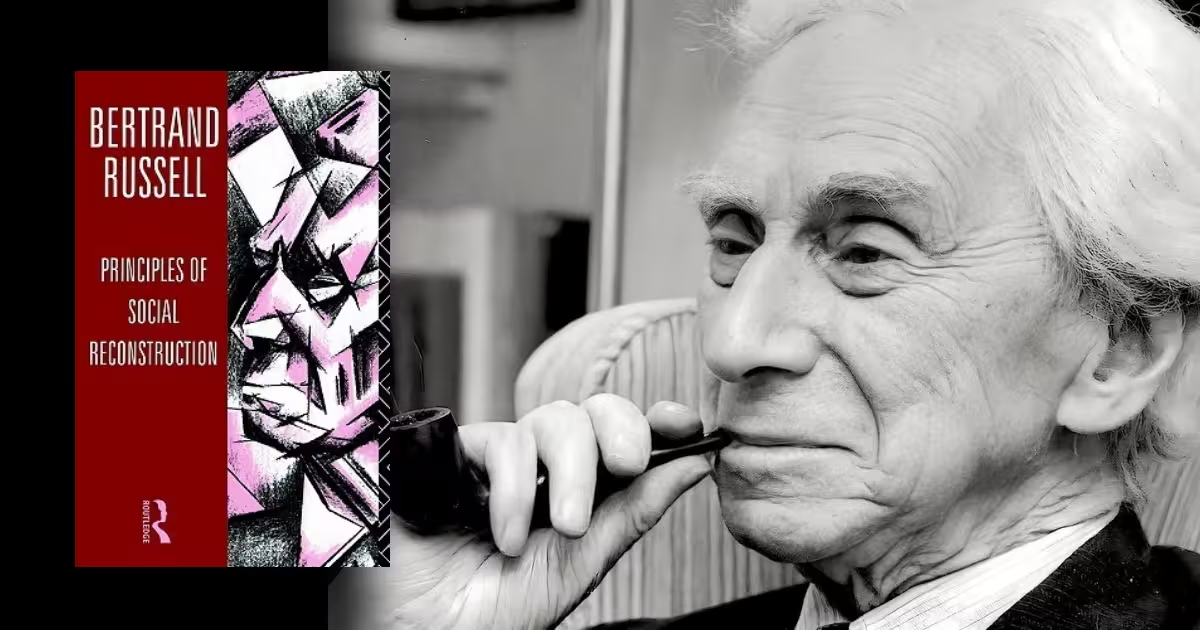
Ever wonder why reasonable people embrace destructive wars and oppressive systems? What if your deepest political beliefs aren’t based on logic at all but on impulses you barely understand? Bertrand Russell’s reveals the very reasons in his Principles of Social Reconstruction.
Overview
Bertrand Russell’s Principles of Social Reconstruction (1916) argues that human behavior—especially political behavior—is driven far more by unconscious impulses than by rational calculation.
Written during the horror of World War I, this philosophical masterpiece proposes that society must be rebuilt around creative rather than possessive impulses. Russell contends that the State, war, and private property are expressions of destructive possessiveness, while education, marriage, and authentic religion should nurture creative growth.
Principles of Social Reconstruction offers a psychological foundation for political reform that remains remarkably relevant today, challenging everything you thought you knew about why societies fail or flourish.
Preferred readers
Principles of Social Reconstruction is best for political philosophy enthusiasts, psychology buffs, war protesters, libertarians questioning their assumptions, progressives seeking theoretical foundations, anyone disillusioned with modern political discourse, and readers who enjoyed Hannah Arendt or John Stuart Mill.
Not for those seeking practical policy prescriptions, readers who prefer modern political science jargon, anyone uncomfortable with Russell’s occasionally dated eugenic language, or those who believe human beings are primarily rational actors.
Table of Contents
Introduction
Book Title: Principles of Social Reconstruction
Author: Bertrand Russell
Publication Date: November 13, 1916 (UK), January 1917 (USA as Why Men Fight)
Publisher: George Allen & Unwin
Genre: Political Philosophy, Social Theory, Psychology, Pacifism
Pages: Approximately 250 pages (original edition)
Bertrand Russell, one of the twentieth century’s most brilliant and controversial thinkers, wrote Principles of Social Reconstruction not from academic detachment but from the trenches of moral crisis. By 1916, the Great War had already consumed millions of lives, and Russell—already a celebrated mathematician and philosopher—found himself increasingly isolated from his fellow citizens who had embraced war fever with terrifying enthusiasm.
According to historian Richard A. Rempel’s introduction, Russell considered this work “his most important contribution to political philosophy” and the “least unsatisfactory” expression of his “own personal religion.”
Principles of Social Reconstruction emerged from eight lectures delivered at London’s Caxton Hall between January and March 1916, attended by intellectuals including Lytton Strachey, who wrote that Russell’s ideas were “a wonderful solace and refreshment” that “sticks at nothing—Governments, religions, laws, property, even Good Form itself—down they go like ninepins.”
The context is crucial: Russell wrote as the war’s ideological stakes had not yet been transformed by the Russian Revolution or American intervention. He was arguing against the very foundations of the nation-state system that millions were dying to preserve.
His courage was remarkable—he was already reviled as a traitor by much of the British press and would later be imprisoned for his pacifism.
What is Russell’s central thesis? Simply put: “Impulse has more effect than conscious purpose in moulding men’s lives.” This seemingly simple observation becomes the lens through which Russell reexamines everything from state power to marriage, from education to property.
He divides all human impulses into two categories: the possessive (aiming at acquiring what cannot be shared) and the creative (aiming at bringing something valuable into the world, like knowledge, art, or goodwill, “in which there is no private property”).
Background: The Intellectual Crucible of 1916
To understand Russell’s radical departure from classical liberalism, we must examine the intellectual forces that shaped this book.
The Jamesian Influence: Russell was profoundly influenced by American psychologist William James, particularly his 1910 essay “The Moral Equivalent of War.” As early as October 1914, Russell wrote “Why Nations Love War” for Norman Angell’s magazine, incorporating James’s insight that people needed an enemy and wanted war as a release for vital energies.
In Principles of Social Reconstruction, Russell explicitly acknowledges James: “His statement of the problem could not be bettered; and so far as I know, he is the only writer who has faced the problem adequately. But his solution is not adequate.”
The Lawrence Collision: Principles of Social Reconstruction also bears the mark of Russell’s tumultuous friendship with D.H. Lawrence. Both men were horrified by the war’s irrationality. Lady Ottoline Morrell arranged for them to meet in February 1915, hoping their shared concerns would produce something transformative.
For a time, they planned a major lecture tour. But by spring 1915, Lawrence had launched a furious personal attack on Russell, condemning him as a “bloodless rationalist with a secret desire for violence.” Russell, in turn, saw Lawrence as a forerunner of fascism.
This brutal rejection pushed Russell to develop his ideas independently, giving the book a harder edge than it might otherwise have had.
The Philosophical Break: Before the war, Russell had been a traditional Liberal in the Benthamite tradition, emphasizing reason and conscious purpose.
The war shattered this confidence. He realized that reason alone could not prevent war because “only passion can control passion, and only a contrary impulse or desire can check impulse.”
This psychological realism—unusual for a philosopher of Russell’s background—sets the book apart from both utopian pacifism and cynical realpolitik.
Principles of Social Reconstruction Summary
Chapter 1: The Principle of Growth
Russell opens by addressing the war’s psychological origins. He rejects both the popular British view “that it is due to the wickedness of the Germans” and the pacifist explanation “that it is due to the diplomatic tangle and to the ambitions of Governments.” Both fail, he argues, because “war grows out of ordinary human nature.”
The crucial insight: “Unfounded beliefs are the homage which impulse pays to reason.” In other words, we construct elaborate rationalizations—about German wickedness or national honor—to justify impulses we already have.
As Russell puts it on page 5 (in the original pagination): “The untrue things which men believe, and the true things which they disbelieve, are an index to their impulses.”
This leads to a profound recognition: impulse, not desire, is the primary driver of human action. Children run and shout not because they expect any good result but because of “a direct impulse to running and shouting.” Dogs bay at the moon not because it’s advantageous but “because they feel an impulse to bark.”
Russell distinguishes between impulse (immediate, instinctive action) and desire (conscious pursuit of distant goals). This distinction matters enormously for political theory:
“In all the more instinctive part of our nature we are dominated by impulses to certain kinds of activity, not by desires for certain ends… Instinctive acts normally achieve some result which is agreeable to the natural man, but they are not performed from desire for this result.”
The possessive-creative dichotomy emerges organically from this psychology. Possessive impulses lead to acquisition, hoarding, and conflict. Creative impulses lead to building, sharing, and growth. Russell argues that the best life is “that which is most built on creative impulses, and the worst that which is most inspired by love of possession.”
This is not mere moralism—it’s a psychological claim. Creative impulses, being shareable, generate harmony. Possessive impulses, being exclusive, generate conflict. War, property, and the State are “the chief political embodiments of the possessive impulses.”
Chapter 2: The State
Russell’s critique of state power is perhaps Principles of Social Reconstruction‘s most radical contribution. He argues that the State has become “harmful to life through excess of power” and that both socialism (which would increase state power) and individualism (which would keep it) miss the point.
The essential problem: The State, by its nature, is “the repository of the collective force of its citizens.” This force operates internally (law and police) and externally (war-making capacity). While internal force is constrained by law, external force “proceeds, with few exceptions, according to some real or fancied national interest.”
Russell makes a startling comparison:
“The State makes an entirely artificial division of mankind and of our duties towards them: towards one group we are bound by the law, towards the other only by the prudence of highwaymen.”
This is not anarchism—Russell accepts that some state functions are necessary. But he insists that the State’s power must be drastically limited, both to prevent war and to preserve individual freedom.
Why do people accept state power? Russell identifies three main sources:
- ✅ Tribal feeling: “Almost every man finds it essential to his happiness to feel himself a member of a group, animated by common friendships and enmities and banded together for defence and attack.”
- ✅ Fear: “The internal orderliness of a civilized community is a great achievement… The strength [of the State] results principally from two fears, neither of which is unreasonable: the fear of crime and anarchy within, and the fear of aggression from without.”
- ✅ Patriotism as religion: The religious element in patriotism “enlists the best that is in most men on the side of national sacrifice.” But this is dangerous because “the good at which it aims is a good for one’s own nation only, not for all mankind.”
The solution Russell proposes is not to abolish the State but to limit it severely:
“The positive purposes of the State, over and above the preservation of order, ought as far as possible to be carried out, not by the State itself, but by independent organizations.”
This anticipates guild socialism, syndicalism, and even modern concepts of civil society. Russell argues that voluntary organizations—trade unions, cooperatives, universities, professions—”are to be welcomed as safeguards of liberty and opportunities for initiative.”
One striking observation: Russell notes that “in a democracy public opinion and the need of conciliating political supporters partially correct these plutocratic influences, but the correction is always only partial.” Even democratic states serve the rich because governments themselves “belong, by their success if not by their origin, to the same class as the great employers of labour.”
Chapter 3: War as an Institution
This chapter directly confronts the war raging around Russell as he writes. He defines war as “a conflict between two groups, each of which attempts to kill and maim as many as possible of the other group in order to achieve some object which it desires.”
Why do nations go to war? Russell dismisses purely economic explanations. The psychological dimension is paramount:
“War, like all other natural activities, is not so much prompted by the end which it has in view as by an impulse to the activity itself.”
This is why rational arguments against war fail. People don’t go to war because they calculate it will make them happier—they go because war itself fulfills a need in human nature.
Russell offers a devastating analysis of the mood that produced war:
“The mood in which Germany embarked upon the war was abominable, but it was a mood fostered by the habitual mood of England. We have prided ourselves upon our territory and our wealth; we have been ready at all times to defend by force of arms what we have conquered in India and Africa.”
His refusal to reduce the war to German evil was courageous in 1916. As he writes: “Germany had as good a right to an Empire as any other Great Power, but could only acquire an Empire through war.”
The deeper psychological analysis focuses on the “war fever” that grips ordinary people:
“The long years of private caution are avenged by a wild plunge into public madness… The old primitive passions, which civilization has denied, surge up all the stronger for repression. In a moment imagination and instinct travel back through the centuries, and the wild man of the woods emerges from the mental prison in which he has been confined.”
This is remarkably modern—anticipating Freudian analysis and contemporary theories of collective behavior.
Russell identifies three factors that make people susceptible to war fever:
- ✅ The need for activity: “Every vigorous man needs some kind of contest, some sense of resistance overcome, in order to feel that he is exercising his faculties.”
- ✅ The escape from dullness: Ordinary life—”In the morning they go to the office or the plough, in the evening they return, tired and silent, to the sober monotony of wife and children”—offers no outlet for adventure. War provides it.
- ✅ The illusion of victory: “The war fever very seldom seizes a nation unless it believes that it will be victorious.”
Russell’s solution is not naive pacifism but the creation of “the moral equivalent of war”—peaceful outlets for the same energies:
“The object of the pacifist should be to give men more and more political control over their own lives, and in particular to introduce democracy into the management of industry, as the syndicalists advise.”
Chapter 4: Property
Russell’s critique of property is one of Principles of Social Reconstruction‘s most concrete and radical sections. He begins with a devastating portrait of money worship:
“The man who worships money has ceased to hope for happiness through his own efforts or in his own activities: he looks upon happiness as a passive enjoyment of pleasures derived from the outside world.”
The moral and psychological damage of wealth worship is extensive:
“Love of money in England takes, as a rule, the form of snobbishly desiring to maintain a certain social status… Men postpone marriage until they have an income enabling them to have as many rooms and servants in their house as they feel that their dignity requires.”
Russell’s critique is not merely moral but biological. He argues that the worship of money “has brought about this death-like slumber of all that makes men great.”
Russell identifies four tests for an economic system:
- Maximum production
- Justice in distribution
- A tolerable existence for producers
- “The greatest possible freedom and stimulus to vitality and progress”
He argues that capitalism focuses exclusively on the first, socialism on the second and third, and both neglect the fourth—which is “much the most important.”
The solution is not complete socialism but a fundamental restructuring:
“The total abolition of private capitalistic enterprise, which is demanded by Marxian socialism, seems scarcely necessary… Provided the sphere of capitalism is restricted, and a large proportion of the population are rescued from its dominion, there is no reason to wish it wholly abolished.”
Instead, Russell advocates a mixture of cooperatives and syndicalism. The goal is to give workers control over their work, restoring the creative impulse to production:
“The whole wage-earning system is an abomination, not only because of the social injustice which it causes and perpetuates, but also because it separates the man who does the work from the purpose for which the work is done.”
On inheritance and land: Russell dismisses both as indefensible. Private property in land is “acquired by the sword” and “has no justification except historically.” Inheritance “has no basis outside the instincts of possession and family pride.”
Chapter 5: Education
This chapter is one of the most influential in Principles of Social Reconstruction, prefiguring Russell’s later educational writings. He argues that education should be guided by reverence for the child:
“The man who has reverence will not think it his duty to ‘mould’ the young. He feels in all that lives, but especially in human beings, and most of all in children, something sacred, indefinable, unlimited, something individual and strangely precious, the growing principle of life, an embodied fragment of the dumb striving of the world.”
The purpose of education should be to “foster the wish for truth, not the conviction that some particular creed is the truth.” Instead, education is corrupted by political motives:
“Almost all education has a political motive: it aims at strengthening some group, national or religious or even social, in the competition with other groups.”
Russell is particularly scathing about history teaching, which “in every country, is so taught as to magnify that country: children learn to believe that their own country has always been in the right and almost always victorious.”
The kind of education Russell wants would develop:
- Independence and impulse (rather than obedience and discipline)
- Justice in thought (rather than ruthlessness)
- Reverence and understanding (rather than contempt)
- Constructive doubt and mental adventure (rather than credulity)
He also critiques the examination system: “For the abler boys there is no time for thought, no time for the indulgence of intellectual taste, from the moment of first going to school until the moment of leaving the university.”
The ultimate goal is not professional training but the joy of mental adventure:
“The powers of thought, the vast regions which it can master, the much more vast regions which it can only dimly suggest to imagination, give to those whose minds have travelled beyond the daily round an amazing richness of material, an escape from the triviality and wearisomeness of familiar routine.”
Chapter 6: Marriage and the Population Question
This chapter is the most controversial from a modern perspective, containing discussions of eugenics that would be unacceptable today. Yet it also contains some of Russell’s most prescient observations.
Russell critiques the marriage law of his time, which made divorce difficult and punished “immorality” while creating widespread hypocrisy. He notes that the law “rests upon the assumption that adultery is sin,” and that “the poor have no right to fine feelings.”
The central problem is demographic. Russell observes that “within the classes that are dwindling, it is the best elements that are dwindling most rapidly.” The birth rate is declining among the educated and industrious while increasing among “the very poor, the shiftless and drunken, the feeble-minded.”
This is where Russell’s eugenic thinking appears:
“If our economic system and our moral standards remain unchanged, there will be, in the next two or three generations, a rapid change for the worse in the character of the population in all civilized countries.”
His solution: state support for children, provided to “mentally and physically sound” parents. “The expense of children ought to be borne wholly by the community. Their food and clothing and education ought to be provided, not only to the very poor as a matter of charity, but to all classes as a matter of public interest.”
On marriage itself, Russell argues that it must evolve. The old form, based on “the authority of the husband,” is dissolving. But a new form has not yet emerged:
“Mutual liberty, which is now demanded, is making the old form of marriage impossible. But a new form, which shall be an equally good vehicle for instinct, and an equal help to spiritual growth, has not yet been developed.”
Chapter 7: Religion and the Churches
Russell’s critique of organized religion is sharp but not anti-religious. He distinguishes between the Church as an institution and authentic spirituality.
The churches have failed because:
- ✅ They are corrupt as institutions: “The clerical profession suffers… from the convention that clergymen are more virtuous than other men. Any average selection of mankind, set apart and told that it excels the rest in virtue, must tend to sink below the average.”
- ✅ They are tied to outmoded creeds: “It is not so much that the creed of the Church is the wrong one. What is amiss is the mere existence of a creed.”
- ✅ They oppose progress: “Political conservatism has brought the Churches into conflict with whatever was vigorous in the working classes.”
Russell’s alternative is not atheism but a new form of religion based on the “life of the spirit” rather than dogma. He distinguishes three aspects of human nature:
- ✅ Instinct: “The source of vitality, the bond that unites the life of the individual with the life of the race.”
- ✅ Mind: “The life of the pursuit of knowledge… thought which is wholly or partially impersonal.”
- ✅ Spirit: “Impersonal feeling… Art and religion are both expressions of the life of the spirit.”
The goal is harmony among these three:
“Instinct, mind, and spirit are each a help to the others when they are all healthy and vigorous; but in the modern world, as in many other periods, they are too often at war.”
The new religion Russell envisions is:
- Based on hope, not fear
- Focused on what to do, not what to avoid
- Celebrating creation, not submission
- Universal in scope, not nationalistic
Chapter 8: What We Can Do
The final chapter addresses the despair that many felt during the war. Russell asks: “What can we do for the world while we live?”
His answer is both humble and ambitious. In the short term, we can do little. But in the long term, ideas matter profoundly:
“Religious toleration was once the solitary speculation of a few bold philosophers. Democracy, as a theory, arose among a handful of men in Cromwell’s army… Socialism owes its origin to a very small number of isolated theorists.”
The power of thought is ultimately greater than any other human power. But this requires courage:
“Without some willingness to be lonely new thought cannot be achieved. And it will not be achieved to any purpose if the loneliness is accompanied by aloofness.”
Two principles guide reconstruction:
- 1️⃣ “The growth and vitality of individuals and communities is to be promoted as far as possible.”
- 2️⃣ “The growth of one individual or one community is to be as little as possible at the expense of another.”
The practical task is to understand “the effect of institutions and beliefs upon the life of impulse, and to discover ways of improving this effect by a change in institutions.” The vehicle for change is the labour movement, “the only powerful political force from which any help is to be expected.”
Russell concludes with a plea for a new philosophy, “a philosophy, or a religion, which will promote life.” But “life devoted only to life is animal, without any real human value.” What is needed is “some end which seems, in some sense, outside human life, some end which is impersonal and above mankind, such as God or truth or beauty.”
Principles of Social Reconstruction Analysis
What makes Principles of Social Reconstruction extraordinary? Reading Principles of Social Reconstruction in 2024 feels eerily contemporary. Russell’s analysis of how irrational impulses drive political behavior anticipates everything from behavioral economics to Trump-era populism.
His critique of nationalism as a quasi-religion seems more relevant than ever. His insistence that economic systems must serve human vitality rather than mere production resonates with current debates about work-life balance and the “Great Resignation.”
Russell’s central insight—that “impulse has more effect than conscious purpose in moulding men’s lives”—has been validated by modern psychology.
Daniel Kahneman’s distinction between System 1 (intuitive) and System 2 (deliberative) thinking, Jonathan Haidt’s work on moral intuitions, and the entire field of behavioral economics all support Russell’s claim that we rationalize what we already feel.
But there are significant limitations. Russell’s eugenic concerns about birth rates are unacceptable by modern standards. His confidence in “the labour movement” as the vehicle for change seems naive given the labor movement’s compromises and failures.
His gender politics, while progressive for 1916, are dated—he speaks of “women’s emancipation” but assumes traditional gender roles in many passages.
Principles of Social Reconstruction‘s greatest weakness is its abstraction. Russell provides no concrete program for change, only principles. As he acknowledges: “As soon as it has become clear what kind of change is required, it will be possible to work out its parts in more detail. But until the war is ended there is little use in detail.”
Yet this abstraction is also a strength. By focusing on principles rather than policies, Russell’s book has aged far better than more specific reform proposals. His vision of a society that nurtures creative impulses while constraining possessive ones is both clear enough to inspire and vague enough to remain adaptable.
Strengths and Weaknesses
Strengths
Psychological realism: Russell’s emphasis on impulse over reason anticipates modern cognitive science. He understood, decades before behavioral economics, that humans are not rational actors.
Courageous moral clarity: Writing in 1916, Russell refused to demonize Germans or support the war. His insistence that “we shared the responsibility for the war” took real courage.
Interdisciplinary scope: Principles of Social Reconstruction seamlessly integrates philosophy, psychology, economics, education, and politics. Few thinkers could manage such range.
Still relevant: Russell’s analysis of nationalism, state power, and the psychological appeal of war applies directly to contemporary political crises.
Practical idealism: Russell avoids both utopian naivety and cynical realism. He offers real principles for reform while acknowledging their difficulty.
Weaknesses
Dated eugenics: Russell’s demographic concerns reflect early 20th century anxieties that have been discredited by subsequent science. His language about “feeble-minded” women breeding too much is offensive to modern readers.
Gender limitations: Despite supporting women’s emancipation, Russell’s analysis remains within a patriarchal framework. He assumes motherhood is women’s natural role and marriage is the proper context for sex.
Underdeveloped economics: Russell’s advocacy of syndicalism and cooperatives is inspiring but vague. He provides no detailed economic model.
Ignorance of Freud: Russell had not read Freud when he wrote this book. Modern psychological understanding would strengthen his argument significantly.
Elitist tone: For all his radicalism, Russell writes as an aristocrat addressing other intellectuals. The book’s language can feel condescending.
Comparison with Similar Works
John Stuart Mill’s On Liberty (1859): Both books defend individual freedom against social control. But Mill emphasizes reason, while Russell emphasizes impulse. Russell is more radical in his critique of the State, and less optimistic about human rationality.
William James’s The Moral Equivalent of War (1910): Russell explicitly acknowledges his debt to James. Both seek peaceful outlets for martial energies. But Russell develops the idea more fully, connecting it to a comprehensive social theory.
Jean-Jacques Rousseau’s The Social Contract (1762): Both Russell and Rousseau critique established institutions and call for a society based on human nature rather than tradition. But Rousseau’s “general will” is far more authoritarian than Russell’s advocacy of voluntary associations.
Karl Marx’s Capital (1867): Russell criticizes capitalism but rejects socialism’s emphasis on the State. He shares Marx’s critique of economic exploitation but rejects revolutionary determinism and favors gradual reform.
Hannah Arendt’s The Origins of Totalitarianism (1951): Russell anticipates Arendt’s analysis of how modern states mobilize irrational energies. Both see nationalism as a pseudo-religion. Arendt is more systematic and historically detailed.
George Orwell’s 1984 (1949): Russell’s critique of state power presages Orwell’s nightmare. Both understand that control of thought is essential to tyranny. Orwell is more pessimistic about resistance.
Conclusion
Principles of Social Reconstruction is not an easy read, but it’s an essential one. It belongs on the shelf with other great works of political philosophy—Mill’s On Liberty, Arendt’s The Human Condition, and Orwell’s essays.
Who will benefit most? Anyone trying to understand why democratic societies embrace irrational policies, why wars start despite everyone’s rational disinterest, why education fails to produce free thinkers, and why economic systems seem to serve accumulation rather than human flourishing. Russell provides no easy answers, but he asks the right questions.
For general readers: Principles of Social Reconstruction is accessible to non-specialists, though its language is occasionally dense. Russell was one of the great prose stylists of the twentieth century; he writes with clarity and wit even when discussing difficult subjects.
For specialists: Political philosophers will find Russell’s psychology a useful corrective to overly rationalist theories. Educators will find his critique of traditional schooling still devastating. Activists will find his principles inspiring, if unspecific.
The enduring value of Principles of Social Reconstruction lies in its recognition that politics is not primarily rational. We are driven by impulses we barely understand, and effective social change must account for this fact. Russell’s distinction between creative and possessive impulses offers a framework for understanding everything from personal happiness to international relations.
As Russell writes in his final chapter:
“What we have to do practically is different for each one of us, according to our capacities and opportunities. But if we have the life of the spirit within us, what we must do and what we must avoid will become apparent to us.”
This is not a prescription but an invitation. Read Principles of Social Reconstruction, and you will understand more clearly the forces that drive your own life—and the lives of nations.